
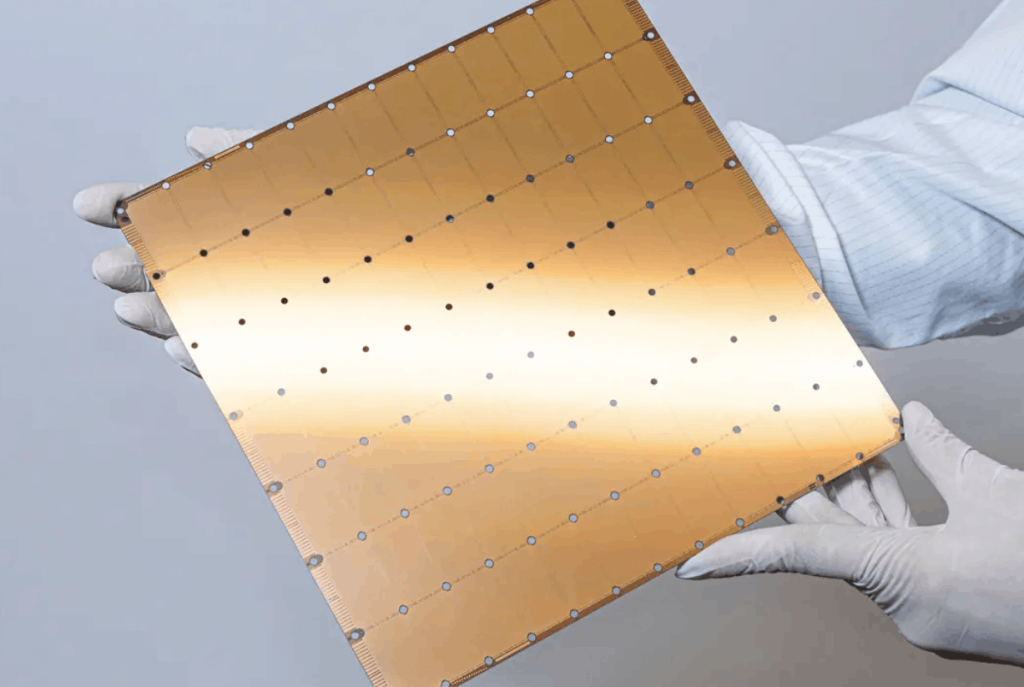
The artificial intelligence boom has already created trillion-dollar winners, but every major technology cycle eventually produces a new challenger. In 2026, few IPOs captured more attention than Cerebras Systems (NASDAQ: CBRS), the AI hardware company behind one of the most ambitious semiconductor architectures ever built: the Wafer Scale Engine (WSE). The company entered public markets with the largest IPO of the year, raising over $5.5 billion at an offering price of $185 per share and immediately becoming one of the most talked-about names in AI infrastructure.
At first glance, the excitement is understandable. Cerebras is not just another AI software startup riding the generative AI wave. The company is attempting to fundamentally redesign the way AI models are trained and deployed by replacing traditional GPU cluster architectures with massive wafer-scale processors capable of handling gigantic AI workloads more efficiently. In a market dominated by NVIDIA Corporation, that alone is enough to attract enormous investor interest.
But while the technological story is compelling, the stock itself has become far more controversial. After a euphoric post-IPO rally, CBRS entered a sharp correction phase despite strong institutional attention, ETF buying, and inclusion into major indexes. The market is now asking a critical question:
Is Cerebras the first legitimate long-term threat to NVIDIA’s AI dominance — or simply another AI hype stock that became overvalued too quickly?
What Cerebras Actually Does
Cerebras Systems specializes in AI accelerators, AI supercomputers, and cloud-based AI inference systems designed specifically for training extremely large AI models.
The company’s flagship product is the Wafer Scale Engine (WSE) — currently one of the largest chips ever built. Instead of using dozens or hundreds of smaller GPUs connected together like NVIDIA systems, Cerebras built an entire processor directly onto a full silicon wafer.
That architectural decision is the foundation of the company’s entire investment thesis.
Traditional GPU systems face bottlenecks involving:
- memory transfer,
- interconnect latency,
- energy consumption,
- and scaling inefficiencies.
Cerebras claims its wafer-scale architecture dramatically reduces those limitations, especially for very large language models (LLMs), scientific simulations, defense AI, and enterprise-scale inference workloads.
The company generates revenue primarily from:
- AI processors and AI systems (~70%)
- AI cloud/model services (~30%)
Unlike many speculative AI startups, Cerebras is already producing meaningful revenue. Fiscal-year revenue reached approximately $510 million, while net income was positive at nearly $88 million. That alone differentiates CBRS from many AI IPOs currently trading purely on future promises.
The company also appears operationally efficient. Revenue per employee exceeds $720,000 annually, unusually high for a relatively young semiconductor infrastructure company.
Why Investors Are Excited About Cerebras
The bullish case for Cerebras is not difficult to understand.
AI infrastructure spending is exploding globally. Hyperscalers, governments, cloud providers, defense contractors, and enterprises are racing to secure compute capacity for generative AI systems. Most of that demand currently flows toward NVIDIA.
The problem is that NVIDIA’s dominance creates vulnerabilities:
- supply constraints,
- pricing power,
- dependence on CUDA,
- GPU shortages,
- and concentration risk.
Large customers increasingly want alternatives.
That is where Cerebras enters the story.
Bulls argue that the company’s architecture offers genuine differentiation rather than incremental improvement. According to the company and several independent performance demonstrations, WSE-based systems can outperform traditional GPU clusters for specific AI workloads involving massive models and ultra-large parameter training.
The company also benefits from several macro trends:
- sovereign AI infrastructure investment,
- enterprise AI adoption,
- AI model scaling,
- defense AI modernization,
- and increasing energy-efficiency demands.
Strategic partnerships with research institutions and enterprise customers further strengthen the narrative that Cerebras may become more than just a niche semiconductor company.
Many investors also see Cerebras as a “second derivative” AI infrastructure play. NVIDIA already became a mega-cap giant. Some institutions are now searching for the next layer of AI hardware winners.
That explains why ETF demand has become extremely strong so quickly after the IPO.
Major ETFs holding CBRS include:
- ARKK
- ARKW
- WTAI
- iShares AI Innovation ETFs
- JPMorgan technology ETFs
- Capital Group growth funds
The accelerated S&P index inclusion announced in May 2026 further increased institutional visibility. Normally, such inclusion creates buying pressure because passive funds must purchase shares to match benchmark allocations.
Yet surprisingly, the stock still weakened afterward.
That matters.
Why the Stock Fell After the IPO Euphoria
Despite one of the strongest IPO launches of 2026, CBRS quickly lost momentum after its initial rally.
This is actually very common in major technology IPOs.
Several factors likely contributed:
1. Extreme Initial Valuation
Even after the pullback, Cerebras still trades at a valuation exceeding $56 billion. With approximately $510 million in revenue, investors are paying an enormous premium for future growth.
Its P/E ratio above 255 suggests the market already expects explosive expansion.
That creates a dangerous setup:
- expectations become extremely high,
- execution risk increases,
- and even good results may disappoint investors if growth slows slightly.
The AI sector is currently experiencing similar valuation pressure across multiple companies.
2. Post-IPO Profit Taking
The IPO opened significantly above the offering price, creating immediate paper gains for early investors. Large IPOs often experience a cooling-off period after the initial excitement fades.
3. Investors Want Proof of Scalability
Technology demonstrations are not enough anymore.
The market now wants proof that Cerebras can:
- scale production,
- maintain margins,
- win hyperscaler contracts,
- compete against NVIDIA ecosystems,
- and generate recurring software/service revenue.
That transition from “promising technology” to “dominant commercial platform” is extremely difficult in semiconductors.
Can Cerebras Really Compete With NVIDIA?
This is the single most important question surrounding the stock.
The short answer is:
Yes — technologically.
But commercially, the challenge is enormous.
NVIDIA Corporation is not just a chip company anymore. It controls:
- CUDA software ecosystems,
- developer tools,
- enterprise relationships,
- hyperscaler partnerships,
- networking infrastructure,
- AI software stacks,
- and enormous manufacturing scale.
That moat is incredibly difficult to break.
However, Cerebras does not necessarily need to “beat NVIDIA everywhere” to become successful.
The company may succeed by dominating specialized high-performance AI workloads where:
- ultra-large model training matters,
- memory bottlenecks become critical,
- energy efficiency matters,
- or sovereign AI infrastructure prefers diversification away from NVIDIA dependence.
This creates a more realistic scenario:
not replacing NVIDIA,
but becoming a premium alternative infrastructure provider.
That alone could still justify a multi-billion-dollar business.
The Competitive Landscape
Cerebras operates inside one of the most competitive sectors in the world.
Major competitors include:
- NVIDIA Corporation
- Advanced Micro Devices (AMD)
- Intel Corporation
- Arm Holdings
- Marvell Technology
- Qualcomm
- Taiwan Semiconductor Manufacturing Company (TSMC)
Indirect competition also comes from:
- cloud providers building custom AI chips,
- hyperscaler in-house accelerators,
- and emerging AI infrastructure startups.
Interestingly, Cerebras also overlaps with companies like:
- Palantir Technologies
- Snowflake
- C3.ai
because enterprise AI infrastructure increasingly blends hardware, cloud orchestration, and AI deployment platforms.
Is CBRS Actually Undervalued?
This is where the debate becomes complicated.
From a traditional valuation perspective:
absolutely not.
At over $56 billion market capitalization and a P/E ratio above 255, the stock is expensive by almost every conventional metric.
However, AI infrastructure companies are not currently trading on traditional valuation frameworks.
Investors are pricing:
- future AI demand,
- strategic importance,
- compute scarcity,
- technological leadership,
- and long-term platform dominance.
If Cerebras successfully captures even a small percentage of the global AI accelerator market, current valuation levels may eventually look reasonable.
But that outcome is far from guaranteed.
The company still faces:
- manufacturing scaling risk,
- hyperscaler adoption risk,
- ecosystem risk,
- and competitive pricing pressure.
What Needs to Happen for the Stock to Rise Again?
For CBRS to return to strong upward momentum, investors will likely need to see several major milestones:
1. Large Enterprise or Sovereign AI Contracts
Massive infrastructure deals would validate real-world demand.
2. Sustained Revenue Acceleration
The market wants proof that growth is not temporary IPO enthusiasm.
3. Expanding AI Cloud Revenue
Recurring cloud revenue would improve valuation quality dramatically.
4. Clear Performance Leadership
If Cerebras consistently outperforms GPU clusters in high-profile benchmarks, investor confidence could return quickly.
Proof That Its Architecture Scales Better Than GPUs
This is the biggest long-term question.
If Cerebras demonstrates clear efficiency advantages over traditional GPU clusters for certain workloads, the company could become far more valuable over time.
5. Strong Gross Margins
Semiconductor hardware alone can become commoditized. Software and services improve valuation durability.
Possible Buy Zones for CBRS
At around $241, CBRS is already trading at a much more interesting price level than at its euphoric post-IPO peak of $350-380, but it still can’t be called a classically cheap stock. The market is now starting to transition from the “story pricing” phase to the so-called “execution pricing” era. This means that in the first period, investors primarily priced the AI story, the comparison with NVIDIA and the revolutionary technology, but now they are waiting for real evidence: sustainable revenue growth, hyperscaler contracts, manufacturing scaling and long-term recurring enterprise revenue.
One of the most important advantages of Cerebras is that it is not a simple AI software company or “AI wrapper startup”, but a true deep-tech infrastructure player. The wafer-scale chip architecture is truly a technological marvel, and many investors are trying to price the company not as a speculative AI hype stock, but as a potential future infrastructure giant. This also explains why the IPO was extremely oversubscribed and why the share price was able to produce a parabolic rise almost immediately after the launch.
The problem is that even at a price of $241, extremely high expectations are built into the valuation. The market is essentially assuming that Cerebras can provide a real alternative to NVIDIA’s AI dominance in the long term. This is a huge expectation from a company that, while technologically superior, still operates with limited scale and a concentrated revenue structure.
From a technical perspective, the current move is completely typical AI IPO behavior. The euphoric rally after the IPO was followed by profit taking, and the stock is now in price discovery. In such cases, the market tries to find a price level where fundamentals and not just hype dominate. This has happened before with ARM, Snowflake, Rivian, and partly C3.ai: a huge IPO rally, followed by a 30–60% correction and a longer consolidation.
That is why the $241 level can be considered a moderately good entry point rather than an ideal buying point. For more aggressive growth investors, this may be acceptable, because a significant part of the IPO hype has been priced out, but the stock is still trading at a premium AI pricing. From a more conservative perspective, the $180–210 zone could seem like a really healthy repricing area. This is also a psychologically important level, since the IPO price was $185, and many institutional investors received allocations there. Such price levels often act as accumulation zones where the “smart money” can start building positions again.
In the event of a deeper AI sector correction, even the $140-$170 range would not be out of the question. However, this would require some stronger negative catalyst: weakening NVIDIA, a strengthening AI bubble narrative, lock-up expiration, insider selling, or an earnings report that fails to meet the market’s extreme growth expectations. It is important to understand that the market is not simply expecting good results from CBRS at the moment, but is practically pricing in “world domination growth” performance. This is a very dangerous valuation environment.
That is why the most logical strategy at the moment may not be a one-time big entry, but a gradual, banded purchase. Such AI IPO stocks are extremely volatile, headline-driven, and very sensitive to market sentiment. A much more stable approach would be to build the position gradually: a small initial position around 240, additional purchases around 210, and then in the event of a stronger correction at $185-190 or even during a deeper panic dip. This reduces the risk of someone taking a full position during a temporary hype peak.
In the short term, the stock still has the potential for another strong AI rally. If NVIDIA rises to new all-time highs and AI sector momentum continues to strengthen, CBRS could easily return to the $300+ range. However, the base case scenario right now is more of a broader consolidation between $180-260, where the price will be driven primarily by earnings reports and new contracts. The bearish scenario would be a complete AI hype burnout, which could push the price down to $150-180.
Investment Evaluation
| Factor | Rating (1–10) | Notes |
| Growth Potential | 9/10 | Massive AI infrastructure opportunity |
| Profitability | 6/10 | Positive earnings but still scaling aggressively |
| Valuation | 3/10 | Extremely expensive |
| Market Position | 7/10 | Genuine technology differentiation |
| Risk | 8/10 | Intense competition + AI hype risk |
| Technical Picture | 5/10 | Post-IPO correction phase |
| Institutional Interest | 8/10 | Strong ETF and index participation |
Overall Investment Score: ~6.6/10
Final Verdict: Revolutionary AI Infrastructure Play or Overheated IPO?
Cerebras Systems is one of the few AI IPOs that appears to have genuinely differentiated technology rather than simply AI branding attached to a weak business model.
That matters.
The company’s wafer-scale architecture could become an important niche — or even strategic — component of future AI infrastructure.
But investors must separate technological potential from stock valuation reality.
Right now, CBRS trades more like a future AI titan than a newly public semiconductor challenger.
That creates both enormous upside and substantial downside risk.
Short term, the stock may continue consolidating after its explosive IPO launch, especially as investors reassess AI valuations across the sector.
Long term, however, Cerebras remains one of the more credible non-NVIDIA AI infrastructure challengers currently available in public markets.
One-sentence conclusion:
Cerebras (CBRS) is not yet a true NVIDIA killer, but it may become one of the most important AI infrastructure challengers of the next decade — if it can scale commercially as successfully as it scales technologically.