
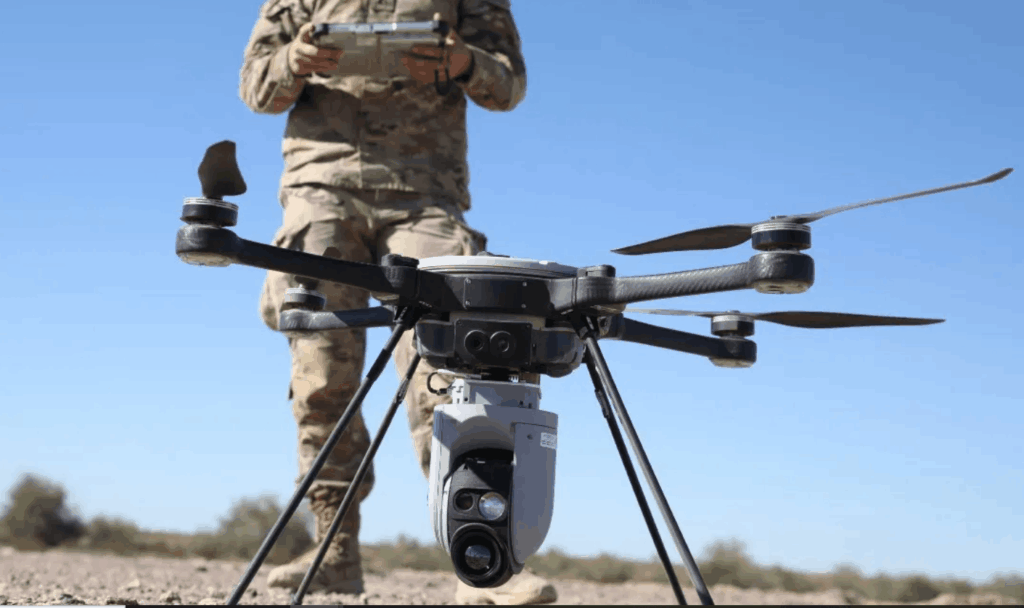
Swarmer (SWMR) is not a drone manufacturer. Instead, it positions itself as the software “brain” behind drone swarms, developing AI systems that allow hundreds of low-cost unmanned systems to operate as a single coordinated unit. The company’s core platforms—STYX, MINAS, and TRIDENT—focus on command, autonomy, and embedded operating systems for drones. This “intelligence layer” approach is strategically important: while hardware becomes commoditized, software can capture the higher-margin, scalable portion of the value chain.
This positioning is not just theoretical. The company claims its software has already been used in over 100,000 real-world combat missions, particularly in Ukraine, creating a rare feedback loop of live battlefield data that continuously improves its algorithms. This is a significant differentiator compared to many early-stage AI startups that rely only on simulations.
From a business model perspective, Swarmer resembles a defense-tech SaaS company. Revenue is expected to come primarily from software licensing and subscriptions (around 70%), supplemented by integration services and ongoing support. In theory, this is an extremely attractive model: recurring revenue, high margins, and scalability without the capital intensity of hardware manufacturing.
However, the financial reality is starkly different. Swarmer generated only about $309,000 in annual revenue, while posting losses exceeding $8.5 million. Despite this, the company’s valuation quickly climbed into the $300–500 million range, implying a Price/Sales ratio in the hundreds (even above 600×).
This disconnect between fundamentals and valuation is one of the most important aspects of the investment case.
The competitive landscape further complicates the picture. While Swarmer is positioned as a niche player, it operates in a space that is rapidly attracting both startups and defense giants. Private companies like Shield AI and Anduril are already building autonomous drone systems at scale, while established contractors such as Lockheed Martin Corporation and Northrop Grumman Corporation are investing heavily in AI-enabled warfare.
In addition, companies like Palantir Technologies Inc. are competing on the software side, providing AI-driven decision-making platforms for defense and intelligence applications. The key challenge for Swarmer is not just technological—it is scale, funding, and access to large government contracts, where incumbents have a massive advantage.
The stock’s explosive rise is best understood through market dynamics rather than fundamentals. Swarmer launched with a relatively small IPO, creating a low float environment where limited supply meets intense demand. Combined with the powerful narrative of “AI + drones + warfare,” this led to a classic small-cap momentum surge.
Investor interest has also been fueled by broader geopolitical trends. Rising global conflicts and increased defense spending have made autonomous systems one of the most attractive themes in the market. The idea of a single operator controlling hundreds of drones is not just futuristic—it is already becoming reality, and markets are pricing that future aggressively.
At the same time, there are early signs that momentum may be fading. Technical indicators, including those tracked on platforms like TradingView, suggest weakening buying pressure and potential overbought conditions. After parabolic moves, such signals often precede sharp corrections or prolonged consolidation phases.
Despite the risks, the long-term opportunity should not be dismissed. The global military drone market is expected to grow at double-digit rates, and swarm technology represents one of the most important evolutions in modern warfare.
Swarmer also reports a backlog of over $16 million in firm orders, with additional potential revenue in the pipeline. If even a portion of this converts into realized revenue, it could significantly change the company’s financial profile in the coming years. The key question is execution: can Swarmer scale from a niche, experimental platform into a reliable supplier for defense organizations?
The risks, however, remain substantial. The company is extremely early-stage, with minimal revenue and heavy reliance on future adoption. Its operations are partly tied to active conflict zones, introducing geopolitical and operational uncertainties. Regulatory scrutiny around autonomous weapons systems could also slow adoption, while competition from better-funded players remains intense.
Perhaps the most immediate risk is valuation. With a revenue base under $1 million and a valuation in the hundreds of millions, the stock is priced for near-perfect execution. Any disappointment—whether in contract wins, revenue growth, or sentiment—could trigger a significant correction. History shows that similar IPO-driven rallies often retrace sharply once the initial hype fades.
Investment Evaluation
Factor Rating (1–10) Notes
Growth Potential 8/10 AI + autonomous warfare trend
Profitability 2/10 heavy losses, early stage
Valuation 1/10 extremely stretched
Market Position 4/10 innovative but small player
Risk 9/10 very high volatility
Technical Picture 3/10 weakening momentum
Overall Investment Score: ~4/10
In the end, Swarmer represents one of the clearest examples of a market pricing the future far ahead of the present. The technology is compelling, the use case is real, and the macro trend is strong—but the company itself is still in its infancy.
One-sentence conclusion: Swarmer (SWMR) is a high-conviction future concept trading at extreme valuations today—making it a speculative hold at best, and a high-risk short candidate if momentum continues to weaken.