
For decades, electric transportation innovation has largely focused on roads and skies. Companies like Tesla tra
That gap is exactly where Candela saw an opportunity.
The Stockholm-based startup is attempting to fundamentally reshape marine transportation through electric hydrofoil vessels that “fly” above water. While traditional electric boats have struggled with limited range, slow speeds, and inefficient battery consumption, Candela believes it has solved one of the maritime industry’s biggest problems through a combination of proprietary hydrofoil technology, lightweight
Founded in 2014 bGustav Hasselskog, Candela started with an ambitious vis
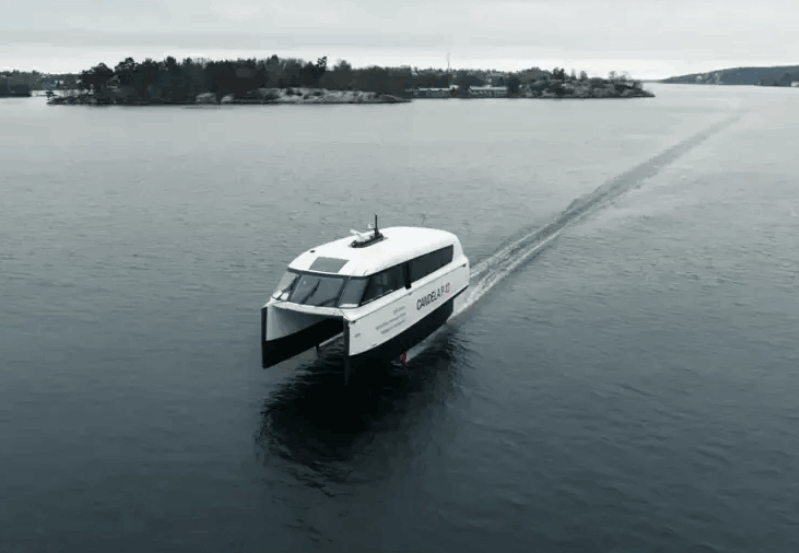
Traditional boats require enormous amounts of energy because their hulls push through water, creating massive drag. Candela approached the problem differently by developing computer-controlled hydrofoils—underwater wings that lift the vessel above the water surface once it reaches speed. When the boat rises above the water, drag is reduced dramatically, allowing the vessel to consume significantly less energy than conventional boats.
According to the company, its hydrofoil technology reduces energy consumption by as much as 80% compared with traditional high-speed vessels, making electric boats far more practical for commercial transportation.
This technological breakthrough helped Candela move from concept stage into actual commercial deployment.
The company initially entered the recreational boating market with models such as the Candela C-7 and later the Candela C-8, premium electric leisure boats aimed at wealthy consumers looking for high-performance sustainable alternatives to traditional speedboats. These early products served as both revenue generators and technological proof points.
However, Candela’s biggest opportunity emerged in commercial transportation.
The company shifted major focus toward public transportation and launched the Candela P-12, an electric hydrofoiling passenger ferry designed for urban transit systems, private shuttle operators, tourism companies, and coastal transportation services.
This move dramatically expanded Candela’s addressable market.
Instead of selling luxury recreational boats to a relatively small niche audience, Candela began targeting global transportation networks.
Its P-12 ferry has already gained significant traction. The vessel entered public transportation service in Stockholm and demonstrated that electric ferries could reduce commute times while lowering operational costs compared to diesel alternatives. The company has also secured projects in places such as Saudi Arabia’s NEOM development, Lake Tahoe in the United States, New Zealand, Germany, Norway, and other global markets.
The startup’s growth has attracted significant investor attention.
Over the years, Candela has raised substantial venture capital to fund manufacturing expansion, research and development, and global scaling.
In 2021, the company raised approximately $27 million in funding led by EQT Ventures, which helped accelerate production capabilities.
In 2024, Candela completed a major $40 million Series C round, including an additional $14 million extension. Investors included SEB Private Equity, EQT Ventures, and KanDela AB.
Then, in March 2026, the company announced another major financing round worth €30 million, bringing its total funding to approximately €129 million since its founding. The latest round included both returning investors and a major new institutional backer: the International Finance Corporation, the private investment arm of the World Bank Group. Existing investors such as EQT Ventures, SEB Private Equity, Ocean Zero LLC, and KanDela AB also participated.
This funding is being used to build a second manufacturing facility in Poland and scale production of the P-12 ferry as global demand accelerates.
Candela’s long-term opportunity is enormous because maritime transportation remains one of the least electrified sectors in the global economy.
Shipping and marine transport account for roughly 3% of global greenhouse gas emissions, and regulators across Europe, North America, and Asia are increasingly pushing for cleaner alternatives. At the same time, major urban centers are searching for transportation solutions that reduce road congestion.
Cities such as New York, Bangkok, London, Sydney, Istanbul, and San Francisco all have underutilized waterways that could become part of future transportation infrastructure.
Candela is effectively betting that cities will increasingly move commuters from congested roads onto electric waterways.
If that thesis proves correct, the company could become one of the dominant players in an entirely new transportation category.
There are also major risks.
Manufacturing boats at scale is capital intensive. Expanding globally requires significant infrastructure investments, regulatory approvals, and local partnerships. Hydrofoil systems also face operational limitations in rough water conditions, and some critics have questioned whether the technology can scale efficiently across all marine environments. Community discussions on Reddit frequently highlight concerns around maintenance complexity, floating debris risks, and weather limitations.
Competition may also intensify as larger marine manufacturers and emerging electric boat startups enter the market.
The question many investors are asking now is whether Candela could eventually go public.
At this stage, the company has not officially announced IPO plans. Candela remains privately held, and management has focused publicly on scaling manufacturing rather than preparing for a stock market listing.
That said, if the company continues winning public transit contracts globally and proves that electric ferries can scale profitably, an eventual IPO remains a realistic possibility. Another potential outcome could be acquisition interest from major transportation, marine manufacturing, or industrial companies looking to accelerate their electrification strategies.
Candela today sits at the intersection of multiple trillion-dollar trends: electrification, climate technology, smart cities, public transportation modernization, and sustainable infrastructure.
Most startups try to improve existing industries incrementally.
Candela is attempting something far more difficult—and potentially far more valuable.
It is trying to create an entirely new category of transportation by convincing cities that the future of commuting may not happen on roads at all, but above water.