
Aerospace & Defense | Precision Manufacturing | Superalloys Industrial | Gas Turbines
Doncasters, the Sheffield-born manufacturer of “can’t fail” engine parts, debuted on the New York Stock Exchange on June 25, 2026 and immediately reminded investors what aerospace scarcity looks like. The shares were 30 times oversubscribed, priced above range, were upsized before trading began, and then jumped 33% on day one. The stock has continued climbing since, trading above $51 as of June 30 — a 57% premium over the $33 offer price in less than a week.
246 Years of “Can’t Fail” Manufacturing
Doncasters was founded in Sheffield in 1778 by Daniel Doncaster as a file-making business. It expanded over two and a half centuries into steel converting, forging, and eventually into the precision casting of aerospace-grade superalloys — one of the most technically demanding manufacturing processes in existence. Today, the company is headquartered in Derby and operates 14 manufacturing facilities across the UK, continental Europe, North America, and Asia, employing approximately 3,070 people.
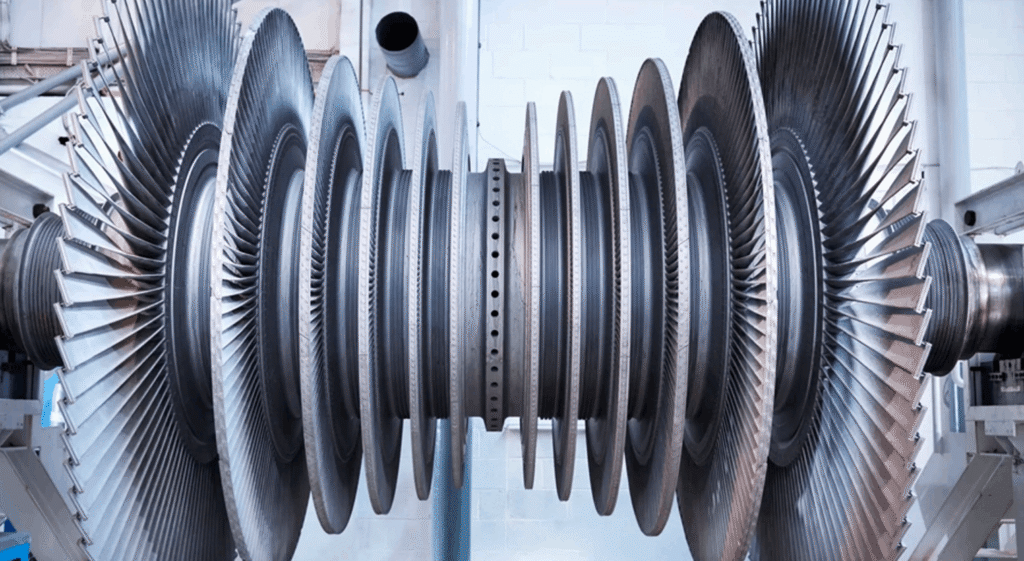
The products DPC makes are genuinely critical. Turbine blades, vanes, structural castings, bearing housings, combustion diffusers, and turbocharger wheels — components that operate at the hottest, highest-pressure points inside jet engines and industrial gas turbines, where temperatures exceed the melting point of most metals. Nickel- and cobalt-based superalloys are the only materials that survive this environment reliably, and the precision casting of these alloys requires multi-year supplier qualification programs, regulatory certification, and proprietary process expertise that cannot be replicated quickly. This is why Doncasters’ industry calls these “can’t fail” parts: they are not commodities, and the barriers to replacing a qualified supplier are enormous.
The holding company structure (DPC Holdings, formerly Alloy Topco Limited, renamed December 2025) was created in November 2019 as a private equity vehicle by J.F. Lehman & Company — a PE firm specialising exclusively in aerospace, defense, and maritime industries. JFLCO took Doncasters through a restructuring and operational turnaround, and the June 2026 IPO is the culmination of that process. JFLCO retains a significant stake post-IPO.
Who Are Doncasters’ Customers?
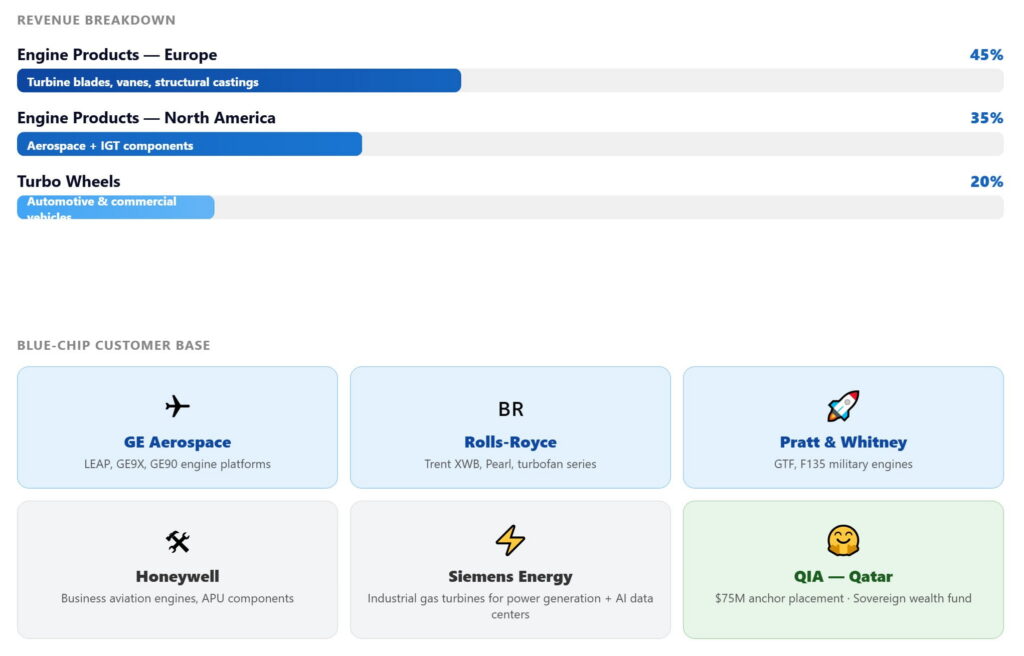
The customer list is one of the most compelling parts of the DPC investment case. Confirmed customers from the SEC prospectus include GE Aerospace, Honeywell, Pratt & Whitney, Rolls-Royce, and Siemens Energy — essentially a who’s who of the global aeroengine and industrial gas turbine industry. These are not transactional relationships. Supplier qualification for “can’t fail” components in certified engines takes 3–7 years, and once a supplier is qualified for a specific part on a specific engine platform, they typically remain the supplier for the lifetime of that platform (often 30+ years). This creates an embedded revenue stream that is extraordinarily difficult for competitors to displace.
The $930 million order backlog as of March 31, 2026 — representing more than 12 months of aerospace and IGT casting production — is direct evidence of this embedded position. It is not speculative future demand: it is already contracted work from existing customers on existing programs.
Beyond the established aerospace names, the AI-driven data center boom is becoming a meaningful new driver. The explosive growth of AI infrastructure requires unprecedented amounts of reliable electricity, and industrial gas turbines are one of the primary ways hyperscalers and grid operators are meeting this demand. Companies like Microsoft, Google, and Amazon are signing long-term power purchase agreements with gas turbine operators — and every new turbine installed or overhauled contains Doncasters’ components. This is not a story the company is telling from scratch: it is a structural tailwind already flowing through the IGT segment of the backlog.
Who Are the Real Competitors?
The PDF’s competitor list — Hilton Grand Vacations, Coinbase, Robinhood — reflects a data classification error and should be set aside entirely. Doncasters’ actual competitive landscape is narrow and well-defined by the niche nature of precision superalloy casting:
Howmet Aerospace (HWM) is the closest public-market comparable. The $22 billion market cap manufacturer makes jet engine components and airframe structures using similar superalloy casting processes. Howmet trades at approximately 25–30x EBITDA — a premium that reflects the same scarcity narrative that drove DPC’s IPO demand. GE Aerospace and RTX Corporation maintain internal casting capabilities but also rely heavily on independent specialists like Doncasters for overflow and niche geometries. Precision Castparts (PCC), now owned by Berkshire Hathaway, is a private market benchmark — the dominant force in aerospace casting that was taken private in 2016 at a $37 billion valuation. The absence of a publicly traded PCC means DPC enters public markets with less direct competition for the aerospace casting investment thesis than one might expect.
The real competitive risk for Doncasters is not losing a contract to a rival — the switching costs make that unlikely in the near term. The real risks are program cancellations or platform transitions (if a major engine platform is discontinued or moves to a casting process Doncasters cannot serve), and the gradual expansion of in-house casting by the large OEMs themselves.
The IPO: Overwhelming Demand, a Confident Debut
The mechanics of this deal told a clear story about institutional demand. The IPO was 30 times oversubscribed — meaning for every share available, 30 orders were placed. The bookrunners responded by increasing the deal size from 23.3 million to 27.86 million shares, pricing above the top of the $28–$32 range at $33, and granting a 30-day overallotment option for an additional 4.18 million shares that would push total proceeds above $1 billion if exercised.
The Qatar Investment Authority anchored the deal with a $75 million concurrent private placement, joined by $66 million from existing shareholders including directors. QIA’s participation — one of the world’s most sophisticated sovereign wealth funds, with a focus on long-term industrial assets — added immediate credibility. The bookrunner team (Jefferies and Morgan Stanley as global leads, Barclays, Moelis, RBC, and Rothschild) was elite.
On day one, DPC opened around $44 and closed near there — a 33% gain from the offer price on 9.9 million shares traded. By June 30, five trading days after listing, the stock was at $51.76 — a 57% premium to the offer price and well above the pre-IPO institutional buyers’ entry. The current market cap stands at approximately $6.8–7.1 billion.
The Balance Sheet: The Debt Is the Story
With $886 million in revenue (LTM March 2026) and $138 million in adjusted EBITDA, Doncasters is operationally sound. The net loss of $167–173 million is primarily a debt-service story, not an operational failure. Pre-IPO, Doncasters carried approximately $712 million in total debt, including a shareholder PIK (payment-in-kind) loan that had been accumulating interest. The IPO proceeds, combined with the $141 million in concurrent private placements, are being used primarily to repay this debt — with $154 million specifically allocated to eliminate the PIK loan. Post-deleveraging, the balance sheet should look meaningfully cleaner, and the interest savings should begin flowing through to net income within the next two reporting periods.
Key post-IPO math: With the PIK loan and most other debt repaid, Doncasters moves from a debt-servicing mode into an organic growth and free cash flow mode. On an EBITDA-to-enterprise-value basis at current prices (~$6.9B market cap), the stock trades at roughly 40–45x adjusted EBITDA. That is a premium to Howmet but below the aerospace industrial cycle peaks seen in 2018–2019.
ETF Exposure and Institutional Ownership
The PDF-listed ETF positions are plausible and consistent with DPC’s market cap and sector. The AB Disruptors ETF (FWD, $3B AUM) — which also held AADX — has a 0.23% position, confirming a pattern of actively picking industrial companies with structural growth tailwinds. Goldman Sachs Small Cap Equity ETF (GSC) holds a 0.16% position, consistent with DPC’s initial small-to-mid-cap profile at IPO. Capital Group U.S. Small and Mid Cap ETF (CGMM, $3.06B AUM) at 0.13% and T. Rowe Price Small-Mid Cap ETF (TMSL, $2.67B AUM) at 0.06% both reflect DPC being picked up across the SMID-cap active management universe. The Baron Technology ETF (BCTK) position at 0.7% is the most interesting — Baron is a long-term growth investor (the same Baron who owns ~15% of SpaceX in BPTRX), and their inclusion of DPC in a technology fund reflects how the market is increasingly classifying precision manufacturing for aerospace and AI power infrastructure as a technological, not purely industrial, investment.
Bulls and Bears
The bull case is straightforward and structurally strong. Doncasters makes genuinely irreplaceable components for some of the most in-demand engine platforms in the world. Its customer relationships are certified, multi-decade, and contractually sticky. The $930 million backlog provides visibility. The debt paydown from IPO proceeds removes the primary drag on net income. And the tailwinds — commercial aerospace recovery, defense spending, AI power demand driving IGT growth — are all real and compounding. The 30x oversubscription at IPO is the clearest possible signal that sophisticated institutional investors, including QIA, found the valuation compelling at $33.
The bear case is equally clear. The stock has moved 57% in five trading days. At $51.76, investors are paying roughly 7.8x LTM revenue and 40–45x EBITDA for a company that is still loss-making on a net income basis. The JFLCO PE overhang — the sponsor retains a large stake — creates a supply question when the lock-up expires (typically 180 days from June 25, placing it around late December 2026). Aerospace is a cyclical business, and any macro slowdown, airline demand shock, or supply chain disruption would hit the order backlog. And while DPC’s products are indispensable, the company faces ongoing pricing pressure from OEM customers who know exactly how much margin their suppliers are generating.
12-Month Price Scenario Analysis
Investors asking whether to buy at current levels face a different calculation than the IPO allocatees who entered at $33. Our scenario analysis for the next 12 months:
Bull scenario (~35% probability): $65–$75. Post-IPO earnings reports confirm operational improvement and debt reduction is tracking ahead of schedule. Commercial aerospace orders for the next cycle (LEAP, GE9X, GTF platforms) drive backlog expansion. IGT segment benefits from AI data center buildout. The stock re-rates toward Howmet comparables. JFLCO begins disciplined secondary sales rather than a dump. Target range: $65–$75.
Base scenario (~45% probability): $45–$58. The stock consolidates in the $45–$58 range as PE lock-up pressure offsets solid but not spectacular operating results. Revenue grows 8–12% organically. EBITDA margin expands modestly. The stock essentially tracks the aerospace sector with modest premium. Lock-up expiry creates a temporary dip opportunity around December 2026.
Bear scenario (~20% probability): $30–$42. A combination of JFLCO secondary sales, macro headwinds (airline demand weakness, defense budget uncertainty), and operational challenges (raw material cost inflation, labor) compresses margins. The stock gives back much of its post-IPO premium and approaches re-test of the IPO price. This is not a fundamental collapse — it is a valuation reset on a business with real revenue and backlog.
Key catalyst dates: First public earnings report (Q3 2026 — expected August/September) · Lock-up expiration (~late December 2026) · Overallotment option exercise decision (within 30 days of June 25) · Any new program win or backlog update announcement
Is DPC Worth Buying at $51?
At $33 on IPO day, the answer was straightforwardly yes — the institutional demand data made that clear. At $51.76 six days later, the question is more nuanced. The premium is real, and investors entering now are paying a 57% markup over what QIA paid last week. That is not inherently wrong — QIA accepted lock-up restrictions and illiquidity that public buyers don’t face — but it does mean the margin of safety is narrower.
For long-term investors with a 2–3 year horizon who believe in the aerospace cycle and the AI power demand narrative, DPC at $50–$55 is still a rational entry, particularly given the quality of the backlog, the customer relationships, and the post-deleveraging earnings trajectory. The December 2026 lock-up expiration may create a better entry for patient investors — JFLCO’s secondary sales will be a real supply event, and the market will likely price that in ahead of time.
For shorter-term traders, the 57% move in five days leaves the stock technically extended. A pullback to the $42–$46 zone (where the first-day close occurred) would represent a more defensible technical entry for a position built on near-term momentum rather than long-term fundamentals.
Investment Evaluation
| Factor | Score |
| Customer Quality & Relationships | 10/10 |
| Backlog & Revenue Visibility | 9/10 |
| Competitive Moat | 9/10 |
| Sector Tailwinds | 9/10 |
| IPO Execution | 9/10 |
| Post-IPO Deleveraging Path | 7/10 |
| Management & PE Sponsor | 7/10 |
| Current Profitability | 5/10 |
| Current Valuation (at $51) | 5/10 |
| Long-Term Growth Potential | 8/10 |
Overall Investment Score: 7.8 / 10 · Quality industrial — strong long-term story; near-term valuation requires patience after the 57% post-IPO run.
Final Verdict
Doncasters is the real thing. A nearly 250-year-old manufacturer of components so critical that the aerospace industry coined a special term for them — “can’t fail” — does not go 30 times oversubscribed by accident. The customer list, the backlog, the technical barriers to entry, and the structural demand tailwinds from both commercial aerospace and AI-driven power generation are all genuine and durable. This is not a startup betting on unproven technology; it is a proven industrial with a temporary balance sheet overhang that the IPO is in the process of resolving.
The challenge for investors today is entirely a valuation question, not a business question. At $51.76 — 57% above where QIA bought in — the margin of safety has compressed significantly. The stock is not overvalued in an absolute sense, but the easy money was made by those who received IPO allocations. For new investors, the most disciplined approach is to wait for the first public earnings report (Q3 2026), which will provide the first clean look at post-deleveraging financials, and to watch the December 2026 lock-up expiration window for a potential secondary market entry below $45.
“Doncasters doesn’t make planes. It makes the parts that make planes work. That is a narrower, deeper, and ultimately more durable business — and the market just discovered it.”
Sources & References
[1] Business Wire — “Doncasters Announces Pricing of Upsized Initial Public Offering” — businesswire.com
[2] IPOScoop — “Doncasters – DPC Holdings Prices Upsized IPO at $33 — Above Range & Stock Jumps” — iposcoop.com
[3] Investing.com — “Doncasters prices IPO at $33 per share on NYSE” — investing.com
[4] EBC Financial Group — “Doncasters IPO: 7 Things to Know About DPC’s Aerospace Bet” — ebc.com
[5] BriefGlance — “Doncasters’ IPO: Forging a Public Future on Aerospace and AI Demand” — briefglance.com
[6] StockTitan — “J.F. Lehman Company-Backed Doncasters Completes Successful IPO” — stocktitan.net
[7] Stock Analysis — “DPC Holdings (DPC) Stock Price & Overview” — stockanalysis.com
[8] Investing.com — “DPC Holdings Live Stock Price” — investing.com
[9] IPOScoop — “QIA to Buy $75 Million in Doncasters Private Placement” — iposcoop.com
[10] Doncasters — Investor Relations — ir.doncasters.com
[11] SEC Filing — DPC Holdings S-1 / 424B4 — sec.gov
[12] TradingView — NYSE: DPC Market Data — tradingview.com
This article is produced by iposight.com based on publicly available information, SEC filings, company materials, and independent research. For informational purposes only — not investment advice. All investments carry risk. Please consult a qualified financial advisor.