

Health Technology | Biotechnology | Sleep Medicine | Sleep Apnea | First-in-Class
Obstructive sleep apnea affects approximately 936 million adults globally. The standard treatment — a CPAP machine strapped to your face every night — has a compliance rate below 50%. Most patients either cannot tolerate it or simply stop using it. For decades, no effective oral drug alternative existed. Apnimed is trying to change that. Its Phase 2 data is the most compelling clinical evidence yet that a once-daily pill could work.
What Apnimed Is Actually Building
Apnimed was founded in 2016 in Cambridge, Massachusetts, by researchers from Harvard Medical School and Brigham and Women’s Hospital. Its lead drug candidate, AD109, is a fixed-dose oral combination of two existing approved drugs: atomoxetine (a norepinephrine reuptake inhibitor, approved for ADHD as Strattera) and oxybutynin (an anticholinergic, approved for overactive bladder). The combination is grounded in a decade of mechanistic sleep research — not repurposing for its own sake, but a precisely designed combination addressing the neuromuscular root cause of OSA.
The mechanism is elegant: OSA occurs when upper airway muscles lose tone during sleep, causing the throat to collapse and block airflow. Atomoxetine, at low doses, activates the hypoglossal nerve pathway that maintains upper airway muscle tone. Oxybutynin prevents atomoxetine from triggering the arousal response that would normally limit its usefulness as a sleep drug. Together, they keep the airway open without waking the patient — addressing the root cause of most OSA cases, not mechanically forcing air through as CPAP does.
The pivotal MYOSA Phase 3 trial (Multiple Months of Once-daily oral Sleep Apnea) is a 26-week, randomised, double-blind, placebo-controlled study enrolling approximately 600 patients with moderate-to-severe OSA. Primary endpoints are the Apnea-Hypopnea Index (AHI) and Oxygen Desaturation Index (ODI). Topline data is expected in 2027, with potential NDA submission in 2027–2028 and possible FDA approval in 2028–2029.
Why the Phase 2 data is significant: The 63% median AHI reduction in the MARIPOSA Phase 2 trial is not modest. CPAP achieves near-complete AHI normalisation in compliant patients — but compliance is below 50%. AD109 at 63% reduction, taken as a pill before bed, would meaningfully outperform the real-world outcome of CPAP for the majority of patients who currently receive inadequate treatment.
The Market: How Large Is the Sleep Apnea Opportunity?
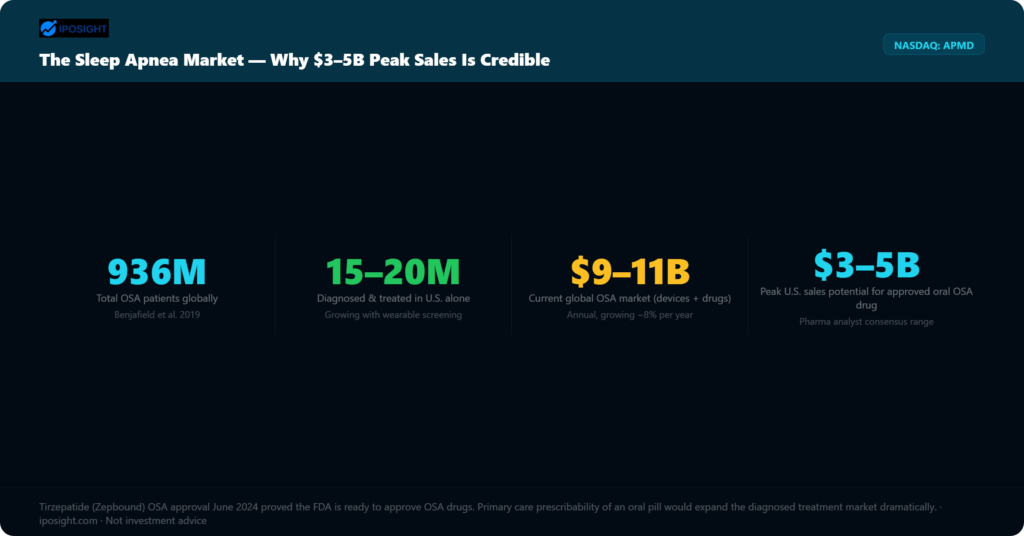
The global OSA patient population is approximately 936 million, with 15–20 million diagnosed and treated in the U.S. alone — growing rapidly as wearable devices (Apple Watch, Oura Ring) enable mass screening and awareness increases. The global sleep apnea device and drug market is estimated at $9–11 billion annually, with pharma analysts projecting a successfully-approved oral OSA drug could reach $3–5 billion in peak annual U.S. sales.
The critical dynamic is the treatment gap. Approximately 80% of people with significant OSA are undiagnosed. Of those diagnosed, only 40–50% are prescribed CPAP. Of those prescribed, fewer than 50% use it consistently. This means the vast majority of OSA patients globally receive inadequate or no treatment. An oral drug that a patient takes before bed — no mask, no machine, no noise — would structurally change this. Primary care physicians who currently cannot manage OSA (lacking sleep lab access and CPAP expertise) could simply prescribe a pill. This market expansion argument is the core commercial case for AD109.
Partners, Revenue, and the Clinical Reality
Apnimed’s revenue is 100% collaboration and grant-based — primarily an AstraZeneca research collaboration exploring additional compounds for OSA, and National Institutes of Health (NIH) grant funding. The AZ collaboration is separate from the AD109 program and validates that AstraZeneca views the OSA pharmacology space as strategically important. The company is a Johnson & Johnson Innovation (JLABS) resident — J&J’s curated incubator for high-potential clinical-stage companies, providing laboratory infrastructure and scientific access. Institutional investors including Atlas Venture and Morningside Venture backed the company through private rounds. IPO proceeds fund the MYOSA trial through the 2027 topline readout.
The Real Competitive Landscape
Three competitive dimensions matter for AD109:
Device competition: CPAP (ResMed, Philips Respironics), oral appliances, and surgical options including Inspire Medical’s hypoglossal nerve stimulator. All effective for compliant patients — but compliance is the market’s defining problem. AD109 competes in the “CPAP-intolerant” and “CPAP-naive” patient populations where devices have already failed.
GLP-1 competition: Eli Lilly’s tirzepatide (Zepbound/Mounjaro) received the first-ever FDA approval for OSA treatment in June 2024. This is important context — it proves the FDA will approve OSA drugs on AHI/ODI endpoints, and it validates the market’s seriousness. But tirzepatide works primarily through weight loss and metabolic improvement, requiring injection and producing significant GI side effects. Its mechanism means limited efficacy in non-obese OSA patients (approximately 30% of the OSA population). AD109 targets the neuromuscular mechanism regardless of weight — directly complementary rather than directly competing with tirzepatide for most patient segments.
Pipeline competition: Jazz Pharmaceuticals has explored OSA pharmacology. Private-stage Galvita Therapeutics is developing upper airway muscle pharmacology. But Apnimed’s 2016 head start, Harvard/Brigham research foundation, and Phase 3 status put it significantly ahead of most non-GLP-1 rivals in the oral neuromuscular OSA space.
ETF Coverage: Broad Biotech Floor
The PDF’s ETF positions reflect broad biotech fund coverage consistent with a new small-cap listing. XBI (SPDR S&P Biotech, $7.5B AUM) at 0.5% is the most significant — XBI is the standard benchmark for small-cap biotech exposure and includes new IPOs systematically. IBB (iShares Biotech, $8B) and BBH (VanEck Biotech) are market-cap-weighted broad funds. FBT (First Trust equal-weight biotech) and PSCH (Invesco SmallCap Healthcare) specifically capture smaller biotechs in a way that large-cap-weighted funds miss. Together these positions create a systematic buying floor through rebalancing that partially insulates the stock from pure sentiment-driven selling in the absence of company news.
Bulls and Bears
The bull case is among the cleaner setups in the 2026 biotech IPO class. The market is vast and the treatment gap is documented. The Phase 2 data is genuine — 63% AHI reduction is statistically and clinically significant. The mechanism is well-understood and the drugs are known, reducing early-stage safety uncertainty. The tirzepatide approval has validated both the FDA’s appetite for OSA drugs and the AHI/ODI endpoint framework that AD109’s Phase 3 is built around. And the 2027 topline data provides a defined investment horizon — unlike many biotechs where the catalyst is years away and ill-defined.
The bear case is structural rather than specific. Phase 3 trials fail at a 30–40% rate even for Phase 2 successes. The MYOSA trial is larger and longer than Phase 2, and the durability data over 26 weeks will be scrutinised. Atomoxetine carries a black-box warning for suicidal ideation (in paediatric patients, not adults — but FDA will require careful safety monitoring). Tirzepatide’s commercial success in obese OSA patients creates a narrative headwind even if the mechanisms are distinct. And any delay in MYOSA creates a cash crunch before topline data.
12-Month Price Scenarios
Bull scenario (~35% probability): +80–150%. Positive interim data or a major pharma commercialisation partnership. XBI inclusion drives systematic buying. The GLP-1 competition is reframed as complementary. Investors anticipate 2027 Phase 3 success.
Base scenario (~45% probability): −10% to +40%. Wide range as MYOSA continues. Stock trades with sector sentiment — XBI beta. Moderate volatility on conference presentations and patent updates.
Bear scenario (~20% probability): −60% to −80%. Safety signal in MYOSA, protocol amendment delaying timeline, or dilutive financing round before topline data. Approaches cash-per-share floor.
Single most important catalyst: MYOSA Phase 3 topline data — 2027. This is a binary event. Everything before it is preparation. Size the position accordingly: meaningful enough to matter if Phase 3 succeeds, manageable enough to absorb if it doesn’t.
Investment Evaluation
| Factor | Score |
| Market Opportunity | 10/10 |
| Phase 2 Clinical Data | 9/10 |
| Scientific Mechanism | 8/10 |
| Regulatory Pathway Clarity | 8/10 |
| ETF & Institutional Coverage | 7/10 |
| Phase 3 Binary Risk | 5/10 |
| Competitive Environment | 5/10 |
| Financial Position | 4/10 |
| Long-Term Upside | 9/10 |
Overall Investment Score: 6.8 / 10 · Strong clinical story, clear 2027 binary catalyst. 0.5–1.5% portfolio position. Best entry: IPO price or biotech-sector selloff.
Final Verdict
Apnimed is one of the cleaner risk/reward setups in the 2026 biotech IPO class. The market is real and massive. The Phase 2 data is genuinely compelling. The mechanism is well-understood. The regulatory pathway is now validated by tirzepatide’s OSA approval. And the Phase 3 trial produces a definitive answer in 2027 — an investment horizon most investors can commit to.
The risk is the same risk every Phase 3 biotech carries: trials fail. At 0.5–1.5% of a diversified portfolio, a Phase 3 failure is painful but not catastrophic. A Phase 3 success — for the first oral neuromuscular OSA drug in a market with 936 million undertreated patients — is the kind of outcome that justifies the position size many times over.
“936 million people have sleep apnea. Most of them won’t wear a CPAP mask. Apnimed is building the pill that could change that. The MYOSA Phase 3 will answer whether the Phase 2 signal holds at scale.”
Sources & References
[1] Apnimed — apnimed.com · Investor Relations — ir.apnimed.com
[2] TradingView — NASDAQ: APMD — tradingview.com
[3] APMD PDF Analysis — Stock Analysis Tool, August 5, 2026
[4] Benjafield et al. (2019) — Global prevalence of obstructive sleep apnea, Lancet Respiratory Medicine
[5] Wellman et al. / Sands et al. — MARIPOSA Phase 2 trial data
[6] FDA — Tirzepatide (Zepbound) OSA indication approval, June 2024
[7] American Academy of Sleep Medicine — CPAP compliance statistics
This article is produced by iposight.com based on publicly available information, SEC filings, company materials, and independent research. For informational purposes only — not investment advice. All investments carry risk. Pre-production mining investments carry very high risk. Please consult a qualified financial advisor.