
EV Battery Materials | Electronic Technology | Copper Foil | CATL / BYD Supplier | China ADR
Every electric vehicle on the road today — whether it carries a Tesla badge, a VW logo, or a BYD nameplate — contains a component most investors have never thought about: copper foil. This ultra-thin, perfectly uniform sheet of copper forms the current collector inside every lithium-ion battery cell. Without it, the battery doesn’t work. Londian Wason makes more of it than anyone else on the planet. On August 12, 2026, it listed on the New York Stock Exchange. The IPO was oversubscribed, priced at the top of the range, and raised $94.3 million. Here is everything investors need to know.
What Londian Wason Actually Makes: The Invisible EV Ingredient
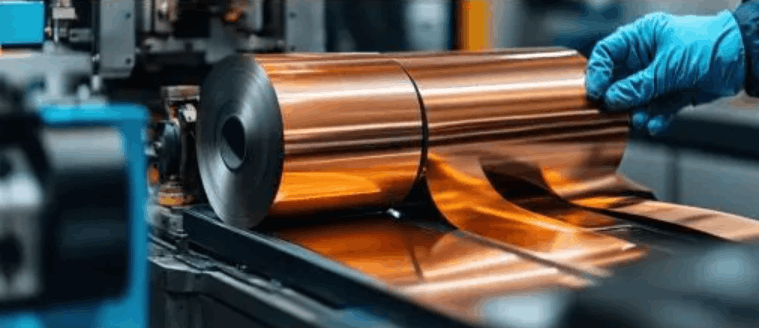
Londian Wason New Energy Tech Inc. (Chinese: 隆电华盛新能源科技) manufactures electrolytic copper foil for lithium-ion batteries. This is a specialised, technically demanding product that is not interchangeable with standard copper sheeting. Battery-grade copper foil is produced through an electrodeposition process: copper sulphate solution is electrolytically deposited onto a rotating titanium drum, peeled off as a continuous thin film, and wound into rolls.
The critical specifications are extreme: thickness uniformity measured in microns (standard battery foil is 6–8 microns; advanced EV foil is 4–6 microns), surface roughness at the nanometre scale, tensile strength sufficient to survive high-speed battery manufacturing lines, and chemical purity sufficient for electrochemical performance. In a lithium-ion battery cell, the copper foil is the anode current collector — it carries the electrical current from the graphite anode to the external circuit. It must be simultaneously thin (to maximise energy density), strong (to survive cell winding at high speed), and perfectly uniform (to prevent hot spots that cause degradation or fire).
The company’s headquarters and primary manufacturing are in Huizhou, Guangdong Province, China — the heart of China’s battery supply chain ecosystem. The new Malaysia facility (funded in part by the $94.3M IPO proceeds) is specifically designed to serve non-Chinese customers who require geographically diversified supply chains under U.S. and European supply chain risk management policies.
The EV battery supply chain reality: CATL, BYD, LG Energy Solution, Samsung SDI, and Panasonic — Londian Wason’s five major customers — collectively supply batteries to essentially every major electric vehicle on the market. CATL alone supplies Tesla (China), BMW, Toyota, and dozens of Chinese EV brands. When you buy an EV, you almost certainly own a Londian Wason copper foil. You just didn’t know it until now.
Financial Performance: Numbers That Are Hard to Ignore
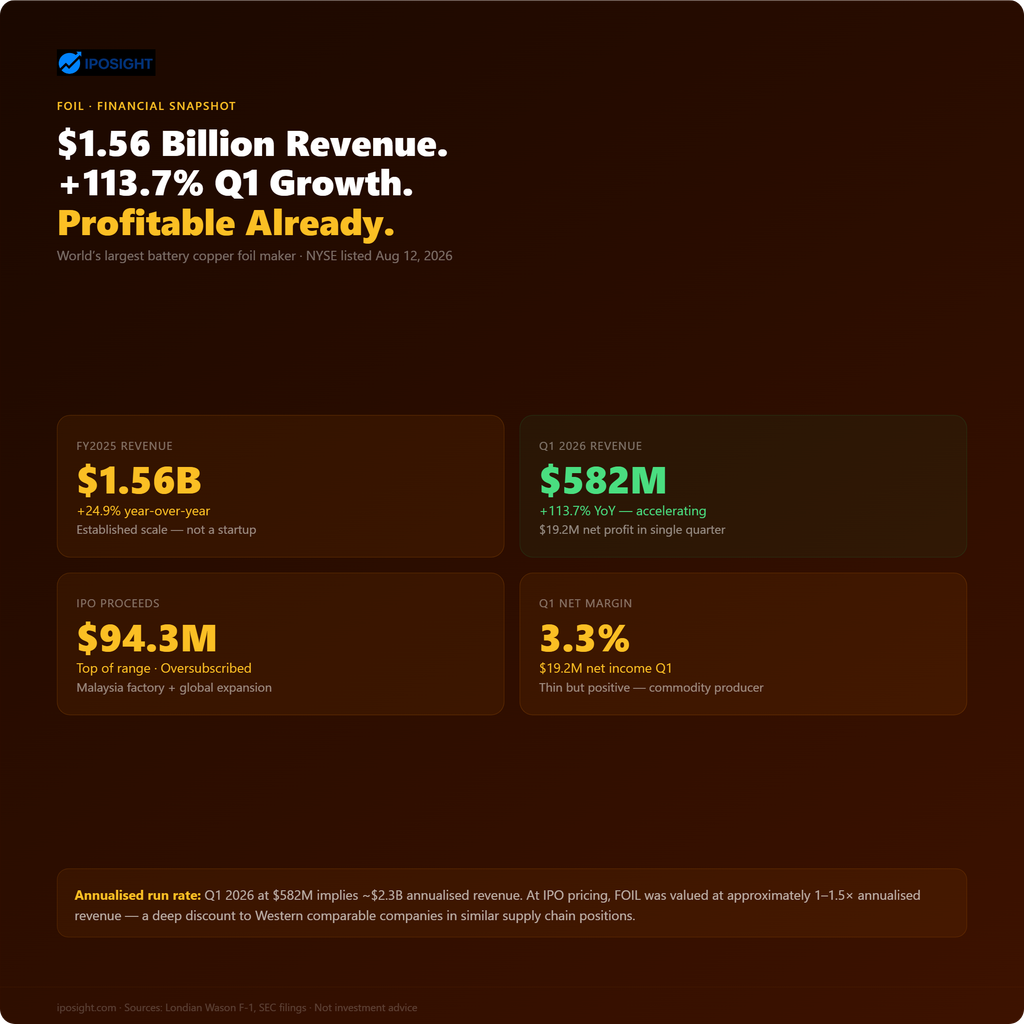
Londian Wason’s disclosed financials are exceptional by any measure for a materials company. FY2025 revenue reached $1.56 billion, a 24.9% increase from FY2024. This is not a startup’s revenue — it is the revenue of an established industrial manufacturer with significant market share. Q1 2026 revenue was $582 million — a 113.7% year-over-year jump — with net income of $19.2 million in the single quarter. The Q1 2026 revenue jump is partly organic growth and partly base effects from a weak Q1 2025, but the absolute level ($582M in a single quarter, implying a potential $2.3B+ annualised run rate) is genuinely striking for a company that just raised $94.3M at IPO.
The profitability picture — $19.2M net income on $582M Q1 revenue — implies a 3.3% net margin. This is thin for a tech company but reasonable for an industrial materials manufacturer with high capital intensity and commodity cost exposure (copper prices directly affect both revenue and COGS). The company’s ability to maintain positive net income while investing in Malaysia expansion and the intense competitive pressure of the Chinese battery supply chain is operationally impressive.
The Market: How Big Is EV Battery Copper Foil?
The global lithium-ion battery copper foil market was approximately $8–10 billion in 2025 and is projected to grow at 20–25% CAGR to 2030, driven primarily by EV adoption. The International Energy Agency projects EV sales to reach 45 million vehicles per year globally by 2030 (from approximately 17 million in 2024). Each EV battery requires approximately 2–4 kg of copper foil depending on pack size. The total copper foil demand from EVs alone will be approximately 90,000–180,000 tonnes by 2030 — and Londian Wason currently produces 111,000 tonnes per year, meaning the entire market’s demand growth will exceed current supply within years.
The addressable market expands further when energy storage systems (grid-scale battery storage), consumer electronics, and stationary storage are included. Battery copper foil is one of the few battery supply chain components where demand growth is guaranteed and supply addition is constrained by technical complexity and capital requirements.
Is the China Risk a Problem or an Opportunity?
This is the central question for most U.S. investors evaluating FOIL. Londian Wason is a Chinese company listed as an ADR on the NYSE — structurally identical to dozens of other Chinese ADRs that have faced regulatory scrutiny, accounting questions, delisting threats, and U.S.-China trade policy volatility over the past decade.
The risk side is real: the PCAOB inspection regime that threatened Chinese ADR delistings in 2022 may resurface. U.S. tariffs and export controls on Chinese EV components could affect customer demand. The VIE structure common to Chinese ADRs creates governance risks for minority shareholders. Currency risk (CNY vs. USD) affects reported earnings. And the U.S.-China geopolitical tension creates headline risk that can move Chinese ADR stocks independently of fundamentals.
The opportunity side is equally real: the Malaysia factory — funded by this IPO — is a direct response to customer demand for non-China supply. As LG Energy Solution, Samsung SDI, and Panasonic build battery factories in North America and Europe to comply with IRA (Inflation Reduction Act) domestic content requirements and EU supply chain diversification mandates, they need copper foil that is not manufactured in China. Londian Wason’s Malaysia plant addresses this directly, potentially unlocking a new tier of Western market demand that Chinese-manufactured copper foil cannot currently access.
For the stock price specifically: Chinese ADRs that are genuinely profitable, serve irreplaceable supply chain roles, and are actively diversifying manufacturing geographically tend to trade at significant discounts to Western comparables. At IPO valuation (approximately 0.5–1× revenue), FOIL is already pricing in significant China risk. The question is whether that discount is sufficient compensation.
Real Competitive Landscape
The battery copper foil market is oligopolistic with high barriers to entry. The main competitors are: Jiayuan Technology (China, #2 globally), Nuode Investment (China, #3), Circuit Foil Luxembourg (owned by Mitsui, European), and Iljin Materials and SKC (South Korea, strong Samsung SDI relationships). The Korean players are the most direct competitive threat for Londian Wason’s Western market ambitions, as they benefit from allied-country status under U.S. IRA rules — a structural advantage that China-manufactured foil cannot match without geographic diversification.
ETF Exposure
The clean energy ETF positions are small but real: ICLN (iShares Global Clean Energy, 0.05%, $3.5B AUM), PBD (Invesco Global Clean Energy, 0.06%, $300M AUM), CNRG (SPDR Kensho Clean Power, 0.07%, $150M AUM), PBW (WilderHill Clean Energy, 0.04%, $700M AUM), TAN (Invesco Solar, 0.02%, $2.5B AUM). These rules-based funds include companies in the clean energy supply chain — copper foil qualifies as an enabling technology for EV batteries. As FOIL’s trading history extends, additional clean energy and materials ETFs may increase positions.
Bulls and Bears
The bull case has three distinct pillars. First, the business is real and large: $1.56 billion FY2025 revenue, profitable, world market leader with confirmed customer relationships at the top of the EV battery supply chain. The IPO was oversubscribed and priced at the top — genuine institutional demand. Second, the growth is exceptional: 113.7% Q1 revenue growth is not typical for a $1.5B revenue company. Third, the Malaysia factory creates a Western-market-accessible supply option precisely as IRA domestic content requirements drive customers to diversify away from China-only sourcing.
The bear case is structural and must be taken seriously. This is a Chinese ADR — the category that produced Luckin Coffee’s fraud, DiDi’s regulatory shutdown, and dozens of Nasdaq/NYSE-listed Chinese companies that were either fraudulent, delisted under PCAOB pressure, or simply worth far less than their promotional materials suggested. The 3.3% net margin on $582M revenue is extremely thin — commodity input prices (copper LME) and customer price pressure from CATL and BYD (who have enormous negotiating leverage) can quickly turn profitable quarters to losses. And at IPO valuation, FOIL is priced for continued growth execution in a geopolitically complex environment.
12-Month Price Scenario Analysis
Bull scenario (~35% probability): $28–$45. Q2 2026 results (first post-IPO quarterly report) confirm Q1 trajectory. Malaysia facility groundbreaking and a new Western customer announcement. Clean energy ETFs increase positions. The company’s operational reality closes the China ADR discount. Stock re-rates toward 1.5–2× annualised revenue.
Base scenario (~45% probability): $16–$28. Stock consolidates near IPO price as the market waits for the first full post-listing financial disclosure. China ADR risk premium stays elevated. Revenue growth moderates from Q1’s exceptional pace. The company is valued at 0.5–0.8× annualised revenue — a reasonable but not exciting multiple for a Chinese industrial company.
Bear scenario (~20% probability): $6–$16. U.S.-China tensions escalate. PCAOB inspection issues resurface. Copper prices spike, compressing margins. A major customer (CATL or BYD) announces internal copper foil expansion, reducing external procurement. Stock tests IPO discount territory.
Key upcoming catalysts: First post-IPO quarterly earnings report (Q2 2026 — September/October) · Malaysia facility construction update · Any new customer announcement from Western battery makers · U.S.-China trade policy developments affecting EV supply chains · PCAOB inspection status for Chinese auditors
Investment Evaluation
| Factor | Score |
| Market Position | 10/10 |
| Customer Quality | 9/10 |
| Revenue Growth | 9/10 |
| EV / Battery Market Tailwinds | 9/10 |
| Malaysia Expansion | 8/10 |
| IPO Execution | 8/10 |
| China ADR Risk | 3/10 |
| Net Margin Profile | 4/10 |
| Analyst Coverage & Transparency | 4/10 |
| Long-Term Upside | 8/10 |
Overall Investment Score: 6.8 / 10 · Strong business, genuine market leadership, exceptional growth. China ADR risk is the primary discount factor. Best entry: IPO price $22 or below. First post-IPO earnings = primary near-term catalyst.
Final Verdict
Londian Wason is the kind of company that Wall Street’s analytical machinery struggles with: genuinely exceptional business fundamentals wrapped in a risk category (Chinese ADR) that triggers automatic discounting from most institutional investors. The result is a stock that could be simultaneously the world’s largest supplier of a critical EV battery component and trade at a fraction of the valuation that a comparable Western company would attract.
The IPO’s oversubscription at the top of the range suggests some institutional investors have decided the fundamentals outweigh the ADR discount. The Malaysia factory specifically addresses the Western market supply chain concern — it is not marketing, it is capital deployed to solve the structural problem that prevents Western customers from fully committing to Londian Wason supply.
For investors who understand the China ADR risk category and can size accordingly: FOIL at $22 is a defensible position in the EV supply chain at a valuation that prices in substantial geopolitical risk. For investors who cannot or do not want China ADR exposure: this is an unavoidable constraint, regardless of the underlying business quality. The business is world-class. The risk category is real. Both are true simultaneously.
“Every EV on the road has Londian Wason copper foil in its battery. Most investors don’t know the company exists. The IPO changes that. Whether it changes the valuation depends on whether the China ADR discount proves temporary or permanent.”
Sources & References
[1] Londian Wason New Energy Tech — londianwason.com · IR — ir.londianwason.com
[2] TradingView — NYSE: FOIL — tradingview.com
[3] FOIL PDF Analysis — Stock Analysis Tool, August 24, 2026
[4] SEC Filing — FOIL F-1 / Prospectus — sec.gov
[5] Frost & Sullivan — Global Lithium-Ion Battery Copper Foil Market Report 2025
[6] IEA — Global EV Outlook 2026
[7] Seeking Alpha — Gytis Zizys, August 11, 2026 · Donovan Jones, August 9, 2026
[8] BloombergNEF — Battery supply chain data
iposight.com — for informational purposes only, not investment advice. Chinese ADR investments carry specific risks including PCAOB, VIE structure, and geopolitical exposure. All investments carry risk.