
Health Technology | Pharmaceuticals | Pain Management | Non-Opioid Pain | Clinical-Stage Biotech
The opioid crisis has killed more than 500,000 Americans since 1999. It has also created one of the most urgent unmet medical needs in modern pharmacology: a pain killer that works as well as an opioid but doesn’t addict, sedate, or kill. Vertex Pharmaceuticals proved in January 2025 that this is scientifically possible, with FDA approval of Journavx (suzetrigine) — the first new class of pain medicine approved in over two decades. Now Latigo Biotherapeutics has entered the race, bringing four pipeline candidates to market with a fresh Nasdaq listing and a $1.39 billion valuation. Zero revenue. Deep losses. And a scientific thesis that could be worth tens of billions — or nothing at all.
The Opioid Crisis and the Non-Opioid Revolution: Why This Moment Matters
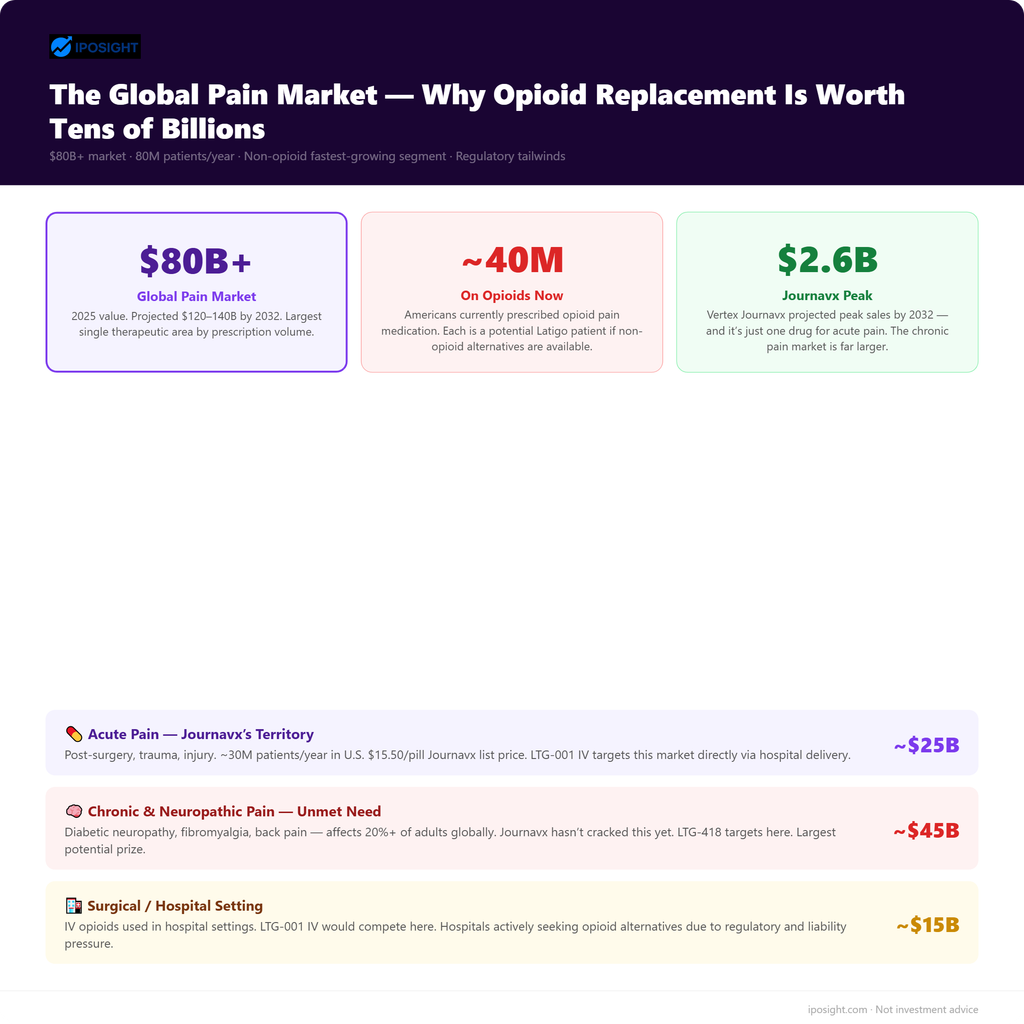
To understand the Latigo opportunity, it is essential to understand the market it is entering. The United States alone has approximately 80 million people prescribed pain medication annually for moderate-to-severe pain, with roughly half receiving opioids. The consequences of opioid dependence are catastrophic: approximately 85,000 people develop opioid use disorder each year from prescription medications, and the broader opioid crisis has driven overdose deaths to approximately 80,000 per year in the U.S.
The global pain management market was valued at approximately $80–90 billion in 2025 and is projected to reach $120–140 billion by 2032. Within this market, the non-opioid segment is the fastest-growing subsegment, driven by regulatory pressure (many U.S. states now mandate non-opioid alternatives be offered before opioids), liability-driven prescribing changes among physicians, and payer pressure from insurance companies seeking to reduce opioid-related costs.
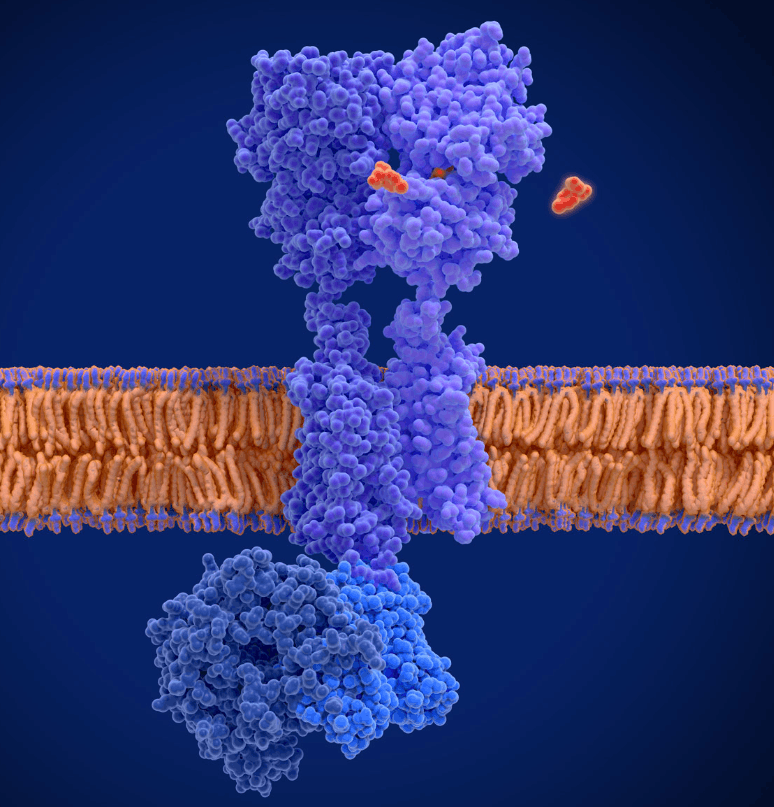
The scientific breakthrough that Vertex demonstrated with Journavx — selective inhibition of the NaV1.8 sodium channel, which transmits pain signals from peripheral neurons to the brain — proved for the first time that opioid-equivalent analgesia is achievable without central nervous system activity. Because Journavx blocks pain signals only found in the periphery, not in the brain, it provides effective relief without the addictive potential of opioids. This validation has opened the field for next-generation approaches, of which Latigo is one of the most well-capitalised entrants.
The Latigo Pipeline: Four Shots at the Target
Latigo’s pipeline is built around a diversified portfolio of non-opioid pain mechanisms, reducing the single-asset risk that kills many clinical-stage biotechs.
LTG-001 is the lead programme — an oral small molecule targeting a specific pain-signalling pathway. Full mechanistic details are not yet publicly disclosed in the company’s pre-commercial communications, which is typical for early-stage biotechs protecting competitive intelligence. The oral route of administration is critical for commercial adoption: physicians and patients strongly prefer pills to injectables for chronic and acute pain management.
LTG-32 is the second oral asset, likely targeting a different pain mechanism or patient population to provide portfolio diversification. Having two oral assets at different stages means Latigo can pursue multiple label expansions simultaneously.
LTG-001 IV is the intravenous formulation of the lead compound — targeting the acute/surgical pain setting where injectable delivery is standard. This directly addresses the hospital and post-surgical pain market, which is the highest-value acute pain segment and the same market where Vertex’s Journavx made its initial commercial entry.
LTG-418 is the fourth asset — described as targeting a distinct mechanism, potentially addressing neuropathic or chronic pain where the unmet need is arguably even larger than in acute pain.
The diversification advantage: With four assets targeting different aspects of the pain pathway, Latigo is pursuing a portfolio biotech strategy rather than a single-molecule bet. If one asset fails in trials, the company retains value from the others. This is a structurally sounder approach than single-asset clinical biotechs, and it partially justifies the $1.39B valuation despite zero revenue.
The Market Validation: What Vertex’s Success Means for Latigo
The most important external data point for evaluating Latigo is the commercial trajectory of Vertex’s Journavx. Projected sales for Journavx could be $105.8 million in 2025, rising to $362 million in 2026, with peak global sales of $2.6 billion by 2032. This commercial validation is critical for Latigo’s investment case in two ways.
First, it proves that physicians and payers will adopt non-opioid alternatives — the market adoption question that previously made non-opioid biotech investment speculative has been partially resolved. Second, it demonstrates that regulators (FDA) are actively supportive of new non-opioid mechanisms, having fast-tracked Journavx approval and explicitly calling out the need for additional non-opioid options in pain management guidelines.
However, the Vertex precedent also creates a competitive challenge: Latigo’s pipeline must either demonstrate superiority to Journavx (better efficacy, fewer side effects, different indication coverage) or differentiation (different patient population, chronic vs. acute pain, different mechanism). The NaV1.8 channel that Vertex targets has been validated; the key question is whether Latigo’s mechanisms offer additional or complementary benefits.
Real Competitive Landscape
Direct clinical competitors in non-opioid pain: Vertex Pharmaceuticals (VRTX) with approved Journavx — the current market leader and the company Latigo must differentiate against. Regeneron Pharmaceuticals (REGN) with fasinumab (NGF inhibitor for chronic pain). Eli Lilly (LLY) with lebrikizumab and other inflammation-related pain targets. Tonix Pharmaceuticals with TNX-102 SL for fibromyalgia. Neurocrine Biosciences (NBIX) with pipeline assets in CNS pain. Protagonist Therapeutics and several other clinical-stage players.
Longer-term structural competitors: If Latigo’s mechanisms prove effective, it will compete with the full marketing budgets of Pfizer, Johnson & Johnson, Merck, AbbVie, and Amgen — all of which have pain management programmes and the commercial infrastructure to dominate any approved indication. Small biotechs in pain typically either partner with or are acquired by these majors — which is both the risk (if not acquired, commercial stage is very difficult) and the opportunity (M&A premium).
ETF Exposure: Genuine Biotech Support
The ETF positions are real and meaningful for a newly-listed biotech: XBI (SPDR S&P Biotech, 0.2%, $7.0B AUM) is the most liquid biotech ETF and its 0.2% weight provides genuine systematic demand. FBT (First Trust Amex Biotech, 0.3%, $3.0B AUM) at the highest weight is the most strategically relevant — it is an equal-weight biotech fund that gives proportionally larger exposure to smaller companies. LABU (Direxion 3× Biotech Bull, 0.25%) is a leveraged ETF — its inclusion means LTGO benefits from leveraged flows on biotech bull days, amplifying upside moves. IBB (iShares Biotech, 0.15%, $7.5B AUM) is the largest biotech ETF by AUM and its inclusion provides stable institutional-quality index demand. These ETF positions collectively represent a meaningful and genuine demand base that many micro-cap biotechs lack.
Is Latigo a U.S. or European Company?
Latigo Biotherapeutics is incorporated and headquartered in the United States — specifically Thousand Oaks, California, which is part of the greater Los Angeles biotech corridor. It is not a European company listing on a U.S. exchange. The question likely arises from the name “Latigo” (a Spanish/nautical term for a type of leather strap) which has no European corporate heritage. European investor interest in LTGO would follow the same channels as any U.S. biotech: institutional access via ADR or direct Nasdaq listing for European funds with U.S. mandate, and retail access via U.S.-listed broker platforms. There is no structural European angle to this investment.
Bulls and Bears
The bull case for Latigo is built on a sector validation story that is genuinely powerful. The non-opioid pain market is at an inflection point: Vertex proved the science works, the FDA approved the first drug in 20 years, and commercial adoption is growing toward a projected $2.6 billion peak for just one drug. Latigo has four pipeline assets, a $1.39B market cap that suggests strong institutional conviction, experienced leadership under CEO Nima M. Farzan, and biotech ETF support that provides a structural demand floor. The stock’s +21.55% gain in the prior month indicates genuine market momentum. If any one of Latigo’s four assets shows strong Phase 2 data, the stock could re-rate dramatically upward.
The bear case is equally compelling and must be weighted honestly. This is a zero-revenue company burning approximately $100M+ per year with a $1.39B market cap — a valuation justified entirely by future probability-weighted clinical outcomes. Clinical-stage biotech is the highest-risk category in public markets: the majority of Phase 2 drugs that enter trials fail to reach approval. The non-opioid pain space specifically has a history of high-profile failures — Pfizer’s tanezumab (NGF inhibitor) was rejected after years of development. Latigo must not only prove safety and efficacy but do so against Vertex’s already-approved, already-prescribing Journavx. And at $1.39B with no revenue, there is limited financial margin for error.
12-Month Price Scenario Analysis
Bull scenario (~30% probability): +50% to +200%+. Positive Phase 2 data from LTG-001 or LTG-32. A major pharma partnership or licensing agreement (the highest-value catalyst for any clinical-stage biotech). Continued market momentum in the non-opioid pain sector following Journavx commercial success. Biotech sector tailwinds from Fed rate cuts supporting risk-on flows into speculative growth. These outcomes could drive 50–200%+ returns from IPO price.
Base scenario (~40% probability): −20% to +30%. The stock consolidates and ranges as investors wait for clinical milestones. No major catalyst in the next 12 months. The stock trades based on sector sentiment and biotech ETF flows rather than company-specific news. High volatility with no sustained directional trend.
Bear scenario (~30% probability): −50% to −80%. Any negative clinical data — a failed endpoint, a safety signal, or a clinical hold — would trigger severe selling. At $1.39B with zero revenue, negative clinical news typically causes 50–80% drops in clinical-stage biotechs. Additional equity dilution through secondary offerings (inevitable given the burn rate) also applies downward pressure.
Critical upcoming milestones: Phase 2 data readouts for LTG-001 and LTG-32 (timing not yet disclosed) · IND amendments or Phase 2 initiations for LTG-001 IV and LTG-418 · Any partnership, licensing, or co-development announcement · FDA guidance meetings · Secondary equity offering (likely within 12–18 months given burn rate)
Investment Evaluation
| Factor | Score |
| Market Opportunity | 10/10 |
| Sector Validation (Vertex/Journavx) | 9/10 |
| Pipeline Diversification | 8/10 |
| ETF & Institutional Support | 7/10 |
| CEO & Leadership | 7/10 |
| Clinical Risk | 2/10 |
| Financial Position | 2/10 |
| Competitive Position vs. Vertex | 3/10 |
| Valuation | 4/10 |
| M&A / Partnership Optionality | 8/10 |
Overall Investment Score: 5.2 / 10 · High-risk / high-reward clinical biotech. Appropriate only for investors who understand and accept total loss risk. Speculative position max 0.5–1% portfolio. Watch for Phase 2 data readouts as primary catalyst.
Final Verdict
Latigo Biotherapeutics is entering the most consequential battle in pharmacology: the race to replace opioids. The market need is genuinely enormous. The regulatory environment is genuinely supportive. Vertex proved the thesis works. And Latigo has four shots at the target where most clinical biotechs have one.
What it doesn’t have is any clinical proof yet — at least none that is publicly available. At $1.39 billion with zero revenue and $109M annual losses, every dollar of market value is a bet on future probability-weighted outcomes in one of the most technically challenging and historically failure-prone areas of drug development. That is not a reason to avoid the stock — it is a reason to size the position correctly.
For investors with a high-risk tolerance, a long time horizon, and the ability to absorb a total loss: Latigo at current levels is a speculative position in a correctly identified mega-trend. For everyone else, the stock deserves a watchlist entry and a revisit after the first Phase 2 data readout. That single event will either justify the valuation or destroy it — and no amount of pre-data analysis can predict which.
“The opioid crisis created the largest unmet need in pain medicine in a generation. Vertex proved non-opioids can work. Latigo has four drugs trying to be the next chapter. The science is right. The risk is real. Both are true.”
Sources & References
[1] Latigo Biotherapeutics — latigobio.com · IR — investors.latigobio.com
[2] TradingView — NASDAQ: LTGO — tradingview.com
[3] LTGO PDF Analysis — Stock Analysis Tool, August 26, 2026
[4] FDA — Journavx (suzetrigine) Approval, January 30, 2025
[5] Managed Healthcare Executive — Journavx commercial projections, July 2026
[6] Yale Medicine — FDA Approves Non-Opioid Pain Medication Suzetrigine
[7] Pharmacy Times — Journavx mechanism and clinical data review
[8] CDC — Opioid Overdose Data 2025
iposight.com — for informational purposes only, not investment advice. Clinical-stage biotechs carry extreme risk of total loss.