
Pre-IPOHong Kong (HKEX)Social CommerceChina Internet
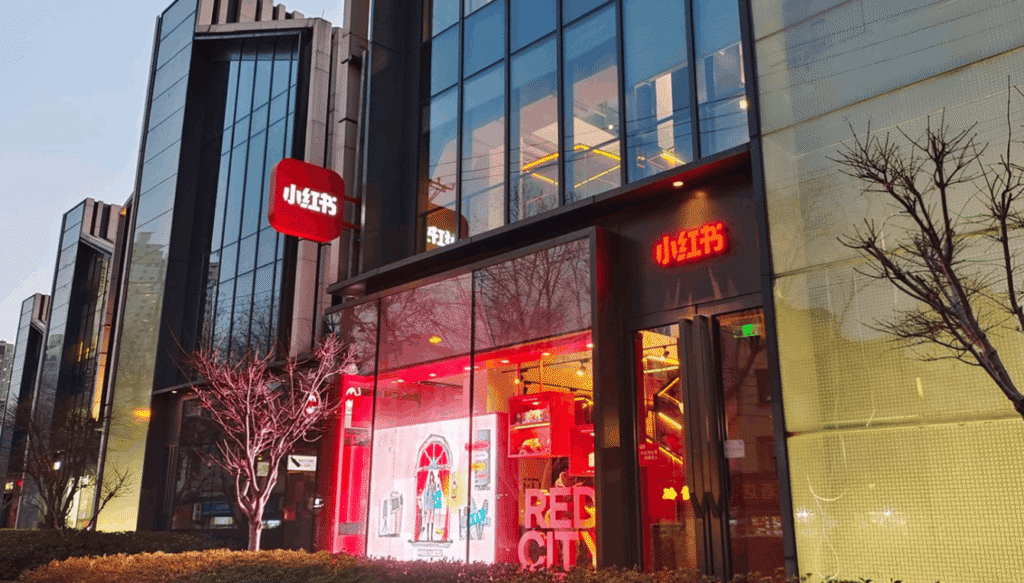
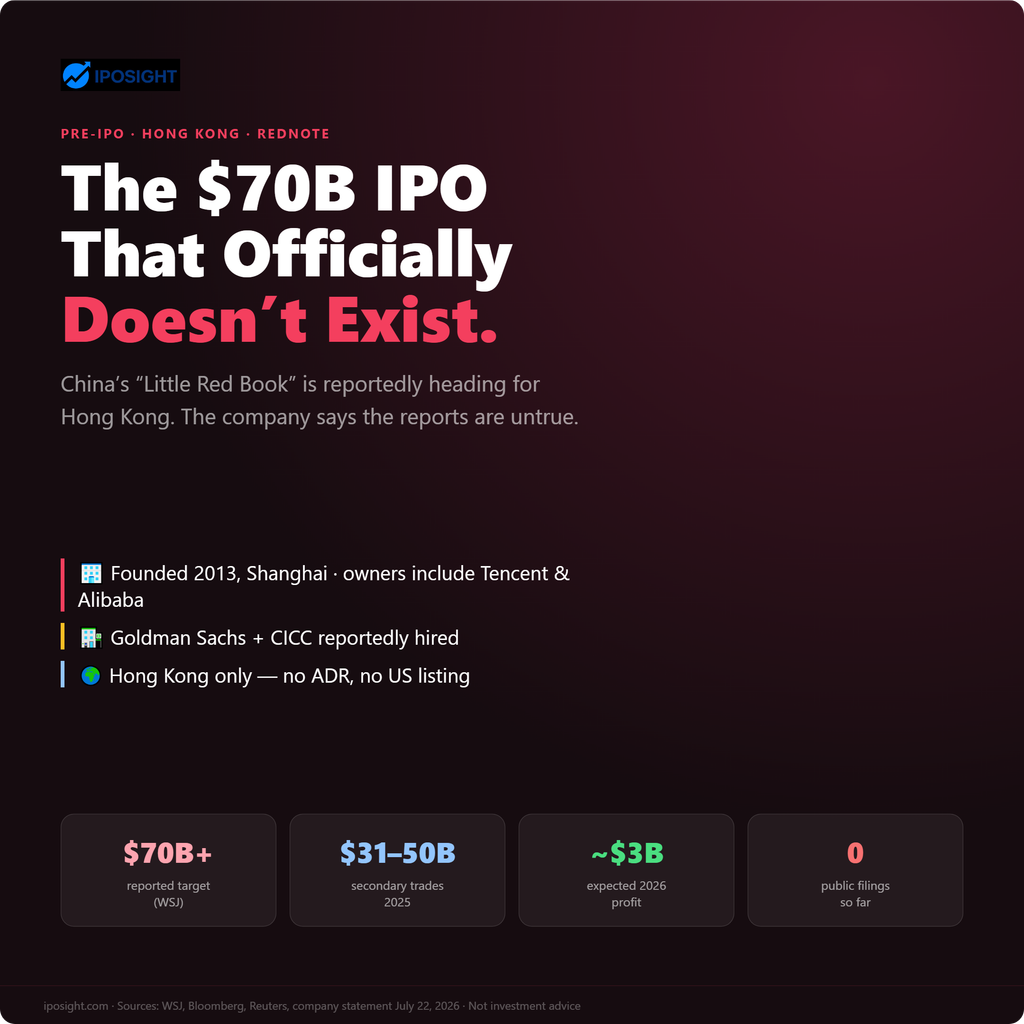
In June, Bloomberg and the Wall Street Journal reported that Xiaohongshu — the Shanghai lifestyle app known in the West as RedNote — had hired Goldman Sachs and CICC and was preparing a Hong Kong IPO by the end of 2026 at a valuation above $70 billion. That would make it one of the largest listings in the world this year. A month later, the company said that “all currently circulating IPO-related information is untrue.” Five months on, there is still no public filing. Yet the case for the IPO keeps getting stronger: profits are expected to reach about $3 billion this year, and Hong Kong is having its best IPO year on record. Here is what is known, what is not, how the valuation compares with listed rivals, and the realistic routes for Western investors who want exposure.
Xiaohongshu in Brief
Xiaohongshu (“Little Red Book”) was founded in 2013 as a guide for Chinese tourists shopping abroad. It has grown into China’s go-to app for lifestyle discovery: users post photos, short videos and reviews about beauty, fashion, food, travel and home, and other users search those posts before they buy. That search behavior is what makes it valuable. In late 2024, users ran almost 600 million searches a day, and many younger consumers now use it instead of Baidu for “what should I buy” questions. In January 2025, the app briefly became famous in the US when “TikTok refugees” pushed it to the top of the App Store. Most of those users drifted away, but the episode gave RedNote a global brand.
Products and Revenue: An Advertising Company With a Shopping Ambition
Xiaohongshu makes money in three ways. Advertising is by far the largest: brands pay for promoted posts, search ads and campaigns built with creators — a practice known in China as “seeding” (zhongcao). Creator marketing runs through its Pugongying platform, which connects brands with influencers and takes a commission. E-commerce and live shopping let users buy directly in the app, but this is still a small part of revenue.
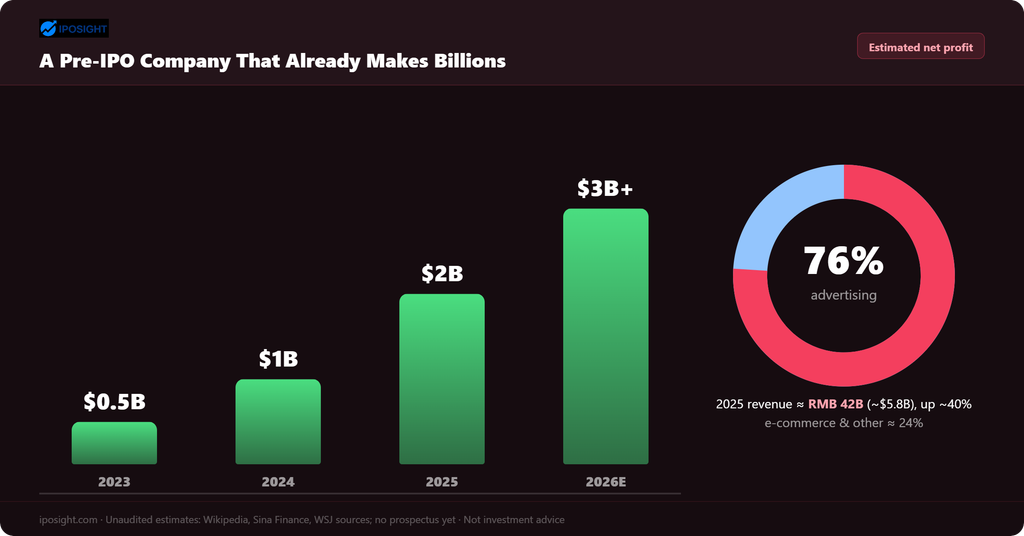
The numbers are unaudited estimates, because the company has never published a prospectus. Chinese media and research houses estimate 2025 revenue of about RMB 42 billion (roughly $5.8 billion), up around 40%, of which about 76% came from advertising. Net profit was about $500 million in 2023, around $1 billion in 2024 and, according to WSJ sources, about $2 billion in 2025, with more than $3 billion expected in 2026. If those figures are right, Xiaohongshu is a highly profitable, fast-growing company — a rare combination for a pre-IPO business.
Why the shopping gap matters: users often discover a product on Xiaohongshu and then buy it on Taobao, Tmall or Douyin. Keeping more of those transactions in its own app is the biggest growth lever — and the hardest, because the platforms where purchases happen are run by its own shareholders and largest rivals.
Owners and Leadership
The company is run by its two co-founders: Charlwin Mao (Mao Wenchao), the CEO, and Miranda Qu (Qu Fang), the President. Ownership has never been officially disclosed, so the stakes below are third-party estimates and should be treated as approximate.
Founders: Charlwin Mao (CEO) and Miranda Qu (President)
Largest single holders, with enhanced voting rights reported
Mao holds a Stanford MBA; Qu is on Forbes’ billionaire list. Third-party estimates put their combined economic stake at roughly 20–25%, with majority voting control. None of these figures are confirmed by filings.
Tencent (HKEX: 0700 · OTC ADR: TCEHY)
Listed owner
Strategic investor since 2018
Co-led the 2018 round and reportedly bought more in 2025. Unverified estimates put its stake around 10%. Tencent also supplies cloud services and the WeChat ecosystem in which Xiaohongshu competes for attention.
Alibaba (NYSE: BABA · HKEX: 9988)
Listed owner
Strategic investor since 2018
Co-led the 2018 round. Also estimated at around 10%. Taobao and Tmall are where much of the shopping inspired by Xiaohongshu posts ends up, which is both a partnership and a tension.
Venture and growth funds
HongShan (ex-Sequoia China), GGV, ZhenFund, Hillhouse, Temasek, DST Global, Boyu, CITIC Capital, GSR Ventures
HongShan has been buying since 2023. Temasek and Genesis joined in 2021, and DST and Boyu in the 2024 stake sales. None of these are publicly traded vehicles that give clean exposure.
The IPO So Far: A Timeline of Reports and Denials
2013
Founded in Shanghai by Charlwin Mao (Mao Wenchao) and Miranda Qu (Qu Fang) as an overseas shopping guide.
Jun 2018
Alibaba and Tencent lead a $300 million round at a $3 billion valuation.
2021
Files confidentially for a US IPO at a ~$20 billion valuation; drops it after Beijing tightens data-security rules, and shifts to Hong Kong.
2024
Stake sales value the company at about $17 billion (DST, HongShan, Hillhouse, Boyu, CITIC Capital).
Jan 2025
“TikTok refugees” push RedNote to #1 on the US App Store; Reuters counts 700,000+ new users in two days.
Feb 2025
Bloomberg: Chinese regulators suggest a state-owned investor would smooth an IPO.
Late 2025
Secondary trades value the company at $31 billion, and at up to $50 billion in some deals.
Jun 15, 2026
Bloomberg: confidential Hong Kong filing planned by end-June; Goldman Sachs and CICC as sponsors.
Jun 17, 2026
WSJ: IPO as early as end-2026 at a valuation above $70 billion.
Jun 28, 2026
A former sales executive files a complaint with HKEX and the SFC over VIE disclosure, stock options and labor practices.
Jul 22, 2026
Xiaohongshu states that “all currently circulating IPO-related information is untrue” and denies having filed.
Nov 6, 2026
No public HKEX application found. The CSRC filing that any listing needs is not public either.
Hong Kong listings by Chinese companies must also be filed with the China Securities Regulatory Commission (CSRC). Reuters noted in June that the CSRC decision “could take months.” Bloomberg had reported in 2025 that regulators suggested bringing in a state-owned investor to ease approval, and the WSJ later reported that state-owned CICC would be among the investors. A company that pulled one IPO after regulatory pushback in 2021 is unlikely to move until Beijing is comfortable.
Reading the denial: Chinese companies often deny IPO reports until a filing is public, so the July statement does not mean an IPO is off the table. But it does mean that the “$70 billion by year-end” headline is a leak, not a plan, and anyone investing on that basis is investing on rumour.
How Big Is the Market?
China is the world’s largest e-commerce market, and social commerce — buying driven by content, creators and live streams — is its fastest-growing part. Xiaohongshu’s estimated e-commerce GMV of RMB 600–900 billion is mostly influenced spending that it does not process itself. The real prize is the advertising budget that consumer brands spend to reach young urban Chinese shoppers, particularly in beauty, fashion, travel and food. On that measure Xiaohongshu has an unusually attractive audience: around 70% female, heavily Gen Z and concentrated in first-tier cities.
The Real Competition
Douyin (ByteDance, private)
The giant
China’s TikTok dominates short video and live-stream shopping. It is the main rival for both user time and advertising budgets, and ByteDance has no Western listing.
Kuaishou (HKEX: 1024)
Listed
The closest listed peer
Short video and live commerce. 2025 revenue was about $20.7 billion and adjusted net profit about $3.0 billion, yet the market cap is only around HK$130 billion (~$17 billion) after a roughly 50% fall in 2026, driven by slowing growth and heavy AI spending. That puts it on about 7 times trailing profit.
PDD, Alibaba, JD
Where the purchase happens
Xiaohongshu inspires purchases that often close on other platforms. Its own closed-loop e-commerce is still small, so the giant marketplaces are both partners and the biggest obstacle to it keeping the transaction.
Bilibili (NASDAQ: BILI) and Weibo (NASDAQ: WB)
Younger-user and public-feed rivals
Bilibili targets Gen Z video; Weibo is the public micro-blog. Weibo is valued at only about HK$13 billion (~$1.7 billion), a reminder of how harshly the market prices slower Chinese social platforms.
Instagram and Pinterest (META, PINS)
Western analogues, not competitors in China
The bull case prices Xiaohongshu like a search-driven Instagram crossed with Pinterest. The bear case says it is a Chinese internet stock and will be valued like one.
The Valuation Gap: Same Profit, Four Times the Price
The most useful comparison is with Kuaishou. Both are Chinese content platforms that earn most of their money from advertising, and both earned roughly $3 billion of adjusted profit for their latest year. Kuaishou is valued at about $17 billion; Xiaohongshu is reportedly targeting $70 billion. The difference is growth and momentum: Xiaohongshu’s revenue is growing at about 40%, Kuaishou’s at about 12%, and Kuaishou’s stock fell more than 14% in a day in March when it announced it would roughly double AI spending. Chinese internet stocks broadly entered a bear market in early 2026 on tax and AI-competition fears.
So the $70 billion figure asks Hong Kong investors to pay around 23 times expected 2026 profit, versus about 7 times trailing profit for Kuaishou. A valuation in the $31–50 billion range seen in private trades would look much more grounded. Our view is that the IPO is more likely to be priced in the $45–60 billion range than above $70 billion, unless Chinese tech sentiment improves sharply.
The Biggest Risks
1. The IPO may not happen soon
Process risk
The company publicly denied filing in July. A Hong Kong listing needs an HKEX application, a listing hearing and a CSRC filing, which usually takes months. A listing before the end of 2026 now looks very unlikely.
2. Beijing
Regulatory risk
In September 2025, the Cyberspace Administration of China penalized Xiaohongshu over “negative content” in trending lists. Chinese regulators have also reportedly asked for a state-linked investor. Content rules, data rules and IPO approvals are all political.
3. The valuation gap
Price risk
At $70 billion, the market would pay about 23 times expected 2026 profit, roughly four times Kuaishou’s multiple. That premium needs Xiaohongshu’s ~40% growth to continue.
4. Too dependent on advertising
Business risk
About 76% of revenue is advertising. Closed-loop e-commerce is still exploratory, and much of the shopping it inspires is completed on Taobao or Douyin.
5. Governance and the VIE structure
Legal risk
Like most Chinese tech companies, it would list through a VIE structure. The whistleblower case highlights a possible inconsistency in how the company describes control over its onshore entity. Founders are expected to keep majority voting control.
6. Community dilution
Product risk
Growth has come from adding male users (sports, the World Cup push) and new categories. Critics warn this could weaken the female-led community that makes the product valuable.
7. US–China tension
Geopolitical risk
Government-device bans in Texas and Taiwan, an India app-store removal in March 2026, and the 2025 TikTok episode show how quickly the international story can turn. Foreign users were separated from Chinese users in March 2026.
How Western Investors Can Get Exposure
This is the hardest part of the story. Unlike SpaceX or Anthropic, there is no listed fund with a disclosed Xiaohongshu stake, no ADR and no US listing planned. Here are the realistic routes, from available today to available only after a listing.
Route 1: Buy Tencent or Alibaba now
Available today
Real but very diluted exposure
Even at a $70 billion IPO value, a ~10% stake is worth ~$7 billion — a small fraction of either company. The IPO would produce a valuation gain, but it is unlikely to move either share price much. This is the only listed route before the IPO.Route 2: Subscribe to the Hong Kong IPO
After filing
Only once a prospectus is out
Hong Kong IPOs have a public retail tranche. Brokers such as Futu (moomoo), Tiger Brokers and Interactive Brokers offer HK IPO subscriptions to eligible clients, often with margin financing. Eligibility depends on your country of residence, and US residents are frequently excluded or restricted. Popular Hong Kong IPOs are often heavily oversubscribed, so retail allocations can be tiny or decided by lottery.
Route 3: Buy on the first trading day in Hong Kong
After listing
Needs a broker with HKEX access
Most large international brokers (Interactive Brokers, Saxo, Schwab and Fidelity global accounts in some regions) can trade HKEX shares. Expect HKD settlement, stamp duty and wider spreads than in US stocks.
Route 4: Wait for index and ETF inclusion
Months after listing
The lazy route
Hang Seng indexes have fast-entry rules for very large new listings. If Xiaohongshu lists at $50–70 billion, it could join Hang Seng benchmark and tech indexes quickly, and with them ETFs such as Hang Seng TECH trackers (e.g. 3033.HK), KraneShares KWEB and Invesco CQQQ. Exposure would be a few percent of each fund.
What does not exist
Caution
Avoid shortcuts
There is no ADR, no US listing plan and no listed pre-IPO fund with a disclosed Xiaohongshu position. Be very careful with “pre-IPO RedNote shares” offered online.
Who Makes Money From the IPO Itself
If the IPO goes ahead, several listed companies benefit whether or not Xiaohongshu shares perform well.
HKEX (HKEX: 0388)
The exchange
A record year: more than HK$388 billion raised in the first nine months of 2026, with KPMG forecasting HK$500 billion for the year. Another mega-listing adds trading and listing fees.
Futu (NASDAQ: FUTU) and UP Fintech / Tiger (NASDAQ: TIGR)
The retail brokers
Hot Hong Kong IPOs drive account openings, margin lending and trading volume for both. They are among the few US-listed ways to benefit from the IPO itself, whether or not the stock performs.
CICC (HKEX: 3908) and Goldman Sachs (NYSE: GS)
Reported sponsors
Fee income for the banks; for Goldman, a rounding error, for CICC more meaningful.
Tencent Cloud, Alibaba Cloud
Infrastructure
Large Chinese apps rely on domestic cloud providers. Exact supplier contracts are not public.
Will It Pop? What Hong Kong IPOs Did in 2026
Hong Kong is having a record year. KPMG counts 116 listings raising more than HK$388 billion in the first nine months of 2026, more than double the same period last year, and ranks Hong Kong second globally behind Nasdaq. Hot technology listings have often been heavily oversubscribed and opened well above their offer prices. That backdrop favors a strong debut. The counterweight is how Chinese consumer internet stocks have traded once listed: Kuaishou itself listed in 2021 to a huge first-day jump and then lost most of its value. A first-day pop is likely if the IPO is priced sensibly; a sustained rerating is not guaranteed.
Is It Worth Subscribing or Buying at the Open?
Nothing can be bought yet, so the real decision is what to do when a prospectus appears. Three principles apply. First, read the audited numbers: the prospectus will confirm or correct the revenue, profit and ownership estimates in this article. Second, judge the price, not the brand: at $45–55 billion, the stock would trade at about 15–18 times expected profit, a defensible price for 40% growth; above $70 billion, the margin of safety largely disappears. Third, size for China risk: regulatory shocks can hit any Chinese platform, so a position should be small and diversified.
A subscription in the public tranche is reasonable for eligible investors if the price is in the lower range. Chasing the first-day open is the riskiest option, as SpaceX showed this year in the US.
12-Month Scenarios: Two Questions, Not One
For a company that has not filed, there are two uncertainties: whether it lists at all within 12 months, and how the stock performs if it does.
Will it list by November 2027? We estimate about 45% that it lists within 12 months, about 35% that it files but lists later, and about 20% that the plan is shelved again for regulatory or market reasons. A listing before the end of 2026 is very unlikely, given there is no public filing.
If it lists, where could it trade 12 months after listing, relative to the IPO price?
Bull scenario — about 30% probability
+30% to +60% from the IPO price
Audited numbers confirm ~$3 billion of profit and 40% growth, e-commerce becomes a visible second engine, and fast entry into Hang Seng indexes brings passive buying. Chinese tech sentiment recovers.
Base scenario — about 45% probability
−15% to +25% from the IPO price
A first-day pop fades as the market compares it with Kuaishou. Strong results are offset by advertising-cycle worries and lock-up expiries six months after listing.
Bear scenario — about 25% probability
−25% to −45% from the IPO price
A regulatory action on content or data, slowing ad spending, or a broad China-tech sell-off pulls the stock well below the offer price, as with many Chinese internet IPOs before it.
Investment Outlook: Bet on Xiaohongshu, or on the Ecosystem?
For Western investors, the honest answer is that the ecosystem route is thin. Tencent and Alibaba give real but tiny exposure; Futu, Tiger and HKEX benefit from the IPO process rather than from Xiaohongshu’s business. The cleanest exposure will be Xiaohongshu’s own Hong Kong shares once listed. Investors who want the theme before that can watch the listed proxy — Kuaishou — which at about 7 times profit already embeds a lot of pessimism about Chinese content platforms. If Xiaohongshu prices at a large premium, a falling Kuaishou could become the more interesting value bet, and a strong Xiaohongshu debut could even lift its listed peers.
Investment Evaluation: Xiaohongshu as a Future IPO
Profitability and growth
Revenue about RMB 42B in 2025 (~+40%), profit ~$2B in 2025 and ~$3B expected in 2026. Rare among pre-IPO companies.
9/10
Market position
China’s leading lifestyle-search and “seeding” platform; ~600M daily searches in late 2024.
8/10
User base quality
300–400M monthly users, young, urban, ~70% female, with high purchasing power.
8/10
Revenue diversification
~76% advertising; e-commerce still small.
5/10
Valuation at $70B+
~23× expected profit vs ~7× trailing for Kuaishou.
4/10
IPO certainty and timing
Company denial in July, no public filing, CSRC process ahead.
3/10
Regulatory and political risk
Content penalties in 2025, VIE and state-investor questions.
3/10
Access for Western investors
Hong Kong only; no ADR; retail IPO access restricted in many countries.
3/10
Governance
Founder voting control, VIE structure, ongoing whistleblower case.
4/10
Overall Investment Score: 5.8 / 10
An excellent, profitable business wrapped in timing, regulatory and access uncertainty. Worth subscribing if the IPO prices at $45–55B; much less attractive above $70B.
Final Verdict
Xiaohongshu is one of the few Chinese consumer internet companies whose numbers look better every year: more users, more searches, more advertising and — unusually for an IPO candidate — billions of dollars of profit. If the estimates are confirmed, it deserves a premium to Kuaishou. But the premium implied by a $70 billion valuation is large, the company has publicly denied the IPO reports, and the CSRC process has not visibly started. For Western investors, access will be limited to the Hong Kong market.
The practical takeaway is to keep it on the watchlist rather than to act now. The trigger to watch for is a public HKEX application with audited financials. Until then, the “$70 billion IPO” is a well-sourced rumour, not an investable event.
“Xiaohongshu is where young China decides what to buy. The question for investors is not whether that is valuable — it clearly is — but whether Hong Kong will pay Instagram prices for a company that still has to live by Beijing’s rules.
”Sources & References
[1] Reuters via Yahoo Finance — Xiaohongshu taps Goldman, CICC for Hong Kong IPO (June 16, 2026)
[2] The Standard / WSJ — IPO by year-end at a $70B+ valuation (June 17, 2026)
[3] BigGo Finance — Xiaohongshu denies IPO rumours; VIE disclosure questions (July 22, 2026)
[4] Sina Finance — Whistleblower complaint and revenue estimates (July 2, 2026)
[5] Wikipedia — Xiaohongshu (history, funding, regulation)
[6] Startup Fortune — A Hong Kong IPO built on the TikTok-ban windfall
[7] FOFA HK — Behind the $31 billion valuation
[8] The Bamboo Works — Xiaohongshu to file confidentially for Hong Kong IPO
[9] The Standard — China hints a state backer could smooth the IPO
[10] BigGo Finance — Kuaishou plunges 14% on AI spending and slowing growth (March 2026)
[11] StockAnalysis — Kuaishou market cap and Weibo market cap
[12] KPMG — Mainland China and Hong Kong IPO markets, Q3 2026 review
[13] Bloomberg — Chinese tech stocks near bear market as tax concerns mount
[14] Canvas Business Model — Ownership estimates (unverified third-party estimates)
[15] Tiger Brokers — Hong Kong IPO subscription
iposight.com — for informational purposes only, not investment advice. Xiaohongshu has not published a prospectus; financial and ownership figures are third-party estimates and media reports and may differ from audited numbers.
Discover more from IPOSight
Subscribe to get the latest posts sent to your email.