
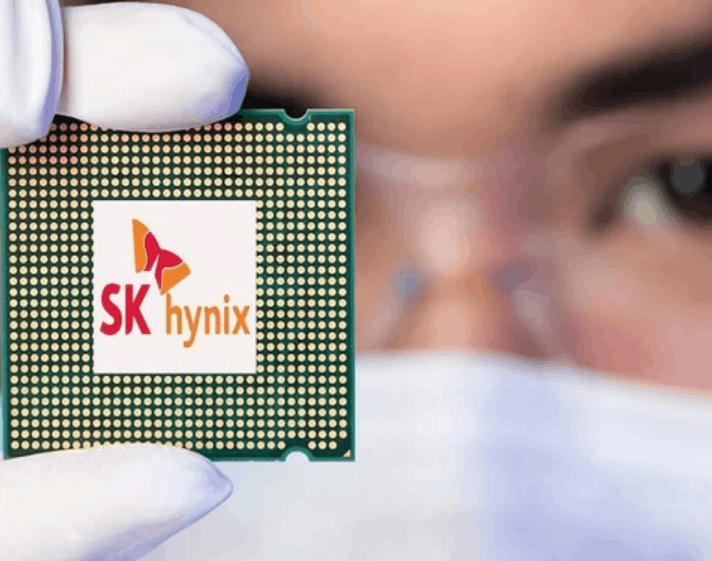
credit:Caixin Global
Electronic Technology | Semiconductors | HBM Memory | AI Infrastructure | Korea Discount
On July 10, 2026, SK Hynix walked onto the Nasdaq and made history twice in the same morning. The South Korean memory chip giant raised $26.5 billion — the largest U.S. listing ever completed by a foreign company, surpassing Alibaba’s 2014 record — and opened trading at $170, a 14% premium over its $149 ADR offer price. More than seven institutional buyers competed for every share available. The company that makes the memory chips inside every major AI accelerator on the planet had finally arrived on American markets.
This Is Not a Traditional IPO — It Is a Valuation Passport
The most important thing to understand about SK Hynix’s Nasdaq listing is what it is not. It is not a company going public for the first time. SK Hynix has traded on the Korea Exchange (KRX: 000660) since 1996 and is the second-largest company in South Korea by market capitalisation, trailing only Samsung. It has real revenue ($67 billion in FY2025), real earnings ($29.6 billion net income), and a real thirty-year operating history.
What changed on July 10 was access. For 14 years, the world’s leading supplier of high-bandwidth memory — the chip category that makes AI possible — was locked inside a Korean-language exchange that most global institutional capital could not easily reach. American fund managers who wanted HBM exposure had one liquid option: Micron Technology, the third-largest HBM player with roughly 20% market share. SK Hynix, the market leader with 56%, simply wasn’t accessible. As Dave Mazza, CEO of Roundhill Investments, put it to Reuters: “SK Hynix has been one of the most important companies in the world that most U.S. institutions could not easily own. The listing removes an accessibility discount, not a quality discount.”
HSBC analysts quantified this “Korea Discount” precisely: Micron has traded at an average 35% premium to SK Hynix over the past 13 years, driven entirely by easier U.S. investor access, not by any difference in business quality. The listing’s thesis, in one sentence, is that this premium should close — and the 14% first-day gain suggests the market agrees.
What SK Hynix Actually Makes: The Memory That Runs AI
SK Hynix produces three categories of memory products. DRAM (Dynamic Random Access Memory) is general-purpose server and consumer memory — the company’s largest category by volume. NAND Flash is storage memory used in SSDs and smartphones. And HBM — High Bandwidth Memory — is the product that defines the company’s current moment and explains why the market values it at over $1 trillion.
HBM is a fundamentally different kind of memory. Instead of lying flat on a circuit board like conventional DRAM, HBM stacks multiple DRAM chips vertically — like a multi-storey building — and connects them through microscopic silicon tubes called through-silicon vias (TSVs). The resulting structure sits directly on top of an AI accelerator chip, delivering 5–10 times more memory bandwidth than standard DRAM at a fraction of the energy consumption. Without HBM, Nvidia’s H100, H200, and Blackwell chips could not process AI training workloads at anything approaching their advertised speeds. Every major AI accelerator on the market — Nvidia, AMD MI300X, Google TPU v5p — requires HBM to function.
SK Hynix was not just first to produce HBM — it was first to mass-produce every generation. HBM2E, HBM3, HBM3E, and now HBM4, which is being shipped to Nvidia for the Vera Rubin platform. UBS estimates SK Hynix will supply approximately 70% of HBM4 for Vera Rubin. HBM3E stacks price at roughly $300 per stack; HBM4 at approximately $500 per stack — a premium that reflects the extreme manufacturing complexity and SK Hynix’s lead in production yields.
The Numbers: Software Margins on Semiconductor Revenue
SK Hynix’s Q1 2026 financial results are genuinely difficult to describe without superlatives. Revenue jumped 198% year-over-year to approximately $34.5 billion for a single quarter. The gross margin was 79.3%. The operating margin was 72%. Net income for the quarter alone was approximately $26.8 billion. These are not semiconductor company margins — they are software company margins applied to a business that makes physical chips at a scale that requires tens of billions of dollars in factory equipment.
For the full year 2025, SK Hynix reported $67 billion in revenue (up 47% from 2024) and $29.6 billion in net income — its first year ever of out-earning Samsung Electronics on an operating profit basis. Analysts project 2026 full-year revenue could reach $225–235 billion won (approximately $165–175 billion), depending on HBM pricing dynamics in H2. The company trades at approximately 5.8x forward earnings at the ADR offer price — a meaningful discount to Micron’s 7x forward multiple, reinforcing the Korea Discount thesis even at $149.
The margin story in one number: SK Hynix’s Q1 2026 operating margin of 72% is higher than Nvidia’s typical operating margins and rivals those of the best pure-software companies in the S&P 500. Applied to a company making physical silicon chips, it reflects the scarcity premium of being the world’s only mass-producer of leading-edge HBM at scale.
The Nasdaq Listing: Strategic Logic Beyond Capital Raising
SK Hynix did not need $26.5 billion in survival capital. The company generated more free cash flow in a single quarter than many tech companies do in a year. The Nasdaq listing was a strategic choice with four specific objectives.
First, index inclusion. The company specifically chose Nasdaq over NYSE to position itself for inclusion in the Nasdaq 100 Index at the December 2026 rebalancing. Passive funds tracking QQQ and related ETFs will mechanically buy SKHY if it qualifies — which requires a minimum of three months of U.S. trading history and meeting market cap and liquidity thresholds. December inclusion would trigger an estimated $3–5 billion in automatic passive buying from index funds that have no choice about the purchase.
Second, valuation repair. The Korea Discount cannot persist indefinitely when the stock is liquid on a U.S. exchange with full U.S. analyst coverage, U.S. dollar settlement, and U.S. governance transparency. As U.S. institutional ownership builds, the multiple gap versus Micron should narrow.
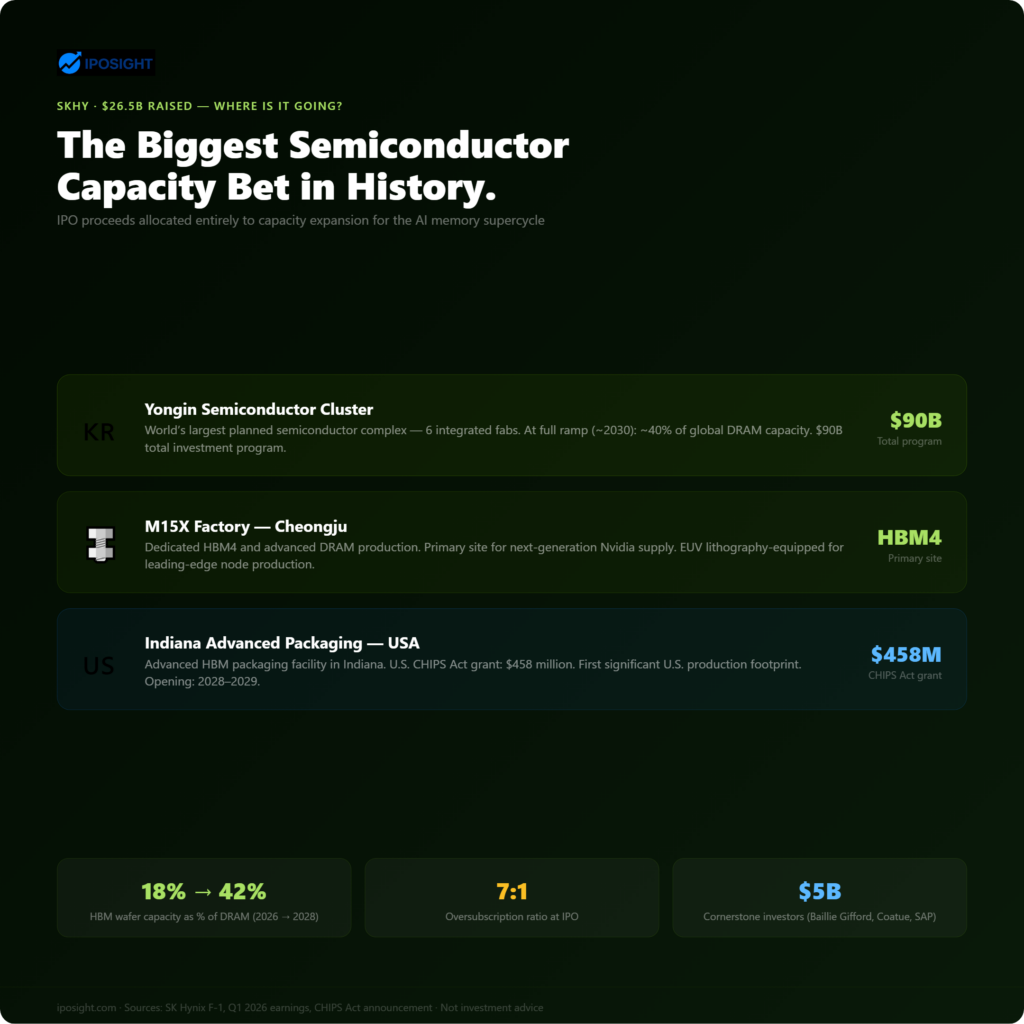
Third, capital deployment for the HBM supercycle. The $26.5 billion is being allocated to: the Yongin Semiconductor Cluster (the world’s largest planned semiconductor complex, with a $90 billion investment program); the M15X factory in Cheongju for HBM4 and advanced DRAM; and the Indiana packaging facility funded in part by the U.S. CHIPS Act’s $458 million grant. The capacity investment is specifically designed to maintain HBM leadership through the 2027–2029 cycle.
Fourth, Vera Rubin supply chain lock-in. The concurrent ramp of HBM4 production timed to Nvidia’s next platform launch is not accidental. By supplying 70% of HBM4 at Vera Rubin launch while competitors are still in qualification, SK Hynix embeds itself in Nvidia’s roadmap for the next 3–4 years of GPU generations.
The Competition: Samsung Is Closing, Micron Is Small
The HBM market has three players, and the distances between them are significant. SK Hynix holds 56.4% of global HBM revenue as of Q1 2026 (per IDC data cited in SK Hynix’s own SEC F-1 filing). Samsung and Micron each hold approximately 21% — Micron’s share being particularly surprising given that it was essentially a non-factor in HBM until 2025.
The competitive risk worth monitoring is Samsung. The world’s largest chipmaker announced in February 2026 that it had started shipping HBM4 chips to unnamed customers. Nvidia CEO Jensen Huang confirmed in June 2026 that SK Hynix, Samsung, and Micron have all passed HBM4 qualification for the Vera Rubin platform — meaning Samsung is no longer locked out of the most valuable HBM supply chain. Samsung’s HBM market share grew from near-zero in 2023 to 21% in Q1 2026, and with the vastly greater resources of the world’s largest semiconductor company behind it, further share gains are plausible by 2027.
Micron presents a different dynamic. At 21% HBM market share and with a $100+ billion market cap, Micron has been the de facto HBM proxy for U.S. investors for three years. SK Hynix’s Nasdaq listing directly threatens this status — not because Micron’s business changes, but because investors no longer need to own the #3 HBM player to access the category. The capital rotation risk from Micron to SKHY is the single most discussed near-term consequence of the listing among U.S. semiconductor analysts.
The ETF Picture: What Happens in December
SKHY begins trading on July 10 under the temporary ticker SKHYV, converting to SKHY on July 13. The ETF story has two phases.
Phase 1 (Now — December 2026): At least 10 fund managers including Direxion and ProShares have filed registrations to launch single-stock leveraged ETFs tracking SK Hynix, which will trade immediately. The iShares MSCI South Korea ETF (EWY) and similar Korea-focused funds already hold SK Hynix’s Korean shares — these positions are not directly comparable to SKHY ADRs but represent existing exposure. Baillie Gifford, Coatue Management, and Situational Awareness Partners collectively purchased approximately $5 billion in cornerstone allocations at the IPO price.
Phase 2 (December 2026 onwards): The Nasdaq 100 inclusion decision is the single most significant structural catalyst on the near-term horizon. If SKHY qualifies for the December rebalancing, passive funds tracking QQQ ($300B+ AUM), QQQM, and dozens of Nasdaq 100-linked ETFs would automatically receive SKHY allocations. This inflow, estimated at $3–5 billion based on the Nasdaq 100’s current market cap weighting mechanics, would be spread over the rebalancing period but would represent guaranteed institutional buying with no price sensitivity — the most valuable kind.
Bulls and Bears: The Case on Both Sides
The bull case rests on three pillars that are all structurally sound. First, HBM pricing power is unlikely to erode before 2027 at the earliest — SK Hynix’s order book is sold out through the end of 2026, and new HBM capacity takes 18–24 months to build and qualify. Second, the Korea Discount is real and measurable, and the Nasdaq listing is the specific mechanism to close it — even a partial convergence from 5.8x to 6.5x forward P/E represents significant price appreciation. Third, December Nasdaq 100 inclusion creates a guaranteed, price-insensitive buying event of $3–5 billion scale. The combination of operating momentum, valuation discount repair, and index inclusion creates multiple independent pathways to appreciation.
The bear case is equally serious and should not be dismissed. Memory cycles are violent — SK Hynix reported a ₩7.73 trillion operating loss in 2023, just two years before its record-breaking 2025. The same operating leverage that produces 72% margins in an upcycle works destructively in a downcycle. Any signal that AI capital spending is slowing — inventory builds at hyperscalers, lower-than-expected Vera Rubin demand, or a broader tech capex pause — would hit SK Hynix’s revenue with amplified force. Samsung’s HBM4 qualification means supply competition accelerates into 2027. And the ADR structure introduces governance concerns for some institutions — Kim Forrest of Bokeh Capital specifically cited ADR governance as a reason to pass on the offering. Currency risk (Korean won vs. U.S. dollar) adds volatility for ADR holders that does not exist for direct KRX share buyers.
Production Capacity: America and Global Context
In global context, SK Hynix is the world’s second-largest memory chip producer by revenue, trailing Samsung and ahead of Micron. It manufactures entirely in Asia — primary fabs in Icheon and Cheongju, South Korea, with volume NAND production in Wuxi and Dalian, China. The Indiana advanced packaging facility (opening 2028–2029) will be the company’s first significant U.S. production presence, enabled by the $458 million CHIPS Act grant.
The scale of the Yongin Semiconductor Cluster investment is difficult to overstate: a $90 billion program to build six semiconductor fabs adjacent to each other, creating the world’s largest integrated memory production site. At full ramp (approximately 2030), the cluster would produce approximately 40% of global DRAM capacity. This is not incremental capacity — it is an attempt to permanently cement SK Hynix’s position as the world’s dominant memory supplier for the AI era.
12-Month Price Scenario Analysis
Bull scenario (~35% probability): $190–$240 ADR. Nvidia Vera Rubin ramps on schedule, HBM4 pricing holds at $500+/stack, SK Hynix captures 65%+ of Vera Rubin supply. December Nasdaq 100 inclusion is confirmed, triggering $3–5B passive inflows. Korea Discount closes from 5.8x to 7x+ forward P/E. Operating margins remain above 65%.
Base scenario (~45% probability): $145–$190 ADR. The stock consolidates near IPO levels as the market waits for Q2 earnings (July 22 — the first major post-listing catalyst) and December index inclusion decision. HBM pricing faces modest pressure as Samsung ramps, but SK Hynix’s Q1 2026 performance has already demonstrated the revenue scale. The stock trades in a wide range with high beta (1.77).
Bear scenario (~20% probability): $90–$140 ADR. AI capex shows signs of moderation. Reports surface of hyperscaler inventory builds. Samsung gains HBM market share faster than expected. HBM pricing falls 20–30% from peak as supply catches up. The same scenario that triggered a 12%+ single-session decline on the Korean exchange in June 2026 (on Rubin output cut rumors) plays out with sustained pressure on U.S. shares. ADR premium to Korean shares compresses.
Critical near-term date: July 22, 2026 — Q2 2026 earnings report. Q1 was extraordinary (+198% revenue, 72% margins). Q2 needs to confirm the trajectory, especially in light of June 23’s single-day 12% decline on Rubin production cut rumours. This is the first post-listing earnings print and will set the tone for the stock’s credibility with U.S. investors.
Investment Evaluation
| Factor | Score |
| HBM Market Position | 10/10 |
| Revenue & Financial Strength | 9/10 |
| AI Sector Tailwinds | 10/10 |
| Valuation vs. Peers | 9/10 |
| Index Inclusion Catalyst | 8/10 |
| Cyclicality Risk | 5/10 |
| Customer Concentration | 5/10 |
| Samsung Competition | 5/10 |
| ADR Structure / Governance | 6/10 |
| Long-Term Growth Potential | 9/10 |
Overall Investment Score: 7.6 / 10 · Strong long-term hold. Best entry: near or below $149 IPO price. Watch Q2 earnings July 22 and December Nasdaq 100 inclusion decision.
Final Verdict
SK Hynix’s Nasdaq debut is not just a listing event — it is the moment that the world’s most important AI infrastructure company finally became accessible to the world’s largest pool of investment capital. The company that supplies the memory chips powering every major AI accelerator on the planet had been invisible to most U.S. institutional investors for 14 years. That invisibility ends today.
The fundamental case for SKHY is among the clearest in the AI investment landscape: genuine market leadership in an irreplaceable technology, operating margins that rival the best software companies, a product backlog that is sold out through the end of 2026, and a valuation that remains below its U.S. peer despite superior market position. The Korea Discount was real. The Nasdaq listing is the mechanism to close it. And the December Nasdaq 100 inclusion is the near-term catalyst that makes the timeline concrete.
The risks are equally real: memory cycles are violent, Samsung is qualified for HBM4, and Nvidia concentration cuts both ways. A stock with a 1.77 beta that fell 12% in a single session on a rumour in June is not a low-volatility investment. But at 5.8x forward P/E for the company that holds 56% of the world’s most strategic chip market, the risk/reward favours investors who can hold through the volatility.
For investors who entered at $149 and are watching the $170 open: the first-day premium reflects the pent-up demand of a U.S. market that has wanted this stock for years. The more interesting question is where it trades in December — after the first post-listing earnings print on July 22 and when the Nasdaq 100 inclusion decision becomes clear.
“SK Hynix has been the most important semiconductor company that American investors could not own. As of today, that changes. The Korea Discount is now the Korea Opportunity.”
Sources & References
[1] Yahoo Finance / Reuters — “SK Hynix Nasdaq debut: ADR opens at $170 after $26.5B offering” — finance.yahoo.com
[2] CNBC — “SK Hynix rises 13% in Nasdaq debut. Chairman tells CNBC ‘demand is enormous’” — cnbc.com
[3] Fast Company — “SK Hynix stock price soars as SKHYV Nasdaq trading begins” — fastcompany.com
[4] Fortune — “SK Hynix US stock listing, second largest US share sale” — fortune.com
[5] Stock Analysis — “SK Hynix (SKHY) Stock Price & Overview” — stockanalysis.com
[6] Seeking Alpha — “SK hynix Vs. Micron: The Nasdaq’s New Memory Stock Is The Better Buy” — seekingalpha.com
[7] Seeking Alpha — “SK Hynix: A Premier Asset Severely Discounted” — seekingalpha.com
[8] Silicon Analysts — “HBM Pricing & Market Share (2026)” — siliconanalysts.com
[9] SK Hynix — Q1 2026 Business Results — news.skhynix.com
[10] WEEX — “SK Hynix Nasdaq Listing 2026: What Investors Need to Know” — weex.com
[11] TradingView — NASDAQ: SKHY — tradingview.com
This article is produced by iposight.com based on publicly available information, live market data, SEC filings, and independent research as of July 10, 2026. For informational purposes only — not investment advice. All investments carry risk. Please consult a qualified financial advisor.