

Technology Services | Packaged Software | European Tech | Subscription SaaS | Constellation Model
When a Milan-based software company turns down a $2.5 billion acquisition offer, takes a decade to go public, and then lists at a $20 billion valuation — all while employing only ~700 people — Wall Street pays attention. Bending Spoons raised $1.68 billion on July 1, 2026, making it the largest Italian tech IPO in history and one of the most idiosyncratic software business models to reach the Nasdaq in years.
What Bending Spoons Actually Is
Founded in 2013 in Bologna by Luca Ferrari and co-founders with Bain & Company backgrounds, Bending Spoons is not a traditional software builder. It acquires digital businesses, executes deep operational transformations, and compounds the proceeds into the next acquisition — indefinitely. The portfolio includes Evernote (200M+ registered users, acquired 2022), Splice (music creation, acquired 2023), Remini (AI photo enhancement, one of the most downloaded apps globally in 2023), StreamYard (browser-based live streaming, acquired 2022), Issuu (digital publishing), and Noteflight (music notation). Before going public, the company reportedly turned down a $2.5 billion acquisition offer — signalling where management believes the long-term value trajectory goes.
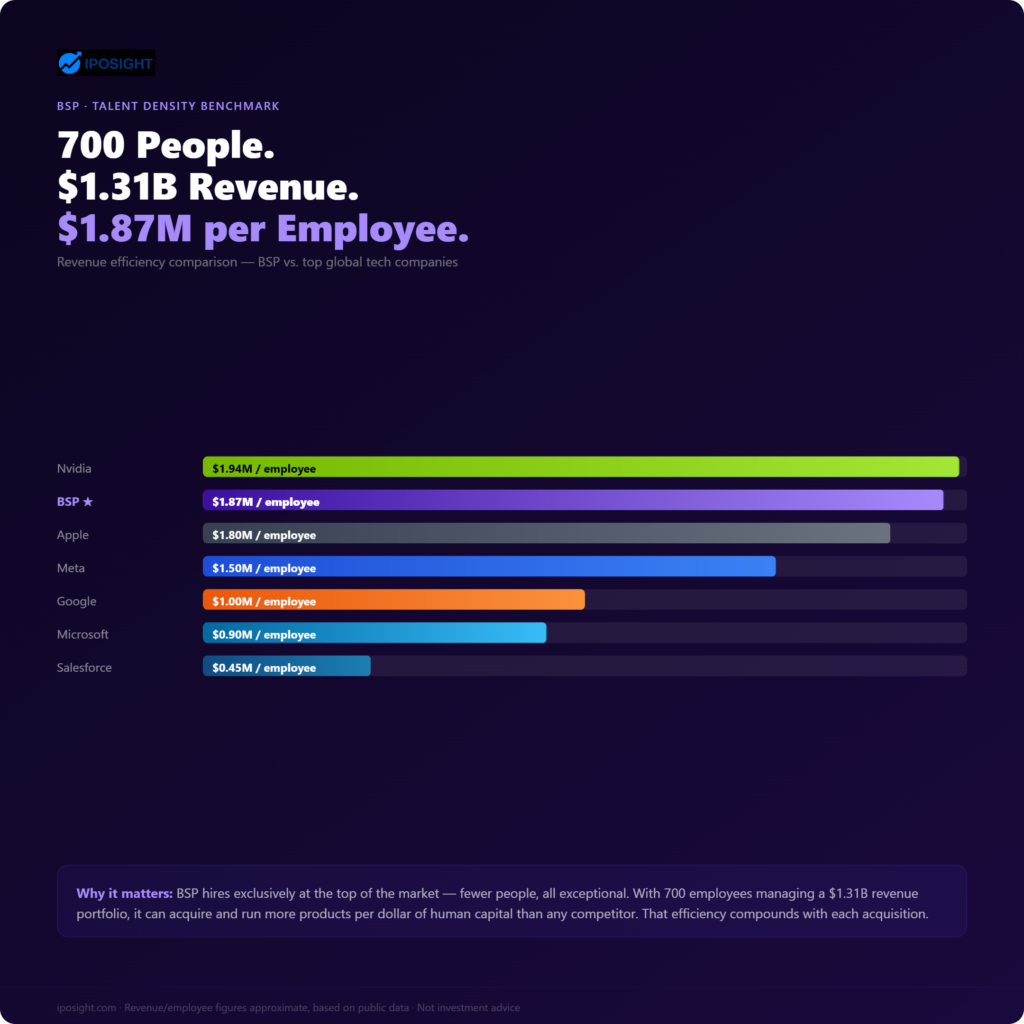
Three operating pillars define the model. First, talent density over headcount: ~700 employees managing $1.31 billion in annual revenue equals ~$1.87M revenue per employee — rivalling Nvidia and dwarfing most software companies. Second, transformation over preservation: when BSP acquires a product, it rebuilds it. Evernote’s 2022–2024 transformation involved eliminating most of the original engineering team, rewriting the architecture, and raising subscription prices aggressively. Third, compounding reinvestment: every available dollar of cash flow goes toward the next acquisition, mirroring the Constellation Software and Berkshire Hathaway playbooks.
Revenue: $1.31 Billion, 85% Subscription, Nearly Zero Net Income
BSP reported $1.31 billion in FY2025 revenue, growing explosively from near-zero through acquisition activity since 2020. Revenue composition: 85% recurring subscription software, 10% in-app purchases, 5% advertising. The net income figure — $−137,000 — is not a typo. A company generating $1.31 billion in high-margin subscription software produced essentially zero profit. This is deliberate: every available dollar is channelled into the next acquisition. It is the Constellation Software model exactly — maximise the acquisition pipeline, not reported earnings.
The $20.28 billion market cap implies ~15× revenue. Constellation Software trades at 10–12× today, but earned those multiples over decades of demonstrated execution. Tiny Ltd. trades at a meaningful discount. BSP is paying the premium of expectation — which requires delivery.
Revenue per employee benchmark: At $1.87M revenue/employee, Bending Spoons matches Nvidia and triples Salesforce. Talent density is not a marketing phrase here — it is the primary source of competitive advantage and measurably exceptional.
How Large Is the Market, Really?
BSP is not a vertical software company targeting one industry. It is a capital allocation strategy applied to the entire universe of underperforming digital software products. The global software market exceeds $650 billion annually and grows at ~11% per year. More specifically, Bending Spoons targets products with large user bases but inadequate monetisation — a segment representing tens of thousands of global assets. The strategic constraint is not market size. It is execution capacity and acquisition target availability at rational prices.
European Company on an American Exchange: Does It Matter?
BSP’s revenue is global and overwhelmingly generated through English-language app distribution. Its peers — Constellation Software is Canadian, SAP is German — suggest the market values software on software metrics regardless of domicile. Where European origin creates specific risk is regulatory: EU Digital Markets Act, GDPR, and consumer subscription regulations apply directly to BSP’s core business. The aggressive subscription management that works legally in the U.S. (reducing free tiers, raising prices, auto-renewal practices) faces stricter EU consumer protection scrutiny. The Evernote transformation generated significant user backlash and press coverage in European markets.
U.S. investor interest in BSP is structured around a specific narrative: a European company that operates like the best U.S. software compounders. The $1.68 billion raised confirms meaningful institutional demand, though the absence of a named cornerstone investor — unlike SKHY, DPC, or PBLS — suggests broad book-building rather than anchor commitments.
The Real Competitive Landscape
At the acquisition level, competition for software assets comes from Vista Equity Partners, Thoma Bravo (PE firms), Constellation Software subsidiaries, and increasingly AppLovin — which built a parallel model through mobile app acquisition and ad-tech optimisation. Rising PE interest in software assets compresses the price advantage that underpins BSP’s model. At the product level, each portfolio company faces its own competitive set: Evernote vs. Notion and Apple Notes; Splice vs. BandLab and Soundtrap; StreamYard vs. Streamlabs; Remini vs. Lensa and Google Photos AI. BSP’s strategy in each case is not to out-innovate these rivals — it is to monetise the existing user base more effectively.
The most instructive peer is Constellation Software (CSU.TO): from C$1/share at its 2006 IPO to C$4,000+ today — a 400× return — through exactly this model. Tiny Ltd. (TINY) is the closest publicly-traded equivalent at earlier stage. Neither is a perfect comparable (Constellation targets vertical market enterprise software; BSP targets consumer and creator tools), but the capital allocation philosophy is identical.
ETF Exposure: Institutional Conviction at Launch
The most significant ETF signal is TCAF (T. Rowe Price Capital Appreciation Equity ETF) at 0.6% of $8.01 billion AUM. TCAF is managed by David Giroux — one of the most respected fundamental long-term investors in the U.S. market. A 0.6% allocation to a newly-public Italian software company is a deliberate, high-conviction statement. CGGR (Capital Group Growth, $24.92B AUM) at 0.2% and CGXU (Capital Group International Focus, $6.28B AUM) at 0.33% suggest Capital Group has built a cross-fund position across both growth and international mandates. These are active fundamental investors, not passive index buyers.
Bulls and Bears
The bull case is the Constellation Software analogy. If BSP sustains its acquisition pace and transformation quality over 10–15 years, the compounding arithmetic becomes extraordinary. The talent density model reduces human capital risk. The subscription revenue base funds the acquisition pipeline. Breaking even at $1.31 billion in revenue while deploying every dollar into growth is precisely the profile of a long-term compounder at work.
The bear case is equally structured. At 15× revenue, BSP prices in years of successful execution not yet demonstrated in public markets. The Evernote transformation — the most visible case study — generated user churn and reputational damage. Running six to eight distinct product portfolios simultaneously, each with its own architecture and user community, creates integration risk that compounds with each acquisition. And at ~$−137K net income, the stock has no earnings floor — in a risk-off environment, it is entirely a story stock with no valuation anchor except revenue multiples that can compress rapidly.
12-Month Price Scenario Analysis
Bull scenario (~30% probability): $40–$55. One or two significant new acquisitions announced in H2 2026. First post-IPO financial disclosure shows 20%+ revenue growth. U.S. institutions begin building positions. T. Rowe Price’s endorsement attracts fundamental investors. Re-rates from 15× to 18–20× revenue.
Base scenario (~50% probability): $25–$40. BSP consolidates near IPO price. No major new acquisitions in first 90 days. First financial disclosure confirms near-breakeven model intact but provides limited upside catalysts. U.S. investor education on the Constellation model takes time. Lock-up expiration (~late December 2026) creates temporary supply pressure.
Bear scenario (~20% probability): $15–$27. Evernote user backlash escalates into broader press. A potential acquisition is announced at a price the market deems excessive. Zero net income makes the stock impossible to defend in a risk-off environment. At $15–$20, BSP would trade at 7–9× revenue — closer to Tiny Ltd.’s multiple, reflecting risk that the Constellation analogy takes longer to validate.
Key catalyst dates: First post-IPO financial results (Q3 2026 — September/October) · Lock-up expiration (~December 2026) · Any new acquisition announcement · EU regulatory developments on subscription software
Investment Evaluation
| Factor | Score |
| Business Model Elegance | 9/10 |
| Talent Density & Execution | 9/10 |
| Revenue Quality | 8/10 |
| Market Opportunity | 8/10 |
| Institutional Validation | 8/10 |
| Current Profitability | 5/10 |
| Valuation vs. Stage | 5/10 |
| Acquisition & Integration Risk | 5/10 |
| European Regulatory Exposure | 4/10 |
| Long-Term Compounding Potential | 9/10 |
Overall Investment Score: 7.0 / 10 · High-conviction long-term hold for patient investors. Not suitable for short-term traders. The Constellation Software analogy is the entire thesis — and it either delivers over decades or it doesn’t.
Final Verdict
Bending Spoons is the most intellectually interesting software IPO of 2026. Not because the business is complex — it isn’t. But because the simplicity of the model is so rarely executed well. Acquire undervalued software. Transform it through operational excellence and talent density. Generate cash. Buy more. Repeat. Constellation Software turned this formula into a 400× return over 20 years. Bending Spoons is now making the bet at European scale, with a CEO who turned down $2.5 billion rather than sell early, and a T. Rowe Price fund manager who built a 0.6% position in the week of listing.
The $20 billion market cap reflects market belief that the bet is credible. What comes next is the patient work of acquiring the next Evernote, transforming the next Splice, and compounding the next dollar of free cash flow — year after year, without the drama that most tech companies require to stay interesting. For investors who can hold 3–5 years and believe the Constellation model works in the hands of 700 exceptional Italians, BSP at $29 is a buy. For everyone else, the December lock-up may offer a better entry. The business will still be there.
“Bending Spoons doesn’t build apps. It buys apps that people already love, makes them dramatically more profitable, and uses those profits to buy more apps. That sentence has described one of the greatest software companies of the past two decades. Now it describes a startup from Milan that just listed on the Nasdaq.”
Sources & References
[1] Bending Spoons — Official Website — bendingspoons.com
[2] Bending Spoons — Investor Relations — investors.bendingspoons.com
[3] TradingView — NASDAQ: BSP — tradingview.com
[4] BSP PDF Analysis — Stock Analysis Tool, July 14, 2026
[5] Seeking Alpha — Geneva Investor, July 8, 2026 · Daniel Jones, July 2, 2026
[6] SEC Filing — BSP F-1 / Prospectus — sec.gov
[7] Constellation Software — Annual Reports 2006–2024 (comparative reference)
[8] Tiny Ltd. (TINY) — public filings (comparative reference)
This article is produced by iposight.com based on publicly available information, official company materials, SEC filings, and independent industry research available at the time of writing. It is for informational purposes only and does not constitute personalised investment advice. All investments carry risk. Please consult a qualified financial advisor before making investment decisions.