
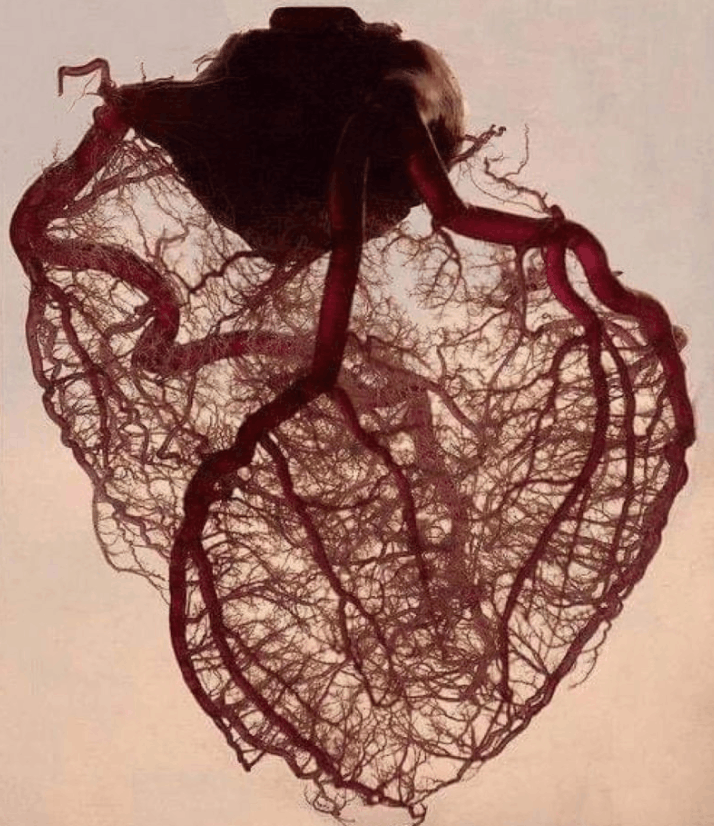
Clinical-Stage Biopharmaceuticals | Cardiovascular | HCM | Forbion
Braveheart Bio raised $439.9 million in one of the largest biotech IPOs of 2026, priced at $18 and surging to nearly $30 on its first day of trading. Four analyst firms cover the stock with Buy ratings and a uniform $48 target price, implying +127% upside. The Phase 3 LIONHEART-HCM trial in obstructive HCM has already been initiated, with interim data expected in the second half of 2027. Andreessen Horowitz, OrbiMed, and Forbion are among the backers. The company cannot go bankrupt for at least three years. The question is whether $21 is the entry point or simply the midpoint of a longer slide before the Phase 3 catalyst arrives.
The Company & What BHB-1893 Is Designed to Do
Braveheart Bio was founded in 2024 in San Francisco, California, and licensed BHB-1893 from Jiangsu Hengrui Pharmaceuticals — China’s largest pharmaceutical company by revenue — through an exclusive global (ex-China) license agreement. This is a critical detail: Hengrui has been developing BHB-1893 in China for several years, generating a substantial body of Phase 1, Phase 2, and now Phase 3 clinical data that Braveheart acquired the rights to build on. This de-risks the platform considerably compared to a purely discovery-stage company.
BHB-1893 is a next-generation oral small-molecule cardiac myosin inhibitor (CMI) designed to treat both obstructive HCM (oHCM) and non-obstructive HCM (nHCM). What makes it different from the existing approved drugs is a specific design philosophy: rapid onset of action, low LVEF (left ventricular ejection fraction) cost, predictable pharmacokinetics with limited drug-drug interactions, and simplified titration. These are not marketing claims — they reflect real limitations of the two currently marketed CMIs that Braveheart is explicitly targeting.
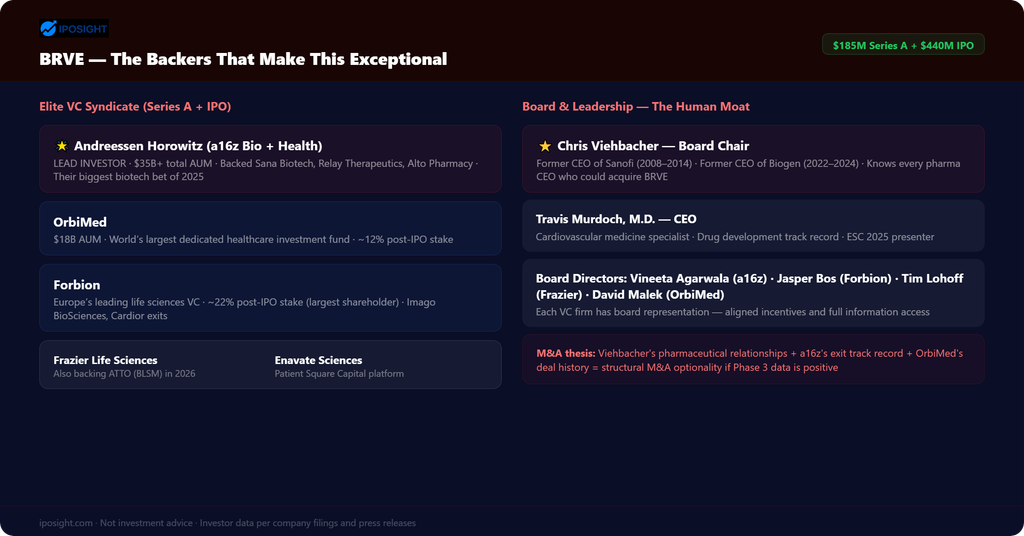
Leadership, Ownership & The Backers Who Matter
CEO Travis Murdoch, M.D. is a cardiovascular medicine specialist with deep experience in drug development. The leadership team includes Chief Development Officer Michele Anderson, Chief Scientific Officer Marc Evanchik, and Chief Medical Officer Emil deGoma, M.D. — a team with combined decades of cardiovascular drug development experience from prior companies including Correvio, Cardurion, and others.
The board is chaired by Chris Viehbacher, the former CEO of Sanofi and most recently CEO of Biogen (2022–2024) — one of the most experienced executives in the pharmaceutical industry. His presence signals institutional credibility at the governance level that goes well beyond typical clinical-stage companies.
The investor syndicate is genuinely elite. Andreessen Horowitz Bio + Health (a16z) — the venture arm that backed Sana Biotechnology, Relay Therapeutics, and dozens of other high-conviction bets — led the $185M Series A. Forbion (Europe’s leading life science venture firm, backers of Imago BioSciences, Cardior Pharmaceuticals) and OrbiMed (one of the world’s largest dedicated healthcare investment funds, $18B AUM) co-led. Frazier Life Sciences (also behind ATTO discussed recently on this site) and Enavate Sciences (Patient Square Capital) round out the syndicate. This is not retail money or momentum capital — these investors do extensive diligence before writing nine-figure checks into clinical-stage cardiology companies.
Why Did the Stock Fall from $30 to $20?
The all-time high of approximately $29.70 was hit on the first day of trading, August 6, 2026. The stock has since declined to $20 — a 32% decline from peak without a single negative clinical development. Four mechanical forces are responsible.
First, IPO-day premium compression. BRVE surged 65% on its first day, pricing the stock at a significant premium to its $18 IPO price. Such premiums are mathematically unstable and typically compress over the weeks following listing as short-term IPO investors sell their allocations. Second, the absence of clinical catalysts. The LIONHEART-HCM Phase 3 trial was initiated in Q3 2026, but interim data is not expected until the second half of 2027. There is a 12-month catalyst desert that naturally suppresses pre-revenue biotech valuations. Third, sector-wide small-cap biotech pressure from the XBI ETF and broader risk-off sentiment has weighed on the entire 2026 IPO class. Fourth, lock-up overhang: pre-IPO holders (a16z, Forbion, OrbiMed, Frazier) are subject to typical 180-day lock-up restrictions from the August 6, 2026 IPO date, meaning expiry around early February 2027 — and the anticipation of potential selling suppresses stocks before the actual date.
None of these factors represent any deterioration in the clinical program, the cash position, or the competitive landscape.
The Disease: Why HCM Is a Blockbuster-Scale Opportunity
Hypertrophic cardiomyopathy is among the most common rare diseases globally, affecting approximately 1 in 500 individuals in the United States — roughly 700,000 Americans. HCM occurs when the heart muscle abnormally thickens, making it harder for the heart to pump blood effectively. In the obstructive form (approximately two-thirds of patients), this thickened muscle impedes blood flow out of the left ventricle. Symptoms include shortness of breath, chest pain, fatigue, fainting, and in severe cases, sudden cardiac death — HCM is one of the leading causes of cardiac sudden death in athletes and young adults.
The commercial scale of this market has been validated by the existing drugs. Bristol Myers Squibb’s Camzyos (mavacamten) — the first approved CMI in 2022 — generated $729 million in H1 2026 alone (a 74% year-over-year increase). Cytokinetics’ Myqorzo (aficamten), FDA-approved in December 2025, is building commercial momentum as the second entrant. Analysts have projected aficamten could reach $3.6 billion in annual sales by 2032. The oHCM marketed drug market currently sits at approximately $593 million in 2026, growing toward $683 million by 2030 — but these numbers dramatically understate the peak potential of a third-generation CMI if nHCM is also addressed, as BHB-1893 explicitly targets both forms.
The nHCM opportunity is where BHB-1893’s biggest differentiation lies. Non-obstructive HCM has no approved targeted therapy today. Mavacamten failed its Phase 3 nHCM trial. Aficamten met its nHCM Phase 3 endpoints and has submitted for FDA approval (sNDA expected 2026). If BHB-1893 succeeds in nHCM via NOBLEHEART-HCM, it would be the second approved option in a market currently served by zero CMIs specifically approved for this indication.
The Clinical Data: What We Know About BHB-1893
Hengrui has conducted extensive trials in China, giving Braveheart an unusually rich pre-IPO clinical dataset. In Phase 2 oHCM results announced in March 2026, BHB-1893 demonstrated rapid and meaningful reductions in LVOT gradient — the key efficacy measure in obstructive HCM. Critically, these reductions came with a low LVEF cost: where mavacamten typically produces LVEF reductions requiring dose interruption in 10–21% of patients (hence its black-box warning and REMS program), BHB-1893’s Phase 2 data showed no patients requiring trial drug interruption for LVEF reductions.
In Phase 2 nHCM results announced in May 2026 (presented at the Heart Failure Association of the ESC annual meeting), BHB-1893-treated patients showed statistically significant, dose-dependent improvements in myocardial relaxation, hemodynamic benefit, and cardiac remodeling compared to placebo. Cardiac biomarkers showed rapid, substantial, statistically significant reductions. Patients’ functional status and exercise capacity were higher at trial end compared to baseline. The drug’s pharmacokinetic profile — rapid onset, predictable half-life, limited drug-drug interactions — supports a simpler dosing approach than the current REMS-burdened alternatives.
More than 250 clinical study participants have received BHB-1893 to date across all trials, building a meaningful safety database. The Phase 3 program initiated in 2026 now seeks to confirm these Phase 2 signals in a larger, global, rigorous setting.
Real Competitive Landscape: Three CMIs, Different Safety Profiles
Bristol Myers Squibb / Camzyos (mavacamten) is the market creator and current revenue leader, generating $729M in H1 2026. It is approved in over 60 countries and has established deep physician relationships. However, its black-box warning for LVEF reduction and mandatory REMS program requiring echocardiogram monitoring every 4–12 weeks creates substantial administrative burden for prescribers. Mavacamten also failed its Phase 3 nHCM trial, limiting it to oHCM. Cytokinetics / Myqorzo (aficamten), FDA-approved in December 2025, is the second entrant and direct BMS competitor in oHCM. It has a cleaner safety profile than mavacamten (10% vs 21% LVEF reduction rates) and is pursuing nHCM approval through a supplemental NDA expected in Q4 2026. Aficamten is Braveheart’s most dangerous near-term competitor as it is already commercially launched and building physician market share. BHB-1893’s differentiation thesis rests on three claims that Phase 2 data support but Phase 3 must confirm: an even lower LVEF cost than aficamten (potentially REMS-free), a simpler titration approach requiring less monitoring, and efficacy in both oHCM and nHCM from a single drug. If BHB-1893 can achieve REMS-free status, it would be a transformational commercial advantage — primary care cardiologists (not just HCM specialists) could prescribe it without complex monitoring infrastructure.
ETF Coverage
The ETF data in the PDF is credible and notable. FMED (Fidelity Disruptive Medicine ETF) at 0.54% and $51.19M AUM is the standout: this is a thematic fund specifically built around medicine-disrupting innovations, and its inclusion of BRVE reflects a deliberate active investment decision rather than passive index mechanics. TMED (T. Rowe Price Health Care ETF) at 0.24% and $32.47M AUM adds institutional quality. FFSM (Fidelity Fundamental Small-Mid Cap ETF) at 0.03% provides small-cap index exposure. ONEQ (Fidelity Nasdaq Composite Index, 0%) will increase as Braveheart’s market cap grows with positive trial results. The Fidelity-heavy ETF positioning is significant: Fidelity is one of the most sophisticated healthcare investment platforms in the world. Having two Fidelity-managed funds hold BRVE in its first weeks of trading signals institutional conviction that goes beyond passive inclusion.
Can BRVE Go Bankrupt? Is This a Safe Investment?
Bankruptcy risk: effectively zero for 3+ years. The IPO raised $439.9M gross ($404.5M net). Combined with pre-IPO cash of $122.8M (as of June 30, 2026), total adjusted cash post-IPO is approximately $527.3 million. Q2 2026 quarterly cash burn was approximately $16M ($11.1M R&D + $4.8M G&A). At this burn rate, the cash runway extends into 2029 — company guidance confirms this. The Phase 3 program (LIONHEART-HCM + NOBLEHEART-HCM) is entirely funded from existing capital. No emergency financing is needed. Frazier Life Sciences, OrbiMed, and a16z do not allow their portfolio companies to run out of capital at this stage.
Whether BRVE is a safe investment is a different question. The clinical risk is binary: a Phase 3 failure would severely damage the stock. The lock-up expiry (~February 2027) could create a temporary sell-off. The competitive landscape is intensifying with aficamten’s commercial launch. And the 12-month wait for interim Phase 3 data is a real patience test. These are genuine risks that must be sized accordingly.
Is BRVE a Good Investment at $20?
The $48 analyst consensus target implies a +127% return to a level that would still value Braveheart at roughly $4.3 billion — a fraction of what a successful HCM drug platform could be worth at peak sales.
The risk/reward is compelling for investors with a 2–3 year horizon and tolerance for binary clinical outcomes. The bull case is not speculative: two positive Phase 2 readouts (oHCM March 2026, nHCM May 2026), an elite investor syndicate, $527M in cash, and a Phase 3 already enrolling patients. The question is not whether the drug works in Phase 2 — it clearly does — but whether Phase 3 confirms the safety and efficacy signals in a larger global population.
The honest bear case is that aficamten is already on the market with a head start of 2+ years, has a clean safety profile, and will have built strong physician relationships and REMS-free prescribing patterns well before BHB-1893 could receive approval (earliest 2028–2029). Coming third into a market where the second entrant is already differentiating on the same safety story requires BHB-1893 to deliver genuinely superior Phase 3 data, not just comparable data.
Best entry level: $18–$22. This is a 2–3 year holding thesis. Maximum portfolio allocation: 1–2%.
Is Multi-Year Appreciation Sustainable?
The five-year pathway: Phase 3 data interim (2H 2027) → full Phase 3 readout (2028–2029) → NDA submission → FDA approval (earliest 2029–2030) → commercial launch. If approved as the third CMI but first REMS-free CMI in oHCM, and the first or second in nHCM, the revenue potential is enormous. The Camzyos/Myqorzo duopoly suggests a third drug capturing even 20–30% of a growing market could generate $500M–$1.5B in peak annual sales. At typical biotech revenue multiples, that would support a market cap of $5–$15B — implying multiples of the current $1.9B valuation.
There is also a structural M&A argument. Chris Viehbacher as Board Chair — the former Sanofi and Biogen CEO, with relationships across the entire global pharma landscape — is not a coincidence. Bristol Myers Squibb, Novartis, AstraZeneca, Roche, or Bayer could acquire Braveheart after positive Phase 3 data at a premium of 50–150% over market price. The HCM franchise validation is complete; the question is which large pharma wants to own the next-generation CMI rather than defend against it.
Investment Evaluation
| Factor | Score |
| Investor Syndicate Quality | 10/10 |
| Cash Runway & No Bankruptcy Risk | 10/10 |
| Phase 2 Clinical Data Package | 9/10 |
| Market Opportunity (oHCM + nHCM) | 9/10 |
| Governance & Leadership | 9/10 |
| BHB-1893 Differentiation (Safety Profile) | 8/10 |
| Phase 3 Competition Risk | 6/10 |
| Phase 3 Interim Data Timeline (2H 2027) | 5/10 |
| ETF Institutional Support | 6/10 |
Overall Investment Score: 8 / 9 · Elite VC backing, best-in-class safety data, Phase 3 fully funded, no bankruptcy risk. Entry at $18–$22 is compelling for 2–3 year horizon. Binary Phase 3 risk requires 1–2% max portfolio. Best catalyst: LIONHEART-HCM interim data 2H 2027.
12-Month Price Scenario Analysis
Bull scenario (~40% probability): $38–$55. LIONHEART-HCM enrollment proceeds on schedule with first patient dosed Q4 2026. NOBLEHEART-HCM Phase 3 initiates 1H 2027 as guided. Analyst coverage expands to 6–8 firms post-lock-up expiry. A major pharma company (BMS, Novartis, AstraZeneca) discloses informal acquisition interest or Braveheart announces a licensing/co-development partnership. Lock-up expiry passes without significant selling pressure as VCs demonstrate long-term commitment. The stock re-rates from $21 toward the $48 analyst consensus as the catalyst calendar becomes clearer.
Base scenario (~40% probability): $18–$30. The stock remains range-bound through 2027 H1 as investors wait for Phase 3 interim data. Lock-up expiry (February 2027) creates a temporary selloff to the $18–$20 range, absorbed by new institutional buyers at or below IPO price. The company continues operational execution — patient enrollment, site activation, conference presentations — without triggering strong directional moves. The interim data event in 2H 2027 becomes the next major inflection point.
Bear scenario (~20% probability): $10–$18. Enrollment in LIONHEART-HCM is slower than anticipated, delaying the 2H 2027 interim timeline. Aficamten’s real-world commercial data shows stronger-than-expected physician penetration, reducing the perceived differentiation opportunity for BHB-1893. Lock-up selling is heavier than expected, pushing the stock toward or below IPO price. A broader biotech/pharma market correction compounds the sector pressure. The stock approaches the IPO floor of $18 and potentially breaks below it toward the $10–$15 range where cash-per-share dynamics begin to provide a floor.
Key upcoming catalysts: First patient dosed in LIONHEART-HCM (Q4 2026 target) · NOBLEHEART-HCM Phase 3 initiation (1H 2027) · Lock-up expiry ~February 2027 · Conference presentations Q4 2026 – Q1 2027 · LIONHEART-HCM interim analysis (2H 2027) · Potential pharma partnership announcement · FDA aficamten nHCM sNDA decision Q4 2026 (competitive signpost)
Final Verdict
Braveheart Bio is the most compelling cardiovascular biotech in the 2026 IPO class. The backing of a16z Bio + Health, OrbiMed, and Forbion — three of the most rigorous due-diligence-driven life science investors in the world — signals a level of institutional conviction that is not present in most pre-revenue biotechs. The Phase 2 data is genuinely impressive: two separate positive readouts in 2026, zero LVEF interruptions, statistically significant improvements across multiple endpoints in both oHCM and nHCM. The $527M cash runway eliminates near-term financing risk entirely.
At $20 — essentially between the IPO price and the analyst consensus — the stock offers what appears to be a reasonable risk/reward for investors who believe: (1) the Phase 2 safety signal is real and will hold in Phase 3; (2) BHB-1893’s simplified titration without REMS will create meaningful commercial differentiation from the existing drugs; and (3) the HCM market is large enough to support three competing CMIs commercially.
The bear case — that aficamten will have captured physician mindshare by the time BHB-1893 reaches the market — is real but not fatal. The HCM market is growing rapidly as diagnosis rates improve with genetic testing and wearables. There is room for multiple successful CMIs, particularly if one covers nHCM better than the others. And the M&A ceiling, with Chris Viehbacher connecting to every major pharma CEO, provides a potential exit path that does not require full commercial buildout.
“Hypertrophic cardiomyopathy has been the most commercially underserved common heart disease in medicine for decades. Two drugs have changed that, and both are generating blockbuster revenue. If BHB-1893 delivers its Phase 3 safety promise, it will be the first drug cardiologists can prescribe to HCM patients without a monitoring program. That is not an incremental improvement. That is a market transformation.”
Sources & References
[1] Braveheart Bio — braveheart.bio · IR: ir.braveheart.bio
[2] Braveheart Bio Q2 2026 Financial Results — September 8, 2026 — ir.braveheart.bio
[3] SEC EDGAR — BRVE Form S-1, S-1/A, 424B4 — sec.gov
[4] MedCity News — Braveheart Bio $185M Series A, November 2025
[5] Bristol Myers Squibb — Camzyos H1 2026 sales data ($729M, +74% YoY)
[6] Cytokinetics / Myqorzo (aficamten) — FDA approval December 2025, $3.6B peak sales projection
[7] Andreessen Horowitz a16z Bio + Health — Series A lead investor announcement
[8] Renaissance Capital — BRVE IPO performance (+65.6% first day)
[9] IMARC / Kavout — HCM market size projections 2026–2036
[10] BRVE PDF Analysis — Stock Analysis Tool, October 5, 2026
[11] TradingView — NASDAQ: BRVE — tradingview.com
iposight.com — for informational purposes only, not investment advice. Clinical-stage biotechs carry extreme risk including total loss of capital.
Discover more from IPOSight
Subscribe to get the latest posts sent to your email.