
Nuclear Energy / SMR /AI Infrastructure / Pre-Revenue
Deep Fission went public on June 18, 2026 — but the road to listing was bumpier than the company let on. It originally planned to raise $157 million at $24–$26 per share, implying a $1.66 billion valuation. It ended up raising $40 million at $16. That’s not a rounding error. It is the first thing every investor needs to understand before looking at anything else.
What Is Deep Fission Actually Building?
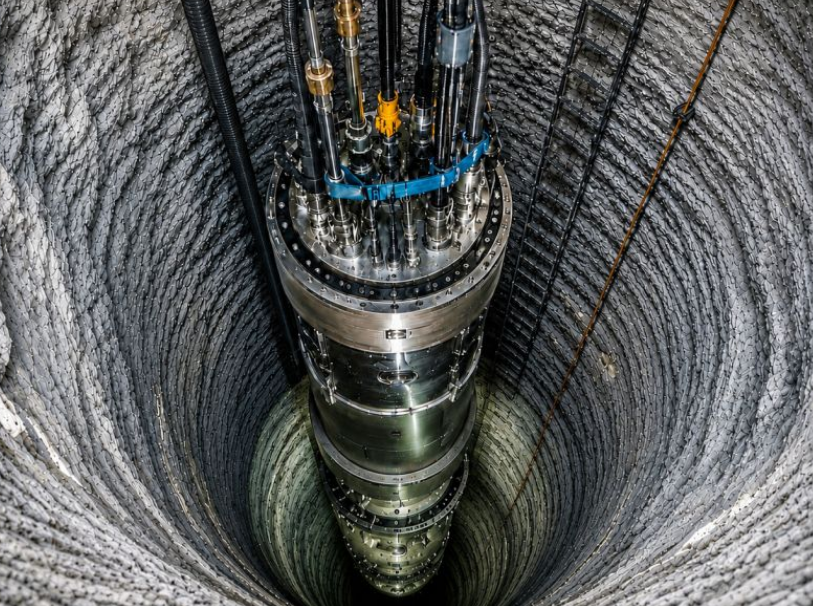
The idea is genuinely bold. Deep Fission is developing the Gravity Nuclear Reactor™ — a small modular pressurized water reactor that sits not in a concrete dome above the ground, but in a vertical borehole drilled roughly one mile (1,600 metres) straight down. The concept combines three mature, proven technologies: pressurized water reactor (PWR) technology that has powered commercial nuclear plants for 60 years; deep borehole drilling methods taken from the oil and gas industry; and geothermal-style heat transfer to bring the energy to the surface.
The underground placement is not just a novelty. It solves several of the most expensive problems in conventional nuclear construction: the hydrostatic pressure of a mile-high water column naturally provides the 160 atmospheres the reactor needs, eliminating the giant pressure vessels and containment domes that dominate surface plant costs. The geological isolation provides inherent shielding and safety. And because each unit is modular — 15 MWe per borehole reactor — the company can scale from a single reactor for a military base to 100 reactors at a hyperscale data center campus, simply by drilling more boreholes.
The founders are father-daughter pair Richard A. Muller — Professor of Physics emeritus at UC Berkeley, holder of 80+ patents, former CTO of nuclear waste company Deep Isolation — and Elizabeth Muller, who serves as CEO and previously led Deep Isolation herself. The operational leadership team is strong: the COO is a former NuScale Power senior leader and U.S. Navy nuclear operator; the Chief Nuclear Officer previously ran reactor engineering at Kairos Power and Fluor.
The IPO Downsize: What Really Happened
The story of this IPO is as instructive as the company itself. In May 2026, Deep Fission launched with genuine ambition — 6 million shares at $24–$26, implying a $1.66 billion valuation and $157 million in proceeds. Auditors had already flagged a going-concern warning: the company might run out of cash within 12 months. The S-1 also quietly dropped a previously communicated July 2026 reactor criticality target without offering a replacement date.
By June 17, the offering had been dramatically restructured: 2.5 million shares at $16, raising only $40 million. The shares offered were cut by more than half, the price was slashed 38% below the bottom of the range, and total proceeds fell 75% from the original plan. This is not a market that was lukewarm on the idea — it was a market that said “not at that price, not at this stage.”
⚠ Going-concern risk: Auditors warned in the S-1 that Deep Fission may exhaust its cash within 12 months. The $40M raised provides some runway, but the company’s annual operating loss is already $61M. Without further financing — debt, grants, or a follow-on offering — the cash question becomes existential by mid-2027.
Where Is the Money Coming From — and Going To?
Revenue is zero. Deep Fission is a pre-commercial development company, and it will remain one for years. The $40 million in IPO proceeds, combined with $80 million raised in February 2026, funds the critical next phase: completing the pilot borehole in Parsons, Kansas; advancing reactor canister engineering; and pursuing Nuclear Regulatory Commission licensing. The company also signed a uranium fuel deal with Urenco USA for approximately $9.2 million — a tangible supply chain commitment, though the reactor that would use it doesn’t exist yet.
The DOE’s Reactor Pilot Program selection is the most credible external validation Deep Fission has received. The Department of Energy chose Deep Fission as one of a small group of companies to receive federal support in accelerating non-light-water and advanced reactor designs toward criticality. That selection carries real scientific credibility — the DOE does not fund technologies it considers implausible. However, the program’s original July 2026 criticality target has passed without Deep Fission achieving it, and the company has provided no revised timeline.
Who Will Actually Buy This Power — and When?
This is the most important question the company faces, and the answer determines whether FISN is a viable long-term investment or a fascinating experiment that runs out of money first. Deep Fission has signed non-binding Letters of Intent totalling a 15 GW pipeline — sites across Kansas, Texas, Utah, and internationally. Those LOIs are not contracts, not revenue, and not commitments. They are expressions of interest from parties who want to keep a seat at the table if the technology proves out.
The most credible near-term customers are hyperscale data center operators. The AI infrastructure buildout has created a power demand crisis that no single technology can solve — and the energy industry’s dirty secret is that solar and wind cannot reliably power a 24/7 compute campus. The Gravity Reactor’s ability to deliver firm, carbon-free baseload power from a minimal surface footprint — with 100 reactors delivering 1.5 GW from a single site — is a genuinely compelling proposition for Microsoft, Amazon, Google, and their data center landlords. Deep Fission has an MOU with Blue Owl Digital Infrastructure Advisors (the data center financing arm of $235B AUM alternative manager Blue Owl Capital) and a strategic term sheet with Endeavour Energy. Neither is a committed purchase order.
Beyond data centers: industrial and commercial operators needing baseload power off-grid or in areas with grid congestion are a natural market. The U.S. military — through DARPA, the Army, and the Air Force — has long sought deployable nuclear power for remote bases; Deep Fission’s small, borehole-contained design is explicitly positioned for this. And utilities facing coal plant retirements and renewable integration challenges represent a long-term market if the economics prove out at scale.
The realistic commercial timeline: a working pilot reactor at Parsons in 2027–2028 (company’s stated target), followed by NRC licensing, followed by first commercial deployment — which industry observers broadly estimate at 2029–2031 at the earliest for a first-of-a-kind design. The first meaningful revenue is probably 4–5 years away under an optimistic scenario.

The Real Competitive Landscape
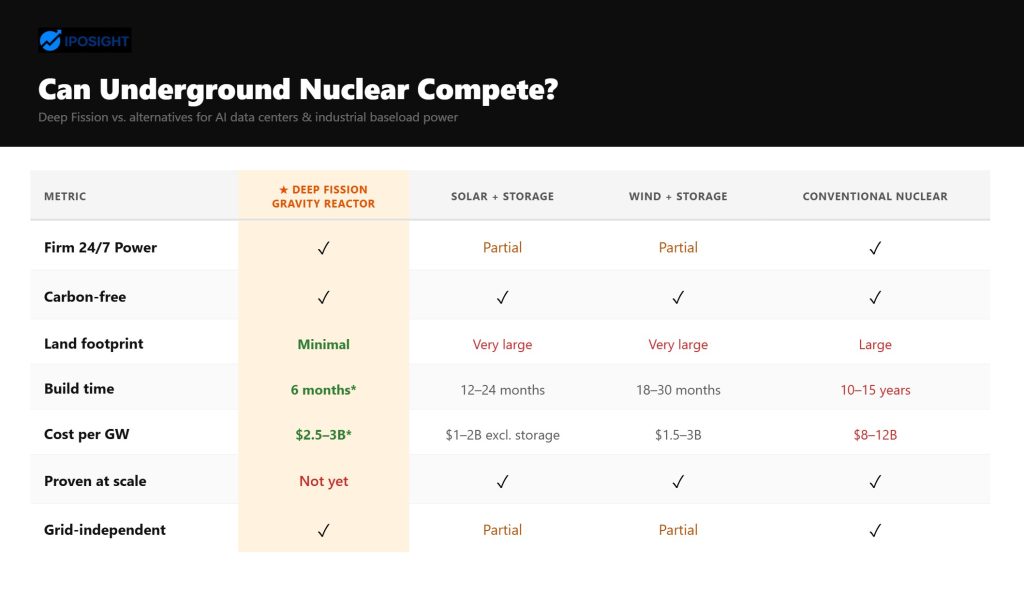
Deep Fission’s competition is not solar panels or wind farms. Those are intermittent — Deep Fission’s whole pitch is that it provides firm power where renewables cannot. The genuine competitive set consists of other advanced nuclear developers, and the landscape is crowded with companies that are further ahead:
NuScale Power (SMR) received the first-ever NRC design approval for a small modular reactor in 2022 and is the most advanced SMR company in the U.S. by regulatory milestone. X-energy completed an upsized IPO in April 2026, is already generating revenue from its fuel fabrication business, and is further along in NRC licensing than Deep Fission. Kairos Power (private) is building a test reactor in Tennessee under an accelerated NRC review. TerraPower (Bill Gates-backed, private) is under construction in Wyoming. Oklo (NYSE: OKLO) is already public with Aurora fast reactor designs.
Beyond nuclear, the relevant competitive framing includes the largest power utilities — Constellation Energy (CEG), Exelon (EXC), Duke Energy (DUK) — that control existing nuclear capacity and can expand it faster than a startup can build new. And on the demand side, the same AI hyperscalers that Deep Fission is courting are simultaneously signing long-term PPAs with established nuclear operators, buying geothermal assets, and investing in fusion startups. Deep Fission is competing for a share of the capital and the contracts in a market that has suddenly become very well-funded and very competitive.
Deep Fission’s genuine differentiator — if the technology works — is cost and deployment speed. The company estimates a FOAK (first-of-a-kind) capital cost of approximately $152 million per 2×2 reactor, coming down to around $84 million at NOAK (nth-of-a-kind) scale. At $2.5–$3 billion per gigawatt at NOAK, this would be meaningfully cheaper than conventional large nuclear ($8–12B/GW) and comparable to advanced SMR peers. The six-month estimated construction timeline per borehole, versus 10–15 years for a conventional nuclear plant, is the most compelling part of the pitch — if it can be demonstrated in practice.
Bulls and Bears: The Honest Case on Both Sides
The bull case rests on three pillars that are genuinely compelling. First, the AI power demand crisis is real and growing — the IEA estimates data centers will consume 1,000 TWh annually by 2026, more than doubling from 2022. Firm, carbon-free baseload power at competitive cost is the hardest problem in energy right now, and Deep Fission’s technology is purpose-built to solve it. Second, at an $878 million market cap, FISN trades at a steep discount to SMR peers: X-energy’s recent IPO valued it at over $2 billion, and NuScale (even after its well-publicised project challenges) carries a billion-dollar valuation. If Deep Fission’s pilot succeeds, the re-rating potential is significant. Third, the team’s nuclear pedigree — NuScale, Kairos, Navy nuclear, Fluor, UC Berkeley — is the kind of depth that actually builds reactors.
The bear case is equally hard to dismiss. The technology remains completely unproven at any commercial scale — the current borehole in Kansas has reached only 6,000 feet, roughly a fifth of the full operating depth, with the most critical load-bearing geology untested. The auditor going-concern warning with $40M raised against $61M in annual losses leaves no room for delays. The IPO downsize itself — from $157M to $40M — reflects what sophisticated institutional investors actually thought of the risk/reward at the original valuation. And the NRC licensing timeline for a first-of-a-kind underground reactor design is genuinely unknown: the regulator has no precedent for this deployment model, and the process could take years longer than the company projects.
Who’s Already In
Cornerstone investors indicated up to $10 million in IPO participation, absorbing a meaningful portion of the $40 million raise. Blue Owl Digital Infrastructure Advisors has an MOU with the company — a strategic relationship with a $235B AUM firm. Goldman Sachs is listed among the company’s strategic relationships in SEC filings. The most relevant thematic ETFs that could include FISN once liquidity and history requirements are met are those focused on uranium and nuclear power — particularly URA (Global X Uranium ETF, $2.5B AUM) and NLR (VanEck Uranium+Nuclear Energy ETF, $500M AUM). These would be meaningful demand catalysts if and when FISN qualifies for inclusion, which typically requires 3–6 months of trading history and minimum average daily volume thresholds.
Is FISN Worth Buying — and If So, When?
This is not a stock for most investors. It is a pre-revenue, going-concern-flagged, first-of-a-kind technology play with a $878 million valuation and a cash runway measured in months, not years.
That said, the asymmetry is real. If the Parsons pilot works — if the borehole reaches depth, the reactor canister deploys, and criticality is achieved — the stock could re-rate dramatically. The 3–16x upside range that Seeking Alpha analysts have cited is not absurd given what a working underground reactor would be worth to hyperscalers starved for carbon-free baseload power. The question is purely one of probability and timing.
For investors who want exposure: the most defensible approach is to wait for a concrete operational milestone — borehole completion to full depth, reactor canister deployment, or an NRC licensing docket opening — before committing meaningful capital. None of these events has occurred yet. The current $16 price already prices in a working technology that has not been demonstrated. A further dilutive financing round — which the cash position makes likely within 12 months — could push the effective cost basis meaningfully lower for new investors who wait.
The lock-up expiration (typically 180 days from June 18 = mid-December 2026) is a date to watch for potential price pressure and a potentially better entry point. But more important than the lock-up is the next concrete technical update from Parsons — which could arrive in either direction.
Investment Evaluation
| Factor | Score |
| Technology Innovation | 8/10 |
| Management & Scientific Team | 8/10 |
| Market Opportunity | 9/10 |
| Strategic Validation | 6/10 |
| Technology Readiness | 2/10 |
| Financial Position / Runway | 2/10 |
| Revenue / Profitability | 1/10 |
| Regulatory Risk | 2/10 |
| IPO Execution / Market Confidence | 2/10 |
| Long-Term Upside Potential | 9/10 |
Overall Investment Score: 4.9 / 10 · Pure speculation — venture-style asymmetric risk. Maximum 1–2% portfolio allocation for high-risk investors only.
Final Verdict
Deep Fission is one of the most intellectually fascinating companies to go public in recent years — and one of the highest-risk. The Gravity Reactor concept is elegant, the team is credible, and the problem they are solving is real and urgent. An AI-era economy that needs gigawatts of firm, carbon-free power delivered from a minimal surface footprint — with a six-month build time and a cost structure that could undercut conventional nuclear by 60% — is exactly what hyperscalers and utilities are desperately looking for.
But between the concept and the commercial reactor lies a chasm filled with unproven geology, unwritten regulatory frameworks, unanswered engineering questions, and a cash position that may not survive long enough to cross it. The IPO’s dramatic downsize from $157 million to $40 million was not a communication failure — it was the market telling Deep Fission, clearly and numerically, that the technology risk at that valuation was too high for institutional capital to absorb at scale.
The appropriate framing for FISN is not “defense manufacturer with a backlog” or “biotech with Phase 1 data.” It is closer to “early-stage fusion company” — an asymmetric bet where the downside is a total loss and the upside, if the technology proves out, is transformative. That is a legitimate investment thesis for a specific type of investor. It is not a thesis for anyone who needs the capital to be there in 18 months.
“The Gravity Reactor is either the most important energy technology of the decade, or the most expensive hole in the ground in Kansas. The market’s job over the next 24 months is to find out which.”