
The short version
- The marks are falling and they do not agree. On 30 June 2026 the comparable funds marked Discord at a median $34.06 a share, in a range of $33.11 to $35.01. A month later ARK Venture Fund marked it at $26.51 — 22% below that median.
- The listing keeps slipping. Bloomberg reported bankers in March 2025, a confidential filing in January 2026 and a hoped-for March debut. There is no public S-1 as of 13 November 2026.
- The company rejected $12 billion. Bloomberg reported in April 2021 that Discord ended takeover talks with Microsoft and turned down a $12 billion offer. Every mark on this page is below that number.
- Nobody knows what it earns. The last credible revenue figure is Bloomberg’s March 2025 report of more than $600 million annualised. That is twenty months old.
- The comparison that explains the markdown: Reddit, a listed community platform, earned $895 million in the third quarter alone, up 53%, at a 44.9% adjusted EBITDA margin. Discord has more users and a fraction of the revenue.
- One listed route exists, and it currently trades at a 22% discount to its own stated net asset value.
The company in brief
Discord is a voice, video and text platform organized around persistent communities it calls servers. It began as infrastructure for people playing games together and became the default place where online groups live: study groups, trading communities, open-source projects, fan clubs, and a very large number of game communities. The company says it has more than 200 million monthly active users, a figure it stated on its own website in December 2025 and which Bloomberg cited when it reported the confidential filing.
It is privately held, has raised about $1.0–1.1 billion across twelve rounds, and employs roughly 500 people. The last priced round was a $500 million Series I in September 2021 at a $14.7 billion valuation. Since then it has raised no new priced round, which is why every valuation discussed below is either a fund’s own estimate or a secondary-market transaction, not a round.
What Discord actually sells
Three things, in descending order of certainty. Nitro is a subscription at roughly $3 to $10 a month that buys better file uploads, higher-quality streaming, custom emoji and profile features. Server boosts are paid upgrades that members buy for a community they belong to, which is an unusual model: the person paying is not always the person who benefits. Advertising is the newest and the one the IPO case rests on — game publishers pay to put quests and promotions in front of an audience that is overwhelmingly young, male and playing games, which is a demographic traditional advertising reaches badly.
The strategic problem is visible in that list. Two of the three revenue lines are paid by users for features, which caps naturally; the third is advertising on a platform whose users chose it partly because it felt like a private room rather than a feed. Every step toward advertising is a step toward the thing the audience left elsewhere to avoid. That tension is not a detail — it is the business model question the IPO has to answer.
The IPO so far: a timeline
| Date | What happened | Source |
|---|---|---|
| Sep 2021 | $500M Series I at a $14.7bn valuation; about $1.0–1.1bn raised in total to date | PitchBook, via Bloomberg |
| Mar 2021 | Microsoft reported in talks to acquire Discord for more than $10bn | Bloomberg, 23 Mar 2021 |
| Apr 2021 | Discord reported to have ended the talks and rejected a $12bn offer | Bloomberg, 20 Apr 2021 |
| Mar 2025 | Working with Goldman Sachs and JPMorgan; revenue reported to have quadrupled 2020–2024 to over $600M annualised | Bloomberg, 26 Mar 2025 |
| Apr 2025 | Co-founder Jason Citron steps down; Humam Sakhnini, former Activision Blizzard vice chairman, becomes CEO | Bloomberg, 23 Apr 2025 |
| Oct 2025 | Third-party support vendor breached; Discord confirms about 70,000 government ID photos exposed, denies a 2.1 million figure, refuses a $3.5M ransom | Discord statement, Oct 2025 |
| 6 Jan 2026 | Confidential US IPO filing reported | Bloomberg, via Reuters, 6 Jan 2026 |
| 7 Jan 2026 | Debut hoped for March 2026 | TechCrunch, 7 Jan 2026 |
| 13 Nov 2026 | No public S-1. Reported timing has moved toward 2027 | — |
Read that sequence as one thing rather than nine. A company that rejected $12 billion hired its underwriters, replaced its founder-CEO with an executive from the most commercial corner of the games industry, and filed. Those are the actions of a company preparing to be measured. Then it did not get measured — for eleven months and counting.
What one Discord share is actually worth
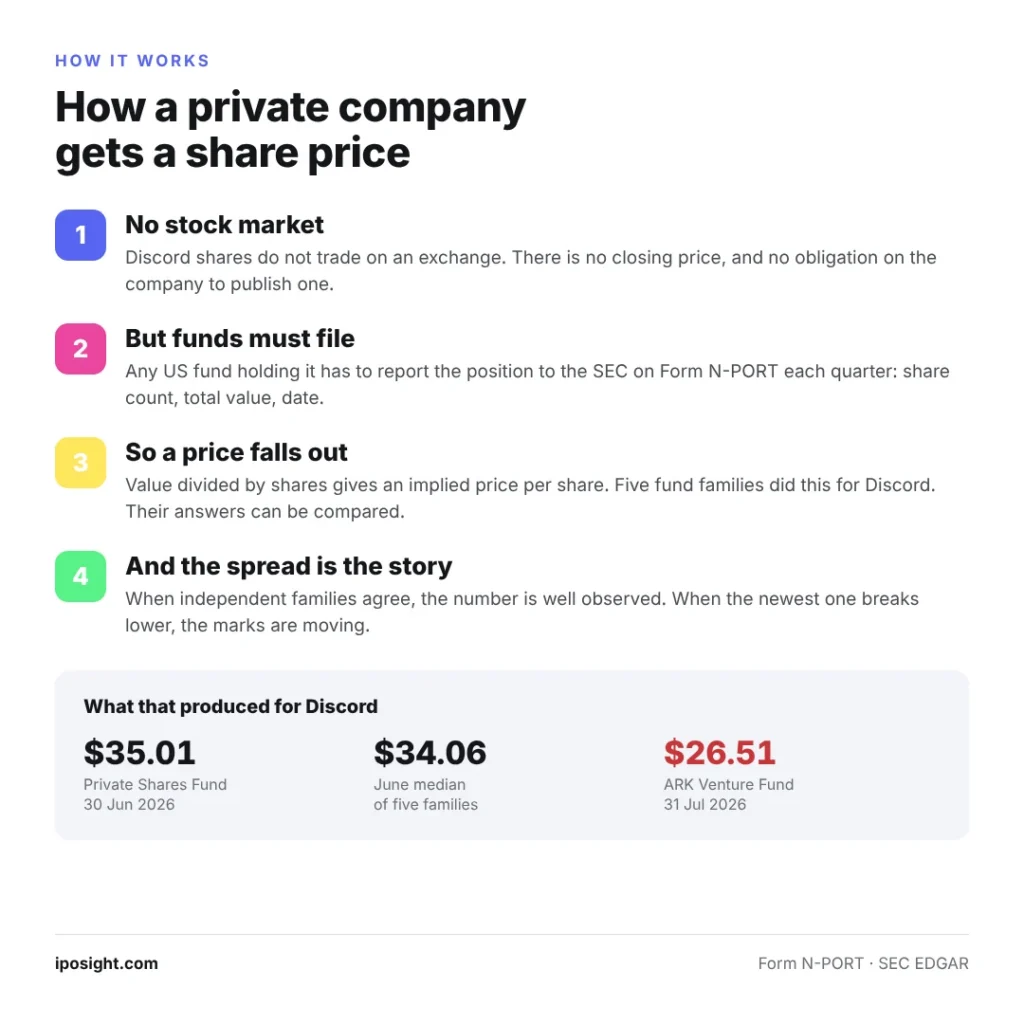
This is the part that is normally written as a single number taken from a press report. It should not be. Mutual funds and closed-end funds that hold private companies must report each position to the SEC on Form N-PORT, with a share count, a value and therefore an implied price per share, dated. Those filings are public. We collect them. For Discord there are six disclosed positions across five funds from five different fund families, worth $31.9 million in total.
| Holder | Shares | Per share | As of | What it is |
|---|---|---|---|---|
| The Private Shares Fund | 366,030 | $35.01 | 30 Jun 2026 | Common shares, held directly |
| The Private Shares Fund (indirect) | 90,910 | $35.01 | 30 Jun 2026 | Through Artist Edge Partners IV, LP |
| Median of the comparable group | — | $34.06 | 30 Jun 2026 | Range $33.11–$35.01; spread 5.6% |
| Secondary market print | — | $29.62 | 24 Oct 2026 | Reported transaction price, not a fund mark |
| ARK Venture Fund | 176,670 | $26.51 | 31 Jul 2026 | Common shares; 22% below the June median |
| BlackRock Technology & Private Equity Term Trust | 32,690 | $239.61 | 30 Jun 2026 | A different security — not comparable |
| BlackRock Science & Technology Trust | 12,713 | $239.61 | 30 Jun 2026 | Same; almost certainly a preferred class |
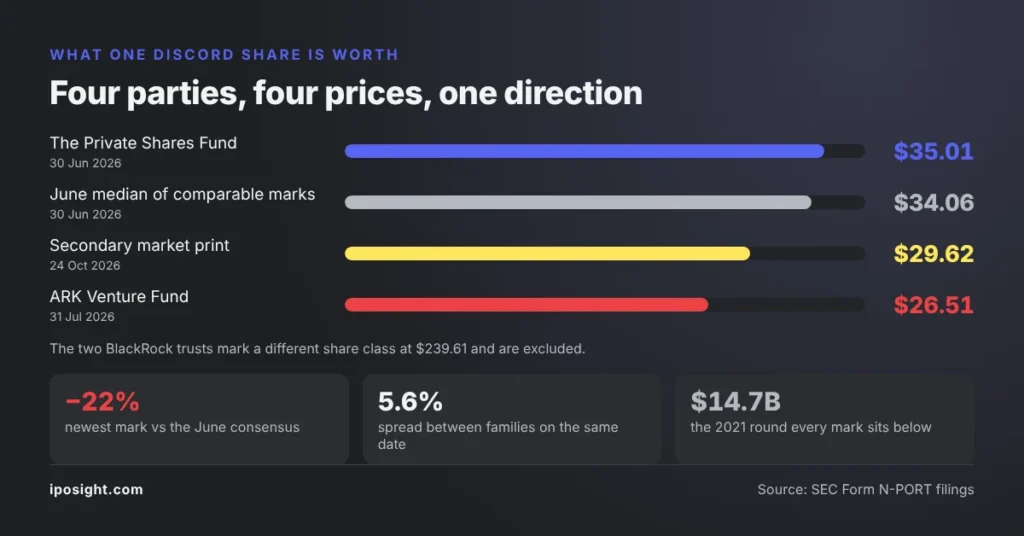
Three things fall out of that table, and none of them is in the press coverage.
First, the independent marks disagree by 5.6% on the same date. That is tight. When fund families differ by more than about 10% on a private company, it usually means they are valuing genuinely different information; 5.6% means they are looking at the same evidence and broadly agreeing. So the June number is not one fund’s opinion — it is a consensus.
Second, the newest mark broke that consensus downward. ARK’s 31 July figure of $26.51 sits 22% below the June median. One month, one fund, and a fifth of the value gone. A single fund can be early or wrong, which is exactly why the third number matters.
Third, the market printed in between. The secondary price of $29.62 on 24 October is 13% below the June consensus and 12% above ARK’s July mark. The direction is consistent across all three sources: whatever Discord was worth in June, it is worth less now, and the funds that have to put it in writing are writing it down.
What the fall actually measures
The press figure in circulation is an implied valuation of about $8.5 billion. Set against the 2021 round’s $14.7 billion that is a fall of roughly 42%. Both numbers are aggregates, and comparing them is only valid if the share count has not changed — which, after four years, no outsider can verify. So here is the same question asked per share, which is the form the filings actually support.
The $8.5 billion figure and the $29.62 secondary price together imply about 287 million shares. On that count the 2021 round works out at $51.23 a share. The secondary print is 42% below it; ARK’s mark is 48% below it. Running the marks the other way: The Private Shares Fund’s $35.01 implies about $10.1 billion, the June consensus about $9.8 billion, and ARK’s $26.51 about $7.6 billion — which would be below Microsoft’s rejected 2021 offer by more than a third.
Why the markdown: the monetization gap
The simplest explanation for a four-year decline is also the most testable one, and it is not about sentiment. Discord has an enormous audience and does not earn very much from it.
The listed comparison is Reddit (RDDT), which is close enough to be useful: a community platform, monetized chiefly by advertising, that went public in 2024 and has spent the time since proving the model. In the third quarter of 2026 Reddit reported revenue of $895 million, up 53%, net income of $283 million at a 31.7% margin, adjusted EBITDA of $402 million at a 44.9% margin, and 130.3 million daily active uniques with global ARPU of $6.87 for the quarter. It guided to $1.00–1.03 billion of revenue for the fourth quarter.
| Discord | Reddit (Q3 2026) | |
|---|---|---|
| Audience | 200M+ monthly actives (company, Dec 2025) | 130.3M daily uniques (+12%) |
| Revenue | $600M+ annualised (Bloomberg, Mar 2025) | $895M in the quarter (+53%) |
| Profitability | Not disclosed | 31.7% net margin, 44.9% adj. EBITDA margin |
| Per-user revenue | Not disclosable — no DAU published | $6.87 ARPU for the quarter |
| Financial disclosure | None; S-1 still confidential | Quarterly 10-Q and 8-K |
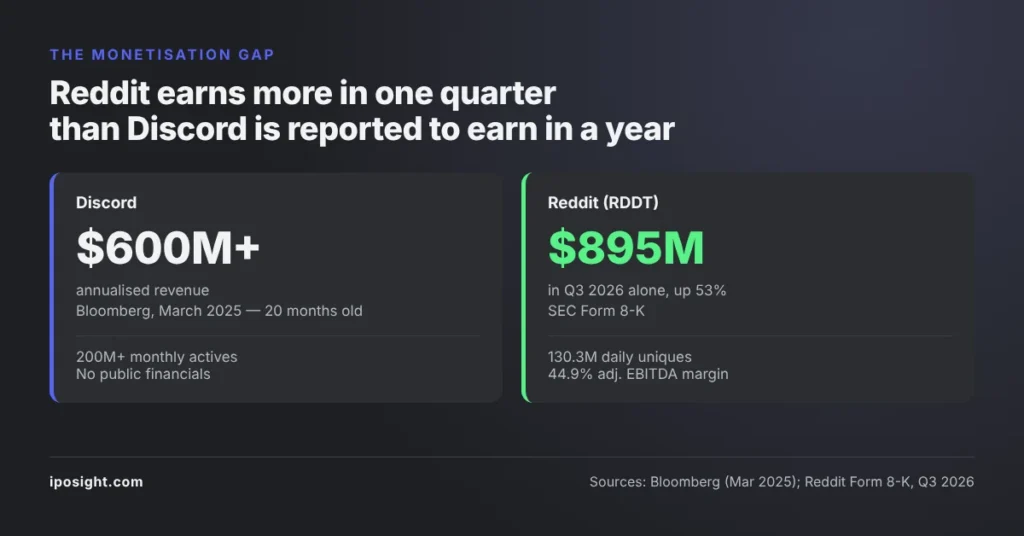
The denominators are different and we are not going to pretend otherwise: Discord publishes monthly actives, Reddit publishes daily uniques, and a per-user comparison across the two would be arithmetic dressed up as analysis. The absolute figures are enough. A platform with more than 200 million monthly users produced, on the last public estimate, less revenue in a year than Reddit now produces in a quarter.
That gap is the bull case and the bear case at once. If Discord’s advertising business works, the audience is already there and the revenue line has a long way to run. If it does not — because the product is private rooms rather than a public feed, and advertising fits the second better than the first — then the audience is a cost center with a subscription attached.
Note also what the table says about the information itself. Every figure in the Reddit column comes from a filing. Every figure in the Discord column is a company statement or a press report, and the most important one is twenty months old. Part of the discount being applied to Discord is a discount for not being able to check.
How investors can actually get exposure
For almost everyone reading this, the honest answer is that they cannot buy Discord directly. Our access map lists one listed route and nothing else.
The listed route is Destiny Tech100 (DXYZ), a closed-end fund on the NYSE holding about 32 private companies, Discord among them, alongside SpaceX at roughly 16% and Anthropic at 14.4% as of 30 June 2026. The fund’s own stated net asset value was $34.30 a share at that date; the shares traded at $26.65 on 3 November 2026. That is a 22% discount to stated NAV — for a fund that once traded at a very large premium, having reached $99.79 in April 2024 against a NAV a fraction of that.
The second route is the secondary market, where the $29.62 print came from, and it is open only to accredited investors at high minimums through brokered platforms. The third route is to wait. Given that the March 2026 target has already passed, waiting has been the correct description of the opportunity for eleven months.
Who makes money from the IPO itself
Goldman Sachs and JPMorgan were reported as underwriters in March 2025 and have now carried the mandate for twenty months without a listing fee. The 2021 investors — the Series I syndicate that came in at $14.7 billion — are, on every mark in this article, underwater. Employees holding options struck against a 2021 valuation are in the same position, which is the part that matters operationally: a down-round listing is a retention problem before it is a valuation problem, and it is one reason companies in this position wait.
The parties who do well from a down-round IPO are the ones buying at the offer price, and the secondary buyers who have been accumulating at marks that fell from the mid-thirties toward the high twenties through 2026.
The biggest risks
- There are no public financials. Everything above rests on company statements, press reports and other people’s estimates. The confidential S-1 exists; nobody outside the SEC has read it. Any view formed now will be tested by one document.
- Age verification is a regulatory thesis risk, not a compliance detail. Discord’s audience skews young, and jurisdictions are moving toward mandatory identity checks. In October 2025 a breach at a third-party support vendor exposed about 70,000 government ID photos that had been collected for exactly that purpose. The company refused a reported $3.5 million ransom. This is the first identity-document breach of the age-verification era and it happened to Discord.
- The monetization model fights the product. Advertising is the growth story, and the audience chose a private room.
- Timing risk compounds. A listing targeted for March 2026 that has not happened by November invites the question of what the S-1 shows that the company would rather fix first.
- Key-person and culture risk. The founder-CEO left in April 2025. The successor comes from Activision Blizzard, a background that reads as commercial discipline to investors and as something else to parts of the user base.
Bulls and bears
Bulls say
- 200M+ monthly actives is a genuinely scarce asset — very few platforms reach that scale
- Advertising has barely started; Reddit shows what a community audience can earn once it does
- The fund marks agree with each other to within 5.6%, so the valuation is at least well-observed
- Underwriters, a commercial CEO and a filing are all in place; the machinery is built
- One listed route exists and currently trades 22% below its own stated NAV
Bears say
- Every mark on this page is below the $12bn Microsoft offer the company rejected in 2021
- The newest filed mark is the lowest, and 22% below the June consensus
- The last credible revenue figure is twenty months old and was only ever ‘more than $600M’
- Reddit earns more in a quarter than Discord is reported to earn in a year
- A March 2026 listing that has not happened by November is information in itself
What has to be true for the listing to work
Three conditions, and the first one carries the other two. (1) The S-1 has to show advertising revenue growing fast enough to make the $600 million figure look stale rather than representative — a platform with Reddit’s audience and a quarter of Reddit’s revenue is either early or structurally limited, and only the filing distinguishes those. (2) The age-verification regime has to settle into something Discord can comply with at a known cost, rather than an open-ended liability on a young user base. (3) The company has to list while the marks are falling rather than wait for them to recover, because the one thing eleven months of delay has demonstrated is that waiting has not helped. If the first condition holds, the down round is a repricing. If it does not, it is a verdict.
Will it pop?
The question every pre-IPO article gets asked, and in this case the setup is unusual enough to answer carefully. A first-day pop happens when a deal is priced below what buyers will pay. Discord’s circumstances cut both ways: a down-round listing is typically priced conservatively, which argues for a pop, but it is also a company whose own holders have been marking it down for two quarters, which argues that the clearing price may simply be low. The 2021 investors’ $51.23-a-share cost basis, on our derived count, is not a floor — it is a number that is already far behind.
What would settle it is the S-1. Until a revenue line, a growth rate and a margin exist in public, nothing in this article — including every mark in the table above — is more than an estimate made by people who also do not have the filing.
12-month scenarios
| Scenario | What happens | Rough probability |
|---|---|---|
| It lists | The S-1 goes public, Discord prices somewhere between the secondary print and the June consensus, and the advertising line turns out to be the story. The marks converge upward on a real number. | 30% |
| It keeps waiting | No public filing through 2027 either. The marks continue to drift with the secondary market, and the most recent one stays the lowest. | 45% |
| It reprices down | The filing shows advertising scaling slower than hoped, or a regulatory cost lands, and the listing comes at or below ARK’s $26.51 mark — under $8 billion. | 25% |
These are judgments about a distribution, not forecasts, and the probabilities are ours rather than anyone else’s.
Investment evaluation
| Factor | Score | Evidence |
|---|---|---|
| Audience and scale | 9/10 | 200M+ monthly actives stated by the company, December 2025 — a genuinely rare asset |
| Product differentiation | 8/10 | Persistent community servers; no listed competitor occupies the same position |
| Revenue model | 4/10 | Two capped user-paid lines and an advertising business in tension with the product |
| Financial transparency | 1/10 | No public financials. Last credible revenue figure is twenty months old |
| Leadership and governance | 5/10 | Founder-CEO replaced April 2025; commercial successor, but an untested pairing with the user base |
| Growth evidence | 5/10 | Revenue reported to have quadrupled 2020–2024; nothing public since March 2025 |
| Competitive position | 7/10 | Reddit proves the category can monetize; Discord has not shown it can |
| Regulatory and legal risk | 3/10 | Age verification on a young user base, and the first ID-document breach of that era, October 2025 |
| Valuation evidence | 6/10 | Marks from five independent fund families agreeing to within 5.6% — well observed, and falling |
| Accessibility to a retail investor | 2/10 | One listed route, as a small slice of a fund dominated by other companies |
| Overall | 5.0/10 | The simple mean of the ten rows above, to one decimal |
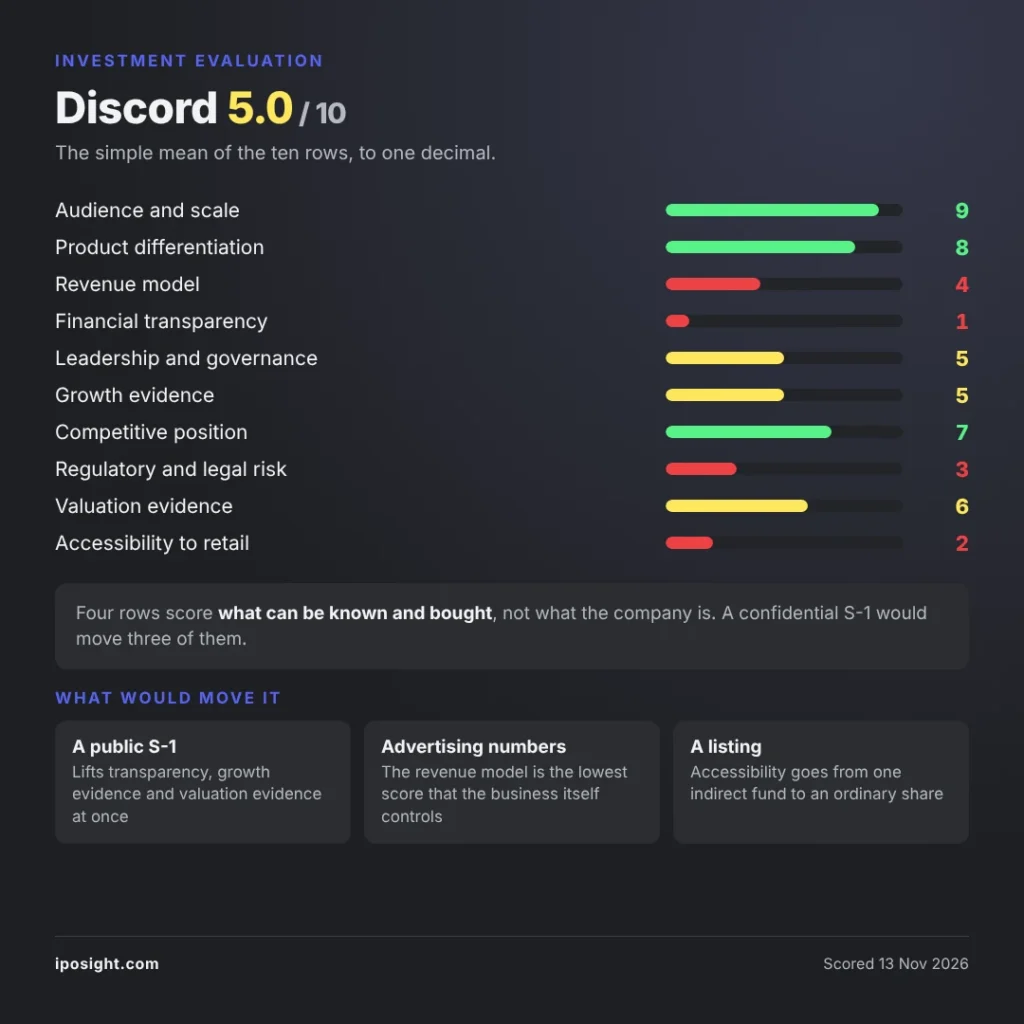
A word on what that score is measuring, because it is lower than the quality of the business would suggest. Four of the ten rows — transparency, growth evidence, valuation evidence and accessibility — are scoring what can be known and bought, not what Discord is. A company with no public accounts and one indirect route to ownership scores badly on this rubric almost by construction. The S-1 would move three of those four rows on its own.
Final verdict
What is factually good here is the audience. More than 200 million people use Discord every month, in communities they chose and return to, and the platform occupies a position no listed company holds. That asset did not get 42% worse between 2021 and 2026.
What has to be believed is narrower. (1) That the advertising business inside the confidential S-1 is growing fast enough to reframe a twenty-month-old $600 million figure as a starting point. (2) That identity verification on a young user base becomes a known cost rather than an open liability, after a breach that exposed 70,000 ID photos. (3) That the company lists into falling marks rather than waiting for a recovery that eleven months have not produced.
The bear case is not that Discord is a bad company. It is that the only people who have to write down a number for it in public keep writing down smaller ones, the newest mark is the lowest, the secondary market agrees with the direction, and there is no filing against which to check any of it. A business can be excellent and still be worth less than it was told it was worth in 2021.
The deeper point is what this case shows about private markets generally. Discord’s valuation is unusually well observed — five fund families, dated filings, a secondary print, marks that agree to within six percent — and even here the honest answer is a range from $7.6 billion to $10.1 billion depending on whom you ask and which month you ask about. For the 1,460 private companies we track, most have nothing like this much evidence. When a pre-IPO valuation is quoted as a single number, it is worth asking who produced it, on what date, and whether anyone had to sign it.
Frequently asked questions
Is Discord going public?
It filed confidentially for a US IPO, reported by Bloomberg on 6 January 2026, with Goldman Sachs and JPMorgan as underwriters. A March 2026 debut was reported as the target. As of 13 November 2026 there is no public S-1 and reported timing has moved toward 2027. A confidential filing is not a commitment to list.
What is Discord worth in 2026?
It depends entirely on whom you ask, which is the point of this article. Independent funds marked it between $33.11 and $35.01 a share on 30 June 2026, ARK Venture Fund marked it at $26.51 on 31 July, and the secondary market printed $29.62 on 24 October. The press figure in circulation implies roughly $8.5 billion, against $14.7 billion in the 2021 round.
Did Discord really turn down Microsoft?
Bloomberg reported in March 2021 that Microsoft was in talks to acquire Discord for more than $10 billion, and on 20 April 2021 that Discord had ended the talks and rejected a $12 billion offer. Every valuation mark discussed here is below that figure.
How can I invest in Discord before the IPO?
For most investors, not directly. The one listed route is Destiny Tech100 (DXYZ) on the NYSE, where Discord is one of about 32 private holdings and a small one next to SpaceX and Anthropic; the fund traded at a 22% discount to its stated NAV in early November 2026 and charges a 2.50% fee. Brokered secondary platforms exist but require accredited status and high minimums.
How much money does Discord make?
Nobody outside the company knows currently. Bloomberg reported in March 2025 that revenue had quadrupled between 2020 and 2024 to more than $600 million annualised. No credible figure has been published since. Revenue comes from Nitro subscriptions, server boosts and a growing advertising business.
Why would a company list below its last private round?
Because the alternative is waiting, and waiting has costs: employee options struck at the old valuation lose their retention value, investors eventually want liquidity, and a stale valuation becomes harder to defend the longer it goes unmarked. Several large technology companies have listed below their peak private valuations. It is a repricing, not necessarily a failure.
Fund marks are taken from Form N-PORT filings collected from SEC EDGAR; each position carries the fund’s CIK and the filing’s accession number in our dataset, and each is reported as of the fund’s own period end — 30 June 2026 for four of the positions and 31 July 2026 for ARK Venture Fund. The median, range and 5.6% spread are computed across the positions the filings describe as common shares; the two BlackRock trusts’ $239.61 mark is excluded as a different security, and one position is held indirectly through a partnership and marked at the same price as its holder’s direct position. N-PORT values are the funds’ own fair-value estimates of Level 3 assets, not transaction prices. The $29.62 secondary print of 24 October 2026 is as reported by stockanalysis.com, sourced to Clarity. The implied share count of about 287 million is derived by dividing the widely reported $8.5 billion implied valuation by that secondary price; it is not disclosed by the company, and every implied valuation in this article follows from it. Funding history, the Microsoft approach, the underwriters, the revenue figure and the confidential filing are from the Bloomberg and Reuters reports cited in the sources below, with their dates. Reddit figures are from its Form 8-K earnings release for the quarter ended 30 September 2026. DXYZ net asset value, price, fee and portfolio weights are from our own fund dataset as of the dates stated. Access routes are from our Key Dates and Calendar pages and the access map behind them; our scoring approach is described on the Method page. Share price and market data to 13 November 2026.
[1] Bloomberg — Discord Is Said to Reject Microsoft’s $12 Billion Offer (20 April 2021)
[2] Bloomberg — Discord Would Give Microsoft a $10 Billion ‘Place to Talk’ (23 March 2021)
[3] Bloomberg (Katie Roof, Ryan Gould, Cecilia D’Anastasio) — Chat App Discord Is Working With Goldman, JPMorgan on Planned IPO (26 March 2025)
[4] Bloomberg — Discord Names New CEO as Co-Founder Steps Down Ahead of IPO (23 April 2025)
[5] Reuters (Prakhar Srivastava, Nathan Gomes) — Chat platform Discord files confidentially for US IPO, Bloomberg News reports (6 January 2026)
[6] TechCrunch (Julie Bort) — Discord’s IPO could happen in March (7 January 2026)
[7] The Record — Discord confirms about 70,000 government ID photos exposed in third-party vendor breach (October 2025)
[8] SEC EDGAR — Reddit, Inc., Form 8-K, Q3 2026 earnings release (quarter ended 30 September 2026)
[9] stockanalysis.com — Discord private company profile: funding history and secondary price of $29.62 as of 24 October 2026, sourced to Clarity
[10] SEC EDGAR — Form N-PORT filings of The Private Shares Fund (CIK 0001557265), ARK Venture Fund (CIK 0001905088), BlackRock Technology & Private Equity Term Trust (CIK 0001836057) and BlackRock Science & Technology Trust (CIK 0001616678)
[11] iposight.com — private-company access map and fund dataset, data as of 5–9 November 2026
iposight.com — for informational purposes only, not investment advice. No position in any security mentioned.
Discover more from IPOSight
Subscribe to get the latest posts sent to your email.