
Five years ago, Anthropic was a small research lab with no product. In the third quarter of 2026 it booked $17 billion of revenue in three months — more than its entire 2024 and 2025 combined, several times over. On October 26 it filed to list on Nasdaq under the ticker ANT, with Goldman Sachs and Morgan Stanley leading, and reports put the target valuation at $1.4 to 1.75 trillion. Marketing to investors could start as early as next week, with trading targeted before Thanksgiving. This is the second trillion-dollar IPO of the year after SpaceX, and probably the most important AI listing yet. Here is what the filing actually shows, whether buying at the opening price makes sense, and — for investors who want in before the bell rings — which public companies and funds already own a piece of Anthropic or earn billions from it.
Anthropic in Brief
Anthropic was founded in 2021 by Dario Amodei (CEO), Daniela Amodei (President) and five other former OpenAI researchers. It is headquartered in San Francisco and organized as a public benefit corporation, meaning its charter requires it to weigh its mission — the safe development of advanced AI — alongside shareholder returns. It makes money in three ways: selling access to its Claude models to businesses through an API (charged per token used), selling subscriptions to its own apps (Claude, Claude Code and Cowork), and selling the same models through the cloud marketplaces of Amazon, Google and Microsoft. In the first half of 2026, about 80% of revenue came from usage-based fees paid by businesses.
The Products: What Customers Actually Buy
The Claude model family. The current lineup is tiered by size and price: Claude Opus 5.5 (released September 22, the flagship for complex coding and knowledge work), Sonnet 5.5 (September 28, the workhorse) and Haiku 5.5 (October 7, the fast, cheap model for high-volume tasks). Above them sits a separate, more powerful tier — Claude Mythos 5.1 and Fable 5.1 — which share the same underlying model; Fable adds extra safeguards for biology, cybersecurity and AI research. This is the tier that was switched off in June under US export controls and restored on July 1.
Claude Code is the product that changed Anthropic’s trajectory. It is an AI agent that writes, tests and fixes software on its own, and it has become the default tool for a large share of professional developers. The S-1 shows how powerful the pull is: the heaviest Claude Code users inside enterprise accounts spend about 20 times more per month than typical enterprise users who do not use it.
The Claude apps and Cowork bring the same capabilities to non-programmers: reading and writing documents, running research, building spreadsheets and working across company files. Anthropic has also launched specialized products such as Claude Security (for finding and patching vulnerabilities) and Claude Science (a research workbench for labs). The strategy described in the filing is to move customers up a ladder — from API to Claude Code to Cowork — and it is working: more than half of customers spending $100,000 a year now use both the platform and a first-party app, up from about 30% at the end of 2025.
Can Anthropic be the market leader? In enterprise AI and coding it already is, by most third-party estimates. In consumer AI it is not: ChatGPT has far more users. The realistic question is whether Anthropic can hold its enterprise lead as Google and OpenAI cut prices and target the same customers. The 900% net revenue retention says customers are expanding fast today; the $600 million of price cuts in Q3 says the competition is already biting.
The Numbers in the S-1: Explosive Revenue, Confusing Losses
The growth figures are hard to overstate. Revenue was $386 million in 2024 and about $4.6 billion in 2025. In 2026 it reached roughly $4.7 billion in Q1, $11.6 billion in Q2 and nearly $17 billion in Q3, for a nine-month total of about $33.2 billion. Q3 revenue was up 1,127% from a year earlier and 47% from the previous quarter. According to Bloomberg, backers expect an annualized run rate of $100–120 billion by the end of the year.
The loss figures look alarming at first: a $80.7 billion net loss in the first half and $23.3 billion in Q3. Almost all of it, however, is an accounting effect. Anthropic raised much of its money through convertible notes, derivatives and SAFEs, which must be revalued as the company’s valuation rises. In the first half, $72.4 billion of the loss came from those revaluations. The real operating picture is much closer to breakeven: an operating loss of $1.7 billion in Q1, an operating profit of $974 million in Q2, and an operating loss of $567 million in Q3. Operating cash flow was positive at $3.9 billion in the first half, and adjusted operating margin was 15% in Q3.
The figure that matters most is on the other side of the ledger. Anthropic had $146.6 billion of liquidity at September 30, but it also had about $895 billion of purchase commitments and leases, almost all for compute. That is about 13 times its annualized revenue. Compute and infrastructure costs rose 382% year on year in Q3, faster than revenue.
How to read the losses: the huge net loss is not cash leaving the company, and most of it will disappear once the convertible notes convert into shares at the IPO. The real question for investors is the operating margin — and whether revenue keeps outrunning a compute bill that is already committed for years.
Who Owns and Who Controls Anthropic
Ownership. Google’s stake is capped at 14.99% and Amazon’s at 12%. Each of the seven co-founders owns about 2%. Spark Capital, the only venture investor on the board, has put in close to $800 million across six rounds. Other large holders include Menlo Ventures, Lightspeed, ICONIQ, Sequoia, Altimeter, Dragoneer, Greenoaks, Coatue, Fidelity, BlackRock and Blackstone. The May 2026 Series H raised $65 billion at a $965 billion post-money valuation.
Control. Ownership and control are deliberately separated. Through Class F shares, the co-founders hold 50.1% of the votes on key matters as long as at least three of them keep a minimum stake. Through Class T shares, the Long-Term Benefit Trust — an independent body tied to the safety mission — elects a majority of the board. The trust’s special rights can be removed by a vote, but not easily. For investors this cuts both ways: it protects the company from short-term pressure, but it also means public shareholders will not be able to change management or strategy.
Who Needs Claude — Customers and Concentration
At September 30, more than 11,900 customers were spending at least $100,000 a year, more than 1,900 were spending $1 million or more, and about 250 were spending over $10 million. Users range from software companies building on the API to banks, insurers, pharmaceutical groups and governments outside the US defense sector. Large consultancies — Accenture, Deloitte, Cognizant — act as resellers and integrators.
The weak spot is concentration. The top five customers made up about 25% of revenue in the first nine months of 2026, and sales through the Google and Amazon clouds were about 48% of first-half revenue. The S-1 also discloses that an estimated 5–7% of this year’s revenue came from customers later found to be violating usage policies, which could fall away.
How Big Is the Market?
Market forecasts are struggling to keep up. Gartner projected worldwide spending on AI models and platforms of $64 billion in 2026, up 63% — yet Anthropic alone is now running at a pace above that, and OpenAI is close behind at around $70 billion. A better way to size the opportunity is by what AI replaces. Software development, customer service, legal and financial analysis together represent several trillion dollars of annual labor cost. If AI agents take even a single-digit share of that, the market for model providers is measured in hundreds of billions a year. The constraint today is not demand — it is compute. Anthropic says it has repeatedly underestimated how much it needs.
The Real Competition
This is effectively a three-to-four-player race at the frontier, with a large and growing pool of cheaper open-weight models below it.
OpenAI
ChatGPT · run rate near $70B · seeking ~$1.4T valuation
The consumer leader and the closest peer on revenue. OpenAI’s run rate grew more than 70% in Q3, and Sam Altman says it will not list this year (2027 is expected). Anthropic is ahead in enterprise coding; OpenAI is far ahead in consumer users. Microsoft backs both.
Google DeepMind (Gemini)
Alphabet · unlimited balance sheet, own chips
The best-funded rival, with its own TPUs, distribution through Search, Android and Workspace, and the ability to price at cost. Google is simultaneously Anthropic’s largest shareholder and its largest chip supplier.
SpaceXAI (Grok) · SPCX
Musk’s merged xAI unit
Strong on compute, weaker on enterprise trust. Its decision to rent Colossus 1 to Anthropic suggests it has more capacity than customers for now.
Meta (Llama) and open-weight models (DeepSeek, Qwen, Mistral)
The price floor
Free or cheap models keep pushing down the price of “good enough” AI. The S-1 already shows about $600 million of revenue lost to price cuts and discounts in Q3.
The Biggest Risks
1. The $895 billion compute bill
Highest-impact risk
Anthropic has signed up for close to $900 billion of compute and infrastructure, roughly 13 times its current annualized revenue. Some of it can be canceled, but about $417 billion of the original commitments are non-cancellable. If demand slows, these become fixed costs that swamp revenue. The company itself warns of “periods of excess or underutilized compute”.
2. Customers can walk away
Revenue quality
Most revenue is pay-as-you-go. The S-1 says customers can cut usage with little or no notice; spending dropped about 20% over two weeks around New Year before recovering. Multi-year contracts are growing, but remaining performance obligations were only $10.8 billion at June 30.
3. Concentration and channel dependence
Who actually pays
The top five customers made up about 25% of revenue in the first nine months. Resale through Google and Amazon clouds was about 48% of first-half revenue. Both of those channels belong to competitors.
4. Washington
Regulatory and political risk
The Pentagon has designated Anthropic a “supply chain risk” since March 2026, and in September the D.C. Circuit let that stand. In June the Commerce Department forced Anthropic to switch off its top two models for nearly three weeks under export controls. Few companies have had their flagship product recalled by the government weeks before an IPO.
5. Public shareholders get little control
Governance
Anthropic is a public benefit corporation with five share classes. Founders hold 50.1% of the votes on key matters through Class F shares, and the Long-Term Benefit Trust elects a majority of the board through Class T. That is by design, to protect the safety mission, but it means buyers of ANT have almost no say.
6. Valuation leaves little room
Price risk
At $1.5 trillion, ANT would trade at about 22 times its Q3 run-rate revenue. That is a premium even to the fastest-growing software companies, and it assumes growth keeps going at an extraordinary pace while margins hold up under price cuts.
7. Lock-up waves
Supply risk
Some insiders can sell up to 10% of their holdings in the first trading days, another 35% after the FY2026 results, and co-founders up to 29% after 180 days or the Q1 2027 report. Each window adds share supply.
How to Invest Before the IPO: Public Companies With Direct or Indirect Ownership
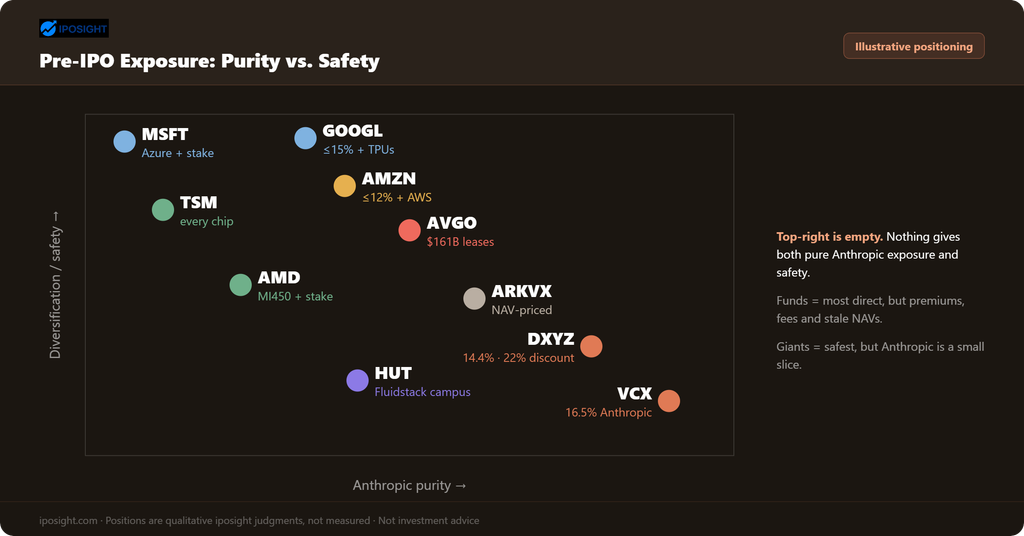
Anthropic shares cannot currently be bought on secondary markets, so the only routes before listing are companies and funds that already own a stake. The important caveat, as with SpaceX, is that for most of these companies the Anthropic stake is a small part of a very large business.
Alphabet (NASDAQ: GOOGL / GOOG) Owner + supplier
Strategic investor · stake capped at 14.99%
Google invested in Anthropic in 2023 and has added capital in later rounds. Its stake is contractually capped at 14.99%. At a $1.5 trillion IPO valuation, a stake near that cap would be worth up to roughly $225 billion.
Why it matters more than the stake: Google is also Anthropic’s largest chip supplier (TPUs), a cloud host with a commitment of more than $114.5 billion running to 2033, and a resale channel through Google Cloud. It is also a direct competitor through Gemini.
Amazon (NASDAQ: AMZN) Owner + supplier
Strategic investor · stake capped at 12% · $6.2B in convertible notes
Amazon put at least $8 billion into Anthropic in 2023–2024 and joined the May 2026 Series H. Its stake is capped at 12%, which at $1.5 trillion would be worth up to about $180 billion. Because a large part of the position is held at fair value, Anthropic’s IPO price will flow into Amazon’s reported profits as a mark-to-market gain.
Operational link: AWS has a hosting commitment of at least $110 billion through 2036. Anthropic trains on Amazon’s own Trainium chips, and Claude is sold through Amazon Bedrock.
Nvidia (NASDAQ: NVDA) Owner + supplier
Investor since November 2025 · up to $10B
As part of the November 2025 three-way deal with Microsoft, Nvidia agreed to invest up to $10 billion. Anthropic committed to use up to one gigawatt of Grace Blackwell and Vera Rubin systems. Nvidia’s GPUs also power the SpaceX and Microsoft capacity that Anthropic rents.
Microsoft (NASDAQ: MSFT) Owner + supplier
Investor since November 2025 · up to $5B
Microsoft agreed to invest up to $5 billion. The original Azure commitment of $30 billion has since grown to at least $44.9 billion through 2033, according to the S-1. Microsoft is also OpenAI’s largest backer, so it owns both leading model labs at once.
AMD (NASDAQ: AMD) Owner + supplier
Investor and chip supplier since July 2026
In July 2026, AMD announced a two-gigawatt deal for its Instinct MI450 accelerators together with an equity investment of up to $5 billion. The S-1 values the initial capacity at more than $20 billion. It is the clearest sign that Anthropic wants to reduce its dependence on any single chip vendor.
Memory makers: SK Hynix, Samsung, Micron Small owners
Series H investors, May 2026
Micron, Samsung and SK Hynix all took part in the $65 billion Series H round. Their stakes are small relative to their own size, but each sells the high-bandwidth memory (HBM) that sits inside every AI accelerator Anthropic rents. SK Hynix trades in the US as SKHY, Micron as MU, and Samsung in Seoul (005930.KS).
Earlier strategic backers: Salesforce, Zoom, Cisco Minor
Small venture stakes from 2023–2025
Salesforce Ventures and Zoom Ventures invested in 2023, and Cisco Investments joined in 2025. These positions are small and will not move those companies’ share prices, but Salesforce and Zoom are also product partners that build Claude into their own software.
The Companies Actually Making Money From Anthropic: The Supply Chain
For once, investors do not have to guess who supplies the company. The S-1 names the contracts and their sizes. In many cases, the supplier side is a stronger form of exposure than the ownership side: these companies book real revenue from Anthropic every quarter, whether or not ANT’s share price rises.
Broadcom (NASDAQ: AVGO) Largest contract
TPU hardware leases · ~$161B, non-cancellable
Broadcom co-designs Google’s TPU chips and leases TPU systems to Anthropic directly. The S-1 shows about $161 billion of non-cancellable lease payments, with a further $125–150 billion under negotiation. This is the single largest commitment in the filing, which makes Broadcom arguably the purest large-cap Anthropic supplier.
SpaceX / SpaceXAI (NASDAQ: SPCX) Cancellable
Colossus GPU capacity · up to $120.5B to 2029
In May 2026, Anthropic agreed to rent the full Colossus 1 supercomputer from SpaceX’s AI division (the former xAI). The contract is worth up to $120.5 billion through 2029, but most of it can be canceled with 90 days’ notice. SpaceX is therefore both a supplier and, through Grok, a competitor.
Alphabet / Google Cloud (GOOGL)
TPU capacity · more than $114.5B, April 2026 – July 2033
On top of the Broadcom leases, Anthropic buys TPU capacity in Google’s own data centers. An additional 3.5 gigawatts announced in April 2026 is due to come online from 2027.
Amazon Web Services (AMZN)
AWS + Trainium · at least $110B, May 2026 – April 2036
Project Rainier, Amazon’s Trainium supercluster, was built largely for Anthropic. The new contract runs for a decade.
Microsoft Azure (MSFT)
Azure + Nvidia GPUs · at least $44.9B, Nov 2026 – May 2033
Azure capacity starts this month. Claude models are also sold to enterprises through Microsoft Foundry and appear inside Microsoft 365 Copilot.
Nscale and Lambda (private)
GPU cloud · $44.6B and $41.3B
Two specialist “neoclouds” with large contracts. Neither is publicly traded, so the listed parallel is CoreWeave (CRWV), which trades at about 3.6× sales and is not an Anthropic supplier.
AMD (AMD)
Instinct MI450 · 2 GW · $20B+ initial capacity
First deliveries are expected in 2027. If AMD’s chips perform well on Claude workloads, this could grow into one of AMD’s largest customer relationships.
TSMC (NYSE: TSM) Hidden winner
The foundry behind almost every chip above
Google TPUs, Amazon Trainium, Nvidia GPUs and AMD Instinct are all made by TSMC. It never appears in the S-1, but it is the one supplier whose revenue rises no matter which chip Anthropic chooses.
Hut 8 (NASDAQ: HUT) via Fluidstack Smaller-cap play
River Bend, Louisiana · 245 MW, up to 2.3 GW
In December 2025, Hut 8 signed a 15-year, $7 billion lease (up to $17.7 billion with options) for a campus that Fluidstack operates for Anthropic, with Google backstopping the lease. Hut 8 is a far smaller company than the giants above, so Anthropic-related demand matters much more to its results. The first data hall is due in Q2 2027.
Partners, Competitors and Strategic Allies
Amazon, Google and Microsoft: partners and rivals at once
The “frenemy” problem
All three host Claude, resell it, and invest in Anthropic. All three also build competing models (Nova, Gemini) or back a rival (Microsoft–OpenAI). The S-1 itself warns that cloud partners increasingly see Anthropic as a competitor, and that they may put their own needs first when compute is scarce.
Accenture, Deloitte, Cognizant
Consulting channel
Accenture signed a multi-year partnership in December 2025 to train its staff on Claude and sell it to clients. Deloitte and Cognizant have rolled Claude out to hundreds of thousands of employees. Consultants are a key route into regulated industries such as banking, insurance and healthcare.
Blackstone and private-equity owners
“Ode with Anthropic”
A venture with Blackstone and other private-equity firms places forward-deployed engineers inside portfolio companies to roll out Claude. Blackstone also helped finance TPU leases.
OpenAI, Google DeepMind, SpaceXAI, Meta
Direct competitors
See the competition section below.
How Dependent Is Anthropic on These Companies?
Very. Anthropic owns almost none of its own computing hardware. It depends on Google and Broadcom for TPUs, on Amazon for Trainium, on Nvidia GPUs rented through Microsoft, SpaceX, Nscale and Lambda, and increasingly on AMD. It depends on Google and Amazon for nearly half of its sales channel. And behind all of them, it depends on TSMC to make the chips and on memory makers for HBM.
The company is clearly trying to reduce this. It has spread its compute across four chip architectures, shifted from renting cloud capacity to leasing chips directly in dedicated data centers, and announced its own $50 billion data-center program with Fluidstack in Texas and New York, alongside the Louisiana campus built by Hut 8. But for the next several years, the balance of power is with the suppliers. That is precisely why the suppliers can be an attractive way to play the theme.
ETFs and Funds With Anthropic Exposure: VCX, DXYZ and Others
Fundrise Innovation Fund (NYSE: VCX) Purest listed route
Anthropic ≈ 16.5% of assets · fee 1.85%
The highest disclosed Anthropic weight of any listed fund. It also holds Databricks (14.1%), OpenAI (12.4%), Anduril (5.5%) and SpaceX (4.0%), according to its March 31 holdings.
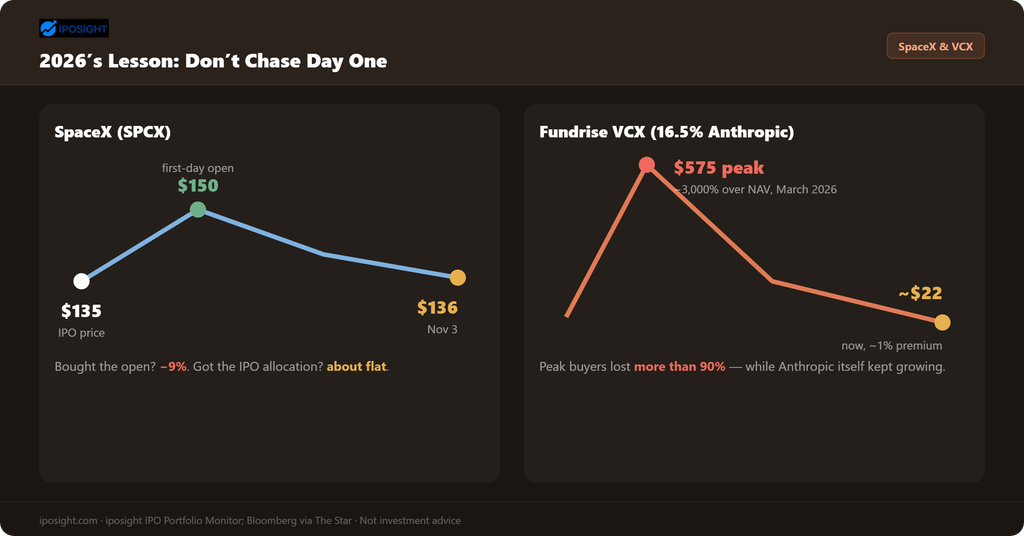
Warning from its own history: after listing on March 19, 2026, VCX spiked as high as $575 against a net asset value near $19 — a premium of roughly 3,000%. It now trades around $22, close to its NAV, with only about a 1.4% premium. Anyone who bought the hype lost more than 90%. Today the price is fair relative to NAV, but the NAV itself is only updated quarterly.
Destiny Tech100 (NYSE: DXYZ) Trades at a discount
Anthropic ≈ 14.4% · 32 private companies
A closed-end fund holding about 32 private tech companies. SpaceX (~16%, now public) and Anthropic (14.4%) are the largest positions, with xAI, Stripe, Discord and Revolut also in the portfolio.
On November 3 it traded at $26.65 against a June 30 NAV of $34.30, a 22% discount. The discount is the opportunity: if Anthropic lists well above its last private mark, DXYZ’s NAV rises and the discount could narrow. The risks are total costs of about 4.5% a year and a NAV that is four months old.
ARK Venture Fund (ARKVX)
Interval fund · priced at NAV
Holds Anthropic alongside SpaceX and other private names. There is no premium or discount because it is priced at NAV, but redemptions are quarterly and capped, so you cannot sell whenever you want.
Active ETFs with small private stakes: AGIX, BAI, TTEQ, ALAI, ATFV, CNEQ
Partial, low-weight exposure
KraneShares, iShares, T. Rowe Price and Alger run active ETFs that are reported to hold small private positions in Anthropic. Weights are typically low single digits or less and change often. Check each fund’s latest holdings before buying for Anthropic exposure.
Direct pre-IPO shares (Forge, EquityZen, SPVs) Caution
Not a real route right now
Forge lists no Anthropic price as of November 4, and Anthropic restricts share transfers. Be very careful with any “pre-IPO Anthropic share” or SPV offered online: many are layered vehicles with high fees, and some are scams.
The lesson from 2026: listed pre-IPO funds can trade far away from what they own. VCX went from a ~3,000% premium to almost none in a few months. DXYZ now trades at a 22% discount. Before buying any of them for Anthropic, check the latest NAV, the premium or discount, and how stale the NAV is.
Will These Stocks Rise After the Anthropic IPO? Has the Market Priced It In?
For the giants — Amazon, Alphabet, Microsoft, Nvidia, Broadcom — the IPO itself is unlikely to be a lasting driver. Their Anthropic stakes, even at $150–225 billion, are a fraction of their market values, and the market has watched these relationships for years. The exceptions are accounting gains: Amazon and Alphabet will likely book large mark-to-market gains in the quarter of the listing, which can lift reported earnings, although analysts usually look through them.
The bigger effect could run the other way. A strong ANT debut would confirm that AI spending is turning into real revenue, which supports the case for the whole supply chain: Broadcom, TSMC, the memory makers and the data-center owners. A weak debut would raise the opposite question — whether $895 billion of commitments can ever be paid for — and could hit the same stocks.
The funds are different. VCX and DXYZ are directly tied to Anthropic’s price. Once ANT trades, their NAVs can be marked to a daily market price, and the gap between price and NAV should become easier to judge.
The SpaceX precedent is instructive. SpaceX priced at $135 in June, opened at $150, briefly went higher — and on November 3 traded at $136.37, almost exactly the IPO price, five months later. Investors who got shares at the offer price are roughly flat; those who bought the first-day open are down about 9%.
Should You Buy ANT at the Opening Price?
There are two different questions here. Getting an allocation at the IPO price is one thing. Anthropic is considering reserving 15–20% of the offering for individual investors, with JPMorgan leading US retail outreach and Citigroup coordinating retail tranches in Australia, Canada, Japan, Britain, Switzerland and parts of Europe. If you can get shares at the offer price, a small position is a reasonable bet on one of the defining companies of the decade.
Buying in the first minutes of trading is another. With heavy retail demand and a limited float, a strong opening pop is likely, and history says chasing it is usually a poor trade. A more disciplined approach is to build a position in stages: a small starter position if you have conviction, then add around the first public earnings report (FY2026 results, likely in early 2027) and around the early lock-up windows, when insider selling often creates better prices.
At a $1.5 trillion valuation, ANT would trade at about 22 times its Q3 run-rate revenue. If the year-end run rate really reaches $100–120 billion, that falls to roughly 12–15 times — expensive, but not absurd for a company growing this fast. The whole case rests on that growth continuing.
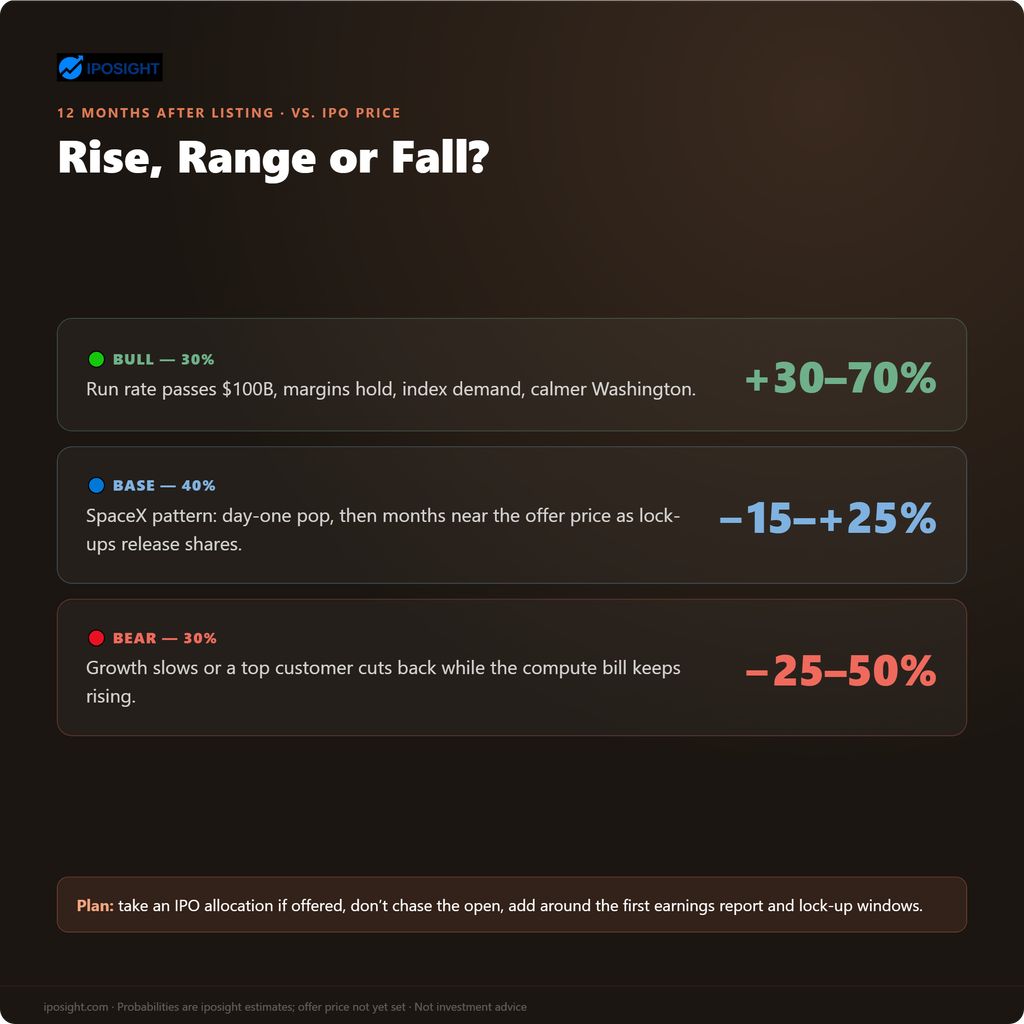
12-Month Price Scenarios After the Listing
These scenarios are measured from the IPO offer price, which has not yet been set.
Bull scenario — about 30% probability
+30% to +70% from the IPO price
The run rate passes $100 billion by year-end as backers expect, the first public quarter shows a stable operating margin, and new compute arriving in 2027 is quickly filled. ANT is added to major indexes and becomes a core AI holding for funds that could not own it privately. Political tensions with Washington ease.
Base scenario — about 40% probability
−15% to +25% from the IPO price
The SpaceX pattern: a first-day pop, then months of trading around the offer price as lock-up windows release shares and investors wait for evidence that growth can outrun the compute bill. Revenue stays strong, but margins dip as price cuts and new capacity land.
Bear scenario — about 30% probability
−25% to −50% from the IPO price
Growth slows sharply — a customer like one of the top five cuts spending, or price competition from Google and OpenAI bites harder — while committed compute costs keep rising. Add a broader AI sell-off or a new clash with the US government, and the stock could fall well below the offer price, as many 2026 IPOs have.
Probability of rising, sideways or falling over 12 months: roughly 30% meaningfully up, 40% range-bound around the offer price, 30% meaningfully down. That is a wide distribution for a trillion-dollar company, and it reflects how much of the price depends on growth that has not happened yet.
Investment Outlook: Should Investors Buy the Ecosystem Instead of Anthropic?
For many investors, a split approach makes the most sense — the same conclusion we reached for SpaceX.
The core of the ecosystem trade is the suppliers. Broadcom and TSMC earn money from Anthropic’s compute regardless of which model wins, and their exposure comes from signed contracts rather than share-price hopes. Alphabet and Amazon combine both sides: a large stake, a multi-year compute contract and a resale channel. They are the lowest-risk way to own a slice of Anthropic, but the slice is small relative to the whole company.
Higher-beta ways to play the theme include AMD (if its MI450 chips succeed with Claude) and Hut 8 (a much smaller company whose growth depends heavily on the Fluidstack–Anthropic campus). These move more on Anthropic news but also carry more company-specific risk.
The most direct pre-IPO route is DXYZ at a discount or VCX near NAV — but both carry other holdings, high fees and stale NAVs.
Anthropic itself offers the purest exposure to the fastest-growing software business ever built, with the biggest commitments and the least shareholder control. A modest direct position, combined with one or two supplier names, spreads the risk between “Anthropic wins” and “AI spending keeps growing whoever wins”.
Investment Evaluation: Anthropic (ANT) as an IPO Stock
Revenue growth
From $386M in 2024 to $4.6B in 2025 to a ~$68B run rate in Q3 2026. Growth on this scale has no precedent in software.
10/10
Product position in enterprise and coding
Over 11,900 customers spend $100K+ a year, 1,900 spend $1M+, and net revenue retention is about 900%. Claude Code is the category leader.
9/10
Balance sheet and liquidity
$146.6B of liquidity at September 30 and positive operating cash flow in H1 2026. Bankruptcy risk over the next several years is very low.
9/10
Unit economics
Adjusted operating margin of 15% in Q3 (19% in Q2), and more than $2 of revenue per $1 of compute. Positive but already slipping.
6/10
Reported profitability
Small operating losses in Q1 and Q3, a $974M operating profit in Q2. Huge net losses are mostly non-cash revaluations that disappear after the IPO.
5/10
Customer concentration and stickiness
Top five customers are ~25% of revenue; most spend can be cut at short notice.
5/10
Compute commitments
~$895B of commitments, ~13 times run-rate revenue. Fine if growth continues, dangerous if it stalls.
3/10
Regulatory and political risk
Pentagon designation upheld in September; export-control shutdown in June.
4/10
Shareholder rights
Founder and trust control by design. Public holders cannot influence strategy.
3/10
Valuation at $1.4–1.75T
Roughly 20–26 times run-rate revenue. Requires flawless execution.
4/10
Overall Investment Score: 6.6 / 10
An exceptional business at a demanding price. Best as a small, staged position next to supplier stocks rather than an all-in bet on the first day of trading.
Final Verdict
Anthropic’s S-1 describes two companies at once. One is the fastest-growing software business ever: revenue up more than tenfold in a year, nearly 2,000 customers spending over $1 million, a dominant position in AI coding, and operating results that are already close to breakeven. The other is a company that has signed up for almost $900 billion of computing, depends on its biggest competitors for chips and sales, and has spent much of 2026 in conflict with its own government.
Both descriptions are true, and the IPO price will decide which one investors are paying for. At $1.4–1.75 trillion, the market is pricing the first company. Investors who agree should still respect the second: build positions in stages, avoid chasing the opening trade, and consider owning the suppliers — Broadcom, TSMC, Alphabet and Amazon — who get paid either way.
“SpaceX taught 2026’s IPO buyers that a great company and a great first-day trade are not the same thing. Anthropic may be the most important company to list this decade. That is exactly why the price you pay matters.”
Sources & References
[1] Anthropic — anthropic.com (model releases Sept 22, Sept 28 and Oct 7, 2026)
[2] SEC EDGAR — Anthropic PBC Form S-1 (Oct 26, 2026) and amended S-1 (Nov 2, 2026)
[3] TechCrunch — Anthropic’s IPO filing reveals its enterprise strategy
[4] Fortune — On the hook for billions in compute
[5] Dealroom — S-1 takeaways: compute commitments and lock-ups
[6] FinanceFeeds — Amended S-1: $17B quarter, $895B commitments
[7] Bloomberg via Yahoo Finance — Anthropic targets pre-Thanksgiving IPO
[8] Finviz / Bloomberg — JPMorgan to lead US retail share sales
[9] Motley Fool — Marketing could begin the week of Nov. 9
[10] Forge Global — Anthropic funding history
[11] Khaleej Times / Reuters — Microsoft and Nvidia invest, $30B Azure commitment
[12] ITPro — Multi-gigawatt TPU deal with Google and Broadcom
[13] Crypto Briefing — Up to $120.5B of compute from SpaceX
[14] Cryptonomist — Hut 8 River Bend lease with Fluidstack for Anthropic
[15] Fortune — Anthropic disables Fable and Mythos after export-control order
[16] Nextgov — Anthropic loses fight over supply-chain risk designation
[17] The Next Web — OpenAI seeks $30B at $1.4T valuation
[18] The Star / Bloomberg — VCX IPO reversal
[19] CEF Connect — Destiny Tech100 price and NAV
[20] ICT Business / Gartner — AI models and platforms spending forecast
[21] iposight.com IPO Portfolio Monitor — fund holdings, SPCX and CRWV market data as of November 3–4, 2026
iposight.com — for informational purposes only, not investment advice. IPO valuations, offer terms and timing were not final at the time of writing and may change.
Discover more from IPOSight
Subscribe to get the latest posts sent to your email.