
Lock-Up Expiries | IPO Supply | November–December 2026
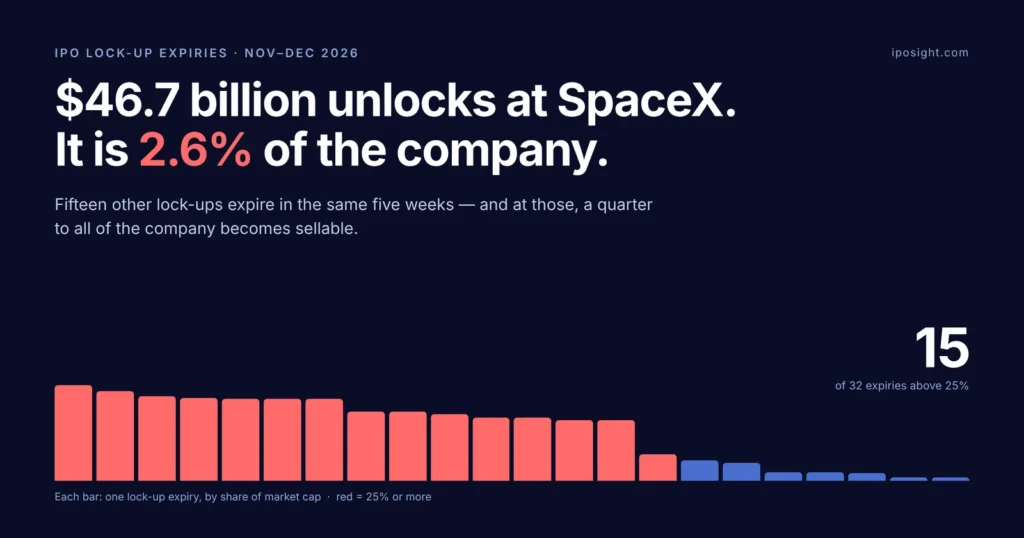
On 8 December, 328.4 million SpaceX shares come free of their lock-up — about $46.7 billion of stock, the largest single IPO lock-up expiry on any calendar this year. It is also one of the least consequential. Those shares are 2.6% of the company, and the market trades enough SpaceX stock in three ordinary sessions to absorb all of them. In the same five weeks, fifteen smaller lock-ups expire where the unlocking stock is worth a quarter to effectively all of the company — and one of them would take the market more than four hundred trading days to swallow. Nobody is writing about those, because the dollar figures are small. The dollar figure is the wrong number.
The short version
- SpaceX unlocks $46.7 billion on 8 December — 2.6% of the company, and 2.9 days of its own trading volume. It is a headline, not an event.
- Fifteen of the 32 expiries we track in this window release stock worth 25% or more of the entire company.
- Fourteen would take 50 or more normal trading sessions to absorb. Forbright would take 406.
- 1 December is the heaviest day: four expiries, roughly $23 billion, every one of them above 85% of its own market capitalization.
- Almost the entire cohort is under water: of the twenty companies we checked, two trade above their first close. That changes who is willing to sell, and it is the part the dollar headlines never mention.
- An expiry removes a legal restriction. It does not create a seller. Everything below is a measure of potential supply.
What an IPO lock-up expiry actually is
When a company goes public, the underwriters require existing shareholders — founders, employees, venture and private-equity backers — to sign an agreement not to sell for a set period. One hundred and eighty days is the convention. The agreement is reproduced in the prospectus, which means the expiry date is public knowledge from the first day of trading.
That matters more than it sounds. There is no surprise in a lock-up expiry. Every participant can read the date in a filing months ahead, so the share price typically adjusts before the date rather than on it. Studies of US listings have found the drift begins weeks out and the expiry day itself is often unremarkable. If you are watching the calendar for a one-day crash, you are usually watching the wrong day.
What is not obvious from the filing is the magnitude. A prospectus gives you share counts and dates; it does not tell you what proportion of the company those shares represent today, and it certainly does not tell you how long it would take the market to absorb them. Those two numbers are what separate an event from a footnote, and they are what we compute for every expiry on our Key Dates page.
The SpaceX number is widely quoted and widely misunderstood
Space Exploration Technologies listed on 12 June 2026 at $135.00 per share, selling 555,555,555 shares for roughly $75 billion — the largest IPO ever completed. Naturally, its lock-up expiry is the one being written about.
But the SpaceX lock-up was never a single cliff. The prospectus sets out a staged release for the 180-day group, and most of it has already run:
- Up to 20% on the first earnings release date, for the quarter ended 30 June 2026.
- Up to a further 10%, conditional: released only if the closing price was at least 30% above the offer price — $175.50 — on at least five of the ten consecutive trading days ending on that earnings date.
- Up to 7% on each of 20 August, 9 September, 24 September, 9 October and 24 October 2026 — 35% in total.
- Up to a further 28% after the quarter ended 30 September 2026.
- On 8 December 2026, day 180: whatever that group still holds.
So the December date is the remainder of a schedule, not the whole of it. The conditional tranche is worth dwelling on, because staged lock-ups with price tests have become common and they are routinely reported as though they were certain: if the condition is not met, nothing is released at all, and a headline built on the full share count overstates what reaches the market.
Separately, the founder’s shares carry no early-release provision and stay locked until day 366, and a further group of shareholders runs on an extended schedule reaching into the middle of 2027.
Then there is the scale. At a market capitalization of roughly $1.82 trillion, 328.4 million shares are 2.6% of the company. SpaceX trades around 114 million shares a day. The entire unlock is 2.9 sessions of normal volume. It is, on both measures, among the least significant expiries on the calendar.
The largest lock-up expiry of 2026 is also one of the smallest things happening in the market that week.
The second number: how much of the company is coming free
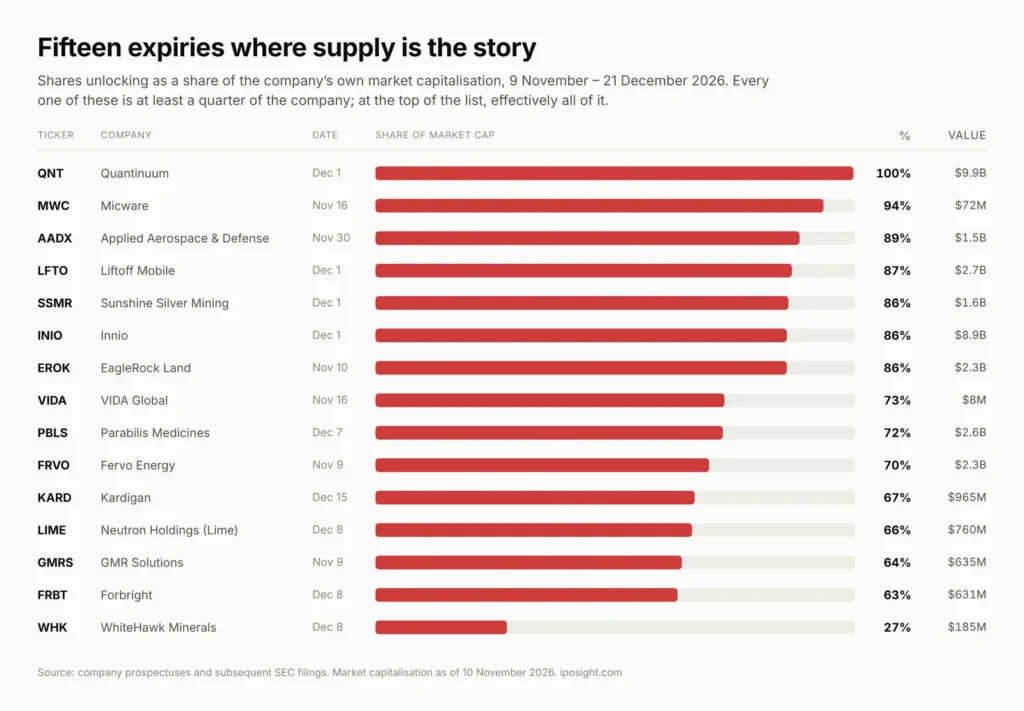
Divide the unlocking value by market capitalization and the calendar reorders itself completely. Of the 32 expiries falling between 9 November and 21 December 2026, fifteen involve stock worth at least a quarter of the whole company. Ranked by that ratio:
| Date | Company | Value | Share of market cap |
| Dec 1 | Quantinuum (QNT) | $9.9B | 100% |
| Nov 16 | Micware (MWC) | $72M | 94% |
| Nov 30 | Applied Aerospace & Defense (AADX) | $1.5B | 89% |
| Dec 1 | Liftoff Mobile (LFTO) | $2.7B | 87% |
| Dec 1 | Sunshine Silver Mining (SSMR) | $1.6B | 86% |
| Dec 1 | Innio (INIO) | $8.9B | 86% |
| Nov 10 | EagleRock Land (EROK) | $2.3B | 86% |
| Nov 16 | VIDA Global (VIDA) | $8M | 73% |
| Dec 7 | Parabilis Medicines (PBLS) | $2.6B | 72% |
| Nov 9 | Fervo Energy (FRVO) | $2.3B | 70% |
| Dec 15 | Kardigan (KARD) | $965M | 67% |
| Dec 8 | Neutron Holdings / Lime (LIME) | $760M | 66% |
| Nov 9 | GMR Solutions (GMRS) | $635M | 64% |
| Dec 8 | Forbright (FRBT) | $631M | 63% |
| Dec 8 | WhiteHawk Minerals (WHK) | $185M | 27% |
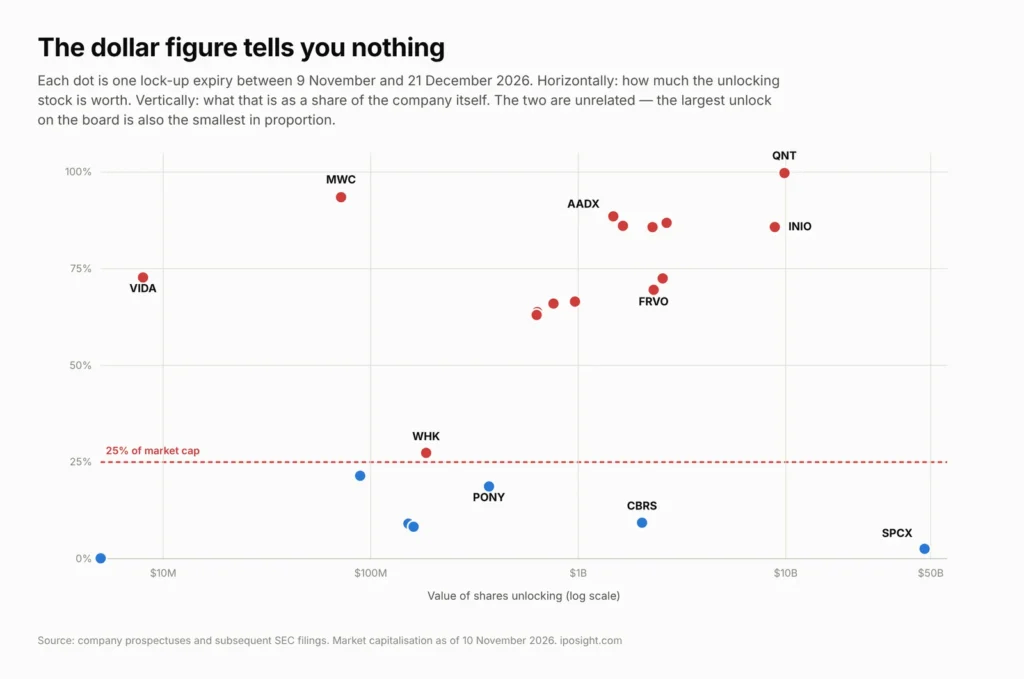
Quantinuum is the extreme case: the shares releasing on 1 December are worth essentially the entire company. Micware, at $72 million, would not appear on any list ranked by dollars — and it is 94% of the company. Fervo Energy’s expiry has already passed, on 9 November, with 205 million shares worth $2.31 billion coming free against a $3.32 billion market cap, in a stock already 58% below its offer price.
The third number: absorb days, and why it changes the ranking again
Proportion tells you how much of the company is involved. It does not tell you whether the market could cope. For that, divide the unlocking share count by the stock’s own average daily volume. We call the result absorb days: the number of normal trading sessions it would take for the market, at its current pace, to take the whole of the newly sellable supply.
It is a crude measure and deliberately so. It assumes every unlocked share is sold, which never happens, and it assumes volume stays at its recent average, which it does not. What it captures is the thing proportion misses entirely — thinness. Two companies can both unlock 65% of themselves; if one trades a million shares a day and the other eighty thousand, they are not the same situation.
As of 13 November, using a twenty-session average volume, here is the same calendar ranked the other way:
| Absorb days | Date | Company | Shares unlocking | Avg daily volume | Share of cap |
| 406 | Dec 8 | Forbright (FRBT) | 33,396,775 | 82,250 | 63% |
| 357 | Nov 10 | EagleRock Land (EROK) | 112,825,000 | 316,460 | 86% |
| 333 | Nov 16 | Micware (MWC) | 55,441,914 | 166,665 | 94% |
| 200 | Dec 1 | Liftoff Mobile (LFTO) | 147,480,527 | 737,025 | 87% |
| 178 | Nov 16 | VIDA Global (VIDA) | 10,332,932 | 58,170 | 73% |
| 137 | Dec 1 | Sunshine Silver Mining (SSMR) | 116,509,480 | 848,280 | 86% |
| 126 | Dec 15 | Kardigan (KARD) | 64,301,057 | 511,685 | 67% |
| 97 | Dec 1 | Quantinuum (QNT) | 231,285,571 | 2,387,095 | 100% |
| 93 | Dec 1 | Innio (INIO) | 646,668,888 | 6,932,200 | 86% |
| 80 | Dec 7 | Parabilis Medicines (PBLS) | 84,981,665 | 1,067,690 | 72% |
| 74 | Dec 8 | Neutron Holdings / Lime (LIME) | 43,100,000 | 584,560 | 66% |
| 58 | Nov 30 | Applied Aerospace & Defense (AADX) | 138,243,518 | 2,375,275 | 89% |
| 57 | Nov 9 | GMR Solutions (GMRS) | 57,685,223 | 1,014,245 | 64% |
| 51 | Dec 8 | WhiteHawk Minerals (WHK) | 7,444,316 | 146,715 | 27% |
| 2.9 | Dec 8 | SpaceX (SPCX) | 328,400,000 | 113,929,205 | 3% |
Forbright is the name the dollar ranking buries and the absorb ranking surfaces. A $631 million unlock is unremarkable by 2026 standards. But the stock trades roughly 82,000 shares a day, and 33.4 million shares are coming free — more than a year and a half of trading at the current pace. That is not a number that resolves itself in a week.
Where the two measures disagree
Most of the time proportion and absorb days point the same way. The interesting cases are the ones where they do not.
High proportion, liquid market: Fervo Energy
Fervo Energy released 70% of its market capitalization on 9 November — but the stock trades almost ten million shares a day, so the unlock is about 21 sessions of volume. Heavy, certainly. Not structurally unabsorbable.
Moderate proportion, no market at all: WhiteHawk Minerals
WhiteHawk Minerals is the lowest entry on the proportion table at 27% — and still needs 51 days of volume. A quarter of a company is a lot when only 147,000 shares change hands a day.
Enormous dollars, trivial on both measures: SpaceX
2.6% of the company, 2.9 days of volume. The largest number on the calendar, and the smallest consequence.
The pattern across the whole list is consistent: the expiries that deserve attention are the small and mid-cap names where a venture-backed register is unlocking into a market that was never built to take it. The mega-cap listings, for all the coverage they attract, have the liquidity to cope.
What decides whether potential supply becomes selling
What follows is not a buy list and not an avoid list. We do not rate shares, and nothing here is a recommendation — a lock-up expiry removes a restriction, it does not tell you what a company is worth. But three mechanics decide how an expiry plays out, and they can be read off the numbers.
First: are the holders in profit?
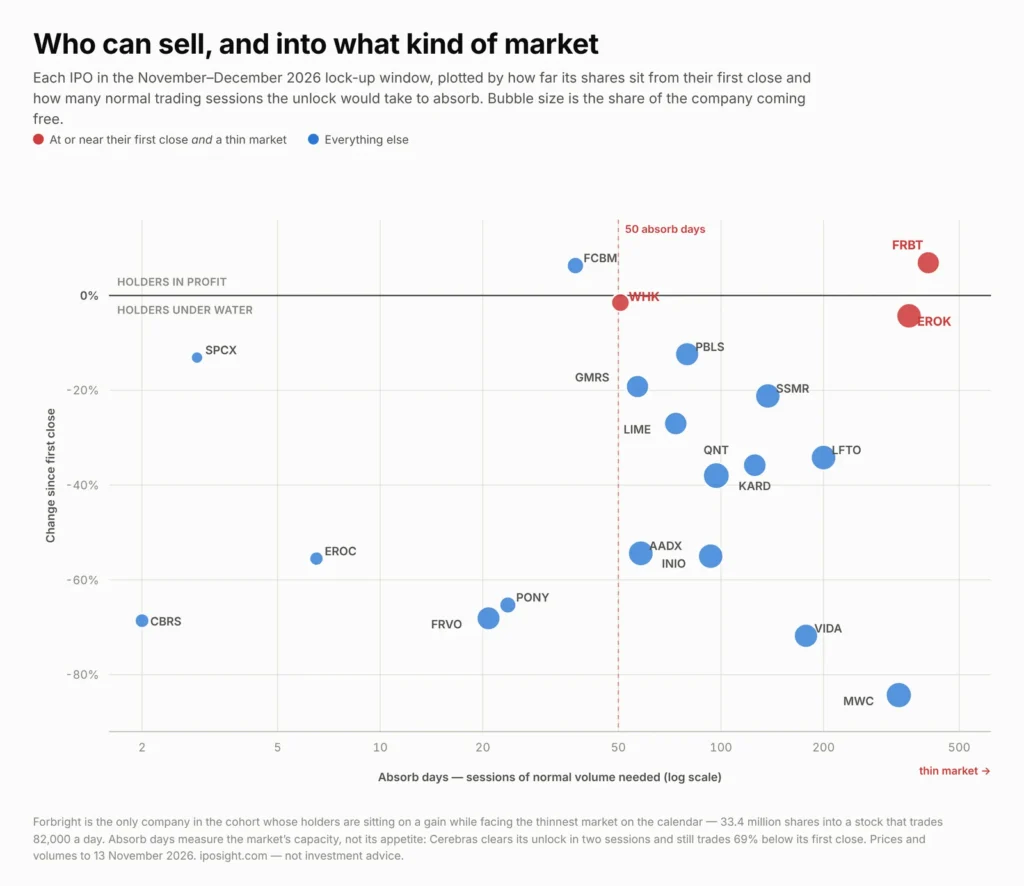
This is the mechanism most coverage skips. A shareholder sitting on a gain has both the ability and a reason to realize it; a shareholder nursing a 70% loss has the ability and no reason at all. The classic bad setup is a stock that has run up hard into a large unlock: willing supply meets a price that rewards selling.
What makes this cohort unusual is that the setup barely exists. We checked all twenty companies in this window against their first closing price. Two are above it:
| Company | Since first close | Share of cap unlocking | Absorb days |
| Forbright (FRBT) | +6.9% | 63% | 406 |
| First Carolina (FCBM) | +6.3% | 21% | 37 |
| WhiteHawk Minerals (WHK) | −1.5% | 27% | 51 |
| EagleRock Land (EROK) | −4.3% | 86% | 357 |
| Parabilis Medicines (PBLS) | −12.4% | 72% | 80 |
| SpaceX (SPCX) | −13.1% | 3% | 2.9 |
| GMR Solutions (GMRS) | −19.2% | 64% | 57 |
| Sunshine Silver (SSMR) | −21.2% | 86% | 137 |
| Lime (LIME) | −27.0% | 66% | 74 |
| Liftoff Mobile (LFTO) | −34.2% | 87% | 200 |
| Kardigan (KARD) | −35.8% | 67% | 126 |
| Quantinuum (QNT) | −38.0% | 100% | 97 |
| Applied Aerospace (AADX) | −54.4% | 89% | 58 |
| Innio (INIO) | −55.0% | 86% | 93 |
| ERock (EROC) | −55.5% | 8% | 6.5 |
| Pony AI (PONY) | −65.3% | 19% | 24 |
| Fervo Energy (FRVO) | −68.1% | 70% | 21 |
| Cerebras Systems (CBRS) | −68.6% | 9% | 2.0 |
| VIDA Global (VIDA) | −71.8% | 73% | 178 |
| Micware (MWC) | −84.3% | 94% | 333 |
Forbright is therefore the one name on this calendar where both conditions line up: holders are in profit, and the market that would have to take their stock is the thinnest on the list at 406 absorb days. It is the clearest example of the setup, and it gets almost no coverage because $631 million is not a headline number in 2026.
One caveat that matters, and it cuts against the whole table: a venture or private-equity holder whose cost basis was set years before the IPO can be in profit even when the stock is 70% below its first close. The prospectus discloses what those earlier rounds paid; the share price alone does not. Where a pre-IPO round priced far below the offer, “under water” describes the public shareholder, not the insider with stock to sell.
Second: can the market take it without being asked twice?
Where absorb days are low, the unlock is arithmetic noise whatever the dollar headline says, and if the stock moves in the following weeks the lock-up will not be the reason. In this window that group is:
- Cerebras Systems (CBRS) — $2.0 billion of stock, but 9% of a $21.8 billion company and 2.0 days of volume.
- SpaceX (SPCX) — 3% of cap, 2.9 days.
- Blackstone Digital Infrastructure Trust (BXDC) — 9% of cap, 4.7 days.
- Fervo Energy (FRVO) — 70% of cap, but nearly ten million shares a day and 21 days; and the date has already passed.
- Pony AI (PONY) — 81.2 million shares on 17 November, 19% of cap, 24 days.
But here is the trap, and it is worth being blunt about: depth is not demand. A market that can absorb a large unlock in two sessions is telling you that a lot of stock changes hands, not that buyers like the company. Cerebras has the second-lowest absorb-days figure on the calendar and trades 69% below its first close. Heavy volume in a falling stock is sellers finding buyers at ever lower prices. Absorb days measures the market’s capacity, never its appetite, and no column on this page is a substitute for looking at revenue, margins and cash.
Third: where the arithmetic leaves no room at all
At the other end, the newly sellable stock is large against both the company and the market for it. That does not mean the shares will fall. It means that if even a modest share of holders sell, there is no depth to take it quietly, and the adjustment is measured in months rather than days.
- Forbright (FRBT), 8 December — 63% of cap, 406 absorb days, holders in profit. The sharpest case on the calendar.
- EagleRock Land (EROK), 10 November — 86% of cap, 357 days, and roughly flat since listing, so holders are neither trapped nor punished for selling.
- Micware (MWC), 16 November — 94% of cap, 333 days, 84% below its first close. Here the loss itself is the brake on selling.
- Liftoff Mobile (LFTO), 1 December — 87% of cap, 200 days, $2.7 billion of stock.
- Quantinuum (QNT), 1 December — the only name where the unlocking stock is worth essentially the whole company, at 97 days of volume.
What tells you which way it resolved
Potential supply becomes real supply only when someone sells, and that leaves a paper trail. Affiliates selling restricted stock must file a Form 144 with the SEC before the sale, and officers and directors file a Form 4 after it. Watching those filings in the fortnight after an expiry is the difference between knowing what could happen and knowing what did. A second signal is volume itself: if daily turnover rises several-fold around the date, the supply is being tested; if it does not, the overhang is still sitting there, waiting for a better price.
The calendar: three dates to mark
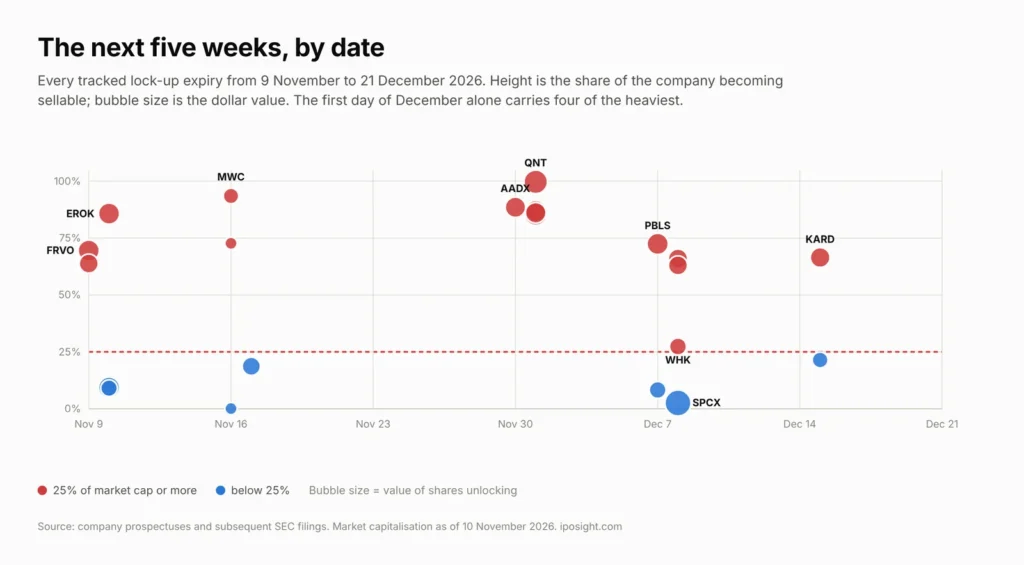
16 November — two micro-caps on the same day
Micware at 94% of its market capitalization and 333 absorb days, and VIDA Global at 73% and 178 absorb days. Both are more than 70% below their first close. In both, the unlocking stock dwarfs anything that currently trades.
1 December — the heaviest day on the calendar
Four expiries at once: Quantinuum, Innio, Liftoff Mobile and Sunshine Silver Mining, together about $23 billion, and every one of them above 85% of its own market capitalization. Quantinuum alone is 231 million shares against a 2.4 million-share daily average.
8 December — the day the coverage goes to the wrong name
The headlines will be about SpaceX at 2.6% of the company. On the same date: Lime at 66% and 74 absorb days, Forbright at 63% and 406, and WhiteHawk Minerals at 27% and 51.
What these numbers do not tell you
Three limits, stated plainly, because a ratio presented without them is worse than no ratio at all.
Unlocking is not selling
A lock-up expiry removes a legal restriction. It does not create a seller, and it does not oblige anyone to do anything. Insiders at a company trading 80% below its offer price may be the least willing sellers on the register. Every figure on this page measures potential supply, nothing more.
Market capitalization is not free float
The proportion column measures unlocking value against the whole company. Measured against the shares that actually trade today, the figures would be larger still at most of these names — which is the direction that matters, but it is not what the column shows. Treat it as a conservative floor.
Average volume is a backward-looking number
Absorb days uses the last twenty sessions. If volume rises into an expiry — and at a contested name it usually does — the real absorption is faster than the figure implies. Equally, a stock that is thin today was often thinner before the IPO cohort arrived. The number is a measure of market depth, not a forecast of anything.
How to read any lock-up headline in thirty seconds
- Divide the dollar figure by market capitalization. Under 5% and the number is scenery, whatever its size.
- Divide the share count by average daily volume. Under about ten sessions and the market can take it in stride; over fifty and the stock has a structural problem for months, not days.
- Check where the share price sits against the offer. A holder in profit is a willing seller; a holder down 70% often is not.
- Check whether the tranche is conditional. Staged lock-ups with price tests are now common. A condition that was not met releases nothing at all, and the headline will not say so.
- Check whether it is the whole lock-up or one stage of it. Founder shares frequently run to day 366 or beyond, on a separate schedule.
- Remember the date was public all along. Whatever the market was going to do about it, it has had months to start.
Frequently asked questions
What is an IPO lock-up expiry?
It is the date on which shareholders who agreed not to sell at the time of the IPO — founders, employees and pre-IPO investors — are first permitted to sell. The agreement and the date are set out in the company’s prospectus, so both are public from the first day of trading.
How long is a typical lock-up period?
One hundred and eighty days is the convention for US listings. Staged releases are increasingly common, with tranches at the first and second earnings dates, at fixed intervals, and at day 180 or day 366. Some tranches are conditional on the share price holding a set premium to the offer price.
Do share prices fall at a lock-up expiry?
Not reliably on the day. Because the date is known months in advance, any adjustment tends to happen in the weeks before it. The size of the effect varies enormously with how much of the company is involved, how liquid the stock is, and whether the holders are sitting on a gain or a loss — which is why we publish all three rather than the dollar value alone.
What are absorb days?
The unlocking share count divided by the stock’s average daily trading volume over the last twenty sessions. It estimates how many normal trading days it would take the market to absorb the supply if all of it were sold. It is a measure of market depth, not a prediction, and a deep market can still be a falling one.
How can I tell whether insiders actually sold?
Affiliates must file a Form 144 with the SEC before selling restricted stock, and officers and directors file a Form 4 afterwards. Those filings, together with a sustained jump in daily volume, are the evidence that potential supply became real supply.
Where can I see the full list?
Every expiry we can date from a filing, with its source document, is on our Key Dates page, updated weekly. The ratio and absorb-days columns are published there alongside each row.
Methodology
Every date, share count and trigger condition on this page is read from the companies’ own SEC filings — prospectuses, annual and quarterly reports, and exhibits — and each row on our Key Dates page links to the filing it came from. Market capitalizations are as of 10 November 2026. Average daily volumes are the twenty sessions to 13 November 2026. Performance is measured from each company’s first closing price as a listed company to its close on 13 November 2026; where we hold the offer price separately, the figure against the offer can differ, and EagleRock is one such case — roughly flat against its first close, but about 13% above its $18.50 offer. Where a lock-up releases in tranches, each tranche is listed on its own date; a staged lock-up is never collapsed into a single day. Our full data method is described on the Method page.
Sources & References
[1] SEC EDGAR — Space Exploration Technologies Corp., Underwriting / Lock-up Agreements
[2] SEC EDGAR — prospectuses, 10-K, 10-Q and exhibit filings for each company listed; each row on the Key Dates page links to its own source document
[3] iposight.com — Key Dates lock-up tracker, data as of 10 November 2026; average daily volume and price performance over the sessions to 13 November 2026
iposight.com — for informational purposes only, not investment advice. No position in any security mentioned.
Discover more from IPOSight
Subscribe to get the latest posts sent to your email.