
Industrial Services | Environmental Services | Recycling | E-Waste Recycling | Micro-Cap Value |
Here is a company that reported 23% revenue growth to $65.8 million, 81% EPS growth to $0.225, zero debt, a P/E ratio of 8.3× at a time when the S&P 500 trades at 19×, and a unique government-licensed monopoly on hazardous e-waste imports in the Philippines. Its stock has fallen 73% in six months. Either the market knows something the fundamentals don’t — or this is one of the most interesting deep-value micro-cap situations of 2026.
What One and One Green Technologies Actually Does
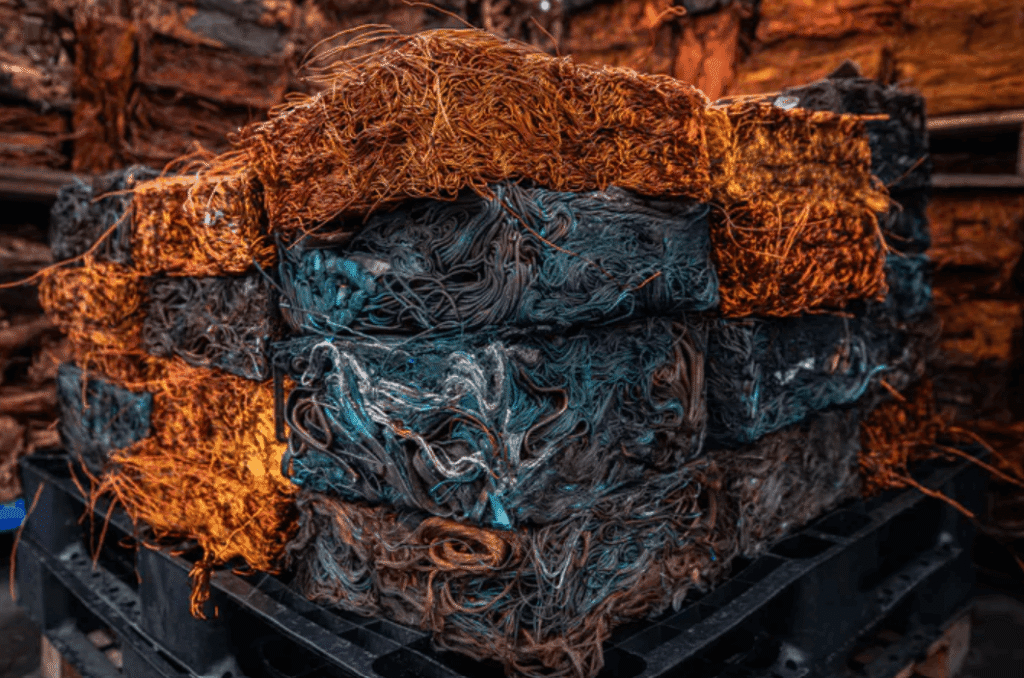
One and One Green Technologies (ticker: YDDL — reflecting its Chinese name, “一比一绿色科技”) is a Filipino-incorporated company with operations primarily in the Philippines and revenue overwhelmingly derived from China. Its core business is the purchase, processing, and trading of electronic waste and scrap metals — specifically copper alloy ingots (30% of revenue), recycled aluminium (25%), tin/zinc/iron (20%), plastic beads recovered from e-waste streams (15%), and other scrap metal trading (10%).
The company’s critical competitive advantage — and the thing that makes it genuinely unusual — is its government licence from the Philippines Environmental Management Bureau (EMB) authorising the import and processing of hazardous electronic waste. This licence is not easily obtained. The Philippines Basel Convention implementation and the EMB’s Toxic Substances and Hazardous and Nuclear Wastes Control Act create a regulatory barrier that few companies can clear. One and One holds this clearance, enabling it to import e-waste from developed markets (Japan, South Korea, Taiwan, and increasingly Europe and the U.S.) at very low cost, process it at its Philippines facility, and sell the recovered metals — primarily into the Chinese industrial market where demand for copper and aluminium is structural and enormous.
The operations are run by a lean team of approximately 90 employees generating $731,000 of revenue per employee — a figure that reflects the capital-intensive, commodity-trading nature of the business rather than high headcount. The vertically integrated model (acquire scrap → process → sell refined metals) is classic commodity processing, with margins depending on the spread between scrap input prices and refined output prices.
The Financials: Real and Genuinely Impressive
The financial profile of YDDL is the central puzzle of this investment case. For a stock down 73%, the numbers are surprisingly strong. Revenue grew 23% year-over-year to $65.8 million. Net income was $11.81 million — a healthy 17.9% net margin for a commodity processor. EPS jumped 81% to $0.225. The company carries zero debt. At the current stock price, the P/E ratio is approximately 8.2–8.3× — compared to 19.2× for the S&P 500 and approximately 12–15× for comparable Western recycling and metals companies (Republic Services, GFL Environmental, Nucor).
The zero-debt balance sheet is particularly significant in the current environment. Most commodity processors carry substantial leverage — debt to fund inventory, working capital, and processing equipment. YDDL’s clean balance sheet means it has no interest expense, no refinancing risk, and genuine financial flexibility to invest in capacity expansion or weather a commodity price downturn without existential pressure.
The value gap in one number: At P/E 8.3× for a company with 23% revenue growth, 17.9% net margin, zero debt, and a government-licenced monopoly on a specific supply chain — this is either one of the most undervalued small-cap companies on any U.S. exchange, or the market is discounting risks that the headline numbers don’t capture. This analysis examines both possibilities with equal rigour.
Why Did It Fall 73%? The Real Risk Factors
The market’s 73% verdict demands a serious explanation. Several factors combine to produce this extreme dislocation:
Micro-cap liquidity risk. At $100M market cap and 90 employees, YDDL is a genuine micro-cap. Daily trading volumes are thin. When even a single small fund exits a position, the market depth cannot absorb the selling without a significant price impact. The 73% decline does not necessarily mean the business deteriorated — it may mean that a few holders who entered at IPO decided to exit simultaneously, and there were insufficient buyers to absorb them. This is a structural feature of micro-cap stocks, not a business commentary.
China revenue concentration. The company’s revenue is overwhelmingly derived from selling processed metals into the Chinese industrial market. China’s post-COVID industrial recovery has been uneven, and copper and aluminium demand has been softer than expected in H1 2026 as Chinese construction activity disappointed. Any slowdown in Chinese industrial activity directly hits YDDL’s top line, and investors may be pricing in a China demand risk premium.
Jurisdictional risk and corporate governance questions. YDDL is a Philippine-incorporated company listed on Nasdaq. For many U.S. institutional investors, this combination — small non-U.S. company, Nasdaq listing, operations in a developing market, primary customers in China — triggers automatic risk filters that lead to exclusion from portfolios regardless of fundamentals. The institutional buyer universe is narrower than for a comparable U.S. company.
Post-IPO lock-up expiry dynamics. The company IPO’d in October 2025. The all-time high was April 7, 2026 — approximately six months post-IPO, consistent with lock-up expiry for early investors. The all-time low was July 24, 2026, as post-lock-up selling continued. This is a well-documented pattern in micro-cap IPOs where early investors exit in waves after lock-up release, creating price dislocations unrelated to fundamental value.
Disclosure and audit quality concerns. Small Asian companies listed on U.S. exchanges via IPO have historically had mixed track records on financial disclosure quality. The Seeking Alpha contributor analysis (the only real outside analytical coverage visible) in April 2026 predated the worst of the decline. Without major institutional coverage or a Big Four audit, some investors apply a “Chinese company discount” even to fundamentally sound businesses. This is not necessarily fair — but it is real.
The Global E-Waste Market: A Genuine Growth Story
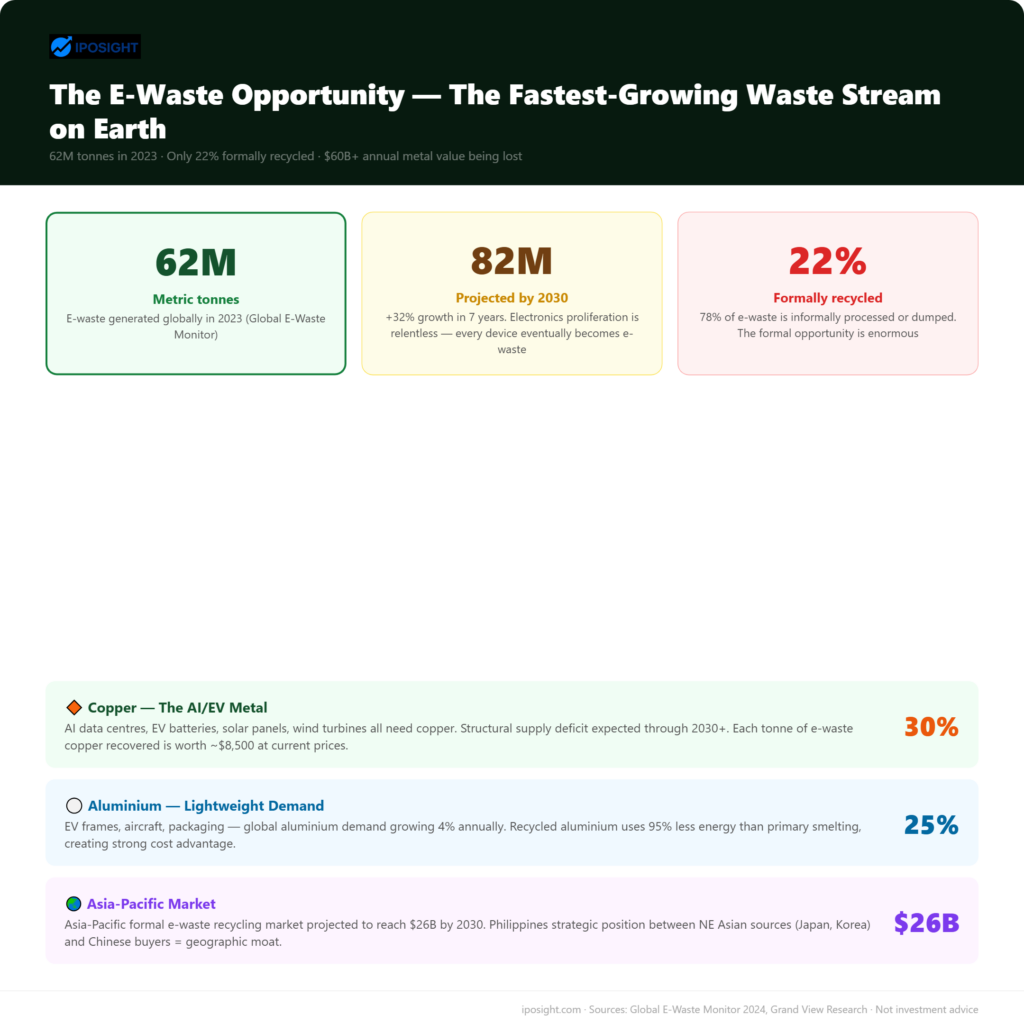
E-waste is the fastest-growing waste stream globally. The Global E-Waste Monitor reports approximately 62 million metric tonnes of e-waste generated in 2023, projected to reach 82 million metric tonnes by 2030. Less than 25% is formally collected and recycled — meaning the vast majority is either dumped, informally processed (often hazardously), or stockpiled. The economic value of the metals in global e-waste is estimated at over $60 billion annually, of which only a fraction is recovered through formal channels.
The Philippines’ geographic position — between the high-volume e-waste generators of Northeast Asia (Japan, South Korea, Taiwan) and the major metals consumers of China and Southeast Asia — creates a natural processing hub opportunity. YDDL’s regulatory licence is the key that unlocks this geography. If copper prices continue their structural rise (driven by EV demand, renewable energy infrastructure, AI data center copper wiring), the value of refined copper from e-waste processing increases proportionally.
The total addressable market for formal e-waste recycling in Asia-Pacific alone is projected to reach $26 billion by 2030 (Grand View Research). YDDL’s current $65.8M revenue represents a tiny fraction of this — which is both the opportunity and the scale risk.
Real Competitive Landscape
The actual competitive landscape operates at three levels.
Formal Asian e-waste processors: Japan’s DOWA Holdings and South Korea’s Korea Zinc are the most sophisticated Asian precious metals recoverers from e-waste, but operate primarily in their domestic markets and at much larger scale. Umicore (Belgium) is the global leader in e-waste precious metals recovery but is not geographically focused on Southeast Asia.
Philippine domestic competitors: Several smaller Philippine recyclers operate in the scrap metal space, but YDDL’s EMB licence for hazardous e-waste imports is its key differentiator — most domestic competitors are restricted to domestically-generated scrap, limiting their supply access and margin.
Informal sector competition: The most significant “competition” is the informal e-waste sector — unregulated operations in the Philippines, Vietnam, and Indonesia that process e-waste without environmental controls. These operations have lower costs but cannot serve regulated export markets and face increasing regulatory pressure as Asian governments tighten environmental enforcement.
ETF Exposure Analysis
The ETF positions are real but microscopic. IWM (iShares Russell 2000, 0.01%) and VXF (Vanguard Extended Market, 0.005%) are broad small-cap index funds that mechanically include Nasdaq-listed companies meeting minimum criteria. SMCP (VanEck Small-Cap Growth, 0.05%) at the highest weight is the most meaningful — it suggests YDDL meets the growth criteria for a small-cap growth screen. SPSM (Invesco S&P SmallCap Momentum, 0.03%) is notable: momentum funds typically exit on sharp price declines, which may partly explain selling pressure.
The combined ETF holdings represent negligible AUM but confirm YDDL is a genuine Nasdaq-listed entity subject to normal index mechanics. There is no major institutional or thematic ETF holding — recycling/e-waste specialist funds do not appear to hold YDDL, which is consistent with the micro-cap size and non-U.S. operations.
Bulls and Bears
The bull case is built on fundamental value that is genuinely unusual for any listed company. A P/E of 8.3× for a company growing revenue 23% with 17.9% net margins and zero debt is a value investor’s dream scenario — if the numbers are real and the business is durable. The government licence creates a genuine regulatory moat. The secular e-waste growth trend is undeniable. Copper and aluminium structural demand from the energy transition is a multi-decade tailwind. And the lock-up-expiry selling that drove the 73% decline is a mechanical phenomenon that resolves itself once early holders have fully exited.
The bear case centres on three risks that the fundamentals cannot fully address: (1) the possibility that the financial statements do not accurately reflect underlying business performance — a risk that cannot be dismissed for small Asian companies with limited institutional coverage; (2) China revenue concentration that makes YDDL effectively a leveraged bet on Chinese industrial demand; and (3) the structural reality that micro-cap stocks with thin liquidity can stay irrationally cheap for extended periods — “cheap can get cheaper” is the most common mistake of micro-cap value investors.
12-Month Price Scenario Analysis
Bull scenario (~30% probability): $4–$8. China industrial demand recovers in H2 2026. Copper prices strengthen. Q3 results confirm revenue growth continuation. A value-focused small-cap fund discovers and publicises the value gap. Additional recycling sector M&A activity (any deal involving comparable companies) brings attention to the category. The stock re-rates from 8× to 12–15× earnings, implying $3.40–$4.25 target (at $11.81M net income), but sentiment-driven re-rating could overshoot.
Base scenario (~45% probability): $1.50–$3. The stock stabilises at current or slightly lower levels as post-lock-up selling exhausts itself. No major catalysts but fundamentals remain intact. The company continues operating profitably but remains invisible to most institutional investors. Range-bound with extreme volatility on any news.
Bear scenario (~25% probability): $0.50–$1.50. Chinese industrial demand deteriorates further. Copper prices fall 15%+ on global recession fears. Revenue contracts. Financial disclosure questions emerge (even without confirmed wrongdoing, any doubt at this scale would be devastating). The stock approaches technical delisting territory or attracts reverse merger speculation.
Scaled Entry Strategy
Given the extreme micro-cap risk, a scaled entry is the only defensible approach. A practical framework for investors who want exposure: 20–25% of intended position at current levels, with subsequent tranches at $1.50 and $1.00 if the stock continues lower, and a final tranche after one confirmed strong quarterly earnings report. Total position size should not exceed 0.5–1% of a diversified portfolio — the loss if the thesis is wrong must be manageable.
The breakeven thesis requires: no financial disclosure problems emerging, China industrial activity remaining stable, and at least one quarter of continued profitability demonstrating that the IPO-year results were not one-time. The P/E re-rating catalyst requires institutional discovery — which requires either significant media coverage or a value-focused fund taking a disclosed stake.
Critical disclaimer for YDDL: This is a micro-cap ($100M), non-U.S. company with limited institutional coverage, primary revenue from China, and a 73% price decline that the market has not explained publicly. The fundamental value case is real. The risks are also real and largely unquantifiable. This is appropriate only for experienced investors who can afford to lose the entire position.
Investment Evaluation
| Factor | Score |
| Fundamental Value | 9/10 |
| Zero Debt Balance Sheet | 9/10 |
| Regulatory Moat | 8/10 |
| E-Waste Sector Tailwinds | 8/10 |
| Revenue Growth | 8/10 |
| China Revenue Concentration | 3/10 |
| Micro-Cap Liquidity Risk | 3/10 |
| Governance & Disclosure Risk | 3/10 |
| Institutional Coverage | 3/10 |
| Long-Term Potential | 8/10 |
Overall Investment Score: 5.6 / 10 · Speculative value play for experienced micro-cap investors only. Maximum 0.5–1% portfolio. Scaled entry. Verify financial statements independently before committing.
Final Verdict
One and One Green Technologies is one of the most intellectually interesting micro-cap situations in the 2026 IPO class. A profitable, growing, zero-debt company with a genuine regulatory moat, in a secular growth industry, trading at 8× earnings after a 73% price collapse. The value gap between fundamentals and price is real and large.
Whether that gap is an opportunity or a warning depends on one question that external analysis cannot definitively answer: are the financial statements accurate? For a $100M Filipino company with China revenue concentration and no institutional coverage, this question carries more weight than it would for a U.S. company with Big Four audit, SEC scrutiny, and institutional analyst coverage.
For investors who can accept this uncertainty and size accordingly — YDDL at current levels is a calculated speculative bet on a real business at a dramatically cheap price. For investors who require institutional validation before committing capital — the stock may be right but the timing may be premature.
“A P/E of 8 for a company growing 23% with zero debt is either the deal of the year or a governance question the market has already answered. The truth is somewhere in between — and finding it is the work of serious micro-cap due diligence.”
Sources & References
[1] One and One Green Technologies — onepgti.com
[2] TradingView — NASDAQ: YDDL — tradingview.com
[3] YDDL PDF Analysis — Stock Analysis Tool, August 17, 2026
[4] SEC Edgar — YDDL filings — sec.gov
[5] Global E-Waste Monitor 2024 — UN University / ITU / UNITAR
[6] Grand View Research — Asia-Pacific E-Waste Recycling Market Report 2024
[7] Seeking Alpha — Renato Neves analysis, April 8, 2026
[8] Philippines EMB — Toxic Substances and Hazardous Wastes Control Act implementation
iposight.com — for informational purposes only, not investment advice. Micro-cap stocks carry extreme risk of total loss.