
Industrial Services | Environmental Services | Advanced Recycling | Plastic Recycling | Polypropylene UPR| Sustainable Packaging
For five years, PureCycle Technologies was the most compelling recycling company that couldn’t quite execute. It had the world’s only scalable process for converting waste polypropylene into virgin-quality resin, a Nobel Prize-winning chemistry licence from Procter & G&le, and a customer waitlist of major consumer brands desperate for recycled plastic. What it lacked was a functioning factory at commercial scale. In August 2026, that changed. The Ironton, Ohio plant is running. Six consecutive quarters of rising revenue. Stan Druckenmiller is still in. The question now is whether $7.33 is the entry point of the decade — or just another false dawn.
What PureCycle Does: The Only Process That Works
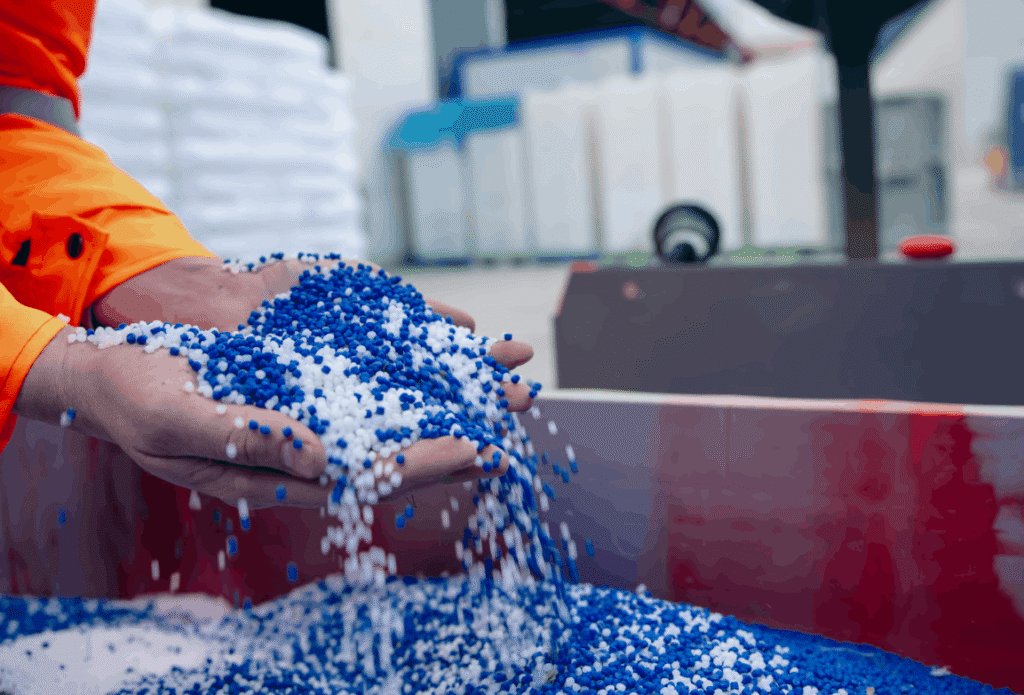
PureCycle Technologies holds an exclusive worldwide licence from Procter & Gamble for a patented purification technology that does what no other industrial process can do at scale: take contaminated, mixed, coloured waste polypropylene — the most widely used plastic in the world — and convert it into ultra-pure, colourless, odourless resin that is functionally identical to virgin polypropylene.
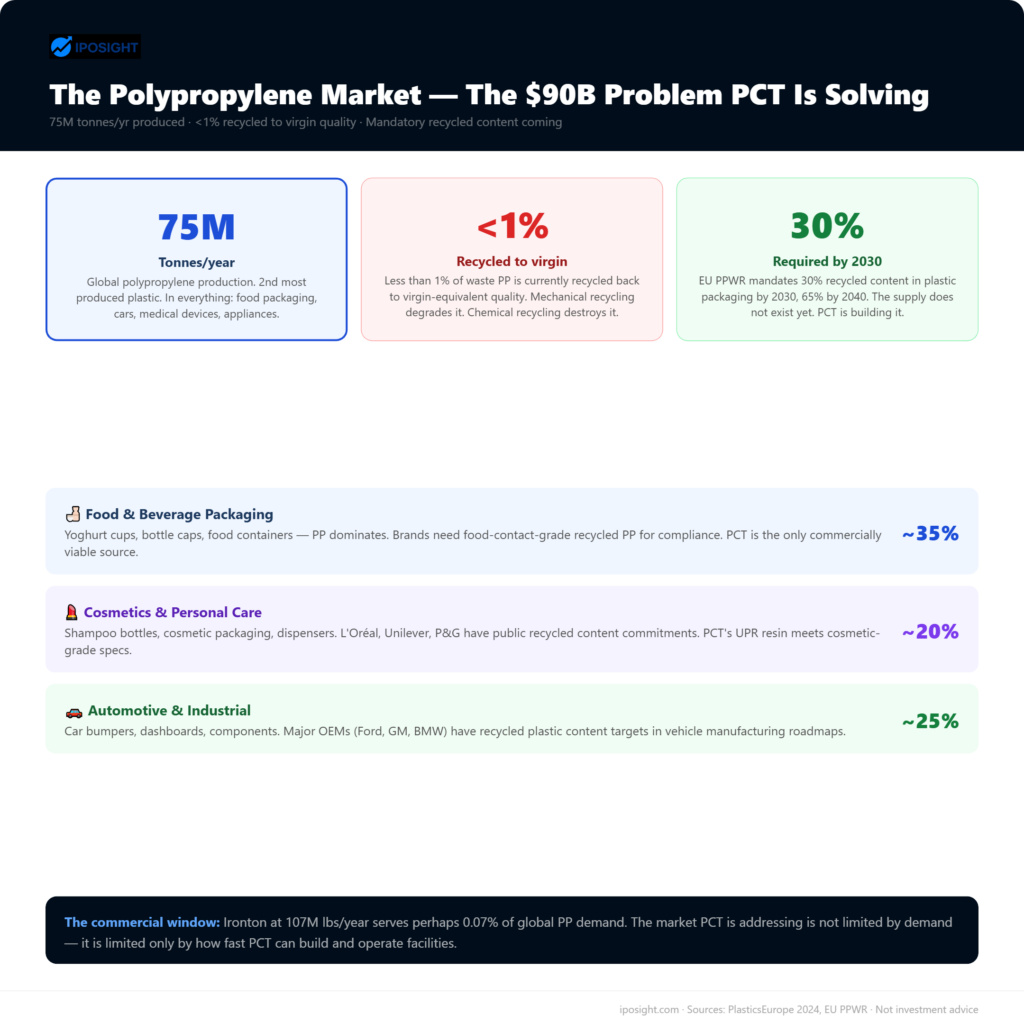
This matters because polypropylene (PP) is in everything: yoghurt containers, car bumpers, medical devices, bottle caps, food packaging, furniture, carpets, appliance components. It is the second-most produced plastic globally at approximately 75 million tonnes per year. Yet less than 1% of waste PP is currently recycled back into equivalent-quality material. Mechanical recycling degrades the polymer chains, producing grey, odorous, contaminated material useful only for low-value applications. Chemical recycling (pyrolysis) breaks PP all the way down to fuel or feedstock. PureCycle’s solvent-based purification process is the only commercial approach that preserves the polymer chains while removing all contamination — colour, odour, additives, labels — producing a product that meets or exceeds food-contact and medical-grade specifications.
The process has two steps. First, the waste PP feedstock is pre-processed to remove gross contaminants and size-reduce to appropriate particle size. Second, it is dissolved in a proprietary solvent at controlled temperature and pressure, which selectively removes all impurities while the PP polymer chains remain intact. The solvent is then recovered and recycled. The purified PP is precipitated and pelletised into ultra-pure recycled (UPR) resin. The yield, purity, and polymer properties of the output are confirmed against ASTM standards and food-contact regulations.
Why this matters to brands: Procter & Gamble, L’Oréal, Berry Global, and dozens of other consumer goods companies have legally binding commitments to the Ellen MacArthur Foundation and their own sustainability reports to use 25–50% recycled content in packaging by 2025–2030. There is essentially no commercially available recycled PP that meets food-contact or cosmetic-contact specifications. PureCycle is the only company that can provide this at scale. The customer waitlist is real and the regulatory pressure making it urgent is also real.
The Ironton Milestone: Why August 2026 Is Different
PureCycle’s history is littered with production ramp announcements that failed to deliver. The Ironton, Ohio facility — the company’s first commercial plant, with a designed capacity of approximately 107 million pounds per year of UPR resin — has been the central focus of investor attention since 2021. It experienced a series of technical challenges that delayed commercial-scale production: equipment failures, feedstock quality issues, processing parameter optimisation, and the decision to bring compounding (the final pelletisation step) in-house rather than outsourcing it.
The Q2 2026 earnings report (August 6, 2026) contained a specific confirmation that previous quarterly updates had withheld: the plant has achieved “stable, consistent, commercial-level production.” Revenue for Q2 2026 was $4.51 million — roughly equal to the entire FY2025 revenue in a single quarter. The plant turnaround was completed ahead of schedule. Compounding was brought in-house, improving product quality control and margin retention. The company stated a target of reaching Ironton breakeven in H2 2026. Six consecutive quarters of rising revenue confirm the trajectory is real.
The significance of this milestone cannot be understated. For a company that has been burning $30–50 million per quarter in operating losses while building toward this moment, the confirmation of stable commercial production is the inflection event that every long-term holder has been waiting for. The question is how quickly the plant can scale from current levels to full capacity — and whether the margin structure at full capacity justifies the current valuation.
The Customer Pipeline: Brand Partners Under Contract
PureCycle’s disclosed customer and offtake partner list reads like a who’s who of global consumer goods: Procter & Gamble (the original technology licensor and anchor customer), L’Oréal (signed a multi-year purchase agreement for UPR resin for cosmetic packaging), Berry Global (packaging solutions partner), and multiple undisclosed CPG companies. Total offtake commitments and letters of intent reported by the company exceed 200 million pounds per year — nearly double Ironton’s designed capacity — which is why the planned Augusta, Georgia and Antwerp, Belgium facilities are critical to the full business case.
The regulatory environment amplifies this demand. The EU Packaging and Packaging Waste Regulation (PPWR) requires 30% recycled content in plastic packaging by 2030 and 65% by 2040. The U.S. EPA’s National Recycling Goal and various state-level EPR (Extended Producer Responsibility) laws are creating similar compliance pressure. For brands that have made public commitments to recycled content, PureCycle’s UPR resin is not just a preference — it is increasingly a compliance necessity.
Stan Druckenmiller and the Investor Case
Stanley Druckenmiller — one of the most respected macro investors in history, with a 30-year track record of 30%+ annual returns at Duquesne Capital — has been a publicly disclosed holder of PCT. Druckenmiller is known for investing in “first or second innings” situations — early-stage companies with asymmetric upside that institutional consensus hasn’t yet recognised. His PCT position is a meaningful endorsement from an investor who has done serious due diligence and is prepared to wait for the multi-year thesis to play out.
The broader institutional holder base includes multiple ESG-focused funds, specialty materials investors, and small-cap growth funds — reflected in the Russell 2000 ETF inclusions (IWM, VBK, IWO) at 0.03–0.06% weights. The VAW (Vanguard Materials ETF) position at 0.07% is the most strategically relevant — it confirms PCT is classified as a materials company with growing index inclusion in materials sector funds.
The Financial Reality: Years of Losses, One Path Forward
The financial picture requires clear-eyed assessment. FY revenue was $8.36 million against a net loss of $182.56 million. Q2 alone showed a $142 million loss — a number that reflects the cost structure of operating a large industrial facility at below-capacity utilisation during ramp-up. The company’s debt load, while restructured into long-term green bonds, is substantial. Cash burn at current rates requires careful monitoring of the liquidity position.
The bull case math works as follows: at full Ironton capacity (~107M lbs/year) at a blended selling price of approximately $0.70–0.90/lb (the current market for UPR PP is approximately $0.65–0.85/lb), annual Ironton revenue would be approximately $75–96 million. At an estimated production cost (including debt service, depreciation, and operating expenses) approaching $0.45–0.55/lb at full utilisation, Ironton breakeven and modest positive EBITDA should be achievable in H2 2026–H1 2027 if the ramp continues on schedule. This does not make PCT a cheap stock today — at $7.33 and approximately $1.3–1.5 billion market cap, the market is pricing in successful Ironton execution and at least one additional plant. But it does make the current level a defensible entry for investors who believe the execution risk has materially de-risked with the Q2 2026 commercial production confirmation.
The Real Competitive Landscape
PCT’s most credible competitor is APK AG (Germany, private) — which uses a solvent-based process (Newcycling®) for polyethylene, not PP. More broadly, the advanced plastics recycling space includes Plastic Energy (pyrolysis, converts to fuel not polymer), Renew ELP (UK, similar solvent-based approach, smaller scale), and Novamont (biodegradable bioplastics, different end market). None of these directly competes for PureCycle’s specific PP-to-UPR-resin niche at commercial scale. The closest threat is that major chemical companies — BASF, LyondellBasell, or Dow — develop competing processes and deploy their vastly greater manufacturing scale. This is a real long-term risk but currently speculative — none has a deployed commercial process for PP purification at equivalent quality.
ETF Coverage
The most credible ETF positions are the Russell 2000 family (IWM at 0.03%, VBK at 0.03%, IWO at 0.06%, VTWO at 0.03%) — mechanical small-cap index inclusions that provide systematic buying support. VAW (Vanguard Materials ETF, 0.07%) is strategically important — materials sector ETFs specifically will increase their PCT weight as revenue grows. PYZ (Invesco Basic Materials Momentum ETF, 1.16%) is the highest single-fund weight and reflects momentum-based inclusion. The PINK (Simplify Health Care ETF, 6.47%) position is almost certainly a data error — a health care fund holding a polypropylene recycler at 6.47% weight makes no sense and should be treated as unreliable data.
Bulls and Bears
The bull case is one of the cleaner long-term stories in the sustainability investment space. PureCycle has a genuine technology monopoly for commercial-scale PP purification. The demand is real, contractually committed, and growing under regulatory pressure. The Ironton plant is now producing. The customer list includes some of the world’s largest consumer goods companies. Stan Druckenmiller has done his diligence and stayed invested through years of delays. The analyst consensus target of $11.80 (+61% from current) reflects belief that the inflection is real.
The bear case is that PureCycle has been here before — “commercial production imminent” announcements that preceded further delays. The net loss of $182 million on $8 million of revenue is a staggering burn rate. The debt is real and the restructured green bonds still carry meaningful interest and principal obligations. The path from “$4.51M quarterly revenue” to “Ironton breakeven” requires sustained operational execution at a scale the company has never demonstrated. Beta of 2.75 means the stock moves violently on any news. And the multi-plant expansion story (Augusta, Antwerp) remains entirely unfunded beyond the current Ironton facility.
12-Month Price Scenarios
Bull scenario (~35% probability): $12–$20. Ironton achieves breakeven in Q3/Q4 2026. Revenue continues the six-quarter upward trajectory and reaches $25–35M annualised run rate. A major new offtake agreement or strategic investment from a brand partner or chemical major is announced. Analyst targets are revised upward and institutional accumulation begins. The stock re-rates toward the $11.80 consensus and potentially beyond.
Base scenario (~45% probability): $5–$9. Ironton continues ramping but breakeven slips to H1 2027. Revenue grows but not dramatically enough to change the loss profile this year. The stock continues to trade in its established $4–8 range with high volatility. No additional dilutive financing needed in the near term.
Bear scenario (~20% probability): $2–$5. Ironton hits unexpected technical issues. Cash position deteriorates requiring a dilutive equity raise. A major brand partner reduces or cancels offtake commitments citing alternative supply development. The stock tests its all-time lows.
Key catalysts: Q3 2026 earnings (November 2026) — will Ironton achieve or approach breakeven as guided? · Any Augusta, GA plant financing announcement · Regulatory developments in EU PPWR implementation · Strategic investor or brand partnership announcement
Investment Evaluation
| Factor | Score |
| Technology Uniqueness | 10/10 |
| Customer & Demand Validation | 9/10 |
| Regulatory Tailwinds | 9/10 |
| Ironton Execution (Q2 2026) | 8/10 |
| Druckenmiller / Institutional Backing | 7/10 |
| Financial Position | 3/10 |
| Execution Track Record | 4/10 |
| Dilution Risk | 4/10 |
| Valuation at $7.33 | 5/10 |
| Long-Term Upside | 9/10 |
Overall Investment Score: 6.8 / 10 · High-conviction long-term hold for patient investors. Best entry: $4–7 range. Watch Q3 2026 for Ironton breakeven confirmation. Scaled entry recommended. Max 2–3% portfolio.
Final Verdict
PureCycle Technologies is not a story about a startup trying to prove a technology. It is a story about whether the world’s only proven, scalable PP purification technology can be commercialised fast enough to justify the capital that has been deployed and the time that has been spent. The Q2 2026 commercial production milestone is the most important data point in the company’s history — not because it proves the future, but because it finally proves the present.
At $7.33, investors are paying approximately $1.3–1.5 billion for a company that has confirmed it can make the product it promised to make, in a market where demand exceeds current supply by at least 2× and where regulatory pressure is making that demand legally mandatory for some of the world’s largest consumer goods companies. Stan Druckenmiller didn’t get rich by being early to obvious ideas. He got rich by recognising that sometimes the best opportunities look like disasters until they don’t.
The scaled entry strategy — building a position across the $4–8 range — remains the most defensible approach. The downside risk (further losses, additional dilution) is real. The upside risk (multi-plant buildout at full capacity serving mandatory demand from major brands) is also real. For investors who can hold through the volatility and understand what they own, PCT at current levels is a carefully sized long-term opportunity.
“The world produces 75 million tonnes of polypropylene per year. Less than 1% gets recycled back to virgin quality. PureCycle’s plant is now running. The customer list is real. The question is time, not technology.”
Sources & References
[1] PureCycle Technologies — purecycle.com · IR — ir.purecycle.com
[2] TradingView — NASDAQ: PCT — tradingview.com
[3] PCT PDF Analysis — Stock Analysis Tool, August 18, 2026
[4] PureCycle Q2 2026 Earnings Release — August 6, 2026
[5] Alembic Global — PCT target $16, June 16, 2026
[6] Northland Securities — PCT target $13, June 25, 2026
[7] Ellen MacArthur Foundation — Global Commitment 2025 Progress Report
[8] EU Packaging and Packaging Waste Regulation (PPWR) — Official Journal of the EU
[9] PlasticsEurope — Plastics: Facts 2024 (PP production data)
iposight.com — for informational purposes only, not investment advice.