

Health Technology | Biotechnology | CRISPR Gene Editing | Jennifer Doudna | AstraZeneca Partner| Biotech IPO
Scribe Therapeutics launched its Nasdaq IPO in July 2026 with one of the most credentialed founding stories in biotech: co-founded by Jennifer Doudna — the Nobel Prize-winning biochemist who pioneered CRISPR-Cas9 — alongside Benjamin Oakes, Brett Staahl, and David Savage. The company has spent six years building a proprietary next-generation CRISPR platform and secured a $420 million partnership with AstraZeneca before going public. The question for investors is whether the scientific pedigree and partnership validation justify the pre-revenue biotech valuation — and what the CRISPR landscape looks like in 2026.
What Scribe Therapeutics Actually Does
Scribe Therapeutics was founded in 2018 in Emeryville, California — adjacent to UC Berkeley, where Jennifer Doudna runs her laboratory. The core insight behind the company is that the original CRISPR-Cas9 system, while revolutionary, has significant limitations when deployed as an in vivo therapeutic: the Cas9 protein is large (making it difficult to package into viral delivery vehicles), can trigger immune responses in patients, and has off-target editing activity that raises safety concerns in clinical settings.
Scribe’s answer is the XE (CRISPR-X Editing) enzyme platform — a proprietary library of next-generation CRISPR enzymes developed through directed evolution and protein engineering. These XE enzymes are compact (fitting into AAV vectors more easily than Cas9), demonstrate improved specificity (fewer off-target edits), and are designed to be less immunogenic. The platform is described as “evergreen” — meaning new enzyme variants can be continuously generated and optimised for specific disease applications without starting from scratch.
Scribe’s pipeline targets diseases where a single genetic correction could provide durable or permanent therapeutic benefit. The primary focus areas are:
Neurological disorders — amyotrophic lateral sclerosis (ALS) and other diseases with identified genetic drivers where in vivo gene editing could arrest or reverse progression. Ocular diseases — inherited retinal dystrophies and other conditions where the eye’s immune-privileged environment makes gene therapy delivery more tractable. Cardiovascular diseases — lipid disorders such as hypercholesterolemia, where editing PCSK9 or ANGPTL3 genes can provide lasting cholesterol reduction (the therapeutic rationale validated by Intellia’s cardio program and Verve’s base editing approach).
The AstraZeneca partnership, announced before the IPO, is the company’s most significant external validation. AZ committed up to $420 million in upfront payments and milestones to co-develop CRISPR therapies for cardiovascular and renal metabolic diseases using Scribe’s XE platform. This is not a discovery-stage research collaboration — it is a development partnership where AZ is betting its own capital on Scribe’s technology being superior to alternatives for specific therapeutic applications.
Why the AZ deal matters: AstraZeneca’s cardiovascular and renal metabolic franchise ($15B+ annual revenue) is one of the most strategically valuable in pharma. When AZ commits $420M to a platform, its internal teams have evaluated CRISPR enzyme performance data in detail. The deal is independent scientific validation from one of the world’s most rigorous drug developers.
The CRISPR Landscape in 2026: Where Scribe Sits
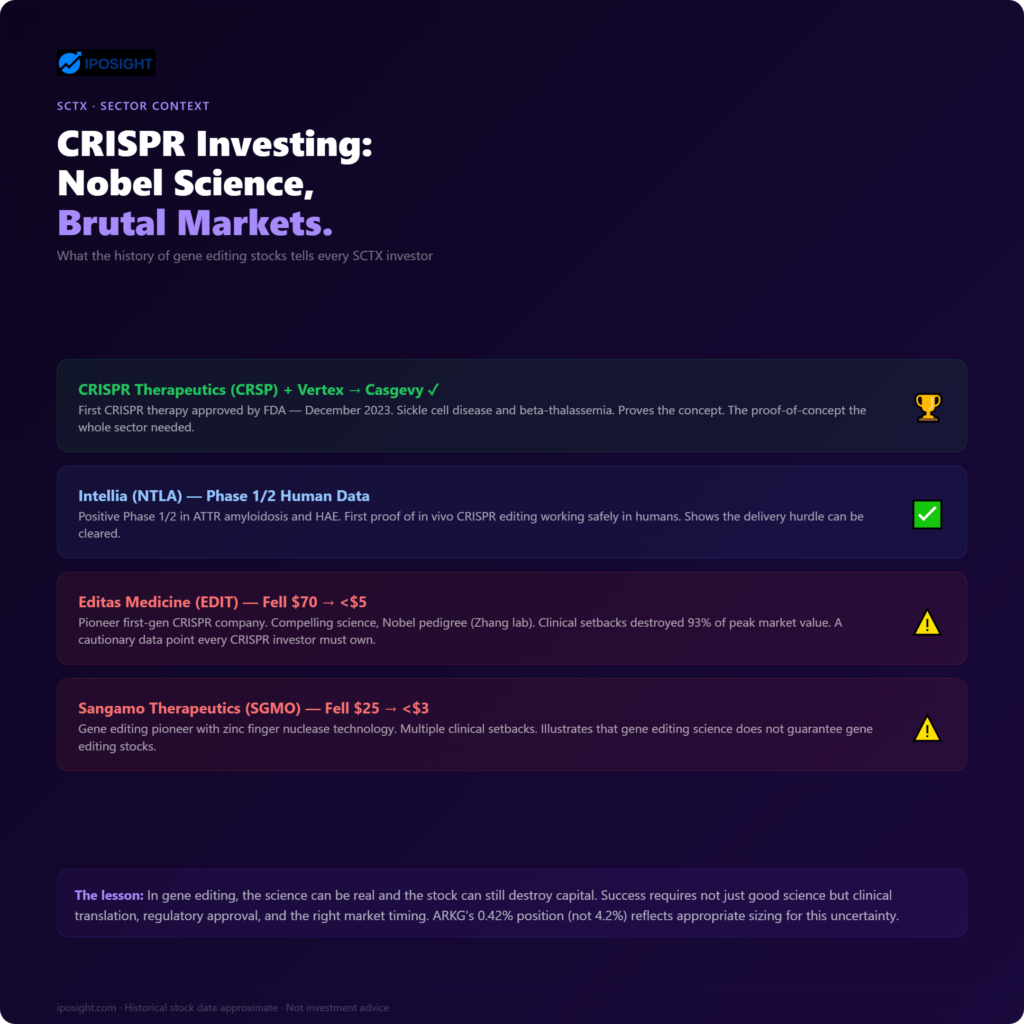
The gene editing space has evolved dramatically since the original CRISPR discoveries. The first wave of CRISPR companies — CRISPR Therapeutics (CRSP), Editas Medicine (EDIT), and Intellia Therapeutics (NTLA) — used first-generation Cas9 or Cpf1/Cas12 systems and targeted relatively tractable diseases like sickle cell disease. The landmark moment came in late 2023 when Vertex and CRISPR Therapeutics received FDA approval for Casgevy (exa-cel) — the first CRISPR therapy approved anywhere in the world, for sickle cell disease. This approval validated the therapeutic concept and opened the regulatory pathway for future gene editing drugs.
The second wave — where Scribe, Beam Therapeutics (base editing), and Prime Medicine (prime editing) operate — uses next-generation tools that address the limitations of first-generation CRISPR. Base editing (Beam) can change single DNA letters without cutting both strands. Prime editing (Prime Medicine) can make precise insertions and deletions. Scribe’s XE enzymes are optimised CRISPR nucleases — still making double-strand cuts, but with dramatically improved specificity, packaging, and immunogenicity profiles.
The competitive peer group from the PDF is accurate: CRSP, NTLA, BEAM, EDIT, VERV, and SGMO are all relevant comparators, though at different stages and with different technical approaches. The most direct technical peers are Intellia Therapeutics (in vivo CRISPR, most advanced pipeline including Phase 1/2 data in ATTR amyloidosis and HAE) and Verve Therapeutics (base editing for cardiovascular, Phase 1b data in heterozygous FH). Scribe’s XE platform competes with all of these for patient populations and for big pharma partnership capital — and the AZ deal suggests it is winning at least one major contest.
Revenue Model: 100% Partnership, Zero Product Sales
Scribe’s entire current revenue comes from the AstraZeneca collaboration — upfront payments, research funding, and future milestones. The PDF correctly notes 100% collaboration and license revenue. This is entirely standard for a clinical-stage biotech: the company has no approved products and will not for years. The $−21.8 million net loss reflects ongoing R&D investment funded by the AZ partnership proceeds and IPO capital.
The key financial metrics for evaluating Scribe are not income statement numbers but rather: (1) how much partnership capital is in the pipeline, (2) whether the AZ deal triggers milestone payments on the expected schedule, (3) whether Scribe attracts additional partnership deals from other large pharma, and (4) how long the current cash position funds the pipeline. The IPO proceeds, combined with the AZ deal, should provide 2–3 years of operating runway — long enough to generate clinical data that would either attract additional partnerships or trigger the existing AZ milestones.
The Real Risk Picture
CRISPR therapeutics face four categories of risk that are worth disaggregating because they affect different time horizons and investment scenarios differently.
Scientific risk — whether the XE enzymes perform better than alternatives in the specific disease targets. This is partially de-risked by the AZ deal (AZ would not have committed $420M without compelling preclinical data) but remains live until Phase 1 human data is published.
Delivery risk — getting the CRISPR machinery into the right cells in the body at therapeutic dose without toxicity. In vivo delivery remains the central unsolved problem for gene editing across all platforms. Lipid nanoparticle (LNP) delivery to the liver is relatively established (validated by Intellia); CNS and ocular delivery remain challenging.
Regulatory risk — the FDA has approved one CRISPR therapy (Casgevy) but the regulatory framework for in vivo editing is still evolving. Off-target editing remains a key agency concern. Any adverse event in a CRISPR trial — at any company — tends to create sector-wide regulatory scrutiny.
Competitive risk — if Intellia, Beam, or a better-funded internal AZ program produces superior data first in one of Scribe’s target indications, the valuation premium for Scribe’s platform narrows. The gene editing space is crowded with well-funded competitors.
⚠ Key watchpoint: The Casgevy approval (CRSP/Vertex) was the sector’s first major regulatory win. Any safety signal in an ongoing CRISPR trial — at NTLA, BEAM, or SCTX — would trigger sector-wide selling. CRISPR biotech stocks are highly correlated: what happens to CRSP or NTLA will happen to SCTX on the same day.
ETF Exposure: ARK Genomic Revolution Is the Signal
The HLTH position is negligible — $1M AUM means the total dollar amount held is essentially rounding error. ARKG is the meaningful signal. Cathie Wood’s ARK Invest has followed the gene editing space closely for years and built major positions in CRSP, NTLA, BEAM, and EDIT at various stages. An ARKG position in SCTX at 0.42% of a $1.52B fund represents approximately $6.4 million — not enormous, but a real endorsement from the most influential thematic investor in genomics. ARK’s genomics positions have historically been high-conviction long-term holds, and ARKG’s inclusion of SCTX shortly after listing suggests they view the XE platform as competitive with the existing CRISPR players they already own.
Bulls and Bears
The bull case rests on four pillars. First, the founding team’s scientific pedigree is unmatched in the sector — a Nobel laureate co-founder is not a marketing credential, it is a signal about the quality of the science underlying the platform. Second, the AZ deal proves the XE enzymes are at least as good as alternatives for the most competitive pharma partnership in cardiovascular gene editing. Third, the CRISPR therapeutic proof-of-concept is now established (Casgevy approval), meaning the question is no longer “can CRISPR work as a therapy” but “which platform works best across the widest range of diseases.” Fourth, if Scribe’s XE platform demonstrates best-in-class specificity and safety data in early clinical trials, the partnership pipeline — additional deals beyond AZ — could generate non-dilutive capital at a scale that fundamentally changes the company’s financial profile.
The bear case is equally real. Clinical-stage CRISPR companies have collectively destroyed enormous amounts of investor capital over the past six years — Editas fell from $70 to under $5, Sangamo from $25 to under $3. The history of gene editing investing is littered with compelling science, Nobel-level founders, and major pharma partnerships that did not translate to stock returns because the clinical translation failed. Scribe’s XE enzymes are unproven in humans. The AZ deal, while impressive, is structured so that AZ bears relatively limited risk — milestone payments only flow when Scribe/AZ achieve specific development targets. And the $−21.8M annual burn rate, while modest by biotech standards, means every year of delay in clinical data is another dilutive financing round.
12-Month Price Scenario Analysis
Bull scenario (~30% probability): +60–120% from IPO price. Scribe announces IND filing or Phase 1 initiation for the AZ collaboration program. Additional partnership deal announced with a second major pharma. Early biomarker or safety data from a Scribe-related program published at a major conference. ARKG expands its position. The stock re-rates to NTLA or BEAM comparable multiples on cash and pipeline value.
Base scenario (~45% probability): −20% to +30% from IPO price. The stock consolidates near IPO levels. The AZ program advances through research milestones on schedule but without major public announcements. No additional partnership deals in the 12-month window. The stock trades as a function of the broader CRISPR sector sentiment — largely range-bound with high beta to sector events.
Bear scenario (~25% probability): −50% to −70% from IPO price. A safety signal in any major CRISPR trial triggers sector-wide selling. AZ’s internal pipeline generates competing data that reduces SCTX’s strategic value to them. A dilutive financing round is needed. The stock approaches book value of cash minus liabilities.
Is SCTX Worth Buying?
Scribe Therapeutics represents exactly the kind of investment that requires honest self-assessment from investors. The science is real and the pedigree is exceptional. The AZ partnership provides meaningful validation and non-dilutive capital. The CRISPR proof-of-concept is established. For investors with a genuine 3–5 year horizon, comfort with binary clinical outcomes, and the ability to size a position that could go to near zero — SCTX is a defensible speculative biotech hold.
The ARK genomic revolution fund’s 0.42% position is a useful sizing guide for retail investors: think of SCTX as a 0.25–1% position in a diversified portfolio, treated as an option on the XE platform proving best-in-class in one or more disease areas. That option has real value — the question is whether the current market cap prices it fairly.
For shorter-term investors: CRISPR biotech stocks are among the most volatile in the market. They move 20–40% on sector news events (competitor trial results, FDA decisions on any gene therapy, conference presentations). Timing matters as much as thesis quality. The best entry points have historically been either at IPO or following a sector-wide selloff triggered by an adverse event that does not affect Scribe specifically.
Investment Evaluation
| Factor | Score |
| Scientific Platform & Founding Team | 9/10 |
| AstraZeneca Partnership Validation | 9/10 |
| Sector Proof-of-Concept | 8/10 |
| ARK Genomic Revolution ETF Signal | 6/10 |
| Pipeline Stage & Clinical Data | 3/10 |
| Revenue & Financial Position | 4/10 |
| Competitive Intensity | 4/10 |
| Regulatory & Safety Risk | 3/10 |
| Sector Correlation & Volatility | 4/10 |
| Long-Term Upside Potential | 9/10 |
Overall Investment Score: 5.9 / 10 · High-conviction speculative biotech. Max 1% portfolio. 3–5 year horizon. Best entry: IPO price or sector-wide correction. The science and the partner are exceptional — the clinical translation remains unproven.
Final Verdict
Scribe Therapeutics is the CRISPR company that most institutional gene editing investors have been waiting for since Doudna shared the Nobel in 2020. The XE platform addresses the real technical limitations that have slowed first-generation CRISPR therapies — size, immunogenicity, specificity. The AZ partnership is the most credible external validation available short of human clinical data. And the founding team’s scientific depth is genuinely exceptional.
The investment case fails not on science but on the brutal statistics of clinical-stage biotech: most drugs fail, most gene editing companies have destroyed more capital than they created, and the distance between compelling preclinical data and an approved drug is measured in years, hundreds of millions of dollars, and multiple points of binary risk. ARKG’s 0.42% position is the appropriate sizing signal — a meaningful but limited bet on a platform that is years from commercial maturity.
For the right investor — patient, informed, diversified, and prepared for the position to halve on a competitor’s adverse event — SCTX is a legitimate speculative hold. For everyone else, watching the first IND filing and Phase 1 safety data before committing capital is the more defensible path.
“Jennifer Doudna didn’t just win the Nobel Prize for CRISPR. She then founded the company trying to make it work as a medicine. Whether that’s enough to generate returns for public market investors depends on whether ‘works in the lab’ becomes ‘works in patients’ — the hardest translation in all of science.”
Sources & References
[1] Scribe Therapeutics — Official Website — scribetx.com
[2] Scribe Therapeutics — Investor Relations — investors.scribetx.com
[3] TradingView — NASDAQ: SCTX — tradingview.com
[4] SCTX PDF Analysis — Stock Analysis Tool, July 29, 2026
[5] SEC Filing — SCTX S-1 / Prospectus — sec.gov
[6] ARK Invest — ARKG Fund Holdings — ark-funds.com
[7] FDA — Casgevy (exagamglogene autotemcel) approval press release, December 2023
[8] Intellia Therapeutics Q2 2026 pipeline update (comparative reference)
[9] Beam Therapeutics — Pipeline and cardiovascular program data (comparative reference)
iposight.com — for informational purposes only, not investment advice. Clinical-stage biotech investments carry very high risk of total loss.