
Consumer Non-Durables | Beverages | Organic | Wellness Shots | Falling Knife? | Consumer Staples
Suja Life went public promising to be America’s leading functional beverage platform — organic cold-pressed juices, wellness shots, a $360M revenue base, and a growth story built on the unstoppable consumer shift to healthier drinks. Then the Q2 2026 earnings came out. The net loss exploded 391% to $27.8 million. EPS missed by 75%. The grocery channel is softening. Guidance was cut. William Blair downgraded. Goldman Sachs cut its target from $31 to $27. Evercore ISI cut from $24 to $15. The stock has now lost 67% from its IPO price and trades at $5.88. The market has delivered a verdict. The question is whether it’s the right one.
What Suja Life Actually Is
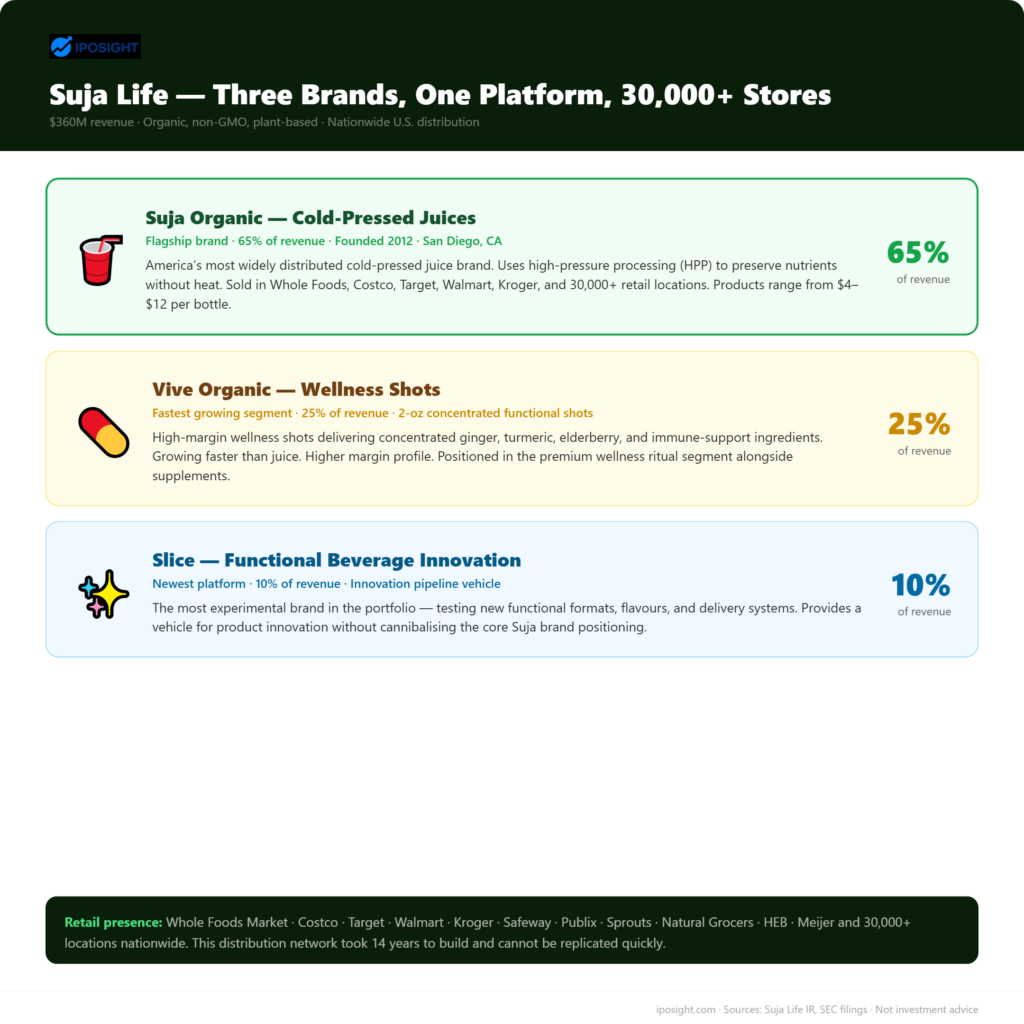
Suja Life is one of the most recognisable brands in the premium organic beverage space. Founded in 2012 in San Diego by a group of health-focused entrepreneurs, the company pioneered mass-market cold-pressed juices — using high-pressure processing (HPP) to pasteurise raw organic juices without heat, preserving nutrients, enzymes, and colour. The company operates three brands: Suja Organic (the flagship cold-pressed juice line, sold in virtually every major U.S. grocery chain), Vive Organic (wellness shots — concentrated functional ingredients in 2-oz servings), and Slice (newer functional beverage innovation platform).
The organic cold-pressed juices at 65% of revenue, wellness shots at 25%, and Slice/other at 10%. At $360–369M in projected 2026 revenue, Suja is not a startup — it is the largest cold-pressed juice brand in the U.S. by retail distribution, present in over 30,000 retail locations including Whole Foods, Costco, Target, Walmart, Kroger, and virtually every natural and conventional grocery chain in the country.
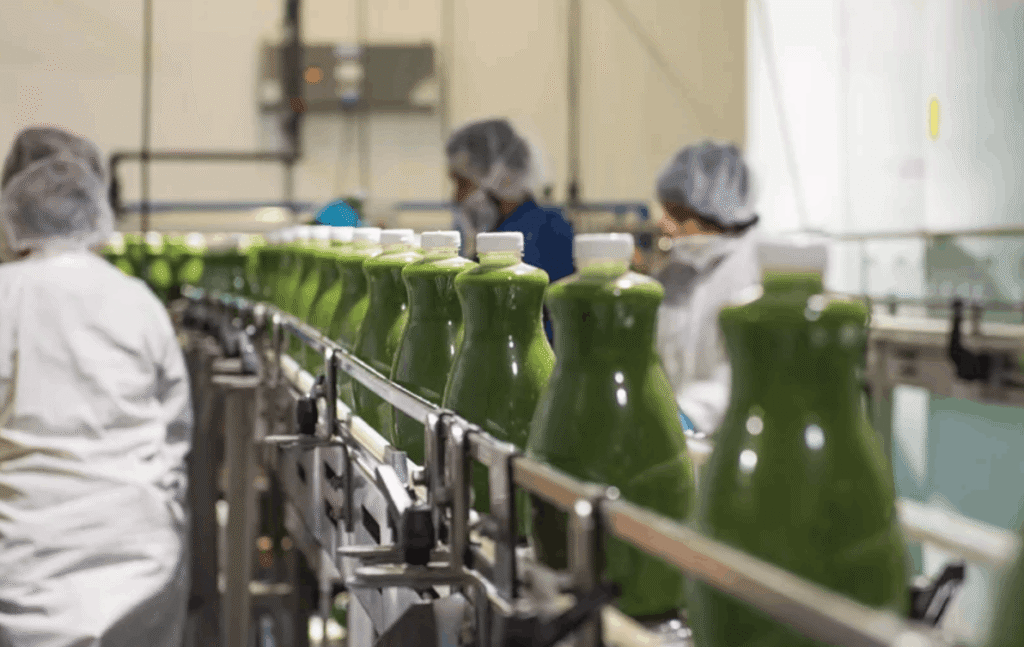
The company is vertically integrated, operating its own production facilities in San Diego — controlling the cold-press, HPP, and bottling processes internally. This vertical integration is a genuine competitive advantage in category freshness and supply chain management, but also means high fixed costs that amplify losses in periods of revenue softness.
The Q2 2026 Earnings: What Went Wrong
The Q2 2026 earnings report, released in early August, was the trigger for the stock’s collapse from its post-IPO trading range. Three specific failures combined to produce the analyst downgrade wave:
Net loss exploded 391%. The $27.8 million Q2 net loss includes one-time IPO-related costs (legal, accounting, underwriting fees for the listing process) that inflated the number. Stripping out one-time items, the underlying loss was smaller — but the adjusted EBITDA improvement of approximately 50% year-over-year (cited in the bulls’ thesis) shows the core operating business is actually improving on a cash basis. The optical horror of a 391% loss jump is real but partially misleading. Investors who did not read past the headline number sold first and asked questions later.
EPS missed badly. The consensus expectation was a loss of $0.08 per share. The reported loss was $0.14 per share — a 75% miss. This kind of magnitude of miss in the first post-IPO earnings period is severely damaging to a stock’s credibility with institutional investors who built models based on management guidance.
Grocery channel is softening and guidance was cut. Management acknowledged meaningful slowdown in the traditional grocery channel — the core distribution avenue for Suja’s flagship products. Q3 2026 guidance implies year-over-year revenue decline. Full-year revenue guidance was cut to $360–369M, below Wall Street’s $370M expectation. This is not a catastrophic miss, but for a growth-story IPO, any revenue guidance cut in the first reporting period destroys the narrative that justified the premium.
The beta problem: −4.29. The PDF reports a beta of −4.29 — an extreme and unusual number indicating that SUJA has been moving strongly inverse to the overall market. A −4.29 beta almost certainly reflects the stock’s IPO-period behaviour when it moved counter to market trends in its first weeks of trading. This is not a stable statistical measure and should not be used for risk modelling. It will normalise as more trading history accumulates.
The Real Competitive Landscape
Direct category competitors: Pressed Juicery (private, primarily direct-to-consumer and retail boutiques) and Evolution Fresh (Starbucks-owned, declining) are the closest cold-pressed peers. In wellness shots, Suja’s Vive Organic competes with Bolthouse Farms (Campbell’s subsidiary) and the private wellness shot segment. In functional beverages broadly, Celsius Holdings (CELH) and Vita Coco are the fastest-growing adjacent players, though in different functional categories.
Platform-level competitors for shelf space: The real competition for Suja is for grocery shelf space against the entire premium beverage universe — Monster Beverage (MNST), Vita Coco (COCO), Oatly (OTLY), SunOpta (STKL), and the massive innovation budgets of Coca-Cola (KO) and PepsiCo (PEP), both of which have acquired or internally developed competing organic and functional beverage lines. The grocery channel slowdown that management cited is partly a category slowdown and partly shelf space competition as major beverage companies push harder into the “better-for-you” segment.
The Real ETF Picture
Suja’s actual institutional ETF exposure would come from: XLP (Consumer Staples Select Sector SPDR) — the primary large-cap consumer staples ETF, unlikely to hold SUJA at its current market cap. FDIS (Fidelity MSCI Consumer Discretionary) and IYK (iShares Consumer Staples) — broader consumer funds that may include small-cap beverage companies. PSCU (Invesco S&P SmallCap Consumer Staples) — the most likely natural home for SUJA, specifically targeting small-cap consumer staples. The absence of confirmed ETF holdings in a consumer staples company is itself a signal: at $5.88/share and a market cap likely below $300M, SUJA may not meet the minimum market cap thresholds for many institutional funds, limiting systematic buying support.
Bulls and Bears
The bull case requires accepting that the Q2 disaster was largely optical and one-time. The IPO costs inflated the net loss. The adjusted EBITDA improvement of 50% year-over-year is the operative financial signal — it suggests the underlying unit economics of the business are improving even as top-line growth disappoints. The brand is genuine: Suja Organic has 30,000+ retail distribution points, strong brand recognition in the natural foods channel, and real consumer loyalty in a category with secular tailwinds. At $5.88 — roughly 1.6× its revised 2026 revenue guidance — the stock is valued in line with distressed food and beverage companies. If management can stabilise the grocery channel, reignite growth through innovation (wellness shots, Slice), and demonstrate adjusted EBITDA expansion over the next two quarters, a re-rating toward 3–4× revenue (implying $10–15) is plausible. The analyst average target of $15 represents 155% upside from current levels.
The bear case is that the grocery channel slowdown is structural, not cyclical. The “better-for-you” beverage boom of 2020–2024 may be entering a consolidation phase as consumers trade down in an inflationary environment and the novelty premium of cold-pressed juice fades. Suja’s vertical integration — a strength in normal operations — becomes a fixed-cost liability when revenue disappoints. The company’s net loss is accelerating, not decelerating. The management team that cut guidance in the first post-IPO earnings call has damaged its credibility with institutional investors who will require multiple quarters of results before rebuilding confidence. And at $5.88, the stock may not have adequate institutional support (ETF inclusion, index membership) to prevent further drift lower if retail holders continue to exit.
12-Month Price Scenario Analysis
Bull scenario (~25% probability): $12–$20. Q3 results show grocery channel stabilisation. Wellness shots continue strong growth (25% of revenue, higher margin). Adjusted EBITDA turns positive on a sustained basis. Institutional buyers begin re-entering near the post-earnings lows. Goldman Sachs and Evercore lift targets. Stock re-rates toward the analyst consensus $15 range.
Base scenario (~50% probability): $4–$8. The stock ranges in the $4–8 band as the market waits for evidence that the grocery slowdown has bottomed. High volatility. No sustained institutional buying. Management executes on cost reduction but revenue remains flat to slightly declining. The stock is range-bound and frustrating for both bulls and bears.
Bear scenario (~25% probability): $1.50–$4. Q3 revenue disappoints again. A dilutive capital raise is required. Grocery channel continues to deteriorate. A major retail partner reduces shelf space allocation. The stock approaches or breaks the $2 range, where it may attract distressed investor interest but would represent near-total loss for IPO buyers.
Banded buying (Scaled Entry) Strategy
Given the extreme volatility and genuine uncertainty, a scaled entry approach — buying in tranches at different price levels — is more appropriate than a single large position. A practical framework: 25% of intended position at current $5.88 (acknowledging the risk), 25% if the stock falls to $4, 25% if it falls to $3, and 25% reserved for confirmation of Q3 stability. This distributes risk across a wide range while building a meaningful position if the stock ultimately recovers.
The breakeven point for holding SUJA is essentially a Q3 2026 earnings report that does not show further deterioration and provides credible evidence that grocery channel share losses have stabilised. Without that confirmation, the stock has further downside. With it, the 155% gap between the current price ($5.88) and the analyst consensus ($15) represents genuine recovery potential.
Critical near-term dates: Q3 2026 earnings (October/November 2026) — the first opportunity to confirm or deny grocery channel stabilisation. Any major retail shelf-space review announcements. New product launch announcements in the Slice platform. Management commentary at any investor day or conference presentation.
Investment Evaluation
| Factor | Score |
| Brand Strength & Distribution | 8/10 |
| Category Tailwinds | 7/10 |
| Adjusted EBITDA Trend | 6/10 |
| Analyst Consensus Signal | 6/10 |
| Revenue & Profitability | 3/10 |
| Grocery Channel Outlook | 3/10 |
| Post-IPO Credibility | 2/10 |
| ETF / Institutional Support | 3/10 |
| Valuation at $5.88 | 5/10 |
| Long-Term Brand Asset Value | 6/10 |
Overall Investment Score: 4.9 / 10 · High-risk recovery play. Scaled entry only. Maximum 1–2% portfolio. Do NOT buy ahead of Q3 earnings without accepting further downside risk. The brand is real — the execution is not yet proven post-IPO.
Final Verdict
Suja Life presents one of the most interesting risk/reward setups in the 2026 consumer IPO class — and one of the most dangerous. The brand is real. The distribution is real. The category tailwind is real. The adjusted EBITDA improvement trend is real. None of these facts have changed since the IPO.
What has changed is the market’s confidence in management’s ability to execute on the growth narrative. A 75% EPS miss and a guidance cut in the first post-IPO reporting period is a serious credibility blow. Institutional investors who built models based on the IPO roadshow numbers have been burned. They will not return quickly.
At $5.88, the stock is priced for a troubled consumer brand at approximately 1.6× revenue — a level that implies either a recovery or a strategic acquisition. The analyst consensus at $15 represents a view that the brand’s underlying value is intact even if execution has disappointed. The M&A angle is real: a strategic buyer (Coca-Cola, PepsiCo, or a PE firm rolling up better-for-you brands) could acquire Suja’s distribution network and brand equity at these prices far more cheaply than building it from scratch.
For investors who believe the grocery channel stabilisation is coming: scale in below $6 and wait for Q3 confirmation. For everyone else: watch from the sideline until the Q3 numbers prove management’s narrative. The brand deserves a second chance. The stock does not deserve blind trust yet.
“Suja’s juices are in 30,000 stores. The stock is down 67%. The gap between the brand’s value and the stock’s current price is either an opportunity or a warning. Q3 2026 will tell us which.”
Sources & References
[1] Suja Life — sujaorganic.com · Investor Relations — ir.sujalife.com
[2] TradingView — NASDAQ: SUJA — tradingview.com
[3] SUJA PDF Analysis — Stock Analysis Tool, August 12, 2026
[4] Jefferies — SUJA initiation, price target $25, June 1, 2026
[5] Goldman Sachs — SUJA target reduction $31 → $27, August 2026
[6] Evercore ISI — SUJA target reduction $24 → $15, August 2026
[7] William Blair — SUJA downgrade, August 2026
[8] Suja Life Q2 2026 Earnings Release and Conference Call
[9] SPINS / Nielsen — Cold-pressed juice and wellness shot category data
iposight.com — for informational purposes only, not investment advice. Consumer small-cap stocks carry significant risk.