
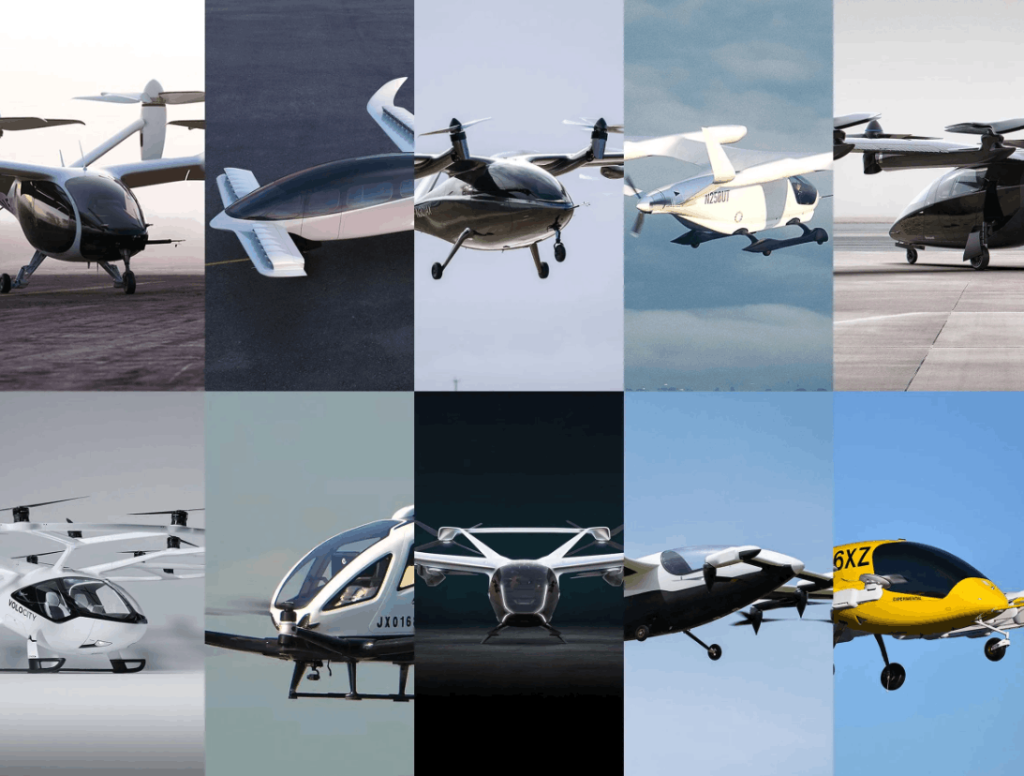
credit:Provided by manufacturers
For years, electric aviation was marketed as the next transportation revolution. Investors were promised flying taxis, autonomous air mobility, zero-emission logistics networks, and trillion-dollar future markets. IPO enthusiasm exploded. Companies like Joby Aviation, Archer Aviation, BETA Technologies, Vertical Aerospace, and EHang became some of the most exciting growth stories on the market.
But the reality in 2026 looks very different from the original hype cycle.
Almost every major publicly traded electric aviation company is deeply negative since IPO or SPAC launch. Investor enthusiasm has cooled dramatically. Cash burn remains enormous. Profitability is still nowhere in sight. Certification timelines continue slipping. And despite technological progress, the sector as a whole remains trapped between futuristic promise and harsh financial reality.
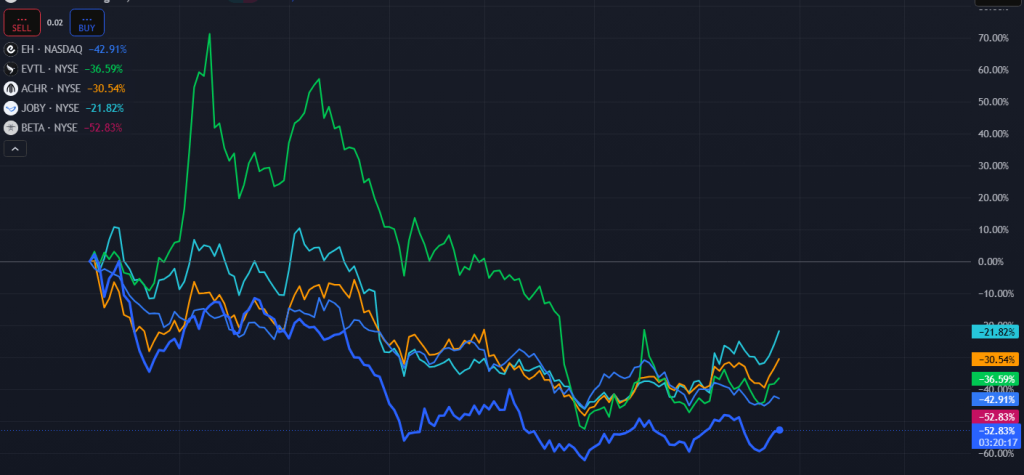
The chart comparing the major eVTOL players since BETA’s IPO perfectly captures the current state of the industry:
- BETA: approximately -53%
- EHang: approximately -43%
- Vertical Aerospace: approximately -37%
- Archer Aviation: approximately -31%
- Joby Aviation: approximately -22%
The key observation is important:
This is not a “BETA problem.” This is an industry-wide de-rating of electric aviation stocks.
The market is no longer pricing these companies based on futuristic concepts alone. Investors now demand:
- real commercialization,
- certification progress,
- actual revenue scalability,
- manufacturing execution,
- and a believable path toward profitability.
The electric aviation sector is entering its first true survival phase.
Why the Entire eVTOL Sector Is Under Pressure
The first generation of electric aviation investing was driven primarily by narrative.
The pitch sounded almost perfect:
- clean transportation,
- autonomous flight,
- urban air taxis,
- defense applications,
- and AI-powered aviation systems.
Money flooded into the sector between 2020–2024.
But then reality arrived.
Investors realized the industry faces enormous structural challenges:
- FAA and aviation certification moves extremely slowly,
- aircraft manufacturing is capital intensive,
- battery limitations remain significant,
- infrastructure barely exists,
- and widespread consumer adoption may take much longer than expected.
The result is what we now see across the entire sector:
- collapsing valuations,
- shrinking hype multiples,
- and much more selective institutional capital.
Importantly, however, this does not necessarily mean the industry is dead.
It may simply mean the market has shifted from “story investing” toward “execution investing.”
That distinction matters enormously.
Which Company Actually Has the Best Long-Term Position?
Joby Aviation — The Institutional Favorite
Among all eVTOL companies, Joby remains the market leader in terms of institutional credibility.
Why?
Because Joby has:
- deep partnerships,
- strong manufacturing progress,
- significant cash reserves,
- and one of the most advanced FAA certification programs.
Toyota’s involvement alone gives Joby substantial industrial credibility. The company is heavily focused on passenger air mobility and urban air taxi deployment.
Strengths
- strongest balance sheet in sector
- advanced certification progress
- institutional support
- manufacturing partnerships
- premium brand positioning
Weaknesses
- enormous valuation expectations
- profitability still very distant
- passenger adoption uncertainty
- urban infrastructure challenges
Joby increasingly looks like the “safe” eVTOL leader — if such a thing exists in this sector.
The stock’s smaller decline relative to peers suggests institutional investors still see it as the most likely long-term winner.
Archer Aviation — The Aggressive Commercialization Play
Archer has become one of the sector’s most aggressive commercialization-focused companies.
The company heavily emphasizes:
- airline partnerships,
- military applications,
- urban mobility,
- and operational rollout strategies.
Archer’s partnership with United Airlines gave the company major visibility early on.
Compared to Joby, Archer often appears more aggressive in marketing and expansion narratives.
Strengths
- strong commercial partnerships
- high market visibility
- defense opportunities
- strong retail investor following
Weaknesses
- high cash burn
- execution risk
- certification dependency
- still heavily speculative
Archer currently trades more like a momentum growth stock than a stable aerospace company.
If the sector rebounds strongly, Archer could outperform due to higher volatility and speculative appetite returning.
But downside risk also remains significant.
BETA Technologies — The Infrastructure and Logistics Specialist
BETA may actually be the industry’s most underrated company.
Why?
Because unlike many competitors focused primarily on “future flying taxis,” BETA concentrated on practical deployment first:
- cargo,
- logistics,
- military transport,
- medical aviation,
- and charging infrastructure.
That strategy may ultimately prove smarter.
The company is building:
- aircraft,
- charging systems,
- infrastructure,
- and operational ecosystems simultaneously.
This resembles Tesla’s early infrastructure-first strategy.
Strengths
- diversified business model
- charging network moat potential
- practical deployment focus
- military and logistics relevance
Weaknesses
- massive losses
- lower hype appeal
- commercialization still early
- weaker retail momentum
Ironically, BETA’s weaker stock performance may partially reflect the fact that it markets itself less aggressively than peers.
But fundamentally, many analysts increasingly view BETA as one of the industry’s most credible long-term operators.
Vertical Aerospace — The High-Risk Turnaround Story
Vertical Aerospace remains one of the sector’s most volatile companies.
The company initially generated enormous excitement due to its ambitious European eVTOL strategy and high-profile partnerships.
However, operational challenges and financing concerns heavily damaged investor confidence.
Strengths
- European positioning
- strategic aerospace relationships
- strong conceptual technology
Weaknesses
- financing pressure
- execution uncertainty
- weaker investor confidence
- elevated bankruptcy concerns in past cycles
Vertical now trades more like a speculative turnaround than a future market leader.
The upside could be substantial if the company stabilizes operationally — but risk remains extremely high.
EHang — China’s Wild Card
EHang may actually represent the most interesting geopolitical angle in the entire sector.
Unlike U.S. competitors, EHang benefits from China’s willingness to accelerate experimental transportation systems more aggressively.
China often deploys new infrastructure and transportation technologies faster than Western regulators.
That matters enormously in eVTOL adoption.
Strengths
- China regulatory flexibility
- autonomous flight focus
- faster deployment potential
- government alignment
Weaknesses
- geopolitical risk
- U.S.-China tensions
- accounting skepticism from investors
- lower Western institutional trust
If electric urban aviation scales fastest in Asia, EHang could surprise investors significantly.
But geopolitical uncertainty will likely permanently discount its valuation relative to U.S. peers.
Is the Industry Actually Viable?
This is the central question.
The answer is probably:
yes — but slower than originally expected.
Electric aviation likely has real long-term potential in:
- logistics,
- regional cargo,
- military applications,
- medical transport,
- and eventually urban mobility.
But widespread “flying taxi everywhere” adoption probably remains farther away than early investors expected.
The sector’s realistic adoption path may happen in phases:
Phase 1
Cargo, military, medical, industrial logistics
Phase 2
Regional short-range passenger systems
Phase 3
Urban air mobility at scale
Most investors originally priced in Phase 3 immediately.
The market now understands Phase 1 comes first.
Which Region Could Lead the eVTOL Revolution?
USA
The U.S. currently leads in:
- capital markets,
- aerospace expertise,
- and technological development.
But FAA regulation moves slowly.
This may delay large-scale adoption.
China
China could become the fastest deployment market.
The government’s willingness to rapidly scale infrastructure and experimental mobility systems gives Chinese firms a potential advantage.
Europe
Europe supports green aviation politically, but bureaucracy and funding fragmentation may slow leadership.
Asia Overall
The most realistic early adoption markets may actually be:
- Singapore,
- South Korea,
- Japan,
- UAE,
- and China.
These regions combine:
- dense urban environments,
- advanced infrastructure,
- and strong government support for transportation innovation.
Could Boeing or Airbus Crush These Companies?
This is one of the biggest investor fears.
The answer is:
not necessarily.
Large aerospace companies often struggle to innovate quickly in disruptive technologies.
Instead, acquisitions may become more likely.
Historically, large aerospace firms frequently:
- partner with innovators,
- invest strategically,
- or acquire emerging technologies later.
This makes acquisition potential a major hidden upside catalyst for smaller eVTOL companies.
Especially if:
- certification progresses,
- infrastructure becomes valuable,
- or military applications accelerate.
Why ETFs Keep Buying These Stocks
Many investors misunderstand ETF ownership.
Yes, some ETF buying is thematic exposure.
But it also signals something important:
institutional investors still believe electric aviation has long-term relevance.
These companies increasingly appear in:
- aerospace ETFs,
- clean energy ETFs,
- disruptive innovation funds,
- drone mobility ETFs,
- and automation portfolios.
ETF ownership does not guarantee success.
But it does provide:
- liquidity,
- visibility,
- and long-term institutional participation.
That matters significantly for survival in capital-intensive sectors.
Which Company Looks Like the Best Investment Today?
Best Long-Term Institutional Bet:
Joby Aviation
Most financially credible.
Best certification progress.
Strongest institutional trust.
Best Risk/Reward:
BETA Technologies
Potentially undervalued relative to operational quality.
Infrastructure strategy could become extremely valuable long term.
Best Speculative Momentum Play:
Archer Aviation
Highest volatility.
Could rally aggressively if sector sentiment returns.
Highest Risk / Highest Potential:
EHang
Could dominate Asian deployment.
But geopolitical risk remains enormous.
Most Fragile:
Vertical Aerospace
Needs execution turnaround quickly.
Final Verdict: Is Electric Aviation Investable Yet?
The sector is no longer a simple hype trade.
It is becoming a real industrial competition.
That changes everything.
The winners will likely be companies that:
- survive financially,
- achieve certification,
- build infrastructure,
- and commercialize gradually.
The market’s massive selloff across the sector suggests investors now understand the timeline is longer and harder than originally expected.
But long-term opportunity still exists.
The electric aviation industry today may resemble:
- electric vehicles in the early 2010s,
- or commercial space companies before commercialization matured.
Most companies will probably fail.
A few could become enormous winners.
Investment Evaluation — Electric Aviation Sector
| Company | Growth Potential | Financial Strength | Risk | Long-Term Position | Overall |
| Joby Aviation | 9/10 | 7/10 | 7/10 | 9/10 | 8.0/10 |
| Archer Aviation | 8/10 | 5/10 | 8/10 | 7/10 | 7.0/10 |
| BETA Technologies | 9/10 | 5/10 | 8/10 | 8/10 | 7.5/10 |
| EHang | 8/10 | 5/10 | 9/10 | 7/10 | 6.8/10 |
| Vertical Aerospace | 7/10 | 3/10 | 10/10 | 5/10 | 5.0/10 |
One-Sentence Conclusion
Electric aviation remains one of the market’s highest-risk, highest-upside sectors — and while most current players may never become profitable, companies like Joby and BETA increasingly look like the most credible long-term survivors in the race to commercialize the future of flight.