
The short version
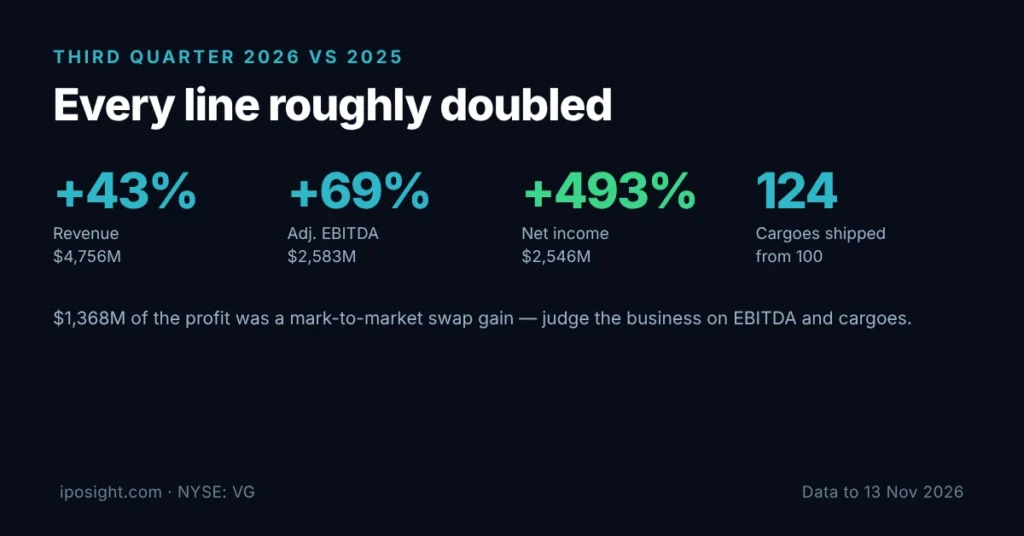
- Record quarter. Revenue $4,756M (+43%), adjusted EBITDA $2,583M (+69%), net income to common $2,546M against $429M. 124 cargoes shipped, up from 100.
- Guidance raised 14% at the midpoint, to $10.0–10.3 billion. 2026 cargoes are 99% contracted at a weighted average fee of $6.46/MMBtu.
- The overhang is uncapped. BP seeks $3.7 billion to over $6 billion, with a damages hearing in May 2027, and Venture Global’s own filing says it does not expect the seller liability cap to apply.
- Two more claims behind it: Galp, capped at $170 million, and an unnamed customer claiming over $2.0 billion where the company believes a $255 million cap applies and the customer disputes it.
- The leverage is real. About $44.6 billion of debt against $14.5 billion of equity — a debt-to-equity ratio of 4.91.
- A second business appeared. Frame agreements for up to sixteen 720 MW power islands, targeting about 5 GW of data-center power by the end of 2031.
The company in brief
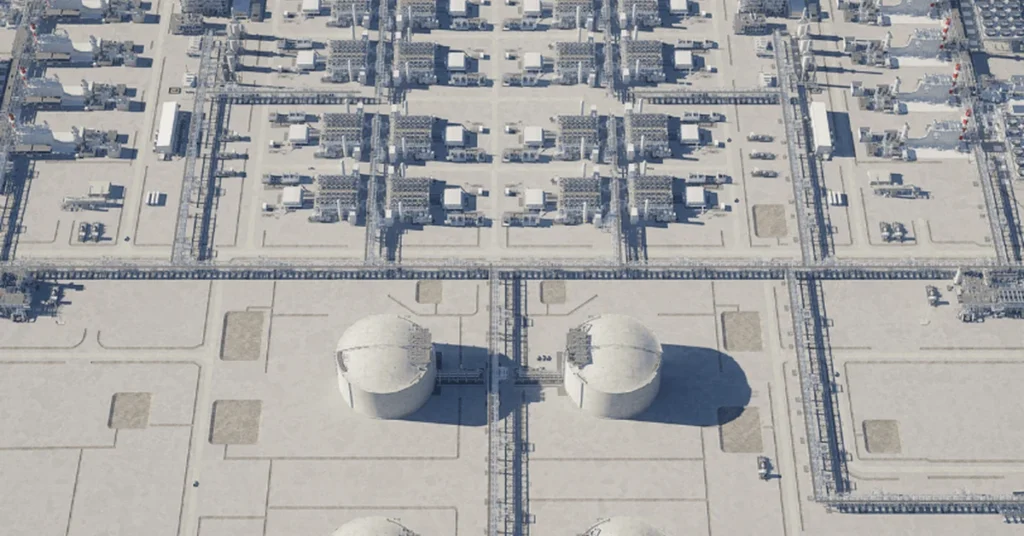
Venture Global is a pure-play American LNG exporter. It buys natural gas, chills it to liquid at terminals on the Gulf Coast of Louisiana, and ships it to buyers in Europe and Asia under long-term sale and purchase agreements, keeping a liquefaction fee for the service. The model is simple to describe and brutally capital-intensive to build: the balance sheet carries $57.4 billion of property, plant and equipment against $14.5 billion of equity.
What separates it from the incumbents is construction method. Rather than building each liquefaction train on site, Venture Global orders factory-built modular trains and assembles them in parallel. That is why Plaquemines Phase 1 reached commercial operation on 31 October 2026, just over 53 months after the final investment decision, and why CP2 is targeting first LNG about 24 months after its Phase 1 FID of July 2025. Speed is the product.
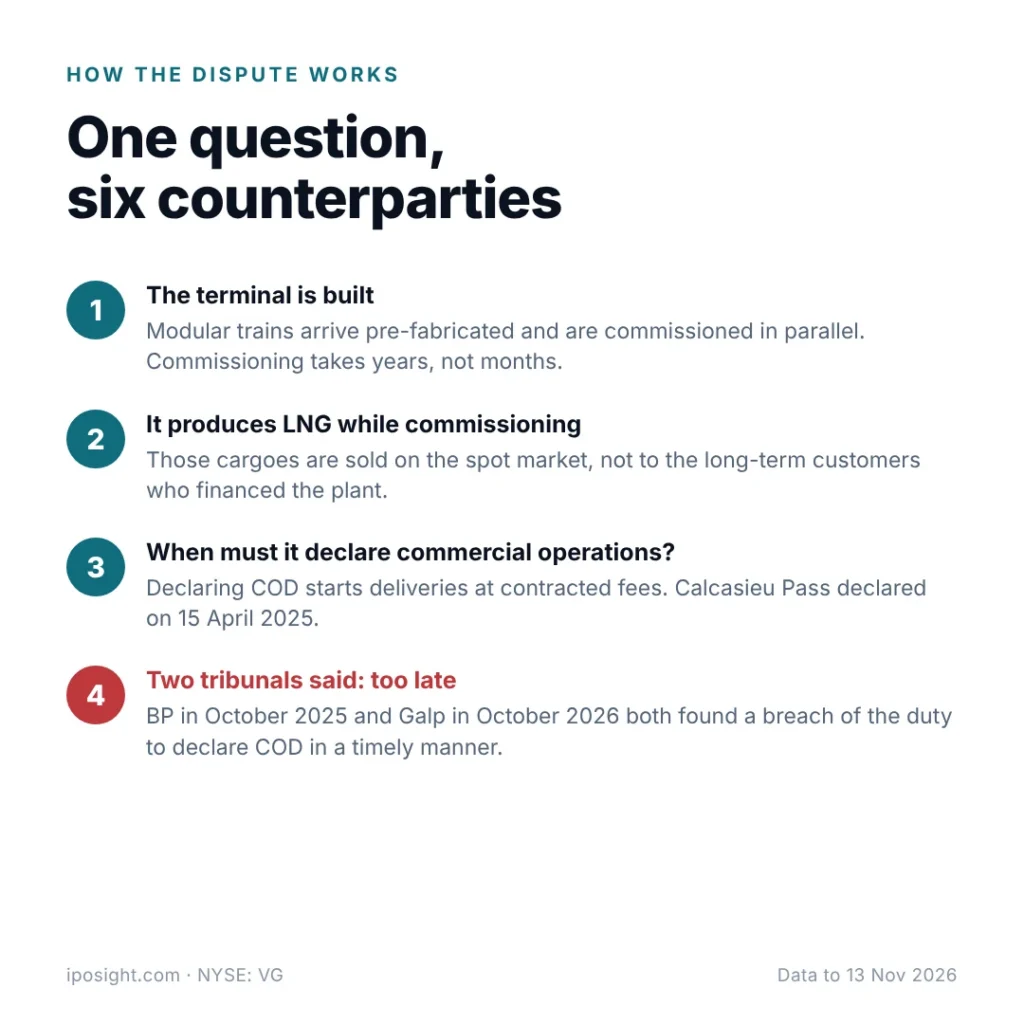
It is also the source of every legal problem the company has. The disputes below all turn on the same question: when a terminal is producing and selling LNG during a long commissioning phase, at what point is it obliged to declare commercial operations and start delivering to its contracted customers at contracted prices rather than selling into the spot market?
The assets: two terminals running, a third under construction
- Calcasieu Pass — commercial operations since 15 April 2025. Produced 37 cargoes in the third quarter, above its SPA obligations. Incremental investment is planned to lift volumes from late 2027.
- Plaquemines — Phase 1 reached commercial operations on 31 October 2026; six cargoes had been loaded for SPA customers by 10 November. Phase 2 targets mid-2027. A brownfield expansion targets FID in mid-2027 and first LNG in 2029, with eight liquefaction trains and compressors already on order.
- CP2 — first LNG targeted for mid-2027, with 24 of 36 liquefaction modules on site. A 10 mtpa expansion targets FID in early 2027 and production in late 2028.
During the quarter the company signed 2.0 mtpa of new or increased 20-year offtake: 1.0 mtpa with ConocoPhillips from 2030, 0.5 mtpa with China Gas from the CP2 Expansion’s commercial operation date, and 0.5 mtpa added by an existing customer. Long-dated contracts of that kind are what makes the cash flow bankable — and what the arbitrations are about.
The numbers behind the record quarter
| Q3 | 2026 | 2025 | Change |
|---|---|---|---|
| Revenue | $4,756M | $3,329M | +43% |
| Income from operations | $2,295M | $1,320M | +74% |
| Net income to common | $2,546M | $429M | +493% |
| Adjusted EBITDA | $2,583M | $1,525M | +69% |
| Diluted EPS | $0.96 | $0.16 | — |
| Cargoes exported | 124 | 100 | +24% |
| LNG exported | 467.1 TBtu | 371.8 TBtu | +26% |
Across nine months the picture is the same shape: revenue $13,933M against $9,324M (+49%), adjusted EBITDA $6,446M against $4,264M (+51%), and 381 cargoes against 252. Trailing net margin runs at 22.1% and return on equity at 45.0%.
Two cautions about the headline profit. First, $1,368 million of the quarter’s result came from a gain on interest rate swaps, against a $144 million loss a year earlier — a mark-to-market item, not cash from selling LNG. Second, interest expense was $486 million in the quarter and is structural: this is a company that borrowed to build.
Why did Venture Global fall from $25 to $13?
The IPO is the first part of the answer. Venture Global went public on the NYSE on 24 January 2025. It had marketed 50 million shares at $40–46, which would have valued it at roughly $110 billion. It priced 70 million shares at $25.00 instead — a cut of about 42% to the midpoint — raising $1.75 billion at a $60.5 billion valuation. The stock opened at $24.05, below the offer price, on day one.
The second part is the arbitrations, which became public knowledge in the months that followed and are discussed below. The third is leverage: debt rose to about $44.6 billion by 30 September 2026 while the build-out continued.
What is easy to miss is that the recovery has already happened once. The shares are up roughly 89% over the past twelve months and still sit 47% below the offer price, because the collapse was front-loaded into the first months of trading. Anyone reading a single “down 47% since IPO” figure is reading two very different periods averaged together.
The arbitration overhang, measured
This is the part of the story that gets reported as a list of case names and almost never as a number. So here is the number. Venture Global earned $2,546 million for common stockholders on 2,496 million basic shares in the quarter. At $13.26 a share that is a market capitalization of about $33.1 billion. Measured against that, here is what each claim is worth per share if it were paid in full:
| Claim | Amount | Per share | Share price | Status |
|---|---|---|---|---|
| BP Gas Marketing — low end | $3.70B | $1.48 | 11.2% | Damages hearing May 2027 |
| BP Gas Marketing — high end | $6.00B+ | $2.40 | 18.1% | Cap not expected to apply |
| Unnamed customer — as claimed | $2.00B+ | $0.80 | 6.0% | Cap disputed |
| Unnamed customer — at the cap VG cites | $255M | $0.10 | 0.8% | Company’s position |
| Galp Trading | $170M | $0.07 | 0.5% | Breach found 7 Oct 2026; damages 2027–28 |
| All claims as asserted | $8.17B | $3.27 | 24.7% | — |
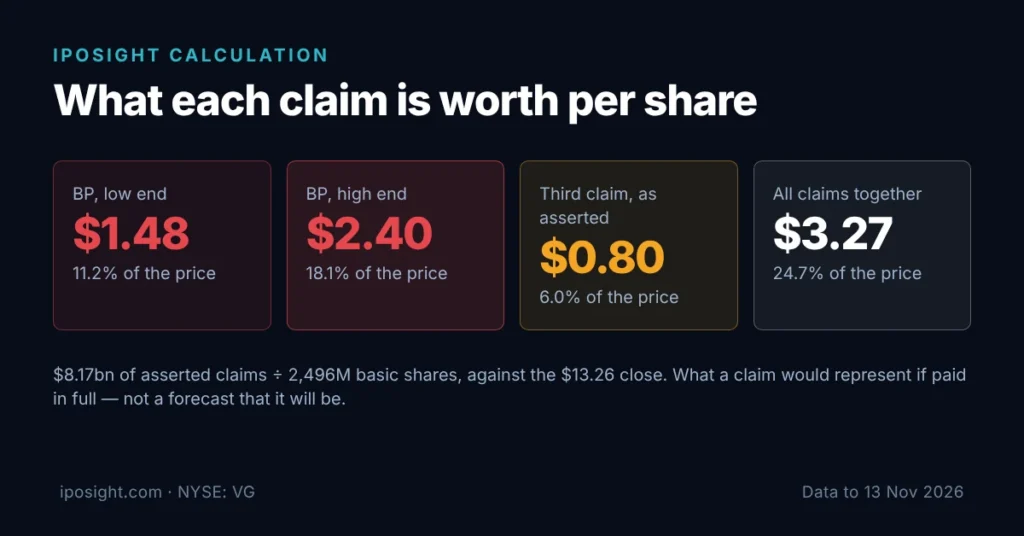
Against the raised 2026 guidance, the BP claim alone is 36% to 59% of a full year’s adjusted EBITDA at the $10.15 billion midpoint. The whole set as asserted is about 80%.
The scoreboard so far is genuinely mixed, which is why the market has struggled to price it. Venture Global won against Shell and against Repsol, and a court later rejected Shell’s attempt to overturn the award. It settled with Edison by supplying extra cargoes. It lost to BP, where an ICC tribunal found in October 2025 that it had breached its obligation to declare commercial operations in a timely manner and to act as a Reasonable and Prudent Operator. And on 7 October 2026 a second tribunal, by majority with one arbitrator dissenting, found the same breach in the Galp contract. The company says it is disappointed and that the Galp decision contradicts the Shell and Repsol outcomes.
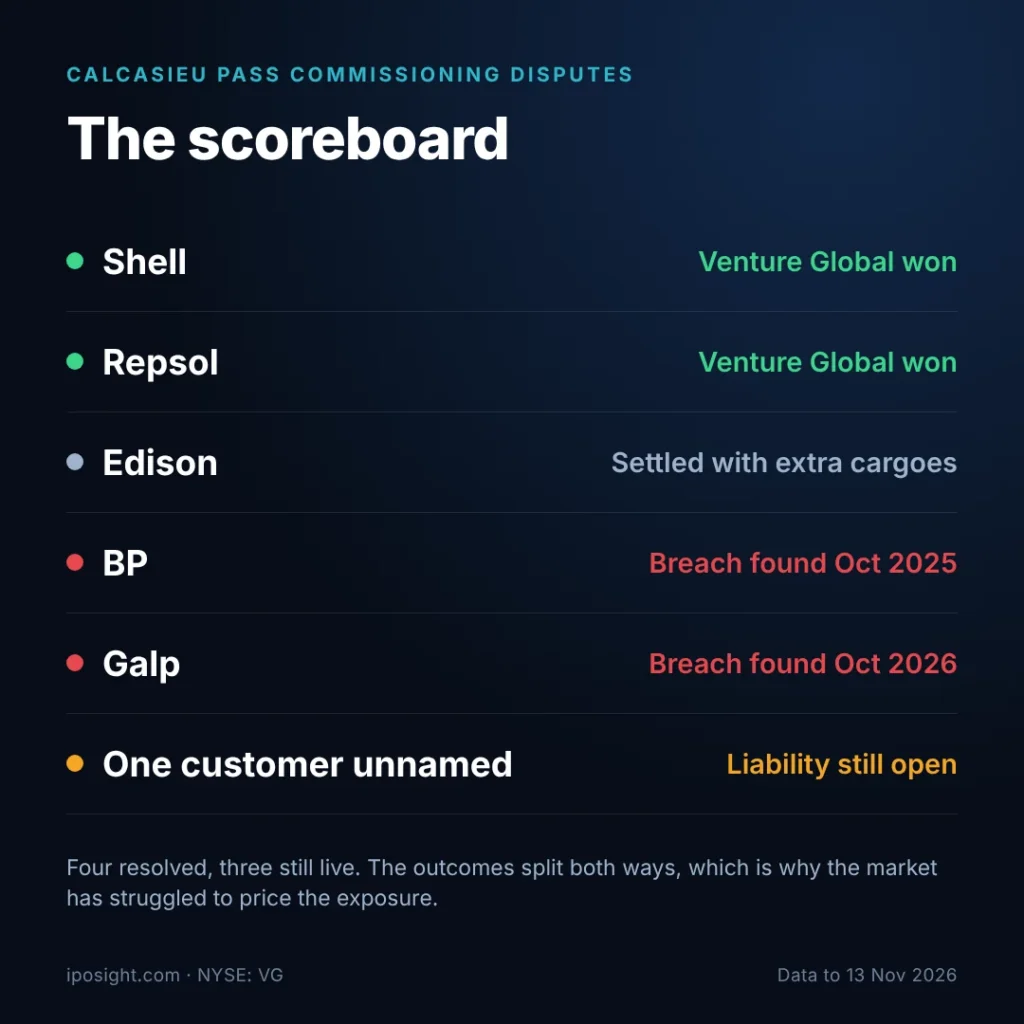
Two dates matter. The BP damages hearing is scheduled for May 2027; a final award would follow. The Galp damages hearing is not yet scheduled and is expected in 2027 or 2028. Trade press has reported that the remaining unnamed customer is Poland’s Orlen, with a liability decision expected around the end of 2026, though the filing itself does not name the counterparty.
One piece of litigation has gone away. The securities class actions brought after the IPO have both been dismissed with prejudice — the first voluntarily in April 2025, the second by final judgment on 15 October 2026. Four shareholder derivative actions remain stayed pending the plaintiffs’ appellate deadline.
How big is the market?
American LNG export capacity has roughly tripled over the past decade, and the United States is now the world’s largest exporter. The demand side rests on two legs: European buyers replacing Russian pipeline gas on long contracts, and Asian utilities growing baseload demand. Both are long-cycle, which is why twenty-year SPAs of the kind signed with ConocoPhillips and China Gas this quarter are the industry’s currency.
For Venture Global the relevant exposure is narrower than the headline commodity. With 2026 volumes 99% contracted at a weighted average fee of $6.46/MMBtu, the business is mostly a fee-for-service toll, not a bet on the gas price. The company’s own sensitivity is explicit: a $1.00/MMBtu change in the fee on the remaining unsold cargoes moves full-year adjusted EBITDA by only $20–30 million. That is a rounding error on a $10 billion guide, and it is the strongest argument in the bull case.
Customers and concentration
The customer list is the asset and the liability at once. Shell, BP, Edison, Repsol, Galp and Orlen are among the counterparties to Calcasieu Pass’s long-term agreements, and all six have been in dispute with the company over the same commissioning question. A contract book concentrated in a handful of European majors is bankable when it performs and systemic when it does not: the revenue note in the 10-Q explicitly reduces the transaction price for “pending disputes with Calcasieu Project post-COD SPA customers”.
The newer Plaquemines and CP2 contracts are spread across a wider set of buyers, which structurally reduces this risk over time. It does not retire the Calcasieu-era claims.
The real competitive landscape
The honest comparison set is short. Cheniere Energy (LNG) is the incumbent: longer operating history, lower leverage and a share price near its all-time high. NextDecade (NEXT) is the earlier-stage challenger, still building Rio Grande LNG and trading at a fraction of either. Sempra (SRE) offers LNG exposure inside a regulated utility, which is a different risk profile entirely.
Venture Global’s claim to the sector is that it builds faster and cheaper. Plaquemines Phase 1 in 53 months from FID is evidence for that claim. The arbitration record is the price of the same strategy: a long, revenue-generating commissioning period is exactly what the tribunals have twice found to be a breach.
The AI power pivot: a second business, or a distraction?
In October 2026 Venture Global signed frame agreements with GE Vernova and Baker Hughes Energy Services for up to sixteen new 720 MW power islands, plus transformers and grid equipment. The stated plan is to deliver compute capacity from late 2028 and scale to about 5 GW by the end of 2031, on two island-mode sites in Cameron and Plaquemines Parishes roughly 250 miles apart.
The logic is not far-fetched. The company already controls about 15,000 acres, roughly 13 bcf/d of pipeline access, about 4 GW of existing power and a 1,000-person in-house EPC team. The constraint on American data-center growth is grid interconnection, and off-grid gas generation on land you already own with gas you already move is a real answer to it. Chief executive Mike Sabel framed it as the same problem the company solved in LNG: speed and scale.
How to get exposure, and what the ETFs hold
Venture Global is an ordinary NYSE-listed common stock, so direct access is straightforward for most retail brokers. Indirect exposure runs through broad energy and midstream funds, where it sits alongside Cheniere rather than instead of it — weightings in index products follow free float, and Venture Global’s float is smaller than its market capitalization suggests because of the founders’ holdings. Anyone buying an energy ETF for LNG exposure is mostly buying Cheniere, not Venture Global. The company declared its first dividend this quarter, $0.04 per share, with a 15 December 2026 record date.
The biggest risks
- The uncapped BP award. $3.7–6 billion claimed, hearing in May 2027, and the company’s own expectation that the liability cap does not apply. This is the single largest identifiable risk on the balance sheet, and it is not yet a number in the accounts.
- Leverage. About $44.6 billion of debt against $14.5 billion of equity, a 4.91 debt-to-equity ratio, and $486 million of quarterly interest. The company has repaid $2.8 billion of the $3.0 billion CP2 equity bridge and secured a $3.0 billion revolver, but the structure only works if the terminals run.
- Execution on three fronts at once. Plaquemines Phase 2 in mid-2027, CP2 first LNG in mid-2027, and the CP2 expansion FID in early 2027. Slippage in any one of them changes the EBITDA ramp.
- Reputational cost with counterparties. Two tribunals have now found the same breach. Future buyers price that in when they negotiate.
- Mark-to-market noise. The swap gain flattered the quarter. Judge the business on adjusted EBITDA and cargoes, not on net income.
Bulls and bears
Bulls say
- 99% of 2026 volume contracted at $6.46/MMBtu — a toll, not a commodity bet
- Guidance raised 14% at the midpoint, mid-year
- Plaquemines Phase 1 delivered in 53 months; the build model works
- Trades at roughly 7.3× EV to 2026 guided EBITDA
- The analyst index improved by 1.58 over six months; no Sell ratings
Bears say
- An uncapped claim worth up to 18% of the market value, heard in May 2027
- 4.91 debt-to-equity with $44.6bn outstanding
- Two tribunals have found the same breach; a third case is live
- The AI program has no customer, no budget and no revenue
- Bernstein reiterated Market Perform at $14.00 on 12 November, barely above the price
What has to be true for the shares to work
Three conditions, and they are independent of each other. (1) The BP award lands near the bottom of the claimed range, or the cap argument succeeds after all — the difference between $3.7 billion and $6 billion is about a dollar a share. (2) CP2 and Plaquemines Phase 2 both reach their mid-2027 dates, because the guided EBITDA ramp assumes them. (3) Leverage falls as contracted cash flow arrives, rather than rising again to fund the AI build. If all three hold, the gap between a $33 billion market value and $10 billion of annual EBITDA closes. If the first one fails, the other two matter much less.
12-month scenarios
| Scenario | What happens | Rough probability |
|---|---|---|
| Re-rating | The remaining liability decision goes Venture Global’s way, CP2 holds its mid-2027 date, and the market prices the EBITDA rather than the litigation. The consensus $17.22 target is the obvious reference point. | 30% |
| Range-bound | Operations deliver, but the May 2027 hearing keeps a discount on the equity. The stock tracks the EBITDA ramp without closing the multiple gap. | 45% |
| De-rating | An adverse liability finding in the third case, slippage at CP2, or a BP award toward the high end. Leverage amplifies the move in both directions. | 25% |
These are judgments about a distribution, not forecasts, and the probabilities are ours rather than anyone else’s.
Investment evaluation
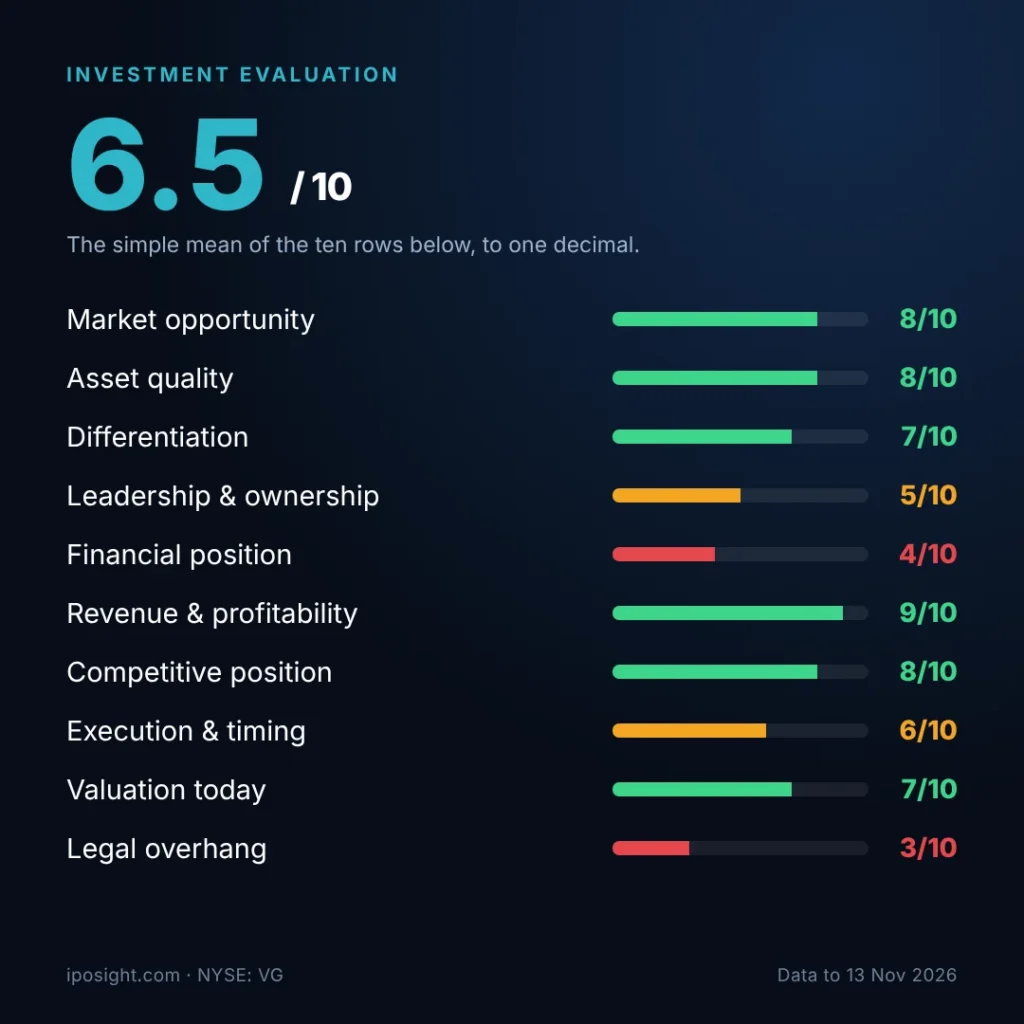
| Factor | Score | Evidence |
|---|---|---|
| Market opportunity | 8/10 | US LNG exports at record levels; 20-year SPAs signed this quarter with ConocoPhillips and China Gas |
| Asset quality | 8/10 | Two terminals in commercial operation, $57.4bn of PP&E, a third at 24 of 36 modules on site |
| Differentiation | 7/10 | Modular build; Plaquemines Phase 1 in 53 months from FID. The same method created the legal exposure |
| Leadership and ownership | 5/10 | Founder-controlled; four derivative actions stayed; two tribunals have found the same contractual breach |
| Financial position | 4/10 | $44.6bn debt, 4.91 debt-to-equity, $486M quarterly interest, $3.4bn cash, current ratio 1.19 |
| Revenue and profitability | 9/10 | 9M revenue +49%, adjusted EBITDA +51%, 22.1% net margin, 45.0% return on equity |
| Competitive position | 8/10 | Second-largest US exporter by cargo count; 509–518 cargoes guided for 2026 |
| Execution and timing risk | 6/10 | Three milestones inside twelve months: Plaquemines Phase 2, CP2 first LNG, CP2 expansion FID |
| Valuation at today’s price | 7/10 | ~7.3× EV to 2026 guided EBITDA; market cap 45% below the IPO pricing valuation |
| Legal overhang | 3/10 | $3.7–6bn claimed by BP, cap not expected to apply, hearing May 2027; two further claims live |
| Overall | 6.5/10 | The simple mean of the ten rows above, to one decimal |
Final verdict
What is factually good here is not in dispute. Venture Global earned $2.55 billion for shareholders in a single quarter, grew revenue 49% over nine months, raised its guidance by 14% at the midpoint with seven weeks of the year left, brought a major terminal into commercial operation 53 months after sanctioning it, and sold 99% of next year’s volume at a fixed fee. Very few companies at any size can show that combination.
What has to be believed is narrower than the usual list. (1) That a tribunal in May 2027 awards BP a figure the balance sheet can absorb without a capital raise. (2) That CP2 and Plaquemines Phase 2 both arrive on schedule, because the guided ramp has no slack in it. (3) That the AI power program is funded from cash flow rather than from new debt on a 4.91 debt-to-equity structure.
The bear case is not that the business is bad. It is that an uncapped claim worth up to 18% of the market value sits eighteen months out, with a tribunal that has already found liability, and that the equity is the residual claim on $44.6 billion of debt. That combination is why a company guiding to $10 billion of EBITDA trades at roughly 7.3 times enterprise value to that figure while Cheniere sits near its high. The discount is not irrational; the question is only whether it is the right size.
The deeper point is that Venture Global’s legal problem and its commercial advantage are the same fact seen from two sides. Building faster than anyone else meant producing and selling LNG for years during commissioning, and two tribunals have now said that was a breach of the contracts that financed the build. Whatever the May 2027 hearing decides, the industry has learned what that strategy costs — and so has every buyer now negotiating a twenty-year agreement.
Frequently asked questions
Why is Venture Global stock still below its IPO price?
The fall happened early. The IPO priced at $25.00 on 24 January 2025 after the range was cut about 42%, and the stock opened below the offer at $24.05. The arbitration disputes and the leverage drove the decline from there. Over the past twelve months the shares are up roughly 89%, so the “down 47% since IPO” figure averages two very different periods.
What are the Venture Global arbitrations about?
All of them turn on when Calcasieu Pass should have declared commercial operations. During a long commissioning period the terminal produced and sold LNG on the spot market rather than delivering to long-term customers at contracted prices. Tribunals found for Venture Global against Shell and Repsol, and against it for BP and Galp.
How much could the BP award cost?
BP seeks $3.7 billion to more than $6.0 billion plus interest, costs and fees. On about 2.5 billion shares that is $1.48 to $2.40 per share, or 11% to 18% of the 13 November price. Venture Global’s 10-Q states it does not expect the seller aggregate liability cap to apply. The damages hearing is scheduled for May 2027.
Is Venture Global exposed to the natural gas price?
Less than most people assume. 2026 volumes are 99% contracted at a weighted average liquefaction fee of $6.46/MMBtu, and the company states that a $1.00/MMBtu move on the remaining unsold cargoes changes full-year adjusted EBITDA by only $20–30 million.
What is the AI data-center plan?
Frame agreements signed in October 2026 with GE Vernova and Baker Hughes cover up to sixteen 720 MW power islands for off-grid generation on land Venture Global already controls. The company targets compute capacity from late 2028 and about 5 GW by the end of 2031. As of the November release there was no named customer, no disclosed budget and no revenue.
When is the next catalyst?
A liability decision in the third remaining arbitration is expected around the end of 2026 according to trade press. After that, CP2 first LNG and Plaquemines Phase 2 in mid-2027, and the BP damages hearing in May 2027.
Operating and financial figures come from Venture Global’s Q3 2026 earnings release filed on Form 8-K and from its Form 10-Q for the quarter ended 30 September 2026; the arbitration details, claimed amounts and liability caps are taken from Part II, Item 1 of that 10-Q. IPO terms are from the January 2025 pricing. The share price, the 12-month return and the move since the opening price are as of 13 November 2026. Market capitalization uses 2,496 million basic shares, derived from the quarter’s $2,546 million net income to common and $1.02 basic EPS. Per-share claim figures divide each asserted amount by that share count; they show what a claim would represent if paid in full, which is not a prediction that it will be. Enterprise value adds $44.6 billion of debt and subtracts $3.4 billion of cash. Analyst coverage, the consensus target and the recommendation-index change are from our own analyst ratings dataset as of 9 November 2026; lock-up and calendar data are on our Key Dates and Calendar pages. Our scoring approach is described on the Method page.
[1] SEC EDGAR — Venture Global, Inc., Form 8-K, Q3 2026 earnings release (10 November 2026)
[2] SEC EDGAR — Venture Global, Inc., Form 10-Q for the quarter ended 30 September 2026 (Part II, Item 1, Legal Proceedings)
[3] SEC EDGAR — Venture Global, Inc., Form 8-K, Galp partial final award (8 October 2026)
[4] Pipeline & Gas Journal — Venture Global breached Galp LNG supply contract, tribunal rules
[5] IPOScoop — Venture Global prices IPO at $25, stock drops in NYSE debut (24 January 2025)
[6] Oil & Gas 360 — Venture Global boosts profit forecast as LNG growth supports AI power expansion
[7] iposight.com — Analyst Ratings dataset, 9 November 2026; price and volume data to 13 November 2026
iposight.com — for informational purposes only, not investment advice. No position in any security mentioned.
Discover more from IPOSight
Subscribe to get the latest posts sent to your email.