
World Stocks · Analysis · VOW3 VWAGY PAH3 BYD MBG BMW STLA
Volkswagen’s preferred shares are down roughly 30% in 2026, trading in the low €70s — near where they sat a decade ago, and a fraction of the €262 all-time high set back in 2015. On the surface, the numbers look almost too cheap to ignore: a price-to-earnings ratio under 6, a dividend yield above 7%, and analyst price targets averaging more than 40% above the current share price. Underneath, the story is messier — a €5 billion annual US tariff hit, a Chinese EV market where Volkswagen’s home-field advantage has eroded for good, and an anchor shareholder that just wrote down its own stake and is publicly demanding a faster overhaul. This is our attempt to separate the value case from the value trap.
Where Volkswagen‘s Revenue Actually Comes From
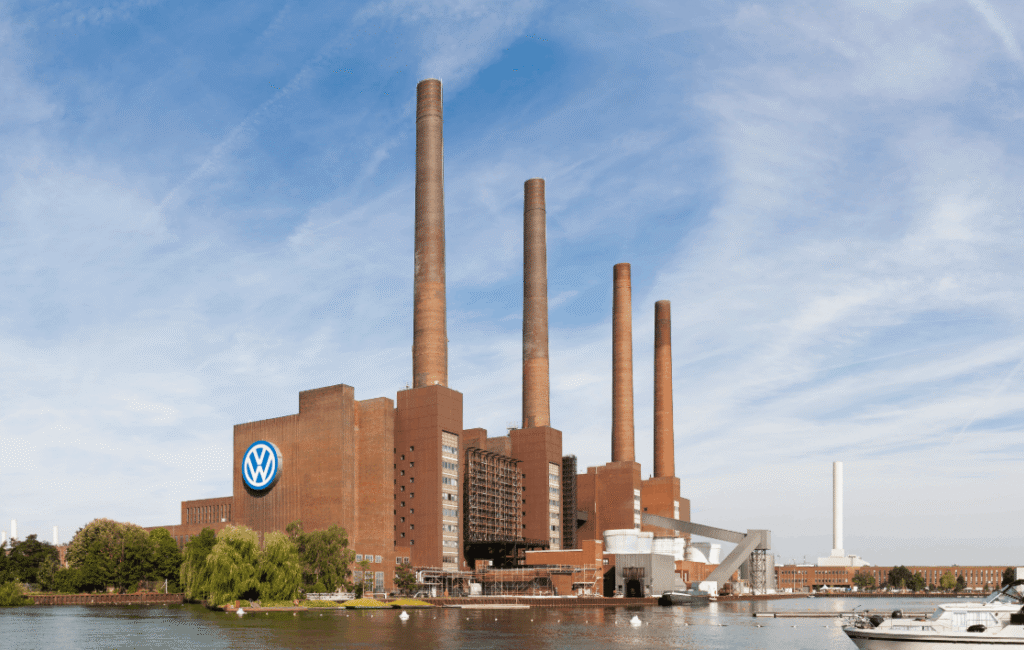
Volkswagen Group is Europe’s largest carmaker and, alongside Toyota, one of the two largest automakers in the world by volume. Trailing twelve-month group revenue sits at roughly €322 billion, with net income of about €6.7 billion and EBITDA near €51 billion (a 15% margin) — figures that make Volkswagen one of the largest industrial companies on the planet by sales, even after a rough stretch. Revenue is generated across four reporting segments: Passenger Cars and Light Commercial Vehicles (the core business, spanning the VW, Škoda, SEAT, CUPRA, Audi, Bentley, Lamborghini, and Porsche brands); Commercial Vehicles, largely housed under the listed TRATON Group (Scania, MAN, Navistar, VW Truck & Bus); Power Engineering (large-bore diesel engines and turbomachinery, recently the subject of a majority stake sale); and Financial Services, which finances and leases vehicles for customers and dealers worldwide and is a meaningful, steady profit contributor in its own right.
That brand and segment diversity is one of Volkswagen’s underappreciated strengths: Porsche and Audi carry premium margins that subsidize thinner-margin mass-market volume, TRATON gives exposure to the commercial-truck cycle, and Financial Services provides a recurring, less cyclical income stream. It is also, at the moment, a source of pain — Porsche’s own profitability has deteriorated sharply enough that Volkswagen took a roughly €3 billion non-cash goodwill impairment tied to the Porsche business in 2025, on top of a roughly €2.1 billion one-off hit from Porsche AG cutting its own medium-term margin ambition from a 15%–17% range down to 10%–15% for 2026–2030.
The first half of 2026 illustrates both the scale and the strain: €158.1 billion in revenue, essentially flat year-over-year, but an operating result of just €5.9 billion, down 11.6%, for an operating margin of 3.8% — below the 4.0%–5.5% range management had guided for the full year. Vehicle deliveries fell 8.4% to 4.0 million units. Management has responded by cutting overhead costs by roughly €1 billion in the first quarter alone and, on July 9, 2026, unveiling a “Future Plan” — the company’s own description of “the most comprehensive and far-reaching program in the company’s history” for products, technology, competitiveness, structures, and growth.
Why the Stock Is Down 30% in 2026
Four distinct pressures have combined to drag VOW3 to its lowest levels in roughly a decade.
US tariffs. Volkswagen estimates the impact of US tariffs at up to €5 billion annually — a direct hit to a company that still exports meaningfully to the United States and has fewer domestic US plants than some rivals to absorb the cost locally.
Porsche writedowns and a guidance cut. The roughly €5.1 billion combined negative impact on 2025 operating results from the Porsche goodwill impairment and the cut to Porsche’s own margin ambition was a rare admission that one of the group’s most profitable brands is going through its own difficult transition, largely tied to a slower-than-planned EV ramp and weaker China demand for combustion-engine premium cars.
China. Chinese consumers have shifted rapidly toward domestic EV brands — BYD, NIO, XPeng, and others — eroding volumes and pricing power for Volkswagen’s joint ventures, historically one of the company’s most profitable regional operations. We cover this in depth in Part 4.
A dividend cut and a nervous anchor shareholder. The dividend for fiscal year 2025, paid in June 2026, was set at €5.26 per preferred share — down about 17% from the €6.36 paid a year earlier. Around the same time, Porsche SE — Volkswagen’s controlling shareholder with 53.3% of voting rights — booked its own roughly €3 billion impairment on its VW stake and, according to multiple reports, is now pushing publicly for a faster restructuring. When a company’s own controlling shareholder writes down its stake and calls for a “faster overhaul,” it tends to unsettle the rest of the market too.
Layered on top of all this: a swelling restructuring program that includes roughly 50,000 planned job cuts group-wide and the first outright closure of a Volkswagen production facility on German soil in the company’s history (the Dresden “Glass Factory”), against a backdrop of German unions holding a firm “red line” against further plant closures. That tension — between a management team that says the old model no longer works and a workforce, and a state shareholder, that has historically protected jobs above all else — is arguably the single hardest structural problem Volkswagen has to solve, and it is one that has no quick fix.
Who Owns Volkswagen? Is There Chinese Ownership?
As of the most recent disclosure (December 31, 2025), Volkswagen’s voting rights are held as follows: Porsche Automobil Holding SE (the Porsche and Piëch family holding company) controls 53.3%; the German State of Lower Saxony holds 20%; Qatar Holding holds 17%; and 9.7% sits in free float. There is no Chinese ownership stake in Volkswagen AG itself.
That said, China is deeply embedded in Volkswagen’s operations rather than its cap table. The company has run joint ventures with China’s SAIC Motor and FAW Group for decades to manufacture and sell vehicles inside China, and has more recently added a joint venture with XPeng to co-develop software-defined EVs — the first jointly developed model, the ID. UNYX 08, rolled off the production line in March 2026. None of these are ownership stakes in Volkswagen; they are Volkswagen’s own investments and partnerships inside the Chinese market, structured (as Chinese law generally requires for foreign automakers) as roughly 50/50 joint ventures with local partners.
One more ownership-adjacent detail worth knowing: the 20% stake held by the State of Lower Saxony is not a passive financial holding. It exists under the so-called “VW Law,” a piece of German legislation that gives the state government a blocking-minority-style influence over major corporate decisions — historically used to protect German jobs and production sites. That is the closest thing Volkswagen has to direct “state support”: not a subsidy, but a structural, legally embedded check that makes rapid, purely shareholder-value-maximizing restructuring (like plant closures) politically and legally harder to execute than at a typical public company. Separately, Volkswagen also benefits indirectly from conventional government support in the form of EV purchase incentives — Germany’s new income-tiered EV subsidy program, worth up to €6,000 per vehicle and backed by a €3 billion federal budget through 2029, benefits VW and its rivals broadly — and has in the past received large direct production subsidies for specific plants, such as the up to $13 billion (CAD) in federal and provincial support tied to its EV battery plant in St. Thomas, Ontario.
The China Problem: Can VW Compete With BYD?
China is both Volkswagen’s biggest historical profit engine and its most serious long-term competitive threat. For most of the past two decades, VW’s joint ventures were the best-selling brand in the world’s largest car market. BYD overtook Volkswagen as China’s top-selling automaker in 2024 and held that position through 2025. In an interesting twist, Volkswagen’s joint ventures reclaimed the top spot in China car sales in early 2026, with a combined 13.9% market share versus BYD’s 7.1% — but multiple analysts caution this had more to do with Beijing winding down its EV subsidies (which hit low-cost EV-heavy brands like BYD harder) than with any fundamental improvement in Volkswagen’s competitive position. Chinese EV sales overall have posted eight consecutive monthly declines as of mid-2026, complicating the picture further.
Volkswagen’s response has been to lean into local partnership rather than compete head-on with its own combustion-era playbook. Beyond the XPeng joint venture, the company has explored an even more striking option: sharing idle European factory capacity — reportedly as much as 3 million vehicles’ worth annually — with BYD itself, effectively renting out underused German plants to a rival that is simultaneously expanding its own European manufacturing footprint in low-cost locations like Hungary and Spain. CEO Oliver Blume has been blunt about the stakes, calling the old business model “unviable” and pushing a roughly 20-model slate of locally developed vehicles for China in 2026 alone. On the product side, Volkswagen is also developing a sub-€20,000 affordable EV for the European market, targeted for a 2027 launch, aimed explicitly at undercutting the price point where Chinese entrants have been winning share. There have been bright spots — the Audi E5 Sportback was named China’s “Car of the Year 2026” — but the structural pressure from lower-cost, faster-iterating Chinese rivals is likely to be a multi-year theme rather than a problem that resolves in a single product cycle.
What Analysts Say: Bulls vs. Bears
The Bull Case
- P/E under 6 and a dividend yield above 7% price in a genuinely severe downturn scenario — some large houses, including Goldman Sachs, have argued Volkswagen and its German peers are undervalued relative to their premium brand positioning.
- Average analyst price target near €104 implies more than 40% upside from current levels, and even the single lowest analyst target (€77) sits above today’s share price.
- Portfolio streamlining is generating real cash: the agreed sale of a 51% stake in Everllence (formerly the Power Engineering unit) to Bain Capital for €7.4 billion, plus reported talks to sell a stake in Škoda Auto Volkswagen India to JSW Group, both reduce complexity and raise capital without touching the core auto business.
- Diversified brand portfolio (Porsche, Audi, Bentley, Lamborghini alongside VW, Škoda, SEAT/CUPRA) and a large, profitable Financial Services arm cushion the core mass-market squeeze.
The Bear Case
- Short-term technical momentum is firmly negative — TradingView’s technical summary has flashed “sell” to “strong sell” readings on 1-week and 1-month timeframes even as fundamental targets stay constructive, a genuine tug-of-war between valuation and momentum.
- China is a structural, not cyclical, problem: BYD, NIO, XPeng, and Geely are iterating faster and cheaper, and are now exporting that advantage into Volkswagen’s own European backyard.
- The dividend was cut 17% for fiscal 2025, and further cuts are possible if margins keep compressing — a 7% yield on a shrinking payout is a different proposition than a 7% yield on a stable one.
- The controlling shareholder, Porsche SE, just wrote down its own VW stake and is publicly pressuring management for a faster overhaul — a sign that even the most informed, aligned shareholder in the stock sees more pain ahead before things improve.
- US tariffs (up to €5 billion annually) and German union resistance to plant closures both limit how quickly management can actually execute the cost cuts the market wants to see.
Who Else Owns VOW3? ETF Exposure
Beyond its concentrated direct ownership, Volkswagen sits inside dozens of passive funds, giving it a layer of price support (and price risk) tied to broader flows rather than company-specific news. The clearest exposure comes through Germany’s DAX 40 index, where VOW3 carries roughly a 0.88% weight in trackers like iShares Core DAX UCITS ETF (EXS1/EXIC) and Xtrackers DAX UCITS ETF (DBXD/XDDA). Broad international and developed-market funds hold smaller but still meaningful stakes — Vanguard’s VXUS and VEA, and iShares’ IEFA and EFA, each carry roughly a 0.04%–0.08% weight, translating into tens to low hundreds of millions of euros in aggregate ETF ownership. Notably, VOW3’s highest weighting among widely held ETFs shows up in income-focused strategies: iShares International Select Dividend ETF (IDV) carries a 1.51% weight, reflecting Volkswagen’s status as one of the highest-yielding large-cap names in its category. Value-tilted funds such as Schwab Fundamental International Equity ETF (FNDF) and Dimensional International Value ETF (DFIV) also hold above-index weights, consistent with VOW3’s low P/E and high yield profile attracting systematic value strategies.
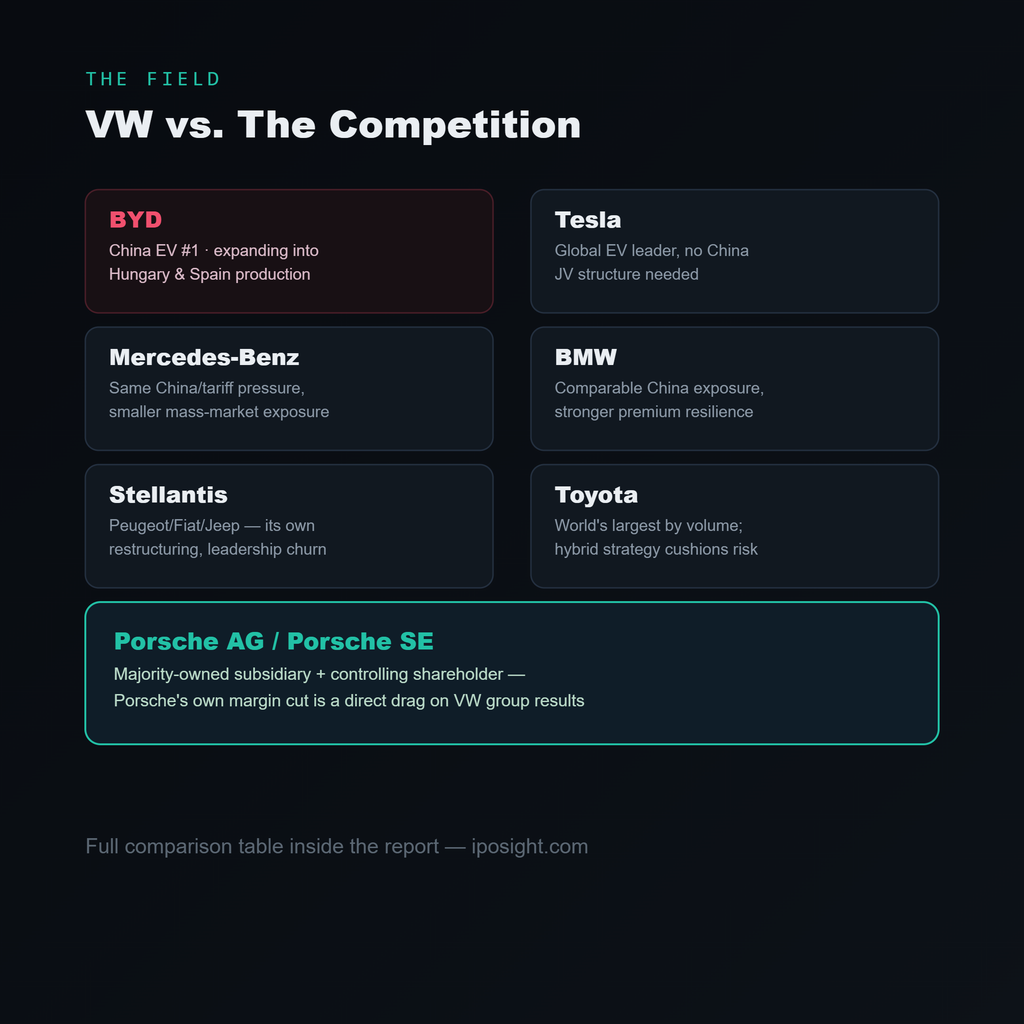
Competitors & Related Stocks
| Company | Relationship to VW | 2026 Position |
| BYD (HK: 1211) | Direct EV competitor, China & Europe; potential capacity-sharing partner | China’s top-selling EV brand for most of 2024–2025; expanding European manufacturing in Hungary |
| Tesla (NASDAQ: TSLA) | Global EV competitor | No China JV requirement; competes directly with VW’s ID. lineup in Europe and the US |
| Mercedes-Benz Group (ETR: MBG) | German premium peer | Facing similar China and tariff pressures; smaller mass-market exposure than VW |
| BMW (ETR: BMW) | German premium peer | Comparable China exposure; historically stronger premium-segment resilience |
| Stellantis (NYSE: STLA) | Mass-market competitor (Peugeot, Fiat, Jeep, Chrysler) | Its own restructuring and leadership turnover; similar tariff exposure |
| Toyota (NYSE: TM) | World’s largest automaker by volume alongside VW | Stronger hybrid positioning has cushioned China/EV transition risk |
| Renault (EPA: RNO) | European mass-market peer; past EV-partnership talks with VW | Smaller China exposure; more Europe-concentrated risk |
| Porsche AG (ETR: P911) / Porsche SE (ETR: PAH3) | Majority-owned subsidiary / controlling shareholder | Own margin-ambition cut and writedowns are a direct drag on VW group results |
| TRATON SE (ETR: 8TRA) | Majority-owned commercial-vehicle subsidiary | Separately listed; incoming orders rose despite special items in Q1 2026 |
The Biggest Risks
- Structural China share loss. Even VW’s early-2026 China sales rebound is attributed largely to fading rival subsidies rather than a genuine competitiveness fix — the underlying product-cost and software gap with BYD, NIO, and XPeng remains open.
- Execution risk on the “Future Plan.” Cost cuts, plant restructuring, and 50,000 planned job reductions all require negotiating around a legally empowered state shareholder and a union with a firm anti-closure stance — a genuine governance constraint most competitors don’t face to the same degree.
- Tariff exposure. The estimated €5 billion annual US tariff impact is a direct, largely uncontrollable cost that compresses margins regardless of operational improvements elsewhere.
- Porsche drag. A meaningful share of group profitability now depends on Porsche’s own turnaround, which faces its own China and EV-transition headwinds and has already required a lowered medium-term margin target.
- Dividend sustainability. A second consecutive dividend cut would remove one of the stock’s main support pillars for income-focused and value-fund holders.
The Turnaround Case: What Could Go Right
Volkswagen’s opportunity case rests on execution across three fronts happening roughly in parallel. First, portfolio simplification: the Everllence stake sale (€7.4 billion) and a potential Škoda India divestment both free up capital and management attention without touching the core automotive business — this is the clearest, most controllable lever management has already started pulling. Second, a genuine China reset: the XPeng joint venture and a faster cadence of locally developed models (roughly 20 planned for 2026) are a real attempt to close the speed-to-market and software gap with domestic Chinese rivals, rather than simply defending share with legacy combustion products. Third, an affordable-EV push in Europe — the sub-€20,000 model targeted for 2027 — directly addresses the price point where Chinese brands have been winning European buyers, backed by a home-market advantage in dealer networks, brand trust, and (per the German subsidy program) EV purchase incentives that favor European-built vehicles. If even two of these three land reasonably close to plan, the current P/E of under 6 and a still-double-digit-billion-euro EBITDA base leave meaningful room for both earnings recovery and multiple re-rating — which is exactly what the €104 average analyst target is pricing in.
Valuation, the Dividend, and a Laddered Entry Strategy
On traditional value metrics, VOW3 screens cheap: a trailing P/E near 5.9, a dividend yield around 7.2%, and a share price near where it traded a decade ago despite meaningfully higher group revenue since then. The tension is that “cheap” and “value trap” look identical in year one — the difference only shows up once earnings either stabilize or keep eroding. Given that near-term technical momentum has been negative even as fundamental targets stay constructive, a single lump-sum entry at any one price carries real timing risk in either direction.
A laddered (dollar-cost-averaging style) entry is a reasonable way to manage that uncertainty for investors who find the long-term case credible: for example, splitting a prospective position into three or four tranches spread across the €65–€80 range over the coming two to three quarters, rather than committing all at once — buying more if the stock revisits its 52-week low near €71, and less if it re-rates quickly toward the mid-€80s. The two nearest concrete catalysts worth watching before adding materially to a position are the next quarterly earnings print (October 29, 2026) and any formal update on the “Future Plan’s” cost-cutting milestones, since both will show whether the current guidance range is holding or slipping further.
12-Month Outlook
The estimates below are directional, reflecting the balance of the catalysts and risks discussed above — not a statistical forecast.
| Scenario | Probability | Approx. 12-Month Price | Key Condition |
| Bull — re-rating toward analyst consensus | 30% | €95–€120 | China JV stabilizes, cost cuts land on schedule, no further dividend cut |
| Base — sideways consolidation | 40% | €68–€92 | Gradual margin recovery, continued China share pressure, flat-to-modest dividend |
| Bear — renewed downside | 30% | €50–€68 | Further China share loss, a second dividend cut, tariff impact exceeds €5B |
Part 12 — Final Verdict
Volkswagen is not a broken company trading at a broken-company price by accident — the P/E under 6 and the 7% yield exist precisely because the market is pricing in real, credible risks: a structural China competitiveness gap, tariff exposure outside management’s control, a governance structure that slows restructuring, and a dividend that has already been cut once. At the same time, this is not a speculative micro-cap story: it is Europe’s largest industrial employer, generating over €300 billion in annual revenue and roughly €50 billion in EBITDA, with a diversified brand portfolio, a profitable financial-services arm, and a controlling shareholder base (Porsche SE, the State of Lower Saxony, Qatar Holding) with every incentive to see the company survive and eventually thrive.
For investors who find the multi-year turnaround thesis credible — a real China reset via the XPeng partnership and localized models, a genuinely cheaper European EV lineup by 2027, and continued portfolio simplification — the current price range looks like a reasonable place to begin building a position gradually, rather than all at once, precisely because near-term technical momentum and China headlines could still push the stock lower before any of those catalysts play out. Investors who are skeptical that the China gap can be closed, or who prioritize dividend stability over yield, have equally reasonable grounds to wait for clearer evidence in the October 29 earnings report and beyond before committing capital.
he low €70s, though near-term technical momentum indicators have been more negative.
Sources & References
[1] Volkswagen Group — “Investors” & “Shareholder Structure” — volkswagen-group.com
[2] Volkswagen Group — “Volkswagen Group stays on track in challenging environment” (H1 2026 results) — volkswagen-group.com
[3] TradingView — “VOW3 Stock Price and Chart” — tradingview.com
[4] TradingView — “VOW3 Forecast — Price Target” — tradingview.com
[5] TradingView — “ETFs holding the stock” — tradingview.com
[6] ActivTrades / TradingView Ideas — “Volkswagen: While union tightens its stance, BYD arrives Dresden” — tradingview.com
[7] Yahoo Finance — “Volkswagen Refocuses China EV Plans As Sales Slump Tests Margins” — finance.yahoo.com
[8] Investing.com — “Volkswagen H1 2026 slides: cash flow surges as China sales plunge” — investing.com
[9] AOL/Reuters — “Volkswagen makes case for deep cuts as Chinese competitors close in on Europe” — aol.ca
[10] Stocktwits — “Tesla Rival BYD’s Top-Selling Spot In China Toppled By Volkswagen” — stocktwits.com
[11] TheStreet — “Volkswagen may turn to major rival for help” — thestreet.com
[12] Simply Wall St — “Narrative Update on Volkswagen” — simplywall.st
[13] TipRanks — “Volkswagen (VOW) Targets Chinese Rivals with Budget-Friendly Electric Cars” — tipranks.com
[14] ad-hoc-news.de — “VW’s Anchor Shareholder Loses Patience as Writedowns and Guidance Cuts Pile Pressure” — ad-hoc-news.de
[15] Smartkarma — “Porsche Automobil Holding (PAH3) Earnings: FY Profit Forecast Cut” — smartkarma.com
[16] ad-hoc-news.de — “Porsche Automobil Holding stock: Q1 loss on VW writedown” — ad-hoc-news.de
[17] Simply Wall St — “Volkswagen (DB:VOW3) Dividend Yield, History and Growth” — simplywall.st
[18] StockAnalysis.com — “Volkswagen AG (ETR:VOW3) Dividend History” — stockanalysis.com
[19] Benchmark Minerals / electrive.com / CleanTechnica — Germany 2026 EV subsidy program coverage — various
[20] CBC News — “Federal government giving Volkswagen up to $13B in subsidies… St. Thomas EV battery plant” — cbc.ca
This article is produced by iposight.com based on publicly available information, company disclosures, and independent research. For informational purposes only — not investment advice. All investments carry risk, and past performance is not indicative of future results. The 12-month outlook scenarios in Part 11 are directional estimates reflecting the balance of catalysts and risks discussed in this article, not a statistical forecast. Please consult a qualified financial advisor before making investment decisions.