
Utilities | Advanced Nuclear | Small Modular Reactors
Six months ago, X-energy was the hottest IPO of the spring. The Amazon-backed reactor developer priced at $23 — well above its $16–19 range — raised $1.02 billion in the largest nuclear listing in history, was reportedly more than 15 times oversubscribed, and touched $37.10 within days. Today the stock trades around $10.60. Nothing in the business has collapsed: liquidity is roughly $1.9 billion with no debt, the commercial pipeline has grown to about 11.5 GW, and the NRC is in the final stretch of reviewing the first Xe-100 construction permit. What changed is the price the market is willing to pay for profits that will not arrive until the 2030s. This analysis asks whether that repricing has gone far enough — and what it would take for XE to get back toward Wall Street’s $31 average target.
The Company in Brief
X-energy was founded in 2009 by Kamal “Kam” Ghaffarian, the aerospace entrepreneur who also co-founded Intuitive Machines and Axiom Space. Headquartered in Rockville, Maryland, it designs a high-temperature gas-cooled small modular reactor, the Xe-100, and manufactures the fuel that runs it through its subsidiary TRISO-X. The model is deliberately “capital-light”: X-energy does not intend to own power plants. It earns money by licensing the design, selling engineering and project services, supplying reactor components, and — most importantly over the long run — selling fuel for the 60-year life of every reactor it deploys.
Today the revenue line is still small and dominated by engineering services and government cost-share. In Q2 2026, revenue and grant income reached $54.6 million (+154% year on year), mostly driven by the Department of Energy’s Advanced Reactor Demonstration Program (ARDP), which co-funds the first plant. By source, roughly 58% of revenue comes from government development contracts (ARDP), 27% from engineering, design and licensing services, and 15% from TRISO-X fuel development and specialty services.
The Products: Xe-100 and TRISO-X Fuel
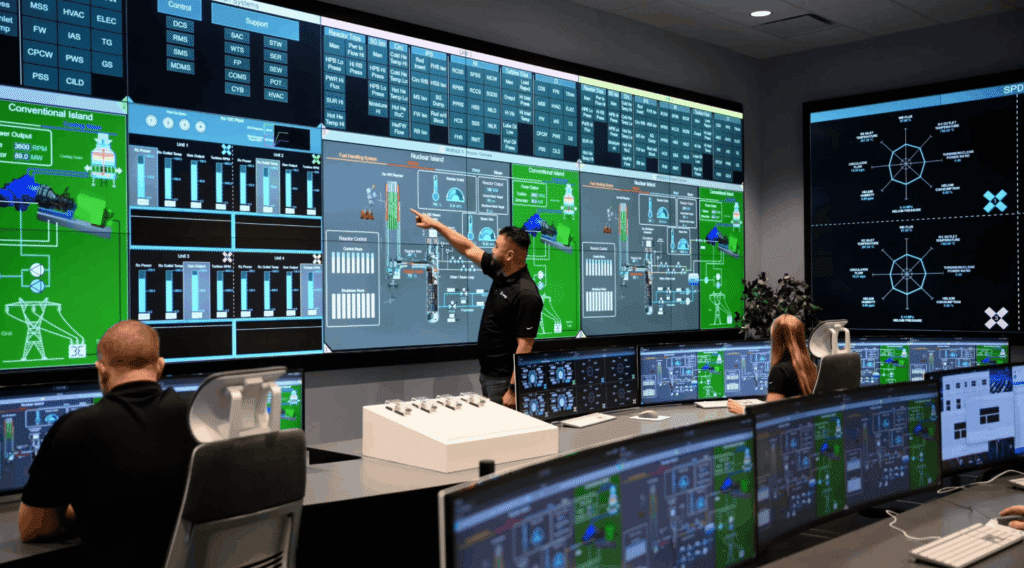
The Xe-100 is an 80-megawatt-electric reactor designed to be built in “four-packs” of 320 MWe. Instead of water, it is cooled by helium, and instead of fuel rods it uses roughly tennis-ball-sized graphite “pebbles,” each packed with thousands of TRISO particles — uranium kernels wrapped in ceramic and carbon layers that retain fission products at temperatures well above anything the reactor can reach. That is the core of the safety argument: the fuel itself acts as the containment, and the reactor can shut down and cool passively without operator action or external power.
The second selling point is heat. The Xe-100 produces steam at around 565°C, far hotter than a conventional light-water reactor. That makes it suitable not just for electricity but for industrial process heat — the reason chemical giant Dow chose it to replace natural-gas boilers at its Seadrift, Texas complex. Data centers, which need large amounts of firm, around-the-clock power, are the other target market, which is why Amazon became both investor and customer.
TRISO-X is the second leg of the business. Its TX-1 fuel fabrication plant in Oak Ridge, Tennessee — licensed by the NRC under Part 70 — completed vertical construction in September 2026 and is expected to begin operations in the first half of 2028. Securing high-assay low-enriched uranium (HALEU) is the sector’s bottleneck; X-energy has signed enrichment supply agreements with Centrus Energy and General Matter to address it.
Is the technology proven? The concept is not new. Germany ran the AVR pebble-bed reactor for two decades, and China’s HTR-PM at Shidaowan — a commercial pebble-bed, helium-cooled plant — entered commercial operation in late 2023. The physics is validated. What has never been demonstrated in the West is building these plants on time and on budget. That, not the science, is the real risk.
Leadership & Ownership
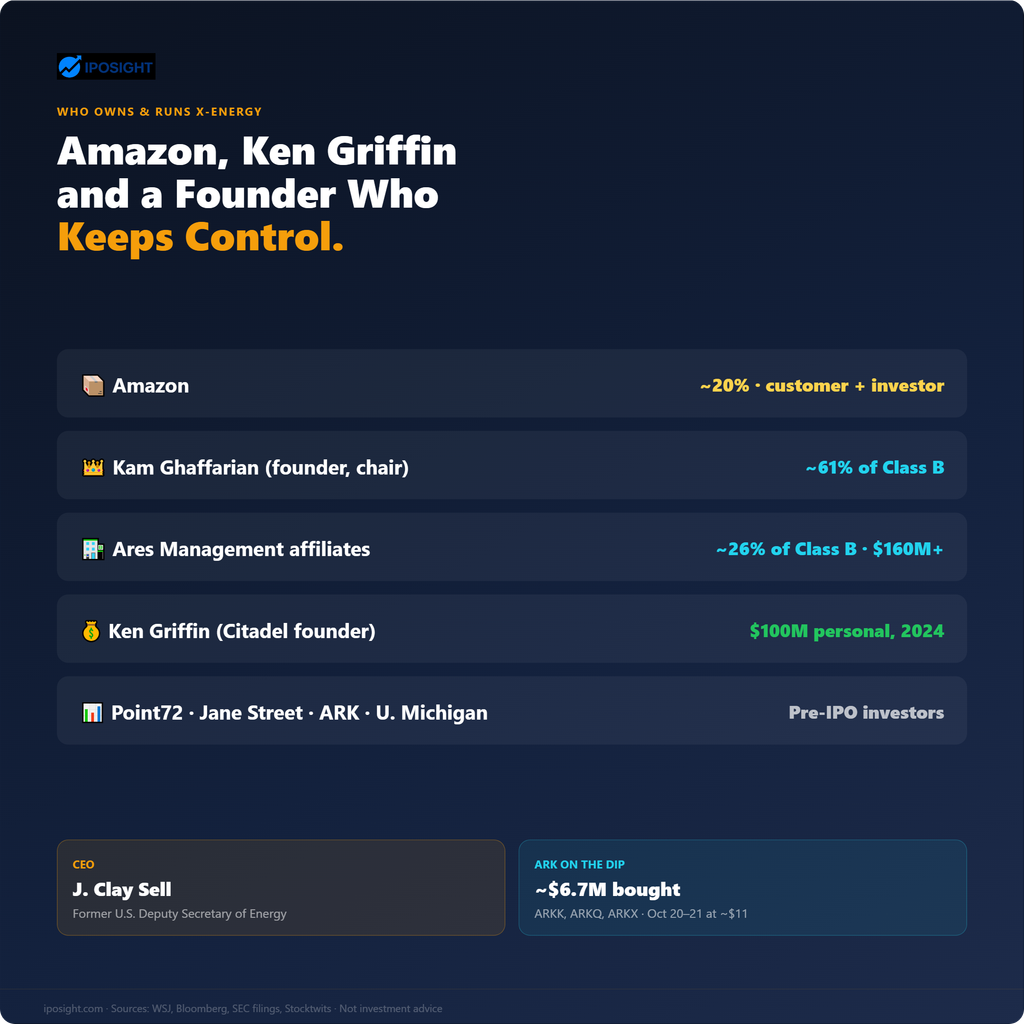
CEO J. Clay Sell served as U.S. Deputy Secretary of Energy — a background that matters in a business where the NRC, the DOE and federal cost-share programs shape the timeline. CFO Daniel Gross runs the balance sheet. Founder Kam Ghaffarian chairs the board and controls about 61% of the Class B shares, with affiliates of Ares Management holding roughly 26% of the Class B. In practice, this is a founder-controlled company; public shareholders have limited influence over strategy.
The cap table reads like a who’s who of sophisticated capital. Amazon owns close to 20% and is also the company’s most important customer, with a commitment for more than 5 GW of new nuclear capacity. Citadel founder Ken Griffin invested $100 million personally in 2024. Ares has put in more than $160 million. Point72, Jane Street, ARK Invest and the University of Michigan are also holders. Notably, ARK has been adding during the decline — buying roughly $6.7 million of XE across ARKK, ARKQ and ARKX on October 20–21 at around $11 a share.
Why Did XE Fall From $37 to $10?
The 71% drawdown has five overlapping causes — and none of them is a technical failure or a lost customer.
1. An IPO priced for perfection. At $37, XE carried a market value above $14 billion for a company with under $100 million in annual revenue and its first reactor roughly seven years from operation. Such valuations only hold while momentum and AI-power enthusiasm stay intact.
2. Losses running ahead of expectations. Q1 2026 net loss reached $166.2 million on $43 million of revenue, and Q2 adjusted EPS of −$0.15 missed the −$0.09 consensus. Operating expenses ($164.6 million in Q2) are growing as fast as revenue.
3. Lock-up expiry on September 1. Pre-IPO shares became tradable at the start of September, adding supply to a stock that was already sliding.
4. A bearish initiation. Piper Sandler started coverage on September 8 with an Underweight rating and a $9 target (since cut to $8), triggering a 9.8% one-day drop. In October, Morgan Stanley trimmed its target from $41 to $34 and UBS from $34 to $18 — both still rating the stock a buy.
5. Rates. A hotter-than-expected September inflation print on October 14 pushed the 10-year Treasury yield to about 5.26%. For companies whose cash flows sit in the 2030s, higher discount rates are brutal. The entire nuclear group — Oklo, NuScale, Centrus — sold off the same week; XE fell from about $14.40 on October 7 to $10.48 by October 16.
How much longer can the decline last? The mechanical selling (lock-up, post-IPO rotation) is largely behind the stock. What remains is macro-driven: as long as long-term yields stay above 5%, long-duration growth stocks are unlikely to re-rate meaningfully. The most plausible near-term floor is formed by the balance sheet — $1.9 billion of liquidity against a ~$4.2 billion market cap — and by the NRC permit decision, which can change the narrative independent of rates.
The Market: How Realistic Is the SMR Build-Out?
Estimates for the small modular reactor market vary widely; one industry study puts it at $5.3 billion in 2026, growing to $15.6 billion by 2035 (12.7% CAGR). For X-energy, top-down numbers matter less than signed demand: an ~11.5 GW pipeline, covering about 144 potential Xe-100 units in the U.S. and U.K.
Will modular reactors actually spread? The honest answer is “yes, but later and more slowly than the 2026 hype implied.” Three forces are favorable. First, buyers have changed: hyperscalers such as Amazon, Google and Microsoft need firm, carbon-free power for AI data centers and are willing to fund development directly, and heavy industry needs high-temperature heat that wind and solar cannot supply. Second, policy is bipartisan — DOE cost-share, NRC licensing modernization, and state incentives such as Tennessee’s $11 million grant for TRISO-X. Third, Canada is building the first North American grid-scale SMR (GE Vernova Hitachi’s BWRX-300 at Darlington), which should de-risk the category.
The headwinds are equally real. NuScale’s first U.S. project with UAMPS was canceled in 2023 when estimated power costs rose to around $89/MWh; first-of-a-kind nuclear plants have a long history of overruns; and HALEU supply remains thin. A realistic timeline for X-energy is: construction permit for Dow Seadrift by Q1 2027, first commercial operation around 2030–2033, and serial “fleet” deployment only in the mid-to-late 2030s. Morgan Stanley models EBITDA breakeven in 2030, the first project online in 2033 and about 20 GW deployed by 2040.
Customers and Projects
Seadrift, Texas
Dow + DOE ARDP
Scope: 4 × Xe-100, power + industrial steam
Status: NRC draft safety evaluation done; permit expected by Q1 2027
Cascade, Washington
Energy Northwest + Amazon
Scope: Up to 12 units / 960 MWe, first block 320 MWe
Status: Construction permit application expected 1H 2027
Sullivan County, Indiana
AEP + Amazon
Scope: 12 units / 960 MWe on a retired coal site
Status: Announced Oct 19, 2026; feasibility stage, Amazon funding development
United Kingdom
Centrica
Scope: Fleet deployment
Status: Generic Design Assessment entry; first phase due by year-end
Kentucky / PJM
PPL, Talen Energy
Status: Exploratory, early discussions
Competitive Landscape
X-energy is one of perhaps half a dozen credible advanced-reactor developers. The table below shows the operational peers that matter — not trading-correlation look-alikes.
GE Vernova Hitachi (GEV)
BWRX-300, light-water SMR
Under construction at Darlington, Canada; TVA project in the U.S. — the timeline leader
NuScale (SMR)
Light-water SMR modules
NRC design approval (77 MWe); still searching for a firm first U.S. buyer
Oklo (OKLO)
Aurora fast reactor
Large data-center pipeline; heavy cash burn and a $1B ATM program
Kairos Power (private)
TRISO pebble, molten-salt cooled
Hermes test reactor; 500 MW Google agreement — closest technological rival
TerraPower (private)
Natrium sodium-cooled + storage
Wyoming project with Bill Gates backing
Westinghouse / Holtec
AP300 / SMR-300
Large-incumbent alternatives for utilities
X-energy’s edge is the combination of high-temperature output (industrial heat, not just power), an in-house fuel supply chain, a first-mover NRC construction permit review for an advanced (non-light-water) design, and the deepest hyperscaler relationship in the group. Its weakness relative to GE Vernova Hitachi is time-to-market: the BWRX-300 uses conventional fuel and familiar water technology and will likely reach operation first. Fuel suppliers such as BWX Technologies and Centrus are partners as much as rivals.
ETF Coverage
Despite its young listing, XE is already a core holding of the nuclear-themed ETF universe — a meaningful source of systematic demand. The heaviest weights sit in dedicated SMR funds: Global X Small Modular Reactor ETF (SMRZ, 19.26%), South Korea’s Mirae Asset TIGER US AI Electricity SMR ETF (14.21%, $78M) and Samsung KODEX US Nuclear Power SMR ETF (11.36%, $27M). These are small funds, but XE is one of their largest positions.
The bigger dollars come from the broad nuclear funds, where even modest weights translate into large positions: VanEck Uranium & Nuclear ETF (NLR, 3.88% of $3.23B ≈ $125M), Global X Uranium ETF (URA, 2.33% of $5.08B ≈ $118M), the European VanEck NUKL UCITS ETF (3.19% of $1.89B ≈ $60M), Range Nuclear Renaissance (NUKZ, 1.23%) and ALPS Nautilus SMR ETF (SMRF, 1.93%). ARK Invest holds XE in ARKQ (1.13%) and ARKK (0.85%) and has been adding on weakness. Combined, ETFs hold several hundred million dollars of XE — a demand floor, but also a channel through which sector-wide outflows hit the stock, which partly explains why XE trades in lockstep with Oklo and NuScale.
Is XE a Good Investment? Can It Go Bankrupt?
Bankruptcy risk over the next three to four years is low. X-energy had about $1.9 billion of liquidity and no debt at the end of June. Quarterly operating expenses of roughly $165 million against $55 million of revenue imply a net burn in the region of $110–150 million per quarter, with DOE cost-share covering a large part of the first plant. That points to a runway into roughly 2029–2030 at today’s pace. The risk is not insolvency but dilution: once the fleet build-out and TX-1 operations ramp, X-energy will almost certainly need to raise more equity before it is self-funding — ideally after the stock has recovered, not at today’s price.
Is $10–11 a good entry? On fundamentals, the case has improved while the price fell: the NRC process has moved ahead of schedule, a third U.S. project with Amazon was added, and TRISO-X hit its construction milestone. At about $4.2 billion, the market cap is only around 2.2 times the cash on the balance sheet. The stock is not cheap on any earnings measure — there are none — but much of the speculative premium has been squeezed out.
A sensible approach is a scaled entry: a first tranche in the $9–12 range, a second if macro pressure pushes the stock toward $7–8 (close to the Piper Sandler bear target), and a third after the Seadrift construction permit is issued. Given the binary nature of first-of-a-kind nuclear projects, a position of 1–2% of a diversified portfolio is appropriate.
How likely is the $31 average target within 12 months? Low — we estimate 10–15%. Reaching it would require a ~3× move, which would need the construction permit, a final investment decision at Seadrift, a new gigawatt-scale contract and falling interest rates all at once. A move back toward $18–25 (UBS’s $18 target to the low end of the bullish cluster) is far more plausible if the permit lands on time.
Is Multi-Year Appreciation Sustainable?
The long-term thesis is more attractive than the short-term one. X-energy’s business model resembles an aircraft-engine maker more than a utility: the reactor sale or license is the entry ticket, while fuel and services generate recurring revenue for six decades per unit. If the company reaches even half of Morgan Stanley’s 20 GW-by-2040 scenario, that is roughly 125 Xe-100 units each needing TRISO fuel reloads — a large, high-margin annuity built on a fuel plant that very few competitors can replicate.
The path there has three gates: the Seadrift construction permit (Q4 2026–Q1 2027), on-budget construction of the first four-pack (late 2020s), and conversion of the Amazon-backed Cascade and Indiana projects into firm orders. Each gate passed should lower the risk premium the market applies. Each gate missed — especially a cost overrun on Seadrift — would be very damaging. A three-to-five-year holding period is the minimum sensible horizon.
12-Month Price Scenario Analysis
Bull scenario (~30% probability): $18–$28. The NRC issues the Seadrift construction permit by Q1 2027 — the first for an advanced non-light-water commercial reactor — and Dow moves toward a final investment decision. Energy Northwest files its permit application, the Indiana project progresses, and long-term yields ease below 5%. Nuclear ETFs add XE. The stock re-rates toward the lower end of the bullish analyst cluster.
Base scenario (~45% probability): $8–$16. The permit arrives roughly on schedule but is largely priced as expected; rates stay elevated. XE trades in a wide range with high volatility, tracking nuclear peers and Treasury yields. Quarterly losses remain large, and investors wait for the Seadrift FID and construction cost estimates.
Bear scenario (~25% probability): $5–$8. The NRC timeline slips, Seadrift cost estimates disappoint, or the company pre-emptively raises equity at a low price. A further rise in yields or an AI-capex slowdown hits the whole sector. The stock falls toward Piper Sandler’s $8 target and below.
Key upcoming catalysts: Q3 2026 results (December 2, 2026) · NRC final safety review for Seadrift (Q4 2026) and permit issuance (expected by Q1 2027) · DOE ARDP budget period through March 2027 · Energy Northwest construction permit application (1H 2027) · Next ~1 GW project announcement · UK Generic Design Assessment progress with Centrica · TX-1 interior build-out and 2028 start-up.
Investment Evaluation
| Factor | Score |
| Customer Quality & Pipeline Amazon (5+ GW commitment and ~20% owner), Dow, Energy Northwest, AEP, Centrica. ~11.5 GW pipeline. The strongest demand base of any listed SMR developer. | 9/10 |
| Balance Sheet & Bankruptcy Risk ~$1.9B liquidity, no debt, DOE cost-share on the first plant. Runway into roughly 2029–2030; future dilution likely but no solvency risk near term. | 8/10 |
| Technology & Fuel Moat High-temperature output for industry, passive safety, proven HTGR physics (HTR-PM in China). Own TRISO fuel plant licensed by NRC — a rare vertical integration. | 8/10 |
| Regulatory Progress Environmental assessment and draft safety evaluation completed ahead of schedule; permit expected by Q1 2027. A first-of-its-kind approval would be a sector milestone. | 8/10 |
| Ownership & Leadership CEO is a former Deputy Secretary of Energy; Amazon, Ares, Ken Griffin, Point72, Jane Street and ARK on the cap table. Offset by founder control via Class B shares. | 7/10 |
| Valuation at ~$10.60 ~$4.2B market cap, ~2.2× cash. Much of the IPO premium is gone, but there are no earnings to anchor value until the 2030s. | 6/10 |
| Competitive Position Strong in industrial heat and hyperscaler demand; behind GE Vernova Hitachi on time-to-market; Kairos is a close technical rival with Google backing. | 6/10 |
| Profitability & Cash Burn Q1 net loss $166M; Q2 opex $165M vs $55M revenue; EPS misses in both reported quarters. Breakeven not expected before ~2030. | 3/10 |
| Execution & Timeline Risk First-of-a-kind construction, HALEU supply, cost overruns (NuScale/UAMPS precedent). First power realistically 2030–2033. | 4/10 |
| Macro & Rate Sensitivity Long-duration cash flows make XE highly sensitive to 10-year yields above 5%; nuclear names trade as a pack. | 4/10 |
Overall Investment Score: 6.6 / 10 · Best-in-class customers and a strong balance sheet, but a 2030s payoff and heavy rate sensitivity. Scaled entry $9–12, add after the NRC permit. Maximum 1–2% of a portfolio, 3–5 year horizon.
Final Verdict
X-energy is the most fundamentally complete company in the listed small-modular-reactor group: real customers with deep pockets, a regulatory process that is ahead of schedule, its own fuel plant, and nearly $2 billion in the bank. It is also a company that will not earn a profit for years and whose share price depends heavily on interest rates and on the mood around AI-power stocks. The IPO priced in the first set of facts and ignored the second; the past six months have priced in the second and partly forgotten the first.
At around $10–11, investors are paying roughly the value of the cash plus a modest premium for a credible chance at becoming one of the default technologies for industrial heat and data-center power in the 2030s. That is a reasonable — not a risk-free — proposition. The next clear inflection point is the Seadrift construction permit. Investors who want to own the story before that event should build gradually; those who need proof can wait for the permit and accept paying a higher price.
“The market spent six months learning that a reactor is not a software product. The useful question now is not whether X-energy is exciting, but whether $4 billion is a fair price for a 60-year fuel annuity that will start paying in the 2030s. For patient investors, the answer is increasingly yes.”
Sources & References
[1] X-energy — x-energy.com · IR: investors.x-energy.com
[2] X-energy — Pricing of upsized IPO, April 23, 2026
[3] SEC EDGAR — X-Energy, Inc. Form S-1, 424B4, 10-Q (Q1 and Q2 2026)
[4] Energy Connects / Bloomberg — X-Energy climbs 27% after $1.02B IPO
[5] WSJ via Tiger Brokers — Nuclear IPO set to deliver big wins to Amazon and Ken Griffin
[6] Nasdaq — X-Energy Q1 earnings call highlights
[7] Finviz — Q2 revenue jumps 154%
[8] POWER Magazine — AEP, X-energy eye 960-MW Indiana plant
[9] MarketBeat — XE analyst forecasts
[10] Quiver Quantitative — XE falls on Piper Sandler initiation and lock-up
[11] Barron’s via Tiger Brokers — Why analysts say the nuclear stock can surge
[12] TIKR — Nuclear selling and the 5.26% 10-year yield
[13] Stocktwits — ARK adds XE for a second straight day
[14] XE PDF Analysis — Stock Analysis Tool, October 30, 2026
[15] Global Market Insights — Small modular reactor market 2026–2035
iposight.com — for informational purposes only, not investment advice. Pre-profit energy technology stocks carry a high risk of loss.
Discover more from IPOSight
Subscribe to get the latest posts sent to your email.