
Non-Energy Minerals | Precious Metals | Silver Mining | Mexico | Pre-Production | Exploration
A billion-dollar silver deposit that sat undiscovered for centuries — concealed beneath a clay cap that defeated generations of explorers — went public on the New York Stock Exchange on June 26, 2026. Sinda Ltd. raised $213 million from its IPO plus $110 million from Fresnillo, the world’s top primary silver producer, in a concurrent private placement. The total raise of $323 million values a company with no revenue, no mine plan, and a 2031 production target at approximately $1.8 billion. The question is not whether the geology is real — three of the most sophisticated investors in precious metals have collectively committed $323 million to confirm they believe it is. The question is what it is worth, and when.
What Is Sinda? A Discovery Hidden for Centuries
Sinda Ltd. is a pre-production silver exploration and development company operating in Mexico’s Guanajuato silver belt — one of the most historically significant precious metals regions on Earth, responsible for roughly a third of the world’s silver output over the past 500 years of recorded mining. The Sinda Property was literally hidden: the primary mineralization lay beneath a clay cover that concealed it from centuries of exploration by Spanish conquistadors, Mexican mining companies, and modern geologists alike. It was discovered in 2016 through the PhD dissertation research of Dr. Larry Buchanan, chief geologist of The Electrum Group — the natural resources investment firm of billionaire Thomas Kaplan that funds and controls Sinda.
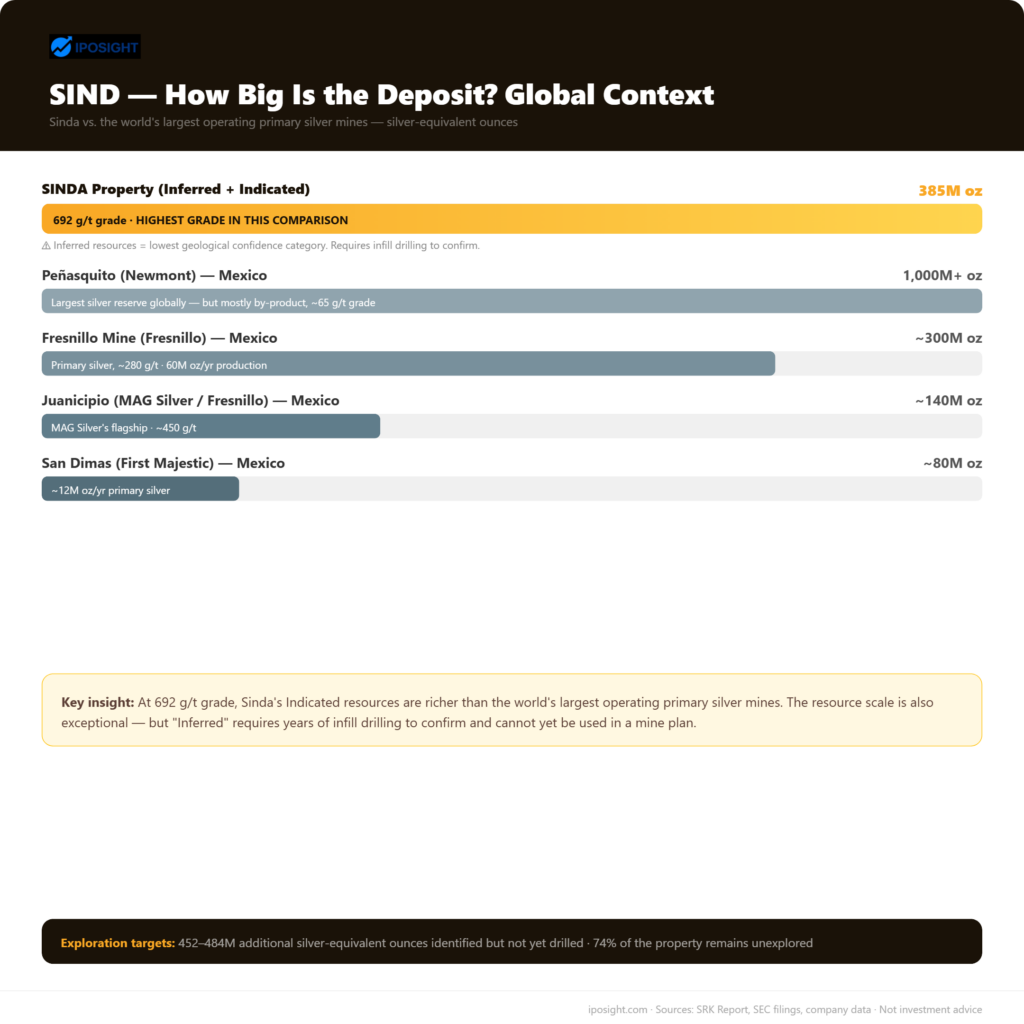
The project spans five contiguous mining concessions covering 6,232 hectares in Guanajuato state. According to the technical report prepared by SRK Consulting — the most respected independent mining consultancy globally — the property hosts 369 million silver-equivalent ounces of Inferred Mineral Resources and 16 million silver-equivalent ounces of Indicated Resources. The Indicated Resources carry an average grade of 692 grams of silver-equivalent per tonne — placing Sinda among the top five highest-grade large primary silver deposits in Latin America. The 182-kilometre identified mineralised strike length represents one of the longest primary silver corridors ever defined on a single property.
The company was founded in 2012, began drilling in 2016 following the discovery, and has spent a decade building the geological database that supported the SRK resource estimate. It has 15 drill rigs currently mobilised on site. The IPO proceeds are earmarked for infill and expansion drilling, construction of a 9-kilometre underground exploration decline at the Caracol deposit (permits already secured), and the economic and technical studies required to advance toward a mine plan. Production is targeted for 2031 at the earliest.
The Strategic Investors: Why Fresnillo and Franco-Nevada Matter
In any pre-production mining investment, the most important signals come not from spreadsheet models — which are purely speculative at this stage — but from the quality of the people committing capital at the IPO price. Sinda’s strategic investor roster is extraordinary:
Fresnillo plc is the world’s largest primary silver producer, operating six mines in Mexico with over 60 million silver ounces of annual production. Fresnillo committed up to $110 million in a concurrent private placement at the IPO price, taking up to 5% of the company. Critically, Fresnillo’s concessions are adjacent to Sinda’s in Guanajuato Sur — meaning Fresnillo is investing in a deposit that borders its own operating mines. This is not a passive financial bet. It is a strategic positioning by the company that knows this geological district better than anyone on Earth. The fact that they paid $12 per share, the same as public investors, is the clearest possible signal about what they think the geology is worth.
Franco-Nevada Corporation, the world’s largest gold-focused royalty and streaming company with a $30+ billion market cap, indicated interest in purchasing up to $10 million of shares as a pure equity investor. Franco-Nevada does not take equity positions lightly — they have decades of experience separating genuine resource stories from promotional ones.
The Electrum Group, Thomas Kaplan’s natural resource investment firm, will retain approximately 78% of voting power post-IPO. Kaplan built his fortune through a series of precious metals discoveries and developments that ultimately generated multi-billion dollar returns. His most celebrated bet — a uranium and silver discovery in Argentina — became the Pirquitas mine. Electrum’s simultaneous listing of sister company Sunshine Silver Mining (which rose 27% on its first trading day days before Sinda’s IPO) reflects a coordinated, sophisticated strategy to bring major silver assets to public markets during a silver price upcycle.
The Silver Market: Why Timing Matters for SIND
Sinda is not a standalone investment decision — it is inextricably tied to the silver price, and the silver market in 2026 is one of the most structurally interesting commodity setups in decades. Silver hit a nominal all-time high of $121.64 per ounce in January 2026, rose over 140% in 2025, and has since pulled back to approximately $66–$67 per ounce at the time of Sinda’s IPO — a 45% decline from the peak. This pullback is the single most important context for understanding SIND’s investment case.
The structural fundamentals have not changed. The silver market is entering its sixth consecutive year of supply deficit in 2026, with the Silver Institute projecting a 46.3 million ounce shortfall. Industrial demand from AI data centers, electric vehicles, solar photovoltaics (despite ongoing thrifting), and semiconductor manufacturing continues to grow. J.P. Morgan projects silver will average $81 per ounce in 2026, while Commerzbank targets $90 by year-end. The long-term forecasts from Goldman Sachs and Bank of America extend to $135–$309 in bull scenarios driven by deepening deficits.
For Sinda specifically, the silver price matters in two distinct ways. First, the current price ($66–$67/oz) determines the market’s willingness to pay for undeveloped silver resources now. Second, the silver price in 2031 — when Sinda targets production — will determine the actual economics of the mine once built. At $80/oz, the economics of a 692 g/t deposit are compelling. At $120/oz — which several major banks consider plausible by 2028–2030 — they would be exceptional. At $50/oz — possible in a macro deterioration scenario — a mine built at great expense and delivered into a weak market would face serious challenges.
Scale, Grade, and What It Could Mean in Production
There is no formal mine plan yet. Without a pre-feasibility study, it is impossible to independently model production rates, capital costs, or cash flow. What SRK’s resource estimate does tell us, however, is that the geological foundation for a very large mine exists if the infill drilling confirms what the discovery drilling suggests.
For context: a 692 g/t silver-equivalent grade is world-class. The best-producing primary silver mines in Mexico — including Fresnillo’s own Fresnillo mine — operate at grades of 180–400 g/t. A deposit with nearly double the grade of an operating Fresnillo mine, if confirmed at scale, would be one of the most economically attractive silver assets in the world. At a hypothetical 5 million tonne per year processing rate (a reasonable starting point for an underground mine of this character), 692 g/t implies annual silver production of roughly 110 million silver-equivalent ounces. That would make Sinda the world’s largest primary silver mine by output — approximately 50% larger than Fresnillo’s combined Mexican operations. This is the upside scenario if geology delivers at the scale the current resource estimate suggests.
In global and American context: total global annual silver mine production is approximately 844 million ounces. A 100+ million ounce Sinda mine would represent roughly 12% of global supply — genuinely world-altering for the primary silver market. For comparison, the largest operating primary silver mine today is First Majestic’s San Dimas at approximately 10–12 million ounces per year. Sinda’s potential scale, if realised, would be a category of one.
The critical caveat: “Inferred” is the lowest geological confidence category. The 369 million ounce figure requires years of infill drilling to convert to the higher-confidence Measured and Indicated categories needed for a formal mine plan. The $213 million raised in the IPO is specifically intended to fund this conversion process. The production target is 2031 at the earliest.
The Competitive Landscape: Primary Silver Is Genuinely Rare
At the exploration stage: MAG Silver (MAG), Vizsla Silver, and Guanajuato Silver Company are the closest pre-production comparables in Mexico’s silver belt. MAG Silver’s Juanicipio mine — now in production with Fresnillo as its joint venture partner — is perhaps the best analogue for what Sinda could eventually become. MAG Silver was valued at roughly $500 million during its exploration phase and has grown to a $2+ billion company as Juanicipio has come into production. Vizsla Silver, at the resource definition stage in Sinaloa state, provides another data point for how the market values large-scale Mexican silver exploration stories.
At the production stage: the relevant comparators are First Majestic Silver (AG), Endeavour Silver (EXK), and Guanajuato Silver — all Mexican operating producers. Fresnillo itself is the benchmark — and the fact that Fresnillo invested $110 million in Sinda is the most relevant competitive intelligence possible.
Large, high-grade primary silver deposits are genuinely scarce. Only about 25% of global silver production comes from primary silver mines — the rest is a by-product of copper, zinc, and lead mining. A new, world-scale primary silver discovery is a rare event. The Sinda Property, if its resource estimate is confirmed through infill drilling, would be the largest new primary silver discovery of the 21st century.
The Risks: What Can Go Wrong
The bull case is compelling. The risks are equally real and must be stated directly.
Inferred resources can disappoint. The geological confidence of the 369 million ounce estimate is low by definition. Infill drilling at the Caracol and other deposits will determine whether grades and continuity hold at depth and lateral extent. If they do not — if the high-grade zones are more isolated than the current model suggests — the resource base shrinks and the valuation must be reset. This is the single most important unknown in the Sinda story, and it will not be resolved for 2–4 years.
Mexico’s regulatory environment carries real uncertainty. The 2023 Mining Law reform created significant uncertainty for Mexican mining operations, though the May 2026 regulatory streamlining (reducing procedure times and documentation requirements) is a positive development. The absence of clarity on the post-2023 regulatory architecture represents a genuine risk factor that institutional investors will need to price appropriately. Sinda has already secured permits for the exploration decline, which is a positive signal — but future production permits will be far more complex and politically sensitive.
Electrum’s 78% voting control. Public shareholders have limited influence over strategy, capital allocation, or executive decisions. Thomas Kaplan is a highly regarded investor, but this is a controlled company — and minority investors’ interests are structurally secondary to Electrum’s preferences.
Capital intensity and dilution risk. Building a mine of Sinda’s potential scale will require hundreds of millions — possibly billions — of dollars beyond what the IPO raised. Every future capital raise dilutes existing shareholders. The 2031 production target assumes smooth execution of drilling, studies, engineering, construction, and permitting over five years — in Mexico, where none of these steps is predictable.
Silver price risk at production. A mine designed and built around $70–$80/oz silver that comes into production into a $45/oz market would be economically marginal. Silver’s volatility — a 45% decline from its January 2026 peak in five months — is not an anomaly, it is a feature. Long-term silver investors must be prepared for multi-year bear phases interspersed with the bull cycles.
ETF Exposure: Where SIND Is Most Likely to Land
Ten ETFs including GDX (VanEck Gold Miners, $12.5B AUM), SIL (Global X Silver Miners, $1.2B AUM), and RING (iShares MSCI Global Gold Miners, $350M AUM). These are plausible future holders, but the positions are not yet confirmed given how recently SIND listed. The most credible near-term ETF inclusion candidates are SIL (Global X Silver Miners) — the primary dedicated silver mining ETF — and RING. SIL specifically targets primary silver mining companies globally; at a $1.8 billion market cap, SIND would be a top-10 position within the fund. GDX includes both gold and silver miners above a certain market cap and liquidity threshold; SIND may qualify for future inclusion as trading history builds. The presence of SLV (iShares Silver Trust) and GLDM (SPDR Gold MiniShares) in the list is implausible — these are pure bullion ETFs that hold physical metal, not mining company shares. We discount those two entries.
Is SIND a Trade or a Long-Term Investment?
This is the most practical question for most investors, and the honest answer is: it is almost exclusively a long-term investment — not a trading vehicle.
Unlike the defense or biotech IPOs we have covered recently, SIND has no near-term catalysts that will create the kind of binary, 30–50% single-session moves that attract short-term traders. There will be no quarterly earnings surprises, no FDA decisions, no contract announcements. The catalysts that drive SIND’s price are geological (drill results, resource upgrades), regulatory (permitting milestones), and macro (silver price). Drill results typically arrive in batches over months, resource upgrades require independent certification, and silver price moves are not company-specific. This is fundamentally a multi-year holding.
The trading pattern of exploration-stage mining companies is well-established: they tend to be range-bound for long periods punctuated by sharp moves on significant news. The “discovery re-rating” — the massive first-day or first-month move — has already happened at IPO. From here, SIND will likely trade in a wide range around $10–$18 for the next 2–3 years until drilling results begin to meaningfully de-risk or upgrade the resource estimate. Silver price moves will amplify or dampen this range in both directions.
12-Month Price Scenario Analysis
Bull scenario (~25% probability): $18–$28. A strong first batch of infill drill results (high grades confirmed at depth in the Caracol deposit) combined with silver recovering above $85/oz. The market re-rates Sinda toward MAG Silver’s early valuation multiples on per-ounce basis. Fresnillo or another major exercises the overallotment option and continues accumulating shares.
Base scenario (~55% probability): $10–$17. SIND consolidates in a range either side of the IPO price. Drilling progresses but no transformative results in the first 12 months. Silver trades in the $65–$85 range. The stock is essentially flat to slight premium over IPO price as the market waits for the 2027–2028 resource upgrade. Electrum lock-up expiration (180 days from June 26 = late December 2026) creates no major selling as Electrum is a long-term holder, not a PE sponsor seeking exit.
Bear scenario (~20% probability): $7–$11. Silver retreats below $55/oz on macro deterioration (dollar strength, rate surprises). First infill drill results show grade inconsistency in specific zones. Mexico regulatory uncertainty resurfaces around the December 2026 anniversary of the 2023 Mining Law. The stock gives back its post-IPO gains and tests below offer price.
Key dates to watch: First infill drill results (Q4 2026–Q1 2027) · Underground decline construction progress updates (quarterly) · Silver price — particularly any move above $85 or below $55 · Fresnillo’s interim results (they may comment on Sinda’s geological progress given their adjacent position)
Investment Evaluation
| Factor | Score |
| Resource Scale & Grade | 9/10 |
| Strategic Investor Quality. | 10/10 |
| Silver Market Tailwinds | 8/10 |
| Discovery Uniqueness | 9/10 |
| Geological Confidence | 3/10 |
| Financial Position / Runway | 6/10 |
| Revenue / Profitability | 1/10 |
| Mexico Regulatory Risk | 4/10 |
| Valuation vs. Stage | 5/10 |
| Long-Term Return Potential | 9/10 |
Overall Investment Score: 6.4 / 10 · Long-term hold for patient investors. Not a trading vehicle. Requires 5+ year horizon and comfort with pre-production risk.
Final Verdict
Sinda is the most intellectually interesting IPO of the 2026 precious metals wave. The asset is genuinely rare — a world-scale primary silver discovery in the world’s most productive silver belt, hidden for centuries and confirmed by independent resource estimation to be both large and high-grade. The investors surrounding it are not speculators: Fresnillo, Franco-Nevada, and Thomas Kaplan’s Electrum Group are among the most experienced and disciplined precious metals investors on Earth. When these three sources of capital converge on the same geological story at the same price, it is not a coincidence.
But the investment is not without severe caveats. The resource is Inferred, meaning its economic conversion is unproven. There is no mine plan. The company will not produce an ounce of silver before 2031. Every dollar between today and production must come from further capital raises that will dilute existing shareholders. Mexico’s regulatory environment requires careful navigation. And the silver price — which is the ultimate determinant of whether any of this makes economic sense — is 45% below its January 2026 peak and subject to multi-year swings.
The correct portfolio context for SIND is a small-to-moderate allocation within a broader precious metals or mining portfolio, held with a genuine 5–7 year time horizon. It is not suitable for investors who need liquidity, cannot tolerate multi-year flat periods, or are uncomfortable with pre-production mining risk. For those who understand what they are buying — and who believe that a world-class primary silver discovery will ultimately be recognised by the market — SIND at $12 represents a compelling long-term entry into one of the scarcest asset categories in the natural resource world.
“The Guanajuato district has produced silver for 500 years. The Sinda Property was hidden beneath it the entire time. How that story ends depends on drilling, permitting, and the silver price — three variables that will take years to resolve, and none of which is in a hurry.”
Sources & References
[1] Mining.com — “Silver miner Sinda raises $323 million in US IPO, placement” — mining.com
[2] Business Wire — “Sinda to Begin Trading on NYSE” — businesswire.com
[3] Sinda Ltd. Official Website — sinda.mx
[4] DiscoveryAlert — “Sinda NYSE IPO: Guanajuato Silver Project Investment Guide 2026” — discoveryalert.com.au
[5] CurvedTrading — “Sinda IPO 2026 (SIND): Date, Price, Valuation, and How to Invest” — curvedtrading.com
[6] StockTitan — “Large Mexican silver developer Sinda Ltd. (SIND) targets NYSE IPO” — stocktitan.net
[7] Silver Institute — “Global Silver Investment to Remain Strong in 2026 Against the Backdrop of a Sixth Consecutive Annual Market Deficit” — silverinstitute.org
[8] Mexico Mining Center — “Sinda Ltd. Announces Launch of Its Initial Public Offering” — mexicominingcenter.com
[9] GBI Direct — “Silver Price Forecast 2026: Industrial Demand Meets Monetary Role” — gbidirect.com
[10] SEC Filing — SIND F-1 / Prospectus — sec.gov
[11] TradingView — NYSE: SIND — tradingview.com
This article is produced by iposight.com based on publicly available information, SEC filings, company materials, and independent research. For informational purposes only — not investment advice. All investments carry risk. Pre-production mining investments carry very high risk. Please consult a qualified financial advisor.