
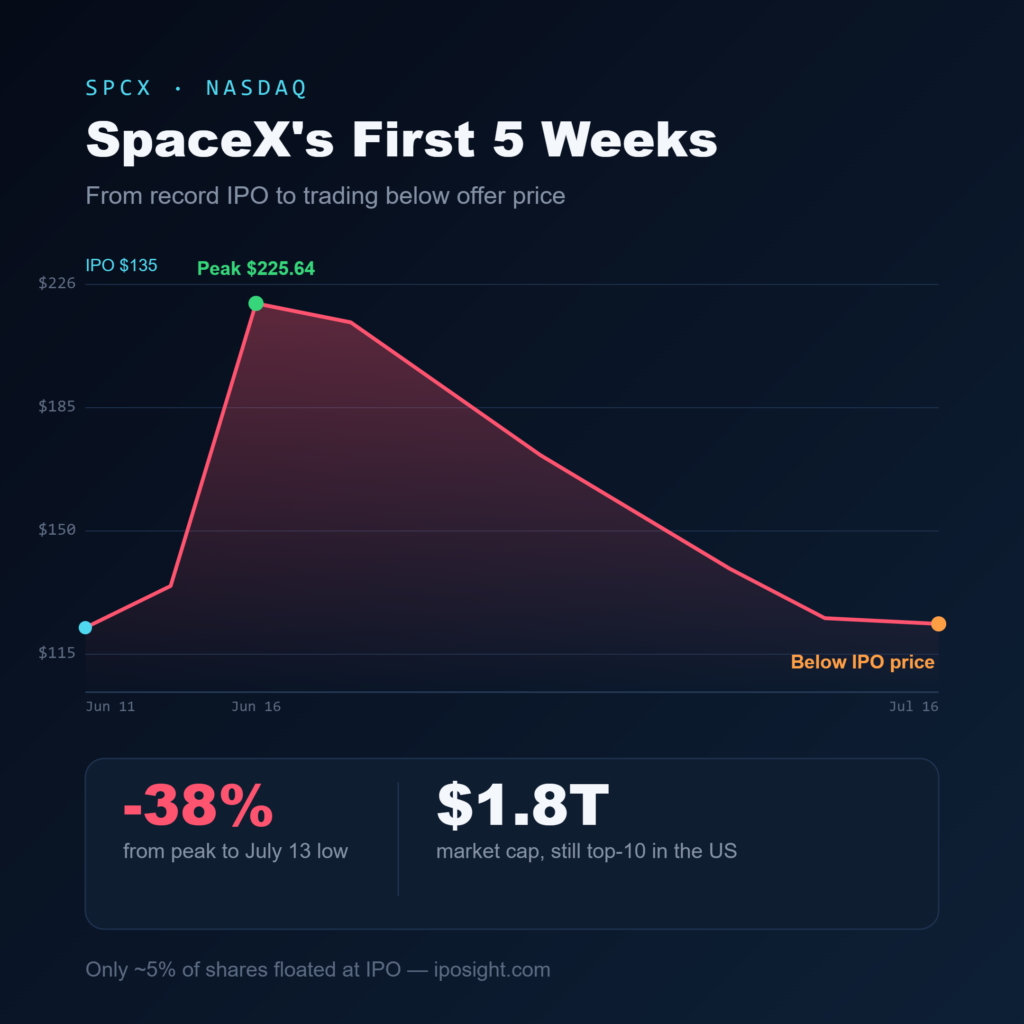
Since peaking at $225.64 on June 16, 2026 — five days after the largest IPO in history — SpaceX (NASDAQ: SPCX) has lost more than a third of its value and, for the first time, briefly traded below its $135 offer price this week. At the same time, Rocket Lab, Intuitive Machines, AST SpaceMobile and Redwire have all fallen harder, in percentage terms, than SpaceX itself — while Lockheed Martin, RTX and, above all, Carpenter Technology have either held steady or set new highs. That split is the real story. It tells you which companies the market actually treats as SpaceX’s ecosystem, and which ones just got caught in the blast radius of a single, oversized IPO.
The Sell-Off, in Numbers
SpaceX’s public listing on June 11–12, 2026 was, by any measure, extraordinary. The offering priced at $135 a share, raised a record $86 billion, and the stock closed its first day of trading up 19%. Within days it kept climbing, touching an intraday high near $225.64 on June 16 and pushing the company’s market value close to $2.1 trillion — a valuation made even more volatile by the fact that SpaceX floated less than 5% of its shares, leaving an unusually small public float to absorb enormous investor demand.
That is where the good news ends, at least for the moment. By July 13, the stock had fallen more than 38% from its post-IPO peak. On July 15 it briefly traded below its $135 offer price for the first time, closing at levels between $133 and $136 depending on the exact print, before recovering slightly to close near $135.27 on July 15–16. As of this week, SpaceX still carries a market capitalization of roughly $1.8 trillion — enough to rank it among the ten most valuable public companies in the United States — but the paper losses from the June peak already run into the hundreds of billions of dollars.
Analysts point to three connected explanations: a forward price-to-sales multiple that briefly exceeded 30x at the peak, a widely discussed net loss for 2025 in the range of $4.9 billion driven partly by AI-related investment (SpaceX’s AI unit reportedly lost roughly $6.4 billion in 2025 and a further $2.5 billion in the first quarter of 2026), and a looming wave of insider lock-up expirations. Under the IPO’s lock-up structure, an additional 455.8 million shares become eligible for sale if the stock trades above $175.50 for five of the ten trading days ahead of SpaceX’s first earnings report as a public company — a level the stock is currently nowhere near. By December, roughly 40% of total shares outstanding could be freely tradable; the remaining 60%, including Elon Musk’s stake, stays locked until mid-2027. In other words, the market is already pricing in supply that has not technically hit the float yet.
None of that, on its own, explains why Rocket Lab, Intuitive Machines and AST SpaceMobile — three companies with no direct capital, ownership or supply relationship to SpaceX — have fallen even further than SpaceX itself over the same window. That is the question this analysis actually sets out to answer.
What the Market Calls the “SpaceX Effect”
Financial media has started using a specific label for this pattern: the “SpaceX Effect.” The mechanism is simple and has shown up twice already — once in late May and early June, as anticipation of the IPO built, and again in the weeks since the listing.
When a single, dominant name absorbs enormous investor attention and capital, money has to come from somewhere. Portfolio managers running space and defense-themed strategies who wanted exposure to the sector’s biggest and most talked-about name sold existing positions — Rocket Lab, Intuitive Machines, AST SpaceMobile, Planet Labs, Redwire, Virgin Galactic — to free up cash ahead of and around the SpaceX allocation. Because most of these are still largely pre-profit, high-beta stocks trading on narrative and backlog rather than trailing earnings, they were the easiest source of funding to tap, and the easiest to sell back into once sentiment turned.
The data bears this out cleanly. In a single trading session in mid-July, SpaceX fell 4.4%, Rocket Lab fell 5.3%, AST SpaceMobile fell 7.7% and Intuitive Machines fell 6.3% — a basket that, equally weighted, dropped 5.9% and underperformed both the Nasdaq-100 (down 1.9%) and the S&P 500 (down 0.8%) by a wide margin. In dollar terms, SpaceX alone accounted for roughly $84 billion of the combined $88.6 billion in market value lost that day, simply because of its sheer size — but in percentage terms, the smaller, high-beta names were hit hardest, which is exactly the fingerprint of a capital-rotation trade rather than company-specific bad news.
Zoom out to a full month and the pattern is even starker. Over the trailing month into mid-July, Rocket Lab was down roughly 24% and Intuitive Machines down more than 40%, even as both companies reported record or near-record quarterly revenue and expanding backlogs. Redwire lost more than 24% in a single week in early June on volume nearly triple its daily average. None of these moves were accompanied by negative company-specific news; if anything, the news flow — new NASA lunar contracts for Intuitive Machines, a Department of War hypersonic interceptor selection for Rocket Lab, reaffirmed guidance from AST SpaceMobile — was uniformly positive.
Rising Treasury yields and a more hawkish tone from the Federal Reserve have amplified the move. Nearly all of these companies are “long-duration” stories in the classic valuation sense: their justification rests on profits several years in the future, which makes their present-day valuations unusually sensitive to the discount rate. When yields rise, the stocks that get marked down hardest are precisely the ones with the most distant cash flows — which, not coincidentally, describes most of the pure-play space sector.
Three Very Different Groups Are Being Treated as One
The most important finding of this analysis is that the market is currently lumping together at least three structurally different types of companies under a single “space stocks” label, even though they respond to completely different drivers.
Group 1 — Pure-play, pre-profit space bets. Rocket Lab, Intuitive Machines, AST SpaceMobile, Redwire, Planet Labs, BlackSky. These are the names actually moving in sympathy with SpaceX, because they compete for the same speculative capital pool. Their valuations depend on multi-year execution stories — Rocket Lab’s Neutron rocket debut, Intuitive Machines’ lunar program cadence, AST SpaceMobile’s satellite constellation buildout — rather than current profitability, which makes them the most reactive to sentiment swings, rate moves, and, now, to the SpaceX Effect specifically.
Group 2 — Diversified primes and Tier-1 suppliers. Lockheed Martin, RTX, Northrop Grumman, L3Harris, Honeywell. On paper, this group should be the “boring, stable” side of the trade — and in the sense that none of them move on SpaceX headlines, that is true. But several of them have had a rough 2026 anyway, for reasons that have nothing to do with SpaceX. Northrop Grumman is down roughly 12% year-to-date. L3Harris is down about 21% year-to-date as of mid-July. Since early March, Northrop has fallen nearly 30% and L3Harris more than 22%, even outperforming Lockheed Martin, which itself briefly traded underwater on a position opened at the start of a geopolitical flare-up in late February. RTX has been the standout of the group, raising full-year guidance after eight consecutive quarterly earnings beats and growing its backlog to $271 billion. The lesson here is important: the primes are not being dragged down by SpaceX, but they are not simply “stable” either — they are being repriced on their own program execution, fixed-price contract risk (Lockheed’s F-16 and Pratt & Whitney GTF issues), and index rotation dynamics, a completely separate storyline from the one hitting Rocket Lab and Intuitive Machines.
Group 3 — Specialized materials and component suppliers. Carpenter Technology, Hexcel, and, in a more mixed case, Karman Holdings. This is the group that best supports the idea of genuine decoupling. Carpenter Technology, whose specialty alloys go into turbine blades, missile structures and rocket engines, is up roughly 83% year-to-date and recently posted record quarterly adjusted operating income, entirely disconnected from the SpaceX news cycle. Hexcel, the world’s largest maker of aerospace carbon fiber, has traded on aircraft build rates and long-cycle defense contracts, attending the Farnborough Airshow this month to showcase new qualifications rather than reacting to SpaceX’s stock chart. These are businesses with diversified, multi-year, sole-source relationships across commercial aviation, defense primes and space customers simultaneously — SpaceX is one buyer among many, not the swing factor in the stock.
Karman Holdings sits awkwardly between Groups 1 and 3. It has genuine, sole-source supply relationships feeding SpaceX’s launch programs (including a reported $250 million long-term space-launch production agreement believed to touch SpaceX’s supply chain), and its backlog and pipeline have both grown sharply — pipeline alone tripled from roughly $1 billion in March 2025 to about $3 billion in May 2026. Yet KRMN fell 45%, from $118 in January to around $55 by early July, for reasons that are almost entirely company-specific: a CEO transition, a disclosed material weakness in internal controls that triggered an auditor change, and a secondary offering in which existing shareholders — not the company — sold 13.5 million shares. Karman is a useful control case precisely because its drawdown proves that not every “SpaceX-adjacent” stock that fell did so because of SpaceX; sometimes a stock falls for its own reasons at the same time the sector is already nervous, and the two effects compound.
The Correlation Map
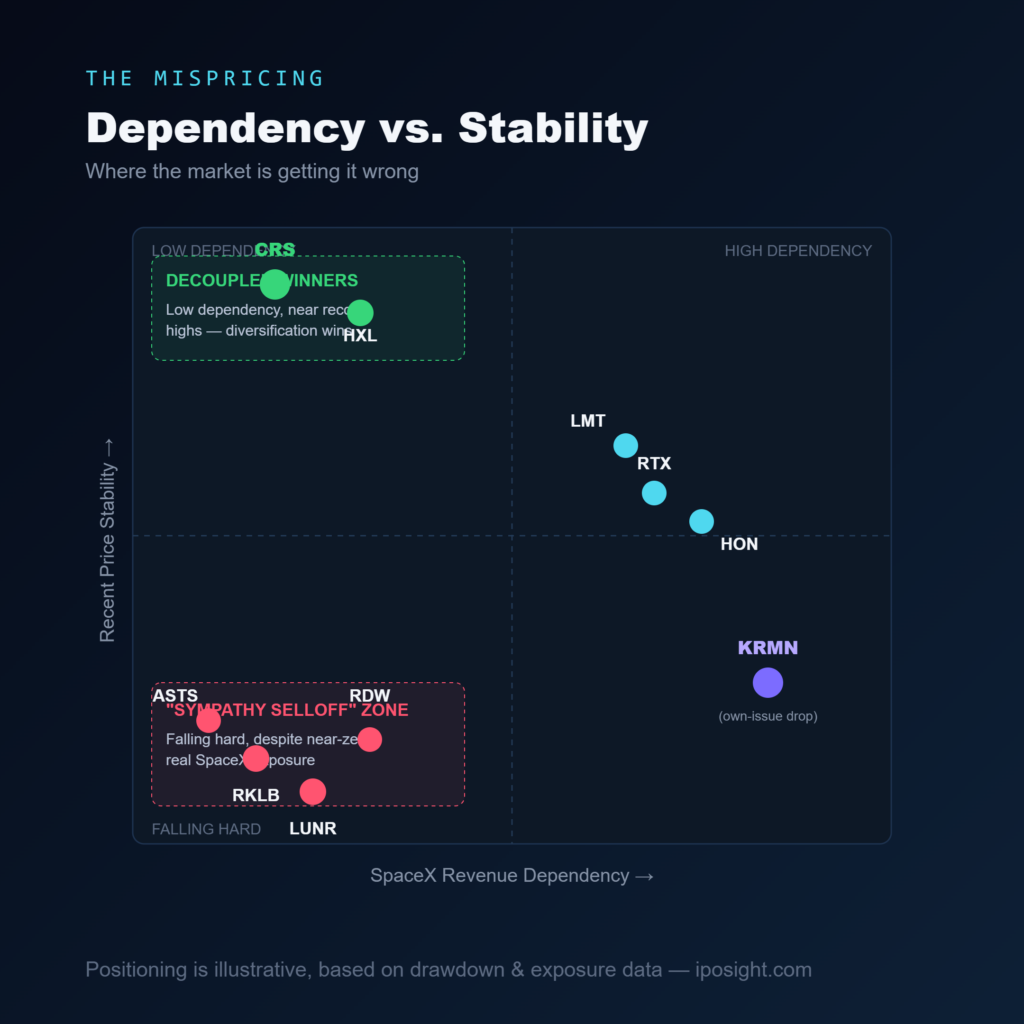
The table below organizes the companies most frequently discussed as part of the “SpaceX ecosystem” by their actual economic relationship to SpaceX, versus how much of their recent stock decline can reasonably be attributed to SpaceX-specific sentiment as opposed to company- or sector-specific drivers.
| Company | Relationship to SpaceX | Direct SpaceX Revenue Exposure | Recent Drawdown (approx., trailing month) | Primary Driver of the Move |
| SpaceX (SPCX) | — | 100% | −38% from June peak | IPO mechanics, valuation, lock-up overhang, AI-unit losses |
| Rocket Lab (RKLB) | Direct competitor, no supply link | None | ≈ −24% | Capital rotation / “SpaceX Effect,” rate sensitivity |
| Intuitive Machines (LUNR) | Competitor in lunar/space services | None | ≈ −40% | Capital rotation, NASA-program concentration risk |
| AST SpaceMobile (ASTS) | Unrelated business model (direct-to-device) | None | ≈ −19% to −25% | Capital rotation, rate sensitivity, pre-revenue status |
| Redwire (RDW) | Competitor/potential supplier | Minimal, undisclosed | ≈ −24% (single week) | Capital rotation, high-beta profile |
| Planet Labs (PL) | Unrelated (Earth observation) | None | ≈ −15% to −20% | Capital rotation, sector beta |
| Karman Holdings (KRMN) | Confirmed Tier-2 supplier | Meaningful, undisclosed % | −45% (Jan–Jul) | Company-specific (governance, secondary offering) plus sector nerves |
| Carpenter Technology (CRS) | Materials supplier (rocket alloys, among many end-markets) | Small, diversified | +83% YTD | Own fundamentals — aerospace/defense demand cycle |
| Hexcel (HXL) | Composite materials supplier (broad aerospace/defense) | Small, diversified | Roughly flat/resilient | Own fundamentals — aircraft build rates |
| L3Harris (LHX) | Partner + competitor (payloads, launches) | Small | ≈ −21% YTD | Company-specific execution and program risk |
| RTX | Supplier + partner (avionics, payload components) | Very small | Broadly resilient, guidance raised | Own fundamentals — record backlog, earnings beats |
| Honeywell (HON) | Supplier (navigation, sensors, valves) | Very small | Broadly resilient | Own fundamentals — diversified industrial base |
| Lockheed Martin (LMT) | Supplier + government-program competitor | Very small | Mixed — up on the month, pressured since Feb–Mar | Program-specific (F-16 charge), record backlog |
| Northrop Grumman (NOC) | Supplier + government-program competitor | Very small | ≈ −12% YTD, worse since Feb–Mar | Company-specific, sector rotation out of primes |
Two patterns jump out. First, the size of a company’s stock decline has almost no relationship to how economically exposed it actually is to SpaceX. Karman, the company with the clearest, contractually confirmed SpaceX supply relationship, fell for reasons that had nothing to do with SpaceX. Rocket Lab and Intuitive Machines, which have zero commercial ties to SpaceX, fell hardest of all — purely because they sit in the same “space” bucket in investors’ minds. Second, the group that actually held up best — Carpenter Technology and Hexcel — are precisely the companies whose SpaceX exposure is smallest relative to their total business. Diversification, not proximity to SpaceX, has been the best protection against this selloff.
The Macro Backdrop Nobody’s Pricing Separately
It would be a mistake to treat this purely as a SpaceX story. Two macro forces are running underneath the entire aerospace and defense complex simultaneously.
The first is rate sensitivity. Space and early-stage aerospace names are, almost without exception, long-duration equity stories: the market is being asked to pay today for profits that show up in 2028, 2030, or later. When Treasury yields rise or Fed commentary turns more hawkish, the discount rate applied to those distant cash flows rises too, and valuations compress mechanically — independent of anything company-specific. This has hit Rocket Lab, Intuitive Machines and AST SpaceMobile especially hard, since none of them yet generate consistent free cash flow at scale.
The second is a genuinely durable structural tailwind that is easy to lose sight of amid the daily price action: U.S. government demand. The Department of War’s FY2027 investment request totals $756.8 billion, with public commentary from the administration suggesting appetite for a total military budget as high as $1.5 trillion. The FY2027 space budget alone is set at $59.7 billion, funding 31 launches — a meaningful step up from prior years. Multi-year framework agreements to scale Patriot, THAAD and PrSM missile production three to four times current rates are already in place, directly benefiting companies like Lockheed Martin and, through the supply chain, Karman Holdings. This is the reason the “boring” primes and materials suppliers have, on the whole, weathered the last two months far better than the pure-play space names: their revenue is underwritten by multi-year government contracts and diversified commercial demand, not by a single company’s stock-market debut.
Scenario Analysis: How Far Could This Go?
SpaceX (SPCX) — 12-month framework. Bull case: the stock stabilizes above $150 as the initial post-IPO overhang clears, Starship and Starlink milestones deliver positive headlines, and the AI-division losses narrow. Base case: the stock trades in a wide $110–$170 range through the rest of 2026, tracking sentiment around the first earnings report and the lock-up mechanics described above — a genuinely binary catalyst, since a print above $175.50 for five of ten days ahead of earnings would trigger the release of 455.8 million additional shares into the float, almost certainly pressuring the price further. Bear case: a disappointing first earnings report as a public company, continued AI-unit losses, or a broader tech/growth drawdown sends the stock into the $80–$110 range, testing the IPO price meaningfully.
Pure-play space names (Rocket Lab, Intuitive Machines, AST SpaceMobile, Redwire) — 12-month framework. These stocks are likely to keep trading as a basket, moving on SpaceX headlines and rate expectations more than on their own news, until each individually reaches a scale where the market starts pricing them on their own fundamentals rather than sector sentiment. The clearest near-term catalysts are company-specific: Rocket Lab’s Neutron rocket debut, guided for the fourth quarter of 2026; Intuitive Machines’ next lunar lander mission; AST SpaceMobile’s satellite deployment cadence. A clean execution on any of these could decouple that individual name from the basket; a stumble would reinforce the “high-beta space trade” label and likely extend the drawdown.
Diversified suppliers and primes (RTX, Honeywell, Lockheed, Carpenter Technology, Hexcel) — 12-month framework. These are far less likely to see SpaceX-driven swings in either direction. Their trajectories will be set by their own earnings (RTX and Lockheed both report in late July), defense budget execution, and — for the materials names — aerospace and defense build-rate trends that are already running at multi-year highs.
Karman Holdings — the specific case. Karman’s own analysis (see our earlier coverage) frames August 6, 2026 — the company’s Q2 earnings report — as the single most important near-term catalyst, since it will show whether the internal-control remediation is on track. A clean quarter could see the stock recover meaningfully toward analyst price targets clustered in the $76–$100 range; a disappointing one could send it toward the low-$40s. Either way, that outcome will be determined by Karman’s own execution, not by what SpaceX’s stock does between now and then.
Where the Value Actually Is
Pulling this analysis together, three practical conclusions stand out for investors trying to use SpaceX’s pullback as a signal.
First, buying “the SpaceX ecosystem” as an undifferentiated basket is exactly the wrong lesson to draw from this selloff. The stocks that fell hardest — Rocket Lab, Intuitive Machines, AST SpaceMobile — are precisely the ones with the least actual economic connection to SpaceX. Their declines say more about crowded positioning and rate sensitivity than about SpaceX’s business.
Second, the companies with genuine, diversified exposure to the broader aerospace and defense supercycle — not concentrated SpaceX exposure — have been the more resilient holdings. Carpenter Technology’s 83% year-to-date gain and Hexcel’s steady performance through the same window make the case that owning the picks-and-shovels layer of the industry, spread across commercial aviation, defense primes and space simultaneously, has been a better risk-adjusted trade than chasing the SpaceX halo effect directly.
Third, Karman Holdings is the name to watch precisely because it is the rare case where genuine SpaceX supply-chain exposure and a separate, resolvable governance overhang have collided at the same time. If the August 6 earnings report confirms that the internal-control weakness was procedural rather than structural, KRMN offers a way to buy real SpaceX supply-chain exposure at a valuation that has already priced in most of the bad news — a different setup entirely from paying a re-inflated multiple for SpaceX itself, or for pure-play competitors with no revenue relationship to SpaceX at all.
None of this means SpaceX’s own pullback is over, or that the pure-play space names won’t eventually reconnect with SpaceX’s trajectory once the current rotation exhausts itself. But the past six weeks have made one thing clear: right now, “space stocks are falling” is at least two different stories happening at once — a SpaceX-specific IPO digestion story, and a much older, much more familiar story about rate-sensitive, pre-profit growth stocks getting repriced in a higher-yield world. Conflating the two is how investors end up selling the wrong stocks, or buying the wrong dip.
Investment Evaluation
| Factor | Rating |
| Structural Space & Defense Demand Growth | 9/10 |
| SpaceX-Specific Ecosystem Correlation (near-term) | 4/10 — weaker than commonly assumed |
| Diversified Supplier Resilience (CRS, HXL, HON, RTX) | 9/10 |
| Pure-Play Space Volatility Risk (RKLB, LUNR, ASTS, RDW) | 3/10 |
| SpaceX Lock-Up / Valuation Risk (12-month) | 4/10 |
| Karman-Type “Mispriced Overlap” Opportunities | 7/10 |
| Macro Rate Sensitivity Across the Sector | 4/10 |
| Government Budget Tailwind (FY2027) | 9/10 |
| Diversification as a Risk Mitigant | 9/10 |
| Overall Sector Opportunity, 12-Month View | 7/10 |
Overall Investment Score: 6.9 / 10
Final Verdict
The SpaceX pullback is real, and so is the broader space-stock selloff — but they are not the same event wearing two faces. SpaceX’s decline is a textbook post-IPO digestion story: an extraordinary valuation, a tiny public float, disclosed losses in its AI unit, and a lock-up structure that keeps a wall of future supply hanging over the stock. The declines in Rocket Lab, Intuitive Machines, AST SpaceMobile and Redwire are a different, older story: high-beta, pre-profit, long-duration growth stocks getting sold to fund exposure to the market’s newest and biggest story, then getting sold further as Treasury yields rose. And the resilience of Carpenter Technology, Hexcel, RTX and Honeywell shows that genuine diversification — across commercial aerospace, defense budgets and space simultaneously — has been the actual hedge against this volatility, not proximity to SpaceX.
For investors trying to position around this moment, the evidence favors three things over a simple “buy the dip on anything space-related” approach: diversified suppliers with pricing power and multi-year backlogs, selective entries into pure-play names only after their own execution catalysts (not SpaceX’s) confirm the thesis, and a close watch on company-specific situations like Karman Holdings, where a real SpaceX supply relationship has been temporarily obscured by a resolvable governance issue. SpaceX itself remains the highest-risk, highest-attention way to play this trade — which is exactly why the more interesting opportunities, as in most gold rushes, may again be sitting one or two layers back from the headline name.
Sources & References
[1] GuruFocus — “SpaceX (SPCX) Stock Falls Below IPO Price for Fourth Consecutive Day” — gurufocus.com [2] GuruFocus — “SpaceX (SPCX) Stock Hits New Low Amid Ongoing Decline” — gurufocus.com [3] Yahoo Finance / Reuters — “SpaceX shares face fresh pressure as lockup expiration approaches” — finance.yahoo.com [4] CNBC — “SpaceX stock sinks below $135 IPO price for the first time” — cnbc.com [5] The Motley Fool — “These 2 Space Stocks Are Down 24% and 41%: Which Is the Better Buy Today?” — fool.com [6] ts2.tech — “SpaceX-led space stocks down $89 billion, basket’s worst hit isn’t a rocket maker” — ts2.tech [7] Benzinga — “Space Stocks In June Gloom: Rocket Lab, Redwire, Firefly Fade While SpaceX Steals The Show” — benzinga.com [8] Benzinga — “Space Stocks Bleed: Redwire, Momentus Down More Than 20%” — benzinga.com [9] 24/7 Wall St. — “Rocket Lab Falls 7%, AST SpaceMobile Drops 5%, Intuitive Machines and SpaceX Slip 3% as Space Stocks Pull Back” — 247wallst.com [10] 24/7 Wall St. — “3 Space Economy Stocks to Buy in July” — 247wallst.com [11] 24/7 Wall St. — “3 Resilient Defense Stocks to Buy in July” — 247wallst.com [12] 24/7 Wall St. — “If You’d Invested $10,000 In Lockheed Martin When The Iran Conflict Started…” — 247wallst.com [13] Yahoo Finance — “L3Harris Technologies, Inc. (LHX) Stock Price, News, Quote & History” — finance.yahoo.com [14] Yahoo Finance — “Aerospace Demand Recovery Fuels Carpenter Technology Corp.’s (CRS) Strength” — finance.yahoo.com [15] Yahoo Finance — “Sales Gains Send Carpenter Technology Higher Before Earnings Report” — finance.yahoo.com [16] Hexcel Corporation — “Hexcel to showcase composites at Farnborough air show” — stocktitan.net [17] iposight — “Karman Holdings (NYSE: KRMN) — Missiles, Hypersonics & a 45% Pullback” — iposight.com [18] iposight — “Investing in SpaceX: The Best Public Supplier Stocks to Buy Today” — iposight.com [19] MEXC News — “SpaceX IPO News Triggers Rally in Aerospace Stocks” — mexc.com [20] Merlintrader — “Karman Holdings (NYSE: KRMN): The Space, Missile Defense And Hypersonics Supplier” — merlintrader.com
This article is produced by iposight.com based on publicly available information, company disclosures, and independent research. For informational purposes only — not investment advice. All investments carry risk, and past performance is not indicative of future results. Please consult a qualified financial advisor before making investment decisions.