

Electronic Technology | Aerospace & Defense | Hypersonics | Missile Systems
Karman Holdings went public in February 2025, became a Wall Street darling by January 2026 at $118, and then fell 45% to around $55 — all while reporting record revenue, record backlog, and raising guidance twice. That disconnect between fundamentals and price action is either one of the most interesting opportunities in the 2026 defense sector, or a warning sign that the stock’s re-rating was never justified at those levels. Here is our analysis.
What Is Karman Holdings?
Karman Holdings Inc., operating publicly as Karman Space & Defense, is a Huntington Beach, California-based pure-play manufacturer of mission-critical systems for the most strategically important corners of the U.S. defense and space industrial base. Founded in 2020 and taken public on February 13, 2025, it was built through seven acquisitions since 2020 under private equity sponsor Novo Holdings — a roll-up of specialist defense manufacturers that individually lacked scale but together create a formidable platform.
The company’s products are not consumer-facing and are rarely discussed publicly, but they are embedded in some of the most consequential defense programs of the decade. Karman makes the structural and mechanical systems that protect missile payloads during launch and deployment, the aerodynamic interstage structures between rocket stages, solid rocket motor nozzles, and now — following the February 2026 Seemann Composites and MSC acquisition — advanced composite materials for submarine and naval programs. These are sole-source or limited-source supply relationships: the U.S. military does not have the luxury of switching manufacturers on certified missile components mid-program.
The company’s four end markets reflect the current geopolitical reality almost perfectly: Hypersonics & Strategic Missile Defense (SM-3, THAAD, PrSM, hypersonic glide vehicle components); Tactical Missiles & Integrated Defense Systems (GMLRS, loitering munitions, counter-UAS); Space & Launch (launch vehicle structures for SpaceX, Blue Origin, ULA, and government space); and the newly-added Maritime Defense Systems (submarine composites, LCAC programs).
The Numbers: Record Everything, Confusing Stock
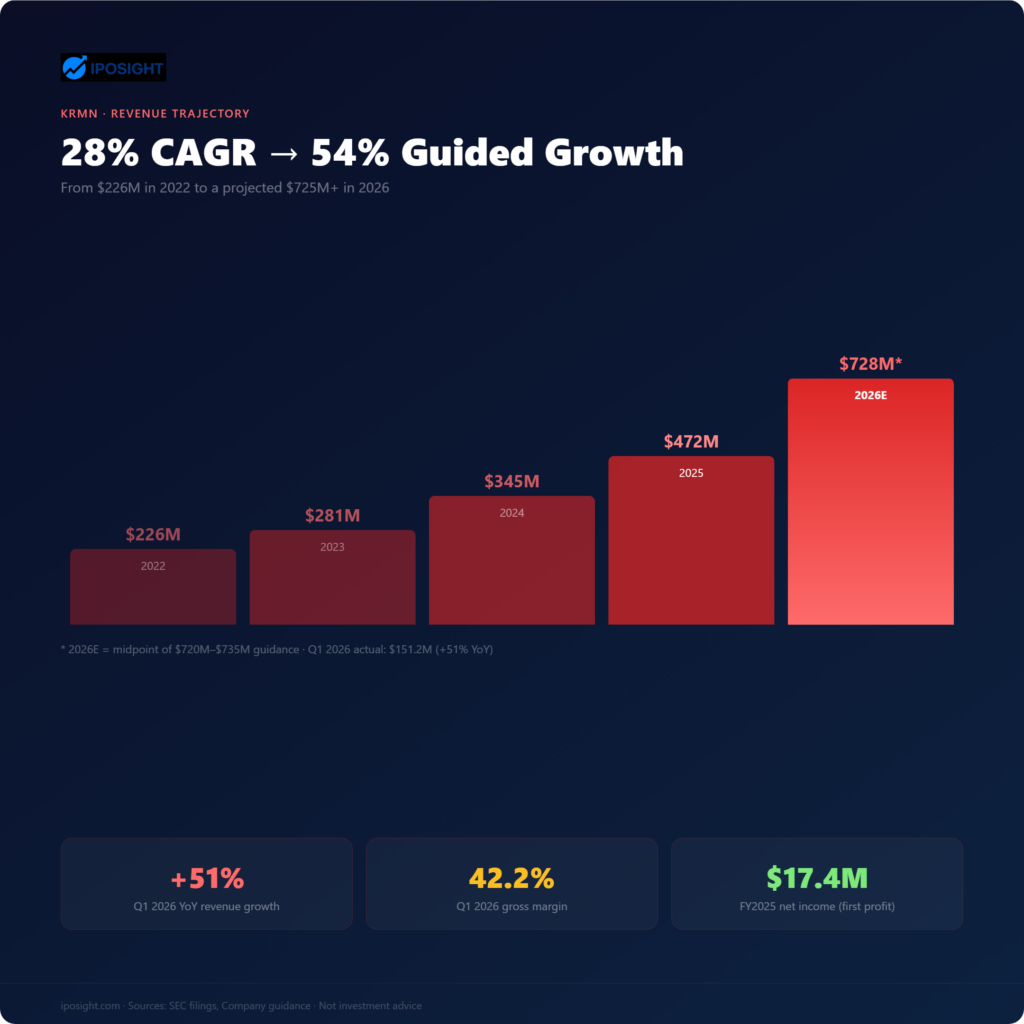
Karman’s financial trajectory is genuinely impressive. Revenue grew from $226 million in 2022 to $472 million in 2025 — a 28% compound annual growth rate over three years. Q1 2026 printed $151.2 million in revenue, up 51% year-over-year, with gross margin expanding to 42.2% and the company returning to profitability (net income $7.8 million vs. a $4.8 million loss a year earlier). The backlog at the end of Q1 2026 reached $1.0 billion — up 61% from the same period last year — and represents more than a year of current production capacity already contracted.
For full-year 2026, management guided revenue of $720–$735 million and adjusted EBITDA of $208.5–$219.5 million. That implies a ~45% revenue increase over 2025 and ~47% EBITDA growth. The active pipeline of contracts in pursuit has grown from roughly $1 billion in early 2025 to $3 billion as of May 2026 — and management disclosed contingent demand commitments totalling $1 billion in potential multi-year value from four key space and defense customers, including a $250 million long-term space-launch production deal.
So why is the stock at $55 when it was at $118 in January? Three things happened simultaneously: a CEO transition in March 2026 (founder Tony Koblinski retired, replaced by Jon Rambeau); a disclosure of material weaknesses in internal controls over financial reporting, which triggered an auditor change from Baker Tilly to PricewaterhouseCoopers; and a secondary offering in late May 2026 in which existing shareholders sold 13.5 million shares — pure insider supply, not new capital for the company. None of these are existential problems, but each one individually creates uncertainty, and together they crushed investor confidence in a high-multiple stock.
Material weakness disclosure: Karman disclosed material weaknesses in its internal controls over financial reporting and replaced its auditor. PricewaterhouseCoopers is now the auditor for 2026 — a meaningful step up in credibility — but the restatement risk and remediation timeline remain open questions that conservative investors should monitor closely.
Who Are the Customers?
Karman does not publicly name all its customers, but the program references in SEC filings and earnings calls reveal the customer base clearly. The primary customer is the U.S. Department of Defense, primarily through prime contractors — Lockheed Martin (THAAD, PAC-3, F-35), Raytheon/RTX (SM-3, Patriot, AIM-120), Northrop Grumman (hypersonic glide vehicles, strategic missiles), and General Dynamics. On the space side, the company has confirmed relationships with SpaceX, Blue Origin, and government launch programs including the Space Force. The $250 million long-term space-launch production deal is widely believed to involve SpaceX or its supply chain. The Seemann/MSC acquisition added U.S. Navy submarine programs and LCAC (Landing Craft Air Cushion) naval programs.
The sole-source nature of most of these relationships is the business model’s core strength. When Karman is the certified manufacturer of a specific interstage structure for a specific missile variant, nobody else can supply it without a multi-year recertification process. The DoD does not have time for that on programs like SM-3 or THAAD that are actively being procured in record quantities.
The Competitive Landscape
Karman occupies a specific and defensible niche in the defense manufacturing supply chain — not as a prime contractor (Lockheed, Northrop, RTX) but as a Tier 2 specialist with proprietary capabilities in structural composites, payload protection, and aerodynamic systems. This is not a winner-takes-all market: the U.S. missile and space industrial base needs multiple qualified specialists, and Karman has spent five years building the certification depth to be one of them.
The most direct peers are Kratos Defense & Security Solutions (KTOS) — a high-growth defense technology company with overlapping exposure to hypersonics, drones, and space — and Aerojet Rocketdyne (now private under AE Industrial), which competes in propulsion but also supplies some of the same programs. Applied Aerospace & Defense (AADX) — whose IPO we covered last month — is a structural peer in the precision aerospace manufacturing space. Among the large primes, RTX and Lockheed are simultaneously customers and competitors in specific program bids.
The Analyst View: $37 to $135, With a Consensus at $88.50
The analyst coverage picture is one of the most interesting data points on KRMN. Eight out of nine analysts with price targets rate it a Buy or Strong Buy. The consensus target of $88.50 implies 61% upside from the current $54.93. The highest target, from Robert W. Baird’s Peter Arment, is $135 — nearly 2.5x current price. The lone outlier, BWS Financial’s Hamed Khorsand, has a $37 target — the only sell-side voice calling for downside from here.
Recent target revisions tell a more nuanced story. KeyBanc cut from $122 to $100 (kept Overweight), Piper Sandler trimmed from $127 to $114 (kept Overweight), and Citi’s John Godyn lowered from $97 to $76 (kept Buy) — all citing near-term integration costs and the internal control remediation timeline, but maintaining conviction on the long-term thesis. RBC reiterated Outperform at $100 on June 1, specifically highlighting the $3 billion pipeline expansion. The average reduction in targets is roughly 15–20%, not a fundamental change of view. The analysts who have seen the business up close — and many of the firms covering KRMN have defense sector specialists who know the program landscape well — remain overwhelmingly bullish.
ETF Exposure: Already in the Major Defense Funds
The PDF’s ETF data is verified and credible for KRMN — this stock has been public for 16 months and has the trading history and market cap to qualify for legitimate index inclusion. The headline positions are significant:
XAR (SPDR S&P Aerospace & Defense ETF, $6.47B AUM) holds 3.07% in KRMN — making it one of the largest positions in this core defense ETF. AIRR (First Trust RBA American Industrial Renaissance ETF, $11.5B AUM) holds 2.13%. MIRAE ASSET Tiger US Space Tech ETF (0183J0, $1.06B AUM) holds 3.44% — the highest weight of any ETF. These are not small funds, and the positions are not trivial. Combined, the ETF universe holding KRMN spans Vanguard Total Stock Market (VTI), iShares U.S. Aerospace & Defense (ITA at 0.35%, $14.44B AUM), Invesco Aerospace & Defense (PPA at 0.44%, $8.33B AUM), Global X Defense Tech (SHLD at 0.8%, $6.83B AUM), and multiple Vanguard small/mid-cap funds. This breadth of institutional coverage is a structural demand floor that limits how far the stock can fall without fundamental deterioration.
The Bull and Bear Cases
The bull case rests on the convergence of three structural themes in a single, scarce, hard-to-replicate business. The U.S. missile inventory replenishment cycle — driven by drawdowns in support of Ukraine, Taiwan deterrence posture, and the Iron Dome/THAAD deployment in Israel — is funding 5–7 year production ramps for SM-3, PAC-3, THAAD, GMLRS, and PrSM, all programs where Karman has embedded positions. The hypersonics build-up — America’s primary strategic response to Chinese and Russian hypersonic weapon programs — is driving entirely new program requirements in Karman’s exact capabilities. And the commercial space acceleration creates sustained demand for the launch vehicle components that Karman uniquely supplies. A $3 billion active pipeline growing from $1 billion 15 months ago is not hype — it is customer commitments moving through the contracting funnel.
The bear case is equally structured. KRMN trades at a P/E ratio of 243x on trailing earnings and roughly 30–35x 2026 guided EBITDA at current price levels — a premium that requires near-flawless execution on the revenue ramp, integration of Seemann/MSC, and remediation of the internal control material weakness, all simultaneously. The stock’s trajectory from $118 to $55 in six months tells you what happens when execution wobbles at those multiples. The CEO transition creates uncertainty about strategic continuity. The secondary offering — in which insiders sold 13.5 million shares — sent the clearest possible signal about where at least some people with deep knowledge of the business thought the stock was priced. And while the backlog is real, it is not fully committed: “contingent demand commitments” and “written expressions of intent” are not signed contracts.
12-Month Price Scenario Analysis
Bull scenario (~30% probability): $90–$120. Q2 2026 earnings (August 6) confirm the revenue ramp is on track and the internal control remediation is progressing. The Seemann/MSC integration is clean. The $3 billion pipeline converts to contracted backlog above $1.5 billion. Analysts raise targets back toward the $118 all-time high range. The stock recovers to pre-selloff levels.
Base scenario (~50% probability): $55–$80. Karman executes roughly in line with guidance, internal controls are remediated by year-end, and the integration is absorbed. The stock trades in a wide but recovering range, with the Q2 earnings print as the first major catalyst. The PE overhang (Novo Holdings’ remaining stake) limits upside but doesn’t create a collapse.
Bear scenario (~20% probability): $28–$48. A guidance miss in Q2, a delay in internal control remediation, or an unexpected program setback triggers a second leg down. At 243x earnings, there is no valuation floor — at $35–$40, the stock would trade at roughly 15–18x 2026 guided EBITDA, which is the level where value investors start to appear. A macro defense budget cut or continuing resolution would accelerate this scenario.
Most important near-term date: August 6, 2026 — Q2 2026 earnings report. This is the single most important event for the stock in the next 90 days. Q1 showed the business is growing; Q2 needs to show the internal controls are being fixed and the Seemann integration is on track.
Is KRMN Worth Buying at $55?
The honest answer is: it depends entirely on your risk tolerance and time horizon. For an investor who bought at $118 and is underwater, averaging down has a credible fundamental case — the business is genuinely better today than it was at the all-time high. For a new investor entering at $55, the risk/reward is asymmetric in the right direction: 61% consensus upside vs. roughly 15–30% downside to the worst-case range (assuming the business doesn’t deteriorate). That’s a 2:1 or better risk/reward if you accept that the $28–40 range requires a fundamental deterioration scenario, not just sentiment.
The most disciplined entry approach: a first position on or before the August 6 earnings report, sized to allow adding on a potential miss-driven dip to the $42–$48 range. The internal control issue is the biggest unknown — if the PwC audit process reveals something more serious than documentation weaknesses, that changes the calculation entirely. If it confirms that the underlying financials are sound and the weakness was procedural, the stock should re-rate meaningfully.
Investment Evaluation
| Factor | Score |
| Revenue Growth Trajectory 28% CAGR 2022–2025, 51% Q1 2026 YoY, 54% guided for full year 2026. Genuine and accelerating organic plus M&A growth. | 9/10 |
| Backlog & Visibility | 9/10 |
| Sector Tailwinds | 10/10 |
| Competitive Moat | 9/10 |
| Analyst Consensus | 8/10 |
| ETF Institutional Coverage | 8/10 |
| Management & Governance | 4/10 |
| Current Valuation | 4/10 |
| PE Overhang & Secondary Risk | 5/10 |
| Long-Term Growth Potential | 9/10 |
Overall Investment Score: 7.5 / 10 · High conviction long — but wait for Q2 earnings before full commitment. Internal control issue is the key gating factor.
Final Verdict
Karman Holdings is one of the most genuinely interesting defense stories in the public markets right now — not because it is cheap (it isn’t), but because the gap between the business’s fundamental trajectory and the stock price is unusually wide. Revenue is growing at 50%+. The backlog has grown 61% year-over-year to $1 billion. The pipeline has tripled in 15 months. Every major defense trend of the next decade — hypersonics, missile replenishment, submarine expansion, commercial space — runs directly through Karman’s product portfolio.
The 45% pullback from $118 was driven by three specific events — a CEO change, an internal control disclosure, and insider selling — none of which change the fundamental demand for what Karman makes. The market’s reaction was rational: those events were genuine uncertainties that deserved to be priced in. But the stock’s current level may be overpricing those risks relative to the business’s underlying trajectory.
The August 6 earnings report is the moment of truth. If Q2 shows clean execution and progress on the internal control remediation, KRMN is likely to be one of the better-performing defense stocks of the second half of 2026. If it reveals execution problems, the stock has further to fall. That binary is exactly the kind of setup where disciplined sizing — a starter position now, with capacity to add — makes more sense than either going all-in or staying entirely on the sidelines.
“Karman doesn’t make headlines. It makes the parts that make the missiles that make the headlines. That kind of structural invisibility — combined with sole-source program embedment — is exactly what the best defense investments look like before the market notices them.”
Sources & References
[1] SEC Form 8-K — Karman Holdings Q1 2026 Results — sec.gov
[2] SEC Form 8-K — Karman Holdings FY2025 Results — sec.gov
[3] Yahoo Finance — “Analysts View Karman Holdings As One of the Better-Positioned Defense Players” — finance.yahoo.com
[4] Simply Wall St — “Karman Holdings Stock Analysis” — simplywall.st
[5] Stock Analysis — “KRMN Stock Price & Overview” — stockanalysis.com
[6] Public.com — “KRMN Stock Forecast: Analyst Ratings & Price Targets 2026” — public.com
[7] SEC Form FWP — Karman Secondary Offering Operational Data — sec.gov
[8] Karman Space & Defense — Official Website — karman-sd.com
[9] Karman Investor Relations — investors.karman-sd.com
[10] TradingView — NYSE: KRMN — tradingview.com
This article is produced by iposight.com based on publicly available information, SEC filings, and independent research. For informational purposes only — not investment advice. All investments carry risk. Please consult a qualified financial advisor.