
Clinical-Stage Biotech | Immunology | Dermatology |
Attovia Therapeutics raised $289 million in one of the largest biotech IPOs of 2026, priced at $17 on August 5. Two months later, the stock sits at $17.80 — barely above the IPO price and having already touched a 52-week low of $16.15. No clinical setback caused this slide. No management departure, no FDA concern, no safety signal. It is a post-IPO mechanical correction in search of a catalyst. That catalyst arrives in Q4 2026: complete Phase 1b data for ATTO-1310, the company’s IL-31 “itch cytokine” inhibitor, which already showed preliminary proof-of-concept in atopic dermatitis and chronic pruritus. Four analyst firms cover the stock with Buy ratings and an average target of $40 — +124% upside. The question is whether $17.80 is the floor or a falling knife.
The Company & What It Does
Attovia Therapeutics was co-founded in 2022 by CEO Tao Fu (CFA, MBA), Zaneta Odrowaz, and Petter Veiby. It is headquartered in San Carlos, California, and employs 44 people. The company licensed the ATTOBODY platform from Alamar Biosciences — a biparatopic VHH-based nanobody technology that enables the design of unusually potent, long-acting biologics with the ability to hit multiple targets simultaneously. All three pipeline candidates were internally discovered using this platform.
The lead program, ATTO-1310, is an anti-IL-31 Fc-fusion protein. IL-31 is known as the “itch cytokine” — it is the primary driver of severe pruritus (itching) in atopic dermatitis and chronic pruritus. ATTO-1310 targets the IL-31 ligand directly (not the receptor, unlike competitor Nemluvio), which Attovia believes enables deeper and more durable itch suppression. Phase 1b data already show proof-of-concept. Beyond that: ATTO-2306 is a bispecific targeting both IL-31 (itch) and IL-13 (lesion control, Dupixent’s target) — a potential “Dupixent plus itch” in one injection. ATTO-1091 is a trispecific targeting TL1A, IL-23, and integrin α4β7 for inflammatory bowel disease (IBD). Both are in IND-enabling or early preclinical stages.
Leadership, Ownership & Who Actually Owns This Stock
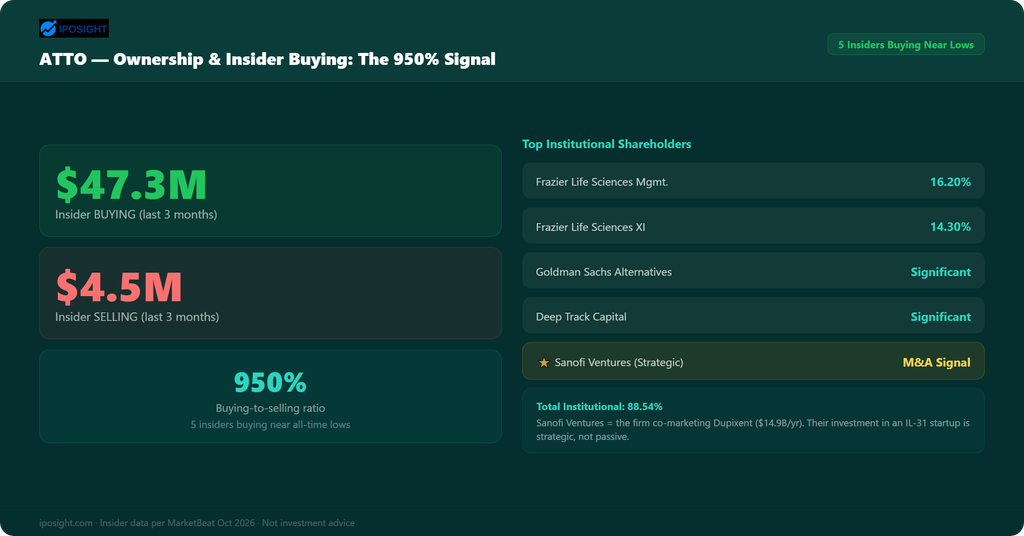
Institutional ownership is extraordinary: 88.54% of shares are held by institutional investors. The two largest shareholders are Frazier Life Sciences Management (16.20%) and Frazier Life Sciences XI (14.30%) — the venture funds controlled by Board Chairman James Topper M.D., Ph.D. Other major holders include Deep Track Capital, Ecor1 Capital, Goldman Sachs Alternatives, Cormorant Asset Management, and the fund that matters most strategically: Sanofi Ventures.
Sanofi Ventures is the venture arm of Sanofi — the company that co-markets Dupixent with Regeneron, generating $14.9 billion in 2024 global sales. Sanofi investing in an IL-31 inhibitor startup is a signal, not an accident. It suggests Sanofi sees ATTO-1310 either as a complement to Dupixent (the high-itch patient who needs both drugs) or as a future acquisition target to extend the atopic dermatitis franchise beyond Dupixent’s IL-4/IL-13 mechanism.
Insider activity reinforces the bull thesis: in the last three months, insiders bought approximately $47.3 million of ATTO stock vs. selling $4.5 million — a buying-to-selling ratio of 950%. When five insiders are buying their own stock near all-time lows, it tends to mean they see the valuation as unjustifiably depressed.
Why Did the Stock Fall From $24 to $16?
The all-time high of $24.32 was hit on the very first day of trading. The stock then declined to a 52-week low of $16.15 and has partially recovered to $17.80. Not a single piece of negative news caused this decline. Instead, four mechanical forces produced it.
The first is IPO lock-up overhang. Pre-IPO institutional investors are typically subject to a 180-day selling restriction from the August 5 IPO date — meaning lock-ups expire around early February 2027. The anticipation of this potential selling event suppresses the stock well before the actual date. The second force is the absence of catalysts. The preliminary Phase 1b data was already in the IPO prospectus. Nothing new has been published since. Markets cannot sustain a post-IPO premium without ongoing news. Third, there has been broad small-cap biotech sector weakness, with the XBI ETF down 5–6% over key recent weeks, disproportionately affecting newly listed pre-revenue names. Fourth, Galderma’s Nemluvio (nemolizumab) received FDA approval for IL-31 inhibition in atopic dermatitis in 2024, raising the differentiation bar for ATTO-1310 and making investors want to see comparative data before fully committing.
The critical point: Everything that caused the selloff is temporary or mechanical. Nothing has changed about the science, the cash position, the management, or the pipeline. The $289M raised from the IPO gives Attovia a cash runway well past 2030 at current burn rates. The company is not going bankrupt. It is waiting for Q4 2026 data to give the market a reason to re-engage.
The Market: Why “Itch” Is a $21 Billion Business
The global atopic dermatitis market reached $21.15 billion in 2026 and is projected to grow at 9.5% CAGR to $33.3 billion by 2031. Approximately 21 million U.S. adults and 10 million children suffer from atopic dermatitis. Dupilumab (Dupixent) alone generated $14.9 billion in global sales in 2024, with roughly 60% attributable to AD, making it one of the most commercially successful biologics ever launched. Chronic pruritus of unknown origin (CPUO) adds millions more patients who currently have no approved IL-31 targeted option.
The key insight behind Attovia’s thesis is that even within the Dupixent-treated population, a significant subset continue to experience severe, debilitating itch that goes inadequately controlled. These “high-itch” patients represent the immediate commercial opportunity for ATTO-1310: not as a Dupixent replacement, but as an add-on or sequential therapy for the patients where Dupixent’s lesion control is good but pruritus relief is insufficient.
The Phase 1b Data: What We Know and What Q4 Will Tell Us
At the Morgan Stanley Healthcare Conference in September 2026, CEO Tao Fu disclosed the key Phase 1 clinical results. A single dose of ATTO-1310 produced approximately 65% week-4 response rate in CPUO patients and approximately 44% in high-itch AD patients. The drug fully suppressed free circulating IL-31 at >95% levels for at least 12 weeks — supporting the quarterly (every 3 months) dosing hypothesis. Crucially, no placebo patients met the responder definition, confirming the drug’s effect is pharmacologically real rather than a symptom fluctuation artefact.
ATTO-1310 also targets the IL-31 ligand directly, whereas Galderma’s Nemluvio targets the IL-31 receptor alpha subunit. Attovia argues this difference allows for more complete inhibition — the analogy is blocking a signal at its source rather than at one of the receptors it activates. Whether this translates to meaningfully better clinical outcomes is exactly what Phase 2 will determine.
The complete Phase 1b data package, covering the full cohort with all timepoints and comprehensive safety data, is expected in Q4 2026. This is the first significant post-IPO data catalyst, and it will set the directional tone for the next 12 months of ATTO’s stock performance.
Real Competitive Landscape
Galderma / Nemluvio (nemolizumab) is the most direct competitor — an IL-31 receptor alpha antagonist already FDA-approved in 2024 for pruritus in AD. It has monthly dosing and first-mover advantage. ATTO-1310’s differentiation argument rests on: (1) direct ligand targeting enabling deeper suppression; (2) quarterly vs. monthly dosing; and (3) potential superior efficacy in CPUO where Nemluvio has no approved indication. Sanofi/Regeneron Dupixent ($14.9B/year) is the market dominant but targets a different mechanism (IL-4/IL-13) — ATTO-1310 is a complement, not a replacement. AbbVie Rinvoq (upadacitinib) is an oral JAK1 inhibitor with strong itch suppression and the toughest commercial competitor: oral convenience beats quarterly injection for many patients. And Attovia’s own pipeline creates a fascinating internal dynamic: if ATTO-2306 (IL-13×IL-31 bispecific) succeeds in Phase 2, it could make ATTO-1310 obsolete within Attovia’s own portfolio — but also deliver a single drug that outperforms both Dupixent and Nemluvio simultaneously.
ETF Coverage
ATTO’s ETF exposure is real and provides systematic demand support. XBI (SPDR S&P Biotech, 0.12%, $6.2B AUM) is the largest by weight and the benchmark small-cap biotech index — its equal-weight methodology gives recently-listed biotechs like ATTO meaningful exposure relative to their market cap. CNCR (Loncar Cancer Immunotherapy, 0.09%), FBT (First Trust Amex Biotech, 0.08%), GNOM (Global X Genomics & Biotech, 0.07%), and PBE (Invesco Dynamic Biotech, 0.06%) round out the biotech index floor. LABU (Direxion 3× Biotech Bull, 0.03%) amplifies daily moves on biotech bull days. ARKG (ARK Genomic Revolution, 0.01%) provides growth-oriented exposure. The combined ETF position creates a baseline institutional demand that limits the downside on days without company-specific news — an important floor protection mechanism near the all-time low.
Is ATTO a Good Investment? Can It Go Bankrupt?
Two questions that must be addressed directly. On bankruptcy risk: the answer is no, not for 3–4 years at minimum. Attovia completed the IPO with $305.4 million in net proceeds. With a quarterly cash burn of approximately $18.7 million (Q2 2026), the runway extends well beyond 2030. The full Phase 2 programme (CPUO, high-itch AD, and ATTO-2306 Phase 1 combined: $170–$210 million) is entirely funded from existing capital. No emergency financing, no immediate dilution risk. Frazier, Goldman, Sanofi Ventures, and Deep Track do not let their companies run out of cash at this stage.
On whether to buy now: the risk/reward at $17.80 is genuinely compelling for investors with a 2–3 year horizon and tolerance for binary clinical risk. Here is the logic: the stock is essentially at its IPO price after two months of positive operational progress (Phase 1b proof-of-concept, Morgan Stanley conference, EADV poster). The $40 analyst target implies +124% upside. Insider buying of $47M vs. $4.5M selling signals that management believes the current price undervalues the company. The Q4 2026 data is the near-term catalyst.
The honest caveat: this is Phase 1 data from a single-dose study in a modest cohort. The 65% week-4 response rate in CPUO is a compelling signal — but Phase 2 with multiple doses, longer follow-up, and a larger patient population is where trials succeed or fail. Galderma’s Nemluvio poses genuine commercial competition. AbbVie’s Rinvoq offers oral convenience that an injectable cannot match. These are real risks. Position sizing should reflect them: maximum 1–2% portfolio allocation.
Is the Multi-Year Appreciation Sustainable?
The five-year pathway from here: complete Phase 1b data (Q4 2026) → Phase 2 initiation in CPUO and high-itch AD (1H 2027) → Phase 2 readout (2028–2029) → NDA filing if successful → FDA approval (2030–2031). If approved, ATTO-1310 enters a market where Dupixent generates $14.9B/year and Nemluvio is establishing itself as the dedicated anti-itch option. A drug offering quarterly dosing and deeper IL-31 suppression would be commercially significant even capturing a 10–20% share of the high-itch AD segment — that alone implies peak annual revenue of $500 million to $2 billion depending on the breadth of the label. At appropriate revenue multiples, a commercial-stage Attovia would be worth substantially more than $40/share. But that assumes clinical success at every step, which has a combined probability of 25–40%.
There is also a non-regulatory exit path. Sanofi Ventures on the cap table is the most obvious hint: Sanofi has both the strategic motive (protecting the Dupixent franchise in the itch segment) and the financial capacity to acquire Attovia pre-approval. An acquisition premium of 50–100% over market price is standard in pre-Phase-2 biotech M&A. If data is positive, the acquisition thesis becomes live before the Phase 2 readout.
Investment Evaluation
| Factor | Score |
| Market Size & Commercial Opportunity | 9/10 |
| Capital Position & No Bankruptcy Risk | 9/10 |
| ATTOBODY Platform & Pipeline Breadth | 8/10 |
| Institutional Ownership & Insider Buying | 8/10 |
| Valuation at $17.80 — Near All-Time Low | 8/10 |
| Phase 1b Clinical Signal | 7/10 |
| Competitive Risk (Nemluvio, Rinvoq) | 4/10 |
| Clinical Development Timeline Risk | 5/10 |
| Q4 2026 Data Risk & Lock-Up Overhang | 5/10 |
Overall Investment Score: 6.4 / 10 · Strong risk/reward at $17–$18 for investors with a 2–3 year horizon. Q4 2026 data is the catalyst that will define the next 12 months. Insider buying of 950% is the strongest near-term bullish signal. Max 1–2% portfolio position. Best entry: $16–$18.
12-Month Price Scenario Analysis
Bull scenario (~35% probability): $35–$50. Complete Phase 1b data confirms the single-dose signal across a larger multi-dose cohort with compelling durability and clean safety profile. Phase 2 initiates in 1H 2027 on schedule. Analysts at all four covering banks raise targets to $45+. Sanofi, Leo Pharma, or AbbVie initiates licensing or acquisition discussions. The stock re-rates sharply toward and through the analyst consensus as M&A premium is embedded.
Base scenario (~45% probability): $20–$35. Q4 data is positive but requires Phase 2 for definitive confirmation of durability. The stock recovers from its post-IPO mechanical trough as lock-up pressure peaks and passes. Gradual drift toward $25–$30 through mid-2027 as Phase 2 enrolment begins and ETF rebalancing provides additional demand. A second analyst initiates independently. No transformative event, but steady fundamental improvement.
Bear scenario (~20% probability): $10–$17. Q4 data reveals that multi-dose durability is weaker than the single-dose preliminary suggested — for instance, IL-31 suppression falling below 70% beyond 12 weeks. Alternatively, a safety signal requiring protocol amendment. Galderma Nemluvio posts strong real-world market share data, weakening the ATTO-1310 commercial thesis. Lock-up expiry (February 2027) adds selling pressure without a catalyst to absorb it. The stock retests or breaks through the $16.15 all-time low.
Key upcoming catalysts: Complete Phase 1b data ATTO-1310 Q4 2026 (defining event) · EADV 2026 & Fall Clinical Dermatology Conference poster presentations (October 2026) · Q3 2026 earnings update (cash runway confirmation) · Next earnings: December 2, 2026 · Lock-up expiry ~February 2027 · ATTO-2306 Phase 1 IND clearance 1H 2027 · Phase 2 CPUO + high-itch AD start 1H 2027
Final Verdict
Attovia is a well-funded, credibly-backed immunology biotech whose stock price tells a story that the fundamentals do not fully support. At $17.80 — essentially the IPO price, and one cent above the 52-week low adjusted for the recovery — the market is offering a second chance at the IPO allocation price with six months of additional positive pipeline execution already in place. The preliminary Phase 1b data is real. The Sanofi Ventures participation is real. The $305M cash runway is real. The insider buying is real. The $40 analyst consensus is real.
What is not yet real is the Phase 2 confirmation that will turn a promising Phase 1b signal into an investable clinical thesis. That gap — between Phase 1 proof-of-concept and Phase 2 conviction — is exactly where the current $17.80 price sits. It is the price of uncertainty, and it is either a bargain or a fair reflection of the risk depending on how the Q4 data reads.
For investors who believe the science and are willing to hold through a binary clinical catalyst, the current level is the most attractive entry since the IPO. For investors who need proof before conviction, Q4 2026 will be the moment to reassess — but at that point, the price may already reflect the result.
“Chronic itch sounds minor to someone who has never experienced it. For patients with severe atopic dermatitis or chronic pruritus, it is relentless, sleep-destroying, and life-defining. A quarterly injection that reliably stops that itch for three months would be worth billions. Q4 2026 will tell us whether ATTO-1310 is that injection.”
Sources & References
[1] Attovia Therapeutics — attovia.com · IR: investors.attovia.com
[2] TradingView — NASDAQ: ATTO — tradingview.com
[3] MedCity News — Attovia $289M IPO, August 2026
[4] Fierce Biotech — Attovia CEO on $289M raise and Dupixent challenge, August 2026
[5] GlobeNewswire — Attovia Q2 2026 Financial Results, September 2, 2026
[6] Investing.com — Attovia at Morgan Stanley Conference, September 2026
[7] MarketBeat — ATTO insider activity data, October 2026
[8] Mordor Intelligence — Atopic Dermatitis Market Size 2026–2031
[9] SEC EDGAR — ATTO Form S-1/A, Form 424B4
[10] ATTO PDF Analysis — Stock Analysis Tool, October 5, 2026
[11] AllSci — Attovia $289M upsized IPO, August 2026
[12] 247 Wall St — Attovia clinical-stage analysis, August 2026
iposight.com — for informational purposes only, not investment advice. Clinical-stage biotechs carry extreme risk including total loss of capital.