
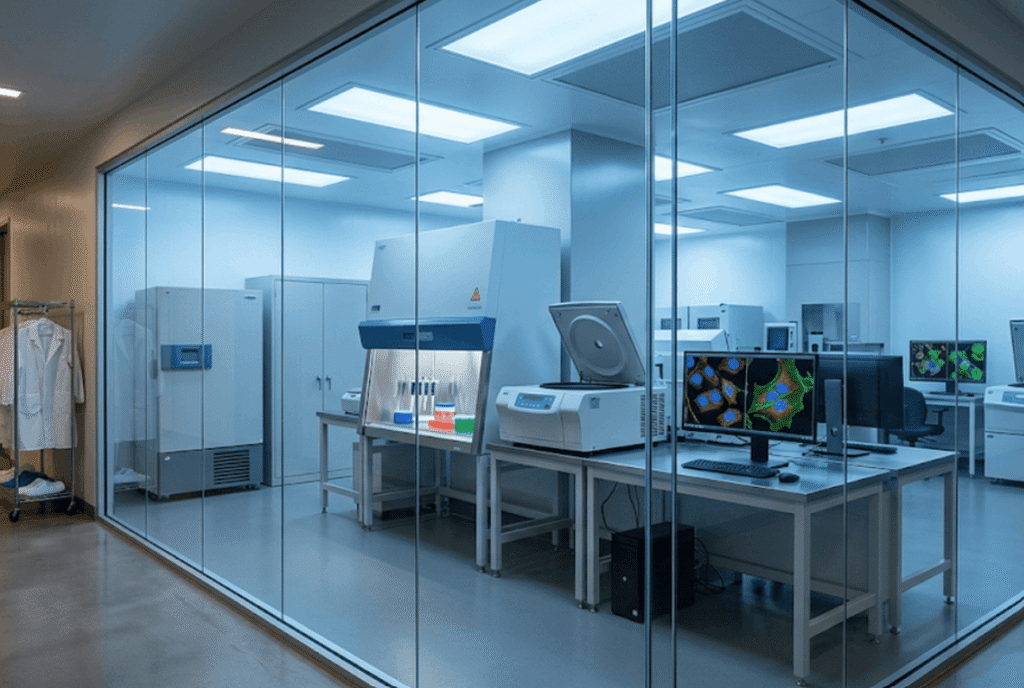
Clinical-Stage Oncology | NSCLC | Small Molecule TKI
BlossomHill Therapeutics listed at $16 on August 7, 2026 and has been rising steadily ever since. At $22.17 it is up 38% from IPO — a measured, fundamentally-driven gain rather than a speculative surge. Yesterday, September 15, the company presented updated SOLARA Phase 1/2 data at the IASLC World Conference on Lung Cancer in Seoul: BH-30643 achieved a 45% objective response rate and 88% disease control rate in EGFR C797S-positive NSCLC — a cancer setting with zero approved targeted therapies. Four analyst firms cover the stock with Buy ratings and an average target of $31.25. The question investors are asking: is this steady climb the beginning of a multi-year appreciation story, or is the $31 target the ceiling?
The Company: BlossomHill’s Chemistry-First Philosophy
BlossomHill Therapeutics was founded in June 2020 in San Diego, California, by Dr. Jean Cui, Ph.D. — a medicinal chemist and industry veteran with a track record in kinase inhibitor design. The company’s founding philosophy is distinctive: rather than screening compound libraries for activity, BlossomHill starts with a deep structural understanding of target proteins and their dynamics, then deliberately designs macrocyclic small molecules to address the specific structural limitations of existing drugs.
This approach — what the company calls “intentional, chemistry-based design” — is the reason BH-30643 is a macrocyclic (ring-shaped), non-covalent inhibitor rather than the covalent inhibitors that define the current EGFR TKI class. Macrocyclic molecules have inherent advantages: greater binding selectivity, the ability to avoid certain resistance mechanisms, and potentially better brain penetration — critical in lung cancer where brain metastases are common and often fatal.
Before its August 2026 IPO, BlossomHill raised over $257 million in pre-IPO capital, including a $100 million Series B in 2024 and an $84.2 million Series B bridge round in December 2025. The IPO raised $150 million (upsized from the original $125 million plan), bringing the total capital raised to over $400 million — substantial for a Phase 1/2 company and a strong vote of institutional confidence.
The Disease: Why EGFR C797S Is the Most Important Unmet Need in Lung Cancer
Non-small cell lung cancer (NSCLC) is the most common and lethal cancer globally, responsible for approximately 1.8 million deaths per year. Approximately 10–15% of Western NSCLC patients (and 30–50% of Asian patients) harbour EGFR-activating mutations — the molecular subset for which EGFR-targeted therapy was developed.
The treatment trajectory for these patients follows a predictable and deeply frustrating pattern. First-line treatment with osimertinib (AstraZeneca’s Tagrisso, a $7.89 billion/year drug) is highly effective, typically controlling disease for 18–24 months. But resistance is virtually universal. The most clinically important acquired resistance mechanism is the EGFR C797S mutation — a point mutation in the EGFR binding pocket that eliminates the covalent binding site exploited by osimertinib and all other approved third-generation EGFR TKIs.
When C797S resistance develops, patients lose their most effective targeted therapy with no approved oral alternative. Chemotherapy — toxic, poorly tolerated, and far less effective than targeted therapy — becomes the default. The unmet need is stark: tens of thousands of patients per year globally reaching C797S resistance after osimertinib with no targeted option. The EGFR NSCLC market across the seven major markets was $3.8 billion in the U.S. alone in 2025; the C797S-positive post-osimertinib population represents a high-value orphan-like segment within this enormous commercial context.
The BH-30643 design breakthrough: BH-30643 is a non-covalent, macrocyclic OMNI-EGFR™ inhibitor. “Non-covalent” means it does not rely on the C797 binding site that osimertinib uses — making the C797S mutation irrelevant to its binding. “Macrocyclic” means the molecule forms a ring structure that confers unusually high selectivity for mutant vs. wild-type EGFR. “Brain-active” means it penetrates the blood-brain barrier, reaching CNS metastases. “OMNI-EGFR” means it covers classical activating mutations, T790M, C797S, atypical mutations, and exon 20 insertions — the entire landscape of clinically relevant EGFR mutations. This breadth is unprecedented among approved EGFR TKIs.
The Clinical Data: SOLARA Phase 1/2 and What the Numbers Mean
The SOLARA (NCT06706076) trial is a global Phase 1/2 first-in-human study running at more than 40 sites in 10 countries. It is evaluating BH-30643 as monotherapy and in combination with chemotherapy across multiple EGFR mutation subtypes.
Yesterday’s IASLC data (September 15, 2026) in the critical C797S resistance cohort: among 40 patients with EGFR C797S-positive NSCLC (with or without concurrent T790M), BH-30643 achieved a 45% objective response rate (ORR, 18/40 patients; 95% CI: 29%–62%) and an 88% disease control rate (DCR, 35/40). Sixteen responses were confirmed; two remained unconfirmed at the May 12, 2026 data cutoff. At efficacy follow-up through August 10, 2026, 25 patients (63%) remained on treatment.
The earlier ASCO 2026 data (Phase 1 dose escalation, March 2, 2026 cutoff) showed that in 32 C797S evaluable patients, ORR was 50% in chemo-naive patients and 39% in patients with prior chemotherapy. Among 174 patients treated at expansion doses (40, 50, 60 mg BID), treatment-related dose reductions and discontinuations occurred in only 9% and 3% of patients respectively — a very manageable safety profile.
The safety signal is particularly important. EGFR C797S is often a terminal diagnosis context; patients in these trials are heavily pretreated. That only 3% discontinued due to treatment-related adverse events and most adverse events were Grade 1 (mild) is a strong tolerability signal. The most common adverse event was bilirubin elevation, generally asymptomatic and consistent with a known, manageable pharmacological mechanism (UGT1A1 inhibition).
For context: osimertinib achieved approximately 80% ORR in first-line treatment and approximately 65% ORR in the T790M-resistant second-line setting. A 45% ORR in the post-osimertinib C797S population — the most treatment-refractory group — is clinically meaningful and competitive with what early data from other fourth-generation candidates have shown.
Pipeline Beyond BH-30643
BlossomHill is not a one-drug company, which distinguishes it from many clinical-stage oncology biotechs.
BH-30236 (CLK inhibitor) — A macrocyclic CDC-like kinase (CLK) inhibitor currently in Phase 1/1b for relapsed/refractory acute myeloid leukemia (R/R AML) and higher-risk myelodysplastic syndrome (HR-MDS). At EHA 2026, the company presented initial clinical data showing preliminary anti-leukemic activity as monotherapy and in combination with venetoclax (Roche’s blockbuster AML drug), including in patients who had previously progressed on venetoclax-based regimens. This is a potentially important finding: venetoclax resistance in AML currently has no approved standard of care, and BH-30236’s ability to resensitise venetoclax-refractory disease would represent a significant commercial opportunity.
BH-501284 (pan-KRAS) — A preclinical non-covalent, selective pan-KRAS Switch II inhibitor. At AACR 2026, the company presented preclinical data showing high potency (median IC50 of 0.83 nM) and prolonged residence time (>54 hours) — properties that suggest potential for durable pathway inhibition beyond current approved KRAS inhibitors (Amgen’s sotorasib covers only KRAS G12C). IND-enabling studies are ongoing. KRAS-mutant solid tumors represent approximately 25% of all human cancers.
Who Actually Matters
The MRK, PFE, BMY, LLY, AZN, JNJ, AMGN, GILD, REGN represent major pharma companies that are potential acquirers or partners, not operational peers. AstraZeneca (AZN) is the most directly relevant: it owns Tagrisso (osimertinib), the drug from which C797S resistance emerges, and has a $6+ billion annual franchise to protect. A BH-30643 approval would either complement AstraZeneca (if used as a sequential therapy after Tagrisso) or compete with it in combination strategies. AstraZeneca, Pfizer (already active in EGFR with dacomitinib), and Merck are all logical strategic partners or acquirers as BH-30643 advances toward registrational data.
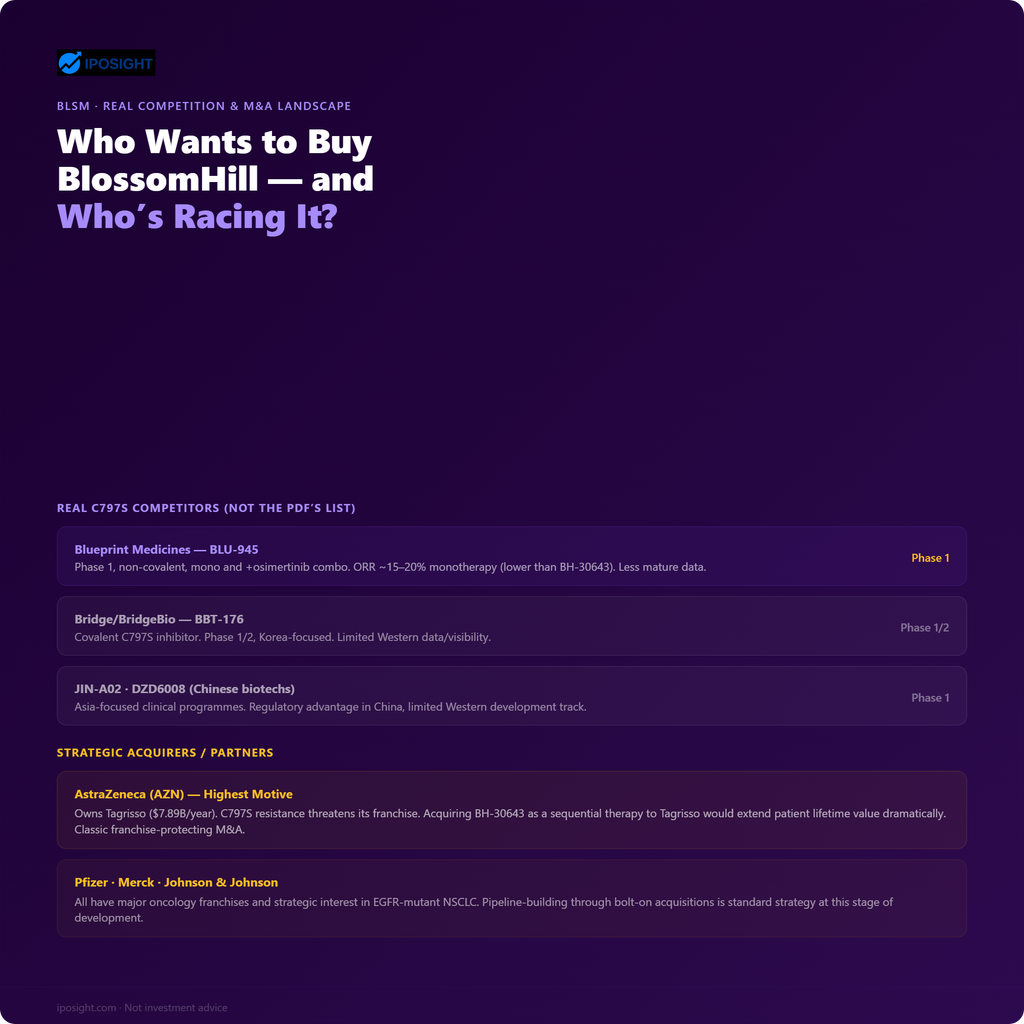
Real Competitive Landscape: Fourth-Generation EGFR TKIs
The C797S resistance space is the “fourth-generation EGFR TKI” frontier:
Blueprint Medicines BLU-945 — Phase 1, monotherapy and combination with osimertinib. Early ORR data in C797S were approximately 15–20% as monotherapy; combination data showed improved responses but added toxicity. Less clinically advanced than BH-30643.
Bridge Biotherapeutics/Bridgebio BBT-176 — Covalent C797S inhibitor in Phase 1/2. Being evaluated in Korea and international centres. Early data limited.
JIN-A02 / DZD6008 — Additional fourth-generation TKI candidates from Chinese biotechs; primarily Asia-focused development with limited Western visibility.
Cullinan Oncology/Taiho zipalertinib — NDA submitted in November 2025 for EGFR exon 20 insertions specifically, not C797S. Different patient population; not a direct competitor in the C797S setting.
BH-30643 is distinguishable by: (1) its macrocyclic, non-covalent chemistry that avoids the off-target toxicity common in covalent approaches; (2) its brain penetration (CNS activity, critical in NSCLC); (3) its OMNI-EGFR coverage across diverse mutation profiles; and (4) the most mature C797S clinical data of any fourth-generation candidate in global development as of September 2026.
ETF Coverage
Expected near-term inclusions include XBI (SPDR S&P Biotech ETF, equal-weighted) as the next rebalancing date passes, followed by IBB (iShares Biotech), BBH (VanEck Biotech), and SBIO (ALPS Medical Breakthroughs, which specifically targets small-cap oncology biotechs with Phase 2-ready assets). LifeSci Capital’s coverage provides some demand anchor but the lack of ETF inclusion is a current limitation — and a potential near-term catalyst as inclusion begins.
Can the $31 Target Price Be Achieved?
The analyst consensus of $31.25 (range $28–$35) implies 41% upside from the current $22.17. Based on the clinical data trajectory and near-term catalysts, this target is achievable but not guaranteed.
The positive case for $31: BH-30643’s Phase 2 initiation in Q1 2027 — after the end-of-Phase 1 FDA meeting planned for Q4 2026 — will be a major de-risking event. FDA Fast Track designation (granted August 18, 2026) creates the possibility of Accelerated Approval pathways based on ORR data rather than survival endpoints, materially shortening the time to potential approval. The Phase 2 data, when it begins reading out in 2028, will be the true value-creating event. Between now and then, the stock is likely to trade up to the analyst target as the Q4 2026 FDA meeting approaches. A successful FDA interaction (confirmation of Accelerated Approval pathway) could push the stock to and through $31–$35.
The negative case: Phase 1/2 data in 40 patients with 95% CI of 29%–62% still has statistical uncertainty. The lower bound of the confidence interval (29% ORR) would be less impressive against emerging competition. Regulatory rejection of an Accelerated Approval pathway would push commercial timelines significantly further and restrike investor patience.
Is Multi-Year Appreciation Sustainable?
Multi-year appreciation for BLSM hinges on one core question: does BH-30643 achieve Accelerated Approval in EGFR C797S-positive NSCLC, and when? The pathway is: Phase 2 initiation Q1 2027 → Phase 2 interim data (2028) → Accelerated Approval filing (2028–2029) → approval and commercial launch (2029–2030). At that point, pricing in the $20,000–$25,000/year range for an approved targeted oncology therapy would generate peak sales of $500M–$1.5B/year in the C797S setting alone, with OMNI-EGFR expansion across earlier lines potentially multiplying this substantially. At a 5–8× revenue multiple, commercial-stage BLSM could be worth $25–$50/share on a diluted basis. The path is visible if the science holds. The path is navigable if the FDA cooperates. AstraZeneca or Pfizer may make this question academic with an acquisition offer before approval — the C797S space is precisely the kind of franchise-protection acquisition that big pharma pays premiums for.
Investment Evaluation
| Factor | Score |
| Clinical Data Quality (45% ORR, 88% DCR) | 9/10 |
| Disease Setting: C797S with Zero Approved Targeted Therapy | 10/10 |
| BH-30643 Drug Design (Macrocyclic, OMNI-EGFR, Brain-Active) | 9/10 |
| FDA Fast Track + Accelerated Approval Pathway | 9/10 |
| Pipeline Depth (BH-30236, BH-501284) | 8/10 |
| Analyst Coverage & Institutional Quality | 8/10 |
| Valuation at $22.17 (~$465M cap) | 7/10 |
| Clinical Risk (Phase 2 readout timeline) | 5/10 |
| Competitive Risk (BLU-945, BBT-176, DZD6008) | 5/10 |
| Financial Position (>$400M raised) | 8/10 |
Overall Investment Score: 6.8 / 10 · Strong science, unique drug design, meaningful clinical data, $31 target achievable. Buy range: $20–$23 accumulation zone. Catalyst-driven upside to $35+ if Q4 2026 FDA meeting confirms Accelerated Approval pathway. Max 1–2.5% portfolio.
Is BLSM a Good Investment?
At $22.17 and approximately $465M market cap, BlossomHill is trading at a rational valuation for a Phase 1/2 oncology company with high-quality clinical data in a high-value indication. Unlike VOGX (which was priced at 144% above IPO on momentum), BLSM’s 38% post-IPO gain is fundamentally driven — anchored by the August 18 Fast Track designation and the September 15 IASLC data presentation. This is a more defensible price level.
The case for buying is clear: 45% ORR in a zero-approved-therapy setting, FDA Fast Track, premier institutional coverage, and an Accelerated Approval pathway that could compress the approval timeline dramatically. The case for caution: this is still Phase 1/2 data in 40 patients, Phase 2 begins Q1 2027 and the definitive readout is two-plus years away, and the competitive field is intensifying.
The best entry range is $20–$23 — essentially the current level. Investors who wait for a significant pullback may miss the Q4 2026 FDA meeting catalyst. The $31 analyst consensus is the 12-month upside case; the bear scenario (failed FDA meeting, trial delay, or disappointing Phase 2 interim) could take the stock back to $14–$18.
12-Month Price Scenario Analysis
Bull scenario (~35% probability): $32–$45. End-of-Phase 1 FDA meeting (Q4 2026) confirms Accelerated Approval pathway based on ORR data. Phase 2 opens ahead of schedule. Leerink and a fifth analyst initiate with $35+ targets. AstraZeneca or Pfizer approaches with partnership or acquisition interest. Stock re-rates to acquisition premium above $35.
Base scenario (~45% probability): $22–$32. Steady climb as the FDA meeting approaches and occurs. Stock reaches analyst consensus ($31.25) by mid-2027 as Phase 2 enrols and the company presents additional clinical data at ASCO 2027. Valuation range expands with analyst upgrades. No transformative event but sustained upward drift.
Bear scenario (~20% probability): $14–$20. FDA meeting (Q4 2026) indicates that Accelerated Approval is not available in Phase 2 due to insufficient Phase 1/2 sample size or evolving requirements. Trial timeline delayed. A competitor (BLU-945 or BBT-176) presents better Phase 2 data earlier. Broader biotech sector sell-off.
Key upcoming catalysts: End-of-Phase 1 FDA meeting Q4 2026 (Accelerated Approval pathway) · Phase 2 global initiation Q1 2027 · ASCO 2027 data presentation · Leerink Partners initiation (pending) · BH-30236 AML Phase 1 data update 2026–2027 · ETF inclusion (XBI rebalancing)
Final Verdict
BlossomHill Therapeutics is the best-positioned clinical-stage oncology IPO in the current cycle for one fundamental reason: BH-30643 addresses a patient population with a clear, validated unmet need, positive Phase 1/2 clinical evidence, FDA Fast Track designation, and a credible Accelerated Approval pathway. The company has the right drug (macrocyclic, brain-active, OMNI-EGFR), the right target (C797S resistance after osimertinib, where zero oral alternatives exist), the right capital base ($400M+ raised), and the right institutional support (JPMorgan, Leerink, Guggenheim).
The 38% post-IPO gain is justified by the Fast Track designation and IASLC data. The additional 41% to the analyst consensus target ($31.25) is achievable over 12 months if the Q4 2026 FDA meeting goes well. For long-term investors, the 3–5 year case — BH-30643 approval and commercialisation, BH-30236 as a venetoclax-combination AML therapy, and BH-501284 as a pan-KRAS asset — represents one of the most compelling multi-asset oncology platforms to emerge from a 2026 IPO.
“Lung cancer kills more people than any other cancer. EGFR mutation drives the disease in a quarter of patients. Resistance to the best drug (Tagrisso) via C797S is inevitable and leaves patients with no targeted option. BlossomHill has designed a molecule specifically to solve that problem — and early human data suggests it is working. At $22, investors are paying a fair price for a genuine medical advance.”
Sources & References
[1] BlossomHill Therapeutics — bhtherapeutics.com · IR — ir.bhtherapeutics.com
[2] TradingView — NASDAQ: BLSM — tradingview.com
[3] BLSM PDF Analysis — Stock Analysis Tool, September 16, 2026
[4] BioSpace — IASLC 2026 SOLARA data presentation, September 15, 2026
[5] BioSpace — FDA Fast Track Designation, August 18, 2026
[6] AllSci — BLSM $150M upsized IPO, August 2026
[7] GlobeNewswire — SOLARA IASLC full press release, September 15, 2026
[8] GlobeNewswire — BH-30236 EHA 2026 clinical data, June 11, 2026
[9] BioSpace — BH-501284 pan-KRAS AACR 2026 preclinical data, April 22, 2026
[10] DelveInsight — EGFR NSCLC Market Analysis Report 2036
[11] SEC EDGAR — BLSM Form DRS, Form 424B4
[12] RTT News — BH-30643 45% ORR report, September 15, 2026
iposight.com — for informational purposes only, not investment advice. Clinical-stage biotechs carry extreme risk.