

Utilities | Advanced Nuclear Fuel |SMR / Microreactor | HALEU Fuel | Oak Ridge, TN |
Standard Nuclear listed on the New York Stock Exchange on July 16, 2026 — the only U.S. company with industrial-scale TRISO nuclear fuel production facilities, operating from the historic Manhattan Project site at Oak Ridge, Tennessee. It raised $150 million at $15 per share, already a dramatic downsize from the original $383 million plan. By July 27, the stock had fallen to approximately $8.30 — a 45% decline from the offer price in under two weeks. The market delivered a verdict. But is it the right one?
What Standard Nuclear Actually Does: The Rarest Fuel on Earth
Standard Nuclear manufactures TRISO fuel — tristructural-isotropic nuclear fuel — which is the enabling technology for the next generation of advanced nuclear reactors. Understanding what TRISO is and why it matters is the entire investment thesis in physical form.
TRISO fuel consists of poppyseed-sized kernels of enriched uranium, each individually coated in multiple microscopic layers of carbon and ceramic materials. These coatings act as a miniature containment vessel at the particle level: they are engineered to withstand temperatures exceeding 1,600°C without releasing radioactive material. This makes TRISO fuel physically incapable of causing a Chernobyl or Fukushima-style accident — not because of reactor design safety systems, but because the fuel itself cannot melt down at any operating temperature a reactor could reach. It is the reason TRISO is called “the safest nuclear fuel ever made” by the DOE.
The fuel requires HALEU — High-Assay Low-Enriched Uranium, enriched to between 10% and 20% U-235, compared to the 3–5% used in conventional light-water reactors. HALEU is the gating factor for the entire advanced reactor industry. As of mid-2026, the United States has almost no domestic HALEU production capacity — creating a strategic vulnerability and a commercial opportunity simultaneously. Standard Nuclear is one of the first companies to receive DOE authorization to physically receive and process HALEU feedstock, making it genuinely irreplaceable in the near term for any U.S. advanced reactor program that requires domestic fuel supply.
The company operates from Oak Ridge, Tennessee — the original home of the Manhattan Project and still the heart of U.S. nuclear expertise. Its primary production facility (SN-TN) occupies a 19,000-square-foot commercial-scale campus on the former K-25 site. It is also building facilities in Idaho (SN-ID) and operating a joint venture in Washington state. CEO Kurt Terrani is a former Oak Ridge National Laboratory nuclear fuel expert, and the scientific team reflects genuine depth in TRISO fabrication.
The IPO Downsize: What Happened and Why It Matters
The story of STDN’s IPO is structurally identical to Deep Fission’s (FISN) in June 2026 — and the parallel is worth examining carefully. Standard Nuclear originally filed to raise $328–383 million at $18–$21 per share, implying a valuation of approximately $3.55 billion. Institutional investors pushed back. The final deal raised $150 million at $15 — a 61% shortfall from the midpoint of the original target, and pricing 17% below the bottom of the stated range.
This is not a minor adjustment. It reflects institutional investors concluding that $3.55 billion was too much to pay for a company with $3.14 million in annual revenue, no commercial-scale fuel deliveries yet, DOE facility approvals still pending in H2 2026, and a founder controlling 60.8% of voting power through a dual-class structure. The market said: the technology is real, the opportunity is real, but not at that valuation.
The subsequent 45% decline from $15 to ~$8.30 in the first 10 trading days compounded this. At $8.30, Standard Nuclear trades at approximately $1.33–1.41 billion in market cap — roughly 425× annual revenue. This is not a number that can be defended by any conventional metric. It is entirely a bet on what the company becomes.
Going concern context: Standard Nuclear carries an accumulated deficit of $79.9 million as of March 31, 2026, and has historically negative operating cash flows. The $141 million in net IPO proceeds (after expenses) provides runway, but the DOE facility approval timeline — which runs on the government’s schedule, not the company’s — is the critical gating factor for revenue inflection.
The Contract Backlog: Real but Conditional
The most credible near-term data point in the STDN story is its disclosed contract backlog: $245 million total, of which $65 million is funded, plus a qualified pipeline of approximately $986 million in potential additional fuel supply contracts. These are not speculative pipeline figures — they represent actual counterparty commitments at various stages of contracting, primarily from advanced reactor developers and U.S. federal agencies.
The $65 million in funded backlog is particularly significant: this is money that is committed and authorized, waiting for Standard Nuclear to achieve the production certifications required to deliver. The pathway from funded backlog to revenue recognition runs through the DOE’s Documented Safety Analysis (DSA) approval process for the SN-TN and SN-ID facilities — approvals expected in H2 2026 but outside the company’s control.
The $986 million pipeline is a longer-term figure. Advanced reactor developers — X-energy, Kairos Power, Oklo, Ultra Safe Nuclear, USNC — all require TRISO fuel for their respective reactor designs, and none of them can source it domestically from anyone other than Standard Nuclear at meaningful scale. This is a genuinely captive demand pipeline, contingent only on those reactor programs advancing on schedule.
The Real Competition: Less Than It Appears
Domestically, Standard Nuclear’s claim to be “the only U.S. company with industrial-scale TRISO production facilities” is accurate as of mid-2026. BWX Technologies (BWXT) is the most credible near-term competitor — a well-funded defense nuclear contractor that has publicly disclosed TRISO fuel development programs, with the manufacturing scale and regulatory relationships to compete seriously. X-energy (which recently completed its own IPO) has an internal fuel fabrication program for its Xe-100 reactor but positions itself as a reactor developer rather than an independent fuel supplier. Centrus Energy (LEU) enriches HALEU but does not fabricate TRISO fuel. Kairos Power (private) has TRISO fabrication capability at lab scale.
Internationally, the most significant competition is China National Nuclear Corporation, which has been mass-producing TRISO fuel for its HTR-PM reactor since 2021, and Russia’s TVEL (Rosatom subsidiary). Neither is an option for U.S. domestic reactor programs from a national security perspective — which is precisely why the DOE has funded Standard Nuclear’s development and why the domestic TRISO supply chain is a strategic priority.
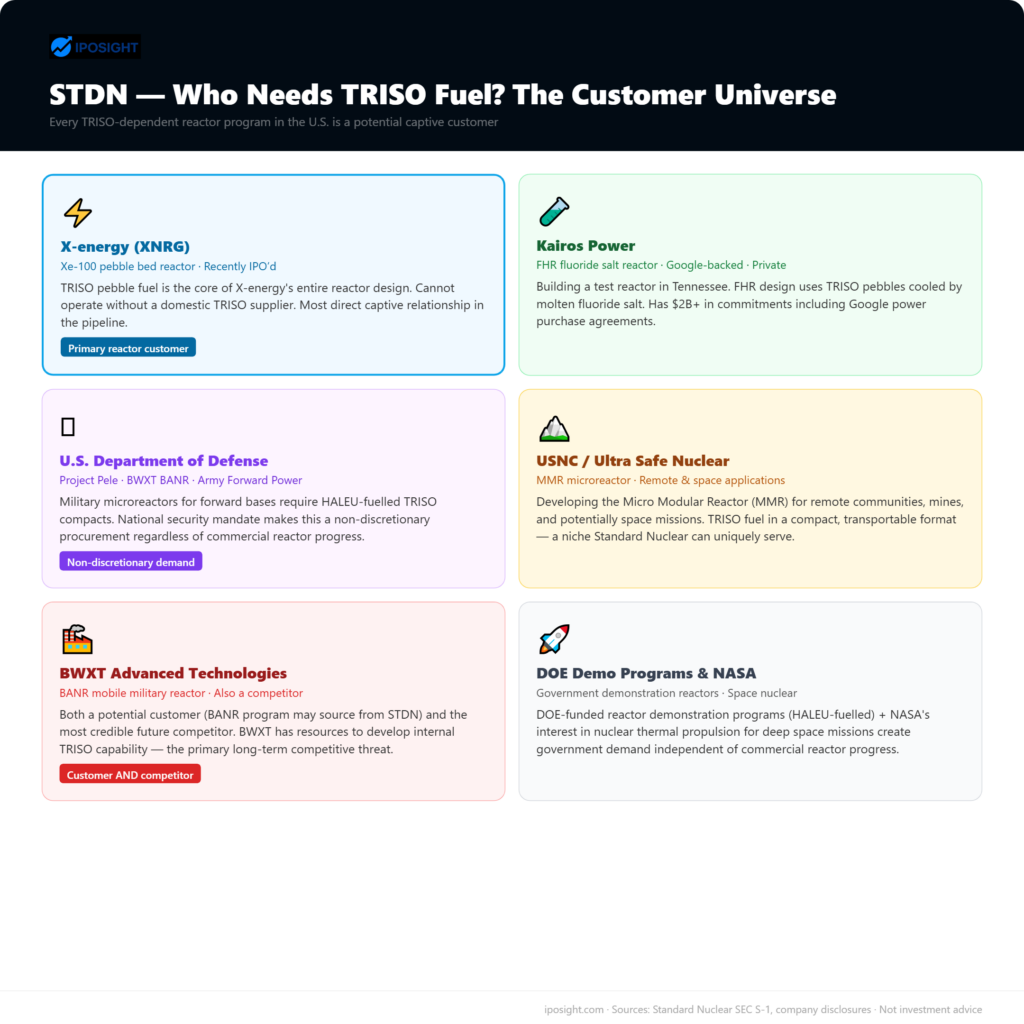
The Customer Universe: Who Needs This Fuel?
Standard Nuclear’s potential customer base maps directly to the advanced reactor developers that have attracted the most investment and regulatory progress in the U.S.:
X-energy (recently IPO’d) is developing the Xe-100 pebble bed reactor using TRISO fuel — its Xe-100 design is explicitly TRISO-dependent and X-energy cannot operate its reactor without a domestic fuel supply. Kairos Power (private, Google-backed) is building a fluoride salt-cooled high-temperature reactor using TRISO pebbles. Ultra Safe Nuclear Corporation (USNC) is developing microreactors for military, remote, and space applications. BWXT Advanced Technologies is developing the BANR mobile microreactor for U.S. Army forward deployment. The U.S. Department of Defense specifically has a programme — the Project Pele mobile microreactor — that requires HALEU-fuelled TRISO compact fuel. These are not speculative future customers: they are parties with whom Standard Nuclear has active contractual or pre-contractual relationships reflected in the backlog.
ETF Exposure: The Nuclear and Clean Energy Funds
The ETF data in the PDF is notable if confirmed. NLR (VanEck Uranium+Nuclear Energy ETF) at 3.1% weight and URA (Global X Uranium ETF) at 2.5% weight would make STDN a meaningful position in both dedicated nuclear ETFs — exactly the right thematic fit. CNRG (SPDR S&P Kensho Clean Power) at 1.7% and PBW (Invesco WilderHill Clean Energy) at 1.2% reflect the clean energy overlap. If these positions are confirmed at the next holdings disclosure period (typically 30–60 days post-listing), they represent meaningful structural demand from thematic ETF buying — particularly relevant because URA ($2.8B AUM) and NLR ($250M AUM) both have rules-based methodologies that would naturally include a U.S. TRISO fuel company. The FAN (First Trust Global Wind Energy) inclusion at 0.8% is less intuitive and may reflect a broad clean energy mandate rather than a specific nuclear thesis.
Bulls and Bears
The bull case is genuinely compelling at the right price. Standard Nuclear is the only U.S. company capable of supplying TRISO fuel at industrial scale to the advanced reactor programs that represent the next 20 years of nuclear energy deployment. It has $65 million in funded backlog, $245 million total contracted backlog, and a $986 million qualified pipeline — from customers who have no alternative domestic supplier. The DOE has not just supported it financially (through the Fuel Line Pilot Program and Other Transaction Agreement) but has made it the centrepiece of its domestic advanced reactor fuel supply strategy. BWXT is the most credible competitive threat, but it is not yet a TRISO fuel supplier at commercial scale. And the U.S. national security case for domestic TRISO production — independent of commercial reactor demand — provides a floor of government purchasing that few competitors can access.
The bear case is also compelling. At $8.30/share and ~$1.33B market cap, STDN trades at 425× revenue on $3.14M of annual sales. The facility approvals that unlock meaningful revenue (the DSA process for SN-TN and SN-ID) run on the DOE’s timeline. Commercial-scale TRISO deliveries — the actual product the backlog is waiting for — require production certifications that are months to years away. The founder controls 60.8% of voting power through a dual-class structure, giving minority public shareholders no meaningful governance recourse. The IPO itself raised only 39% of its original target — a signal that sophisticated institutional investors found the valuation unjustifiable at any price in the original range. And the 45% decline in 10 trading days is not a technical correction — it is the market repeatedly re-pricing a stock for which there is no traditional valuation anchor.
12-Month Price Scenario Analysis
Bull scenario (~25% probability): $15–$25. DOE approves the SN-TN and SN-ID facility safety analyses in H2 2026 on schedule. First commercial TRISO fuel deliveries begin in Q4 2026 or Q1 2027, converting funded backlog to revenue. X-energy or another advanced reactor developer announces a long-term supply agreement that expands the contracted backlog above $500M. The stock recovers to IPO price and beyond as the revenue inflection becomes visible.
Base scenario (~50% probability): $6–$12. DOE approvals are delayed into 2027 — common for nuclear regulatory processes. Revenue remains sub-$10M for the full year. The stock stabilises in a range reflecting the backlog value discounted for timeline risk and execution uncertainty. Thematic ETF buying provides a partial demand floor. The stock is range-bound with high volatility around DOE announcement events.
Bear scenario (~25% probability): $2–$7. A significant DOE facility approval delay (6+ months beyond H2 2026 expectations) signals regulatory complications. A follow-on financing round is needed before revenue reaches breakeven, creating dilution. BWXT announces commercial-scale TRISO production capability, reducing STDN’s monopoly premium. The stock approaches or tests the cash-per-share floor.
Single most important catalyst: DOE Documented Safety Analysis approval for SN-TN (Oak Ridge) facility — expected H2 2026. This is the gating event for commercial fuel delivery and the primary determinant of whether the H2 2026 revenue inflection occurs on schedule. Watch for any press release from Standard Nuclear or the DOE referencing this milestone.
Is STDN Worth Buying at $8.30?
The $8.30 price is almost certainly closer to fair value for the current risk profile than $15 was at IPO. But “closer to fair value” is not the same as “good value.” At $8.30, you are paying approximately $1.33 billion for a company with $3.14 million in revenue, pending regulatory approvals, and a dual-class governance structure that concentrates control in the founder. The market has already repriced it dramatically from the IPO. The question is whether the repricing has overshot.
For investors with genuine comfort in pre-revenue nuclear technology risk and a 3–5 year holding horizon, the current price is more defensible than the IPO price. The backlog is real. The technology is real. The strategic necessity — domestic TRISO supply for U.S. advanced reactor programs — is real. The DOE’s institutional commitment to Standard Nuclear specifically (Fuel Line Pilot Program, Other Transaction Agreement, HALEU authorization) is more than rhetoric. At $6–$8, the stock begins to approach the range where the backlog’s discounted value starts to provide a floor.
But this is not a stock for investors who cannot afford to lose most of the position. The same profile that makes it compelling — unique, irreplaceable, government-backed, early-stage — also makes it fragile. One regulatory delay, one financing round, one competitive development from BWXT can reset the story significantly. Size accordingly: maximum 1–2% of a diversified portfolio, and only for investors who understand what they own.
Investment Evaluation
| Factor | Score |
| Technology Uniqueness | 9/10 |
| Strategic / National Security Positioning | 8/10 |
| Backlog & Pipeline | 8/10 |
| Management & Team | 7/10 |
| Revenue / Commercial Stage | 2/10 |
| Financial Position | 4/10 |
| IPO Execution & Market Confidence | 2/10 |
| Governance | 3/10 |
| Regulatory Risk | 3/10 |
| Long-Term Potential | 8/10 |
Overall Investment Score: 4.9 / 10 · Highly speculative. Maximum 1–2% portfolio allocation for informed risk-tolerant investors. Single gating event: DOE facility approval H2 2026.
Final Verdict
Standard Nuclear is one of those genuinely rare companies where the technology is unambiguously real, the strategic necessity is undeniable, and the financial picture is almost entirely a function of regulatory timing rather than business model viability. America needs domestic TRISO fuel for its advanced reactor programs. No other U.S. company can currently provide it at scale. The DOE has made Standard Nuclear the centrepiece of its domestic fuel supply strategy. These facts do not change at $8.30 per share.
What the 45% post-IPO decline tells us is that the market correctly concluded the original $3.55 billion valuation was unjustifiable for a pre-revenue nuclear fuel startup — and the subsequent trading suggests investors continue to struggle with where a rational floor is. At $8.30, the market cap is approximately $1.33 billion. Against a funded backlog of $65 million and a qualified pipeline of $986 million, this is not obviously irrational if you believe the DOE approvals will come and the reactor programs will advance. It is obviously irrational if you believe they won’t.
The investment case for STDN resolves to a single question: will the DOE approve the SN-TN and SN-ID facility safety analyses in H2 2026 as expected? If yes, the revenue inflection begins, the backlog converts, and the stock has a path to recovery. If no, it has further to fall. That binary is not knowable from the outside. Position accordingly.
“Standard Nuclear makes the fuel that goes inside the reactors that could power the next century of American energy. The only question is whether the regulatory approvals arrive before the capital does.”
Sources & References
[1] StockTitan / SEC 424B4 — “Standard Nuclear Inc Prospectus filed pursuant to Rule 424(b)(4)” — stocktitan.net
[2] Green Stocks Research — “Standard Nuclear IPO Preview: America’s TRISO Fuel Pioneer” — greenstocksresearch.com
[3] Value Add VC — “Standard Nuclear S-1 Breakdown: IPO Filing, Valuation & What the Microreactor Fuel Company Is Worth” — valueaddvc.com
[4] Stock Analysis — “Standard Nuclear (STDN) Stock Price & Overview” — stockanalysis.com
[5] Yahoo Finance — “Standard Nuclear seeks to raise up to $383.3M in US IPO” — finance.yahoo.com
[6] TickerSpark — “Standard Nuclear IPO: What Investors Need to Know” — tickerspark.ai
[7] Investing.com — “Standard Nuclear Inc Stock Price Today | NYSE: STDN” — investing.com
[8] TradingView — NYSE: STDN — tradingview.com
[9] STDN PDF Analysis — Stock Analysis Tool, July 27, 2026
[10] Standard Nuclear — standardnuclear.com
This article is produced by iposight.com based on publicly available information, official company materials, SEC filings, and independent industry research available at the time of writing. It is for informational purposes only and does not constitute personalised investment advice. All investments carry risk. Please consult a qualified financial advisor before making investment decisions.