
Competitors | AMSS | MWC | EXYN| DSC | TMCR | EROC | STDN | REA | SUJA | SBMT | CNXU | VIDA | FISN | DUKR
The Full Scoreboard
All fourteen priced between March and July 2026. As of early August, here is where each one stands relative to its IPO or reference price, ranked from the steepest decline to the smallest.
| Ticker | Sector | Change |
| AMSS | Beverages | −93.1% |
| MWC | Automotive software | −80.3% |
| EXYN | Autonomous robotics | −76.5% |
| SUJA | Beverages | −69.5% |
| DSC | China used-car software | −67.7% |
| TMCR | Mining royalties | −61.6% |
| EROC | Distributed power | −49.0% |
| STDN | Nuclear fuel (TRISO) | −48.8% |
| REA | Rare earth exploration | −46.2% |
| SBMT | Mining exploration | −43.0% |
| CNXU | Regenerative medicine | −42.5% |
| VIDA | AI agent software | −38.8% |
| FISN | Advanced nuclear (SMR) | −38.0% |
| DUKR | Defense drones | −35.4% |
Why These 14 Fell: Five Repeat Patterns
No two companies here are identical, but their declines cluster around five causes that show up again and again in 2026’s small-cap IPO class.
1. Direct listings and thin floats with no price support
AMASS Brands and The Metals Royalty Co. both went public via direct listing — meaning no new capital was raised and no underwriter was contractually on the hook to support the price in early trading. Both fell more than 20% within days of debut. A traditional underwritten IPO at least has a syndicate with an incentive to defend the offer price for a period; a direct listing does not.
2. Pre-revenue or near-pre-revenue business models
The Metals Royalty Co. has not yet collected royalty revenue from its anchor NORI asset, which remains stuck behind seabed-mining permitting. Conexeu Sciences is a preclinical biotech with no product on the market and an FDA submission not expected until 2027. Silver Bow Mining and Rare Earths Americas are both exploration-stage resource companies with no production revenue. When a company’s valuation depends entirely on a multi-year story rather than current cash flow, any wobble in sentiment hits the stock disproportionately hard.
3. Financial-reporting or governance red flags
Exyn Technologies disclosed on June 30, 2026 that it would miss the SEC deadline for its first 10-Q as a public company — a delay that, even though the filing arrived a week late, landed just six weeks after its IPO and rattled confidence in a newly public micro-cap. AMASS Brands’ own pre-listing filings flagged a “going concern” warning and negative working capital before it even began trading.
4. Dilution — actual or anticipated
AMASS raised no capital in its direct listing and then sold $6.99 million of Series C convertible preferred stock to an outside investor days later, introducing a conversion overhang. Deep Fission priced a follow-on public offering of common stock in June 2026, only weeks after other news had lifted the shares — a reminder that even fundamentally strong, well-covered companies see their stock pressured when the share count grows faster than the business.
5. Geopolitical and sector-specific risk
DSC Holdings is a Beijing-based company whose ADSs carry the structural risks common to all US-listed Chinese issuers: audit-inspection uncertainty, delisting-threat headlines, and a 2025 revenue base that had already fallen 29% year-over-year before it even IPO’d. Rare Earths Americas trades inside a rare-earth sector that has swung on US-China trade headlines independent of any single company’s project results — shares across the group, including established names, fell double digits in late October on news of a US-China tariff truce that reduced the urgency of onshoring critical minerals.
Worth Watching: Names With a Real Rebound Case
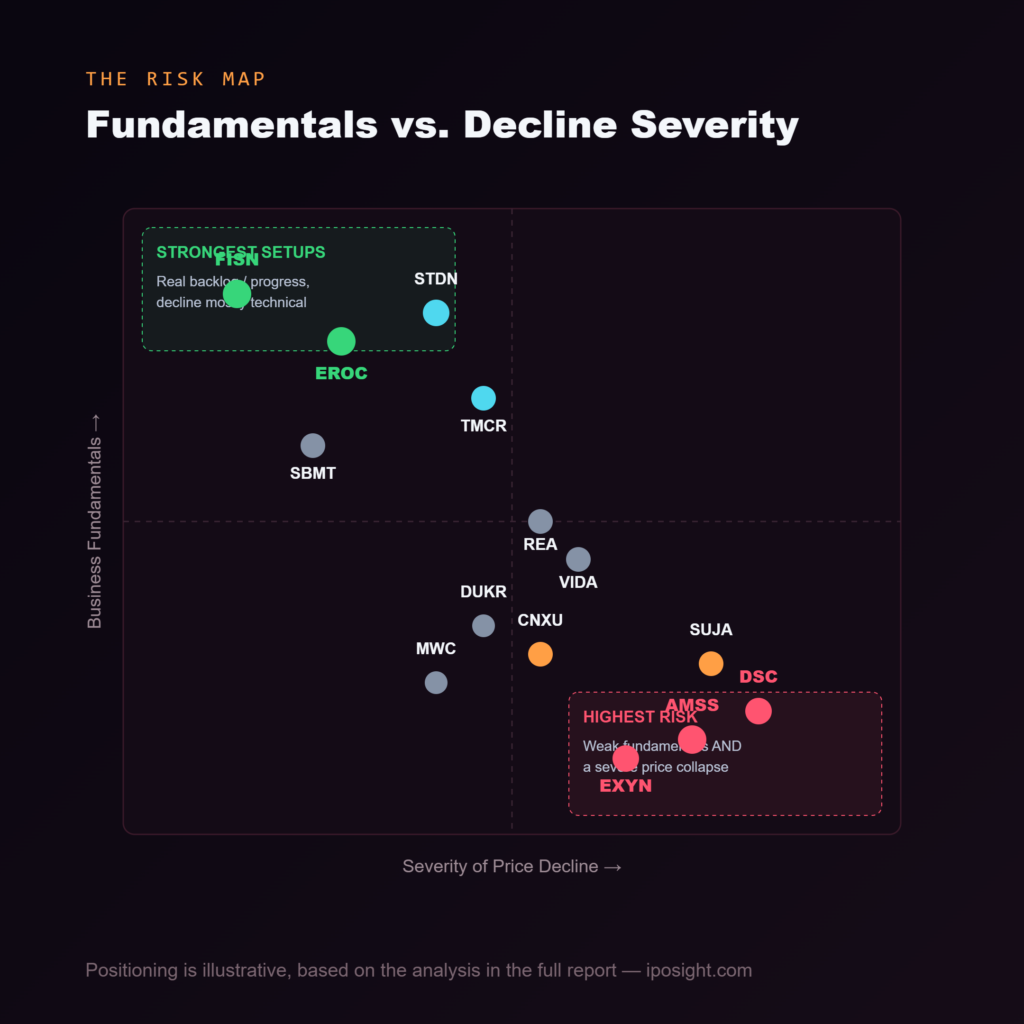
These five, in our view, have fallen for reasons that look more like valuation resets or technical/liquidity effects than deteriorating fundamentals. That does not make them safe — small-cap, early-stage stocks carry real risk regardless — but each has a specific, verifiable reason to stay on a watchlist.
1. Deep Fission (FISN) — the strongest fundamentals of the group
Deep Fission is developing small modular nuclear reactors designed to operate a mile underground, and it is the furthest along of any name here in translating a strategic thesis into physical progress: a prototype reactor canister already shipped to its Kansas site, a non-binding letter-of-intent pipeline of 18.5 gigawatts of power-site partnerships, and sustained coverage from the Wall Street Journal, Bloomberg, Forbes, and The Economist. Its 38% decline lines up closely with the timing of a June 2026 follow-on stock offering — a dilution event, not a sign the underlying business is struggling. The company’s own targeted commercial operation date is 2027–2028, so this remains a multi-year story, but it is the one name on this list with both a credible technical roadmap and a large non-binding demand pipeline already signed.
2. ERock (EROC) — a decline with “no identifiable fundamental catalyst”
ERock (Enchanted Rock) builds and operates distributed natural-gas generation and microgrids for data centers, utilities, and critical infrastructure — squarely in the path of the AI-driven power-demand buildout. Independent coverage of its post-IPO slide explicitly noted no fundamental catalyst behind the drop, attributing it instead to thin aftermarket liquidity and limited institutional follow-on buying, a pattern common to several 2026 power-infrastructure listings. With roughly 1,000 MW of installed base and a claimed 99.999% reliability track record, ERock’s underlying business looks intact; the stock’s weakness looks more like early price discovery for a story the market hasn’t fully absorbed yet.
3. Standard Nuclear (STDN) — real backlog, real overvaluation risk
Standard Nuclear is the only independent, industrial-scale producer of TRISO fuel — the advanced fuel used in small modular and micro nuclear reactors — in the United States, having acquired the assets out of a 2024 bankruptcy auction. It carries a contract backlog of up to $245 million against just $3 million of trailing revenue, and management already cut the IPO’s deal size by 58% before pricing, a sign of realistic, not aggressive, expectations. The gap between backlog and current revenue is real and the stock could stay volatile until that backlog converts to bookings, but the strategic case — the only dedicated US TRISO line, feeding both commercial SMR developers and federal HALEU programs — is one of the more durable theses on this list.
4. The Metals Royalty Co. (TMCR) — diversifying away from its weakest link
TMCR’s steep decline is easy to explain: its anchor asset, a royalty on TMC’s NORI seabed-nodule deposit, has not generated a dollar of revenue while permitting remains stuck. But the company has been visibly working to fix that single-asset concentration, agreeing to acquire a $132.5 million royalty on the Mesabi Metallics iron-ore project in Minnesota, backed by a $75 million private placement. A royalty company with two uncorrelated assets — one deep-sea, one Midwest iron ore — is a meaningfully different, lower-risk business than the one that IPO’d in April, even if the stock hasn’t caught up to that yet.
5. Silver Bow Mining (SBMT) — early, but with real permitting progress
Silver Bow is an exploration-stage silver-zinc developer at its Rainbow Block project near Butte, Montana. It has no production revenue yet, which keeps it firmly in speculative territory, but unlike several other exploration names on this list it has continued to post positive drill results and has already secured Montana DEQ permits — concrete, verifiable milestones rather than promotional claims. Its addition to the Russell 3000 in 2026 also brought a layer of passive institutional ownership that most of the other micro-caps here lack.
Better Left Alone: The Highest-Risk Names
These names combine the steepest declines with the least reassuring fundamentals. That doesn’t mean they can’t recover — small-caps can and do stage sharp rebounds — but the specific risk factors below go well beyond ordinary post-IPO volatility.
AMASS Brands Group (AMSS) — a disclosed going-concern warning
Down 93%, the worst performer on this list. AMASS pursued a direct listing — raising no fresh capital — while its own pre-listing disclosures flagged negative working capital and a going-concern warning. It has since layered on a dilutive Series C convertible preferred sale. Until the balance sheet and financing structure look materially different, this is a name to watch from the sidelines, not to catch falling.
DSC Holdings (DSC) — China ADR structural risk on top of a shrinking business
DSC came public with 2025 revenue already down 29% year-over-year, a thin $51 million raise, and the full set of risks that apply to any small US-listed Chinese ADS: audit-inspection uncertainty, geopolitical tariff and export-control headlines, and limited legal recourse for US shareholders. Its 90%-plus share of China’s used-car dealer software market is a genuine competitive moat inside China, but that moat does little to protect a US-listed shareholder from cross-border regulatory risk.
Exyn Technologies (EXYN) — thin cash, widening losses, a late filing
Exyn’s autonomous-mapping technology has real industrial and defense applications, but the fundamentals since its May IPO have moved the wrong way: a widening net loss, a 2.3% revenue decline in its first quarter as a public company, roughly $19.5 million in liabilities against about $5.2 million in assets, and a delayed first 10-Q. The stock’s beta above 4.9 confirms what the chart shows — this is one of the most volatile names in the group, and the fundamentals haven’t yet given a clear reason to buy the dip.
Conexeu Sciences (CNXU) — years from any product revenue
Conexeu’s collagen-scaffold regenerative-medicine platform is scientifically interesting and has real academic partnerships (Wake Forest Institute for Regenerative Medicine), but its lead product candidate is still preclinical, with an FDA 510(k) submission not targeted until the first quarter of 2027. That is a binary, multi-year biotech-style risk profile for a stock currently priced like an operating company.
Duke Robotics (DUKR) — a legacy micro-cap with almost no revenue
Duke Robotics’ defense-and-utility drone technology is credible, but its own financial history shows revenue of just $108,000 in 2024 (down from $300,000 in 2023) and a company that traded for years on the OTCQB before its recent uplisting. A 12-month range that has spanned $0.10 to $10.24 tells you most of what you need to know about how thin and speculative the trading in this name has been.
Suja Life (SUJA) — a Q2 earnings crash reshuffled the story
Suja Life looked like the steadiest name on this list through July, holding in the $10–$11 range on real revenue growth. That changed on August 4, 2026, when its first earnings report as a public company showed net loss widening 391% to $27.8 million — a figure that includes $25.1 million of one-time IPO-related transaction costs and a $2.3 million loss on debt extinguishment — alongside a guidance cut citing “near-term softness concentrated in the grocery channel.” The stock lost more than 40% in a single session, Evercore ISI cut its price target to $15 from $24, William Blair downgraded the shares to Market Perform, and at least one law firm has since announced a securities investigation into the company’s disclosures. Some of the headline loss is genuinely transitory IPO-related accounting; the grocery-channel guidance cut is not, and the fact that this was the company’s very first earnings print as a public company makes the disclosure and investigation overhang hard to ignore for now.
The Biggest Risks Across the Group
Zooming out, four risks recur across most or all of these fourteen names, regardless of sector:
- Dilution risk. Several companies here have already raised, or are structurally likely to raise, additional equity or convertible capital before reaching profitability — AMASS, Deep Fission, and Micware (which retains a 45-day underwriter over-allotment option) all illustrate this in different ways.
- Liquidity and float risk. Small IPO sizes — several raised under $25 million — mean thin trading, wide bid-ask spreads, and outsized reactions to ordinary news flow, as seen in ERock’s and Micware’s post-IPO trading patterns.
- Single-asset or single-customer concentration. The Metals Royalty Co.’s dependence on NORI, Exyn’s small customer base, and Rare Earths Americas’ exploration-stage single-region assets each leave limited room for one setback to move the whole valuation.
- Regulatory and geopolitical exposure. DSC Holdings’ China-ADR risk and the rare-earth sector’s sensitivity to US-China trade headlines sit outside any individual company’s control.
- First-earnings-report risk. A company’s first quarterly report as a public entity is a common trigger point: Suja Life’s stock lost more than 40% in a single session on its August 4 print, a reminder that a strong pre-IPO growth story still has to clear the higher disclosure and scrutiny bar of being public.
12-Month Outlook, Name by Name
The estimates below are directional and qualitative — a reflection of the balance of company-specific catalysts and risks discussed above, not a statistical model or a guarantee. We frame each name across three outcomes: a meaningful move higher, broadly sideways/range-bound trading, or a further decline.
| Ticker | Higher | Sideways | Lower |
| FISN | 40% | 40% | 20% |
| EROC | 40% | 35% | 25% |
| STDN | 35% | 35% | 30% |
| TMCR | 35% | 30% | 35% |
| REA | 30% | 30% | 40% |
| SBMT | 30% | 35% | 35% |
| SUJA | 25% | 35% | 40% |
| VIDA | 25% | 35% | 40% |
| MWC | 25% | 30% | 45% |
| DUKR | 20% | 30% | 50% |
| EXYN | 20% | 25% | 55% |
| CNXU | 20% | 25% | 55% |
| DSC | 15% | 30% | 55% |
| AMSS | 15% | 25% | 60% |
Final Verdict
Fourteen IPOs, one three-month window, and a spread of outcomes from “painful but survivable” to “structurally troubled.” The pattern that stands out most is that the size of the share-price decline is a poor stand-alone signal of business quality. Deep Fission and ERock — two of the more credible, tailwind-backed businesses on this list — fell largely on dilution and thin post-IPO liquidity rather than any deterioration in their underlying prospects. AMASS Brands and DSC Holdings fell for reasons that go to the core of the business: a going-concern warning in one case, a shrinking revenue base wrapped in cross-border regulatory risk in the other.
For investors looking at this list as a hunting ground, the more useful question isn’t “which stock fell the least” but “which company’s decline was caused by something that is likely to resolve.” A follow-on offering dilutes today’s shareholders but doesn’t change tomorrow’s addressable market. A going-concern warning, by contrast, is a statement about whether there will be a tomorrow at all. Judged on that basis, Deep Fission, ERock, Standard Nuclear, The Metals Royalty Co., and Silver Bow Mining are the five names from this group most worth revisiting — while AMASS Brands, DSC Holdings, Exyn Technologies, Conexeu Sciences, Duke Robotics, and now Suja Life, following its August 4 earnings crash, carry risk factors that argue for staying on the sidelines until the picture changes.
Frequently Asked Questions
Why have so many 2026 IPOs lost most of their value?
Most of the decline traces back to a small set of repeatable causes: thin public floats that make small-cap IPOs extremely volatile, pre-revenue or early-revenue business models that can’t yet support their IPO valuation, dilution from follow-on offerings and convertible financings, and in a few cases direct listings that provided no underwriter price support after debut.
Which recent IPO has fallen the most?
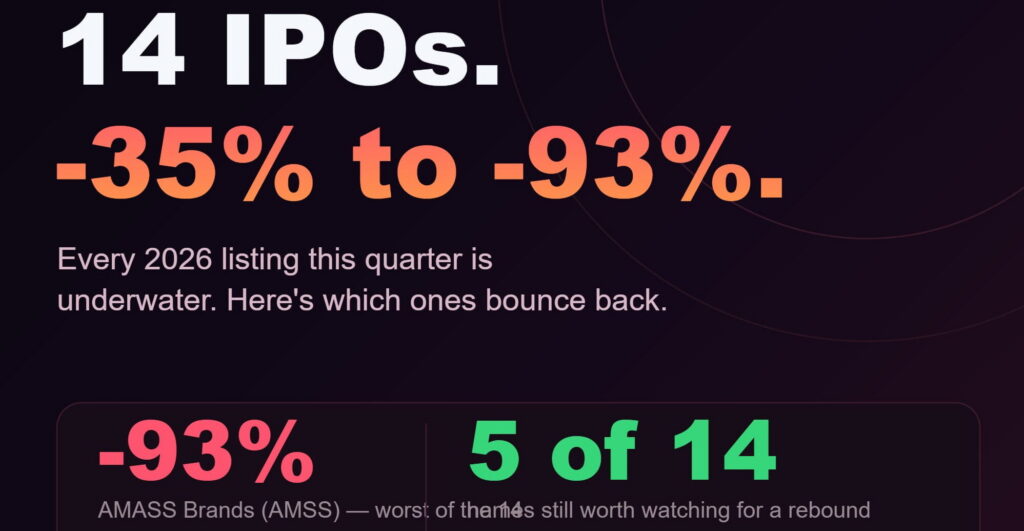
AMASS Brands Group (AMSS) has fallen roughly 93% from its IPO reference price, the steepest decline among the 14 IPOs reviewed here, following a direct listing, a disclosed going-concern warning, and a dilutive convertible preferred financing.
Are any of the worst-performing 2026 IPOs worth buying after the drop?
A handful of names, including Deep Fission, ERock, and Standard Nuclear, show real revenue backlogs, strategic industry tailwinds, and business progress despite steep share-price declines, making their pullbacks more a function of valuation reset and dilution than deteriorating fundamentals. Others, such as AMASS Brands and DSC Holdings, carry going-concern or structural risk factors that argue for caution.
What is the biggest risk across this group of IPOs?
Dilution is the most common risk: several companies in this group have already raised, or are likely to raise, additional capital through follow-on offerings or convertible instruments, which increases share count and pressures the stock independent of operating performance.
Sources & References
[1] Benzinga — “What’s Going On With AMASS Brands Stock Friday?” — benzinga.com
[2] Seeking Alpha — “AMASS Brands Aims For Direct Listing Despite Weak Financial Results” — seekingalpha.com
[3] StockShips — “AMSS Stock: AMASS Brands Direct Listing, Brands & 2026 Outlook” — stockships.com
[4] StockTitan — “Micware Co., Ltd. Announces Closing of Upsized Initial Public Offering” — stocktitan.net
[5] Simply Wall St — “A Look At Micware (NasdaqGM:MWC) Valuation After Honda Award Recognition” — simplywall.st
[6] Trefis — “Exyn Technologies (EXYN)” — trefis.com
[7] Timothy Sykes — “EXYN Stock Slides As Traders Focus On Cash Burn And Volatility” — timothysykes.com
[8] Simply Wall St — “Exyn Technologies (Nasdaq:EXYN) Stock Analysis” — simplywall.st
[9] Nikkei Asia — “Ant-backed DSC lists on Nasdaq in China’s first cross-border IPO of 2026” — asia.nikkei.com
[10] CryptoBriefing — “DSC Holdings sets terms for $51M US IPO under ticker $DSC” — cryptobriefing.com
[11] Trefis — “Metals Royalty (TMCR)” — trefis.com
[12] StockTitan — “Tmc The Metals (TMC) Stock News” — stocktitan.net
[13] Kalkine — “ERock (NYSE:EROC) Falls More Than 10% Approaching 52-Week Low in Post-IPO Decline” — kalkine.com
[14] Yahoo Finance — “Is Standard Nuclear (STDN) Fully Valued On Its IPO Slide And Early Losses?” — finance.yahoo.com
[15] Renaissance Capital — “Small modular reactor fuel developer Standard Nuclear slashes deal size by 58%” — renaissancecapital.com
[16] iTiger News — “Rare Earth Stocks Extend Decline” — itiger.com
[17] Bloomberg — “Organic Juice Maker Suja Life Sinks 14% After $186.7 Million IPO” — bloomberg.com
[18] Seeking Alpha — “Suja Life: A Bad Taste Post IPO” — seekingalpha.com
[18b] GlobeNewswire / Holzer & Holzer, LLC — “SUJA Investor Alert: Investigation of Suja Life, Inc.” — globenewswire.com
[18c] StockTitan — “Suja Life Reports Second Quarter 2026 Financial Results” — stocktitan.net
[19] Silver Bow Mining — company press releases — silverbowmining.com
[20] Conexeu Sciences — company newsroom — conexeu.com
[21] Deep Fission, Inc. — press releases and media coverage — deepfission.com
[22] StockTitan — “DUKR Stock Price, News & Analysis” — stocktitan.net
[23] StockTitan — “Duke Robotics Reports 2024 Financial Results and Provides Business Update” — stocktitan.net
[24] Vida Global — company press releases — stocktitan.net
[25] iposight — “The 2025–2026 IPO Washout: Why 38 New Listings Collapsed” — iposight.comThis article is produced by iposight.com based on publicly available information, company disclosures, and independent research. For informational purposes only — not investment advice. All investments carry risk, and past