
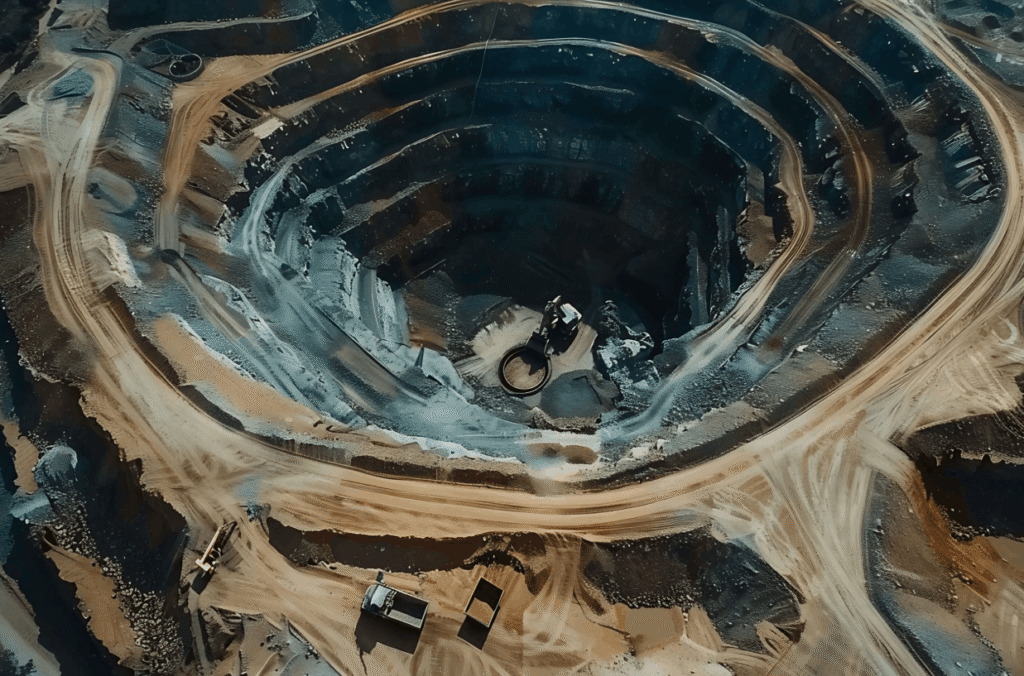
Basic Materials | Rare Earth Metals | Exploration Stage | Nd Pr Dy Tb | Anti-China Supply
On April 4, 2025, China placed seven heavy rare earth elements — including dysprosium and terbium — under export controls. Within weeks, European terbium prices had risen 4–5 times. Car manufacturers cut production lines. Defence contractors scrambled. The message was unmistakable: the Western world had built its entire technology economy on a supply chain it does not control. IMC Rare Earths listed on NYSE American on July 29, 2026 with one proposition: a 1.1-billion-tonne rare earth deposit in Brazil can become the alternative the West desperately needs. The stock has already more than doubled from its $5 IPO price.
What Is IMC Rare Earths? The Itarantim Project in Detail
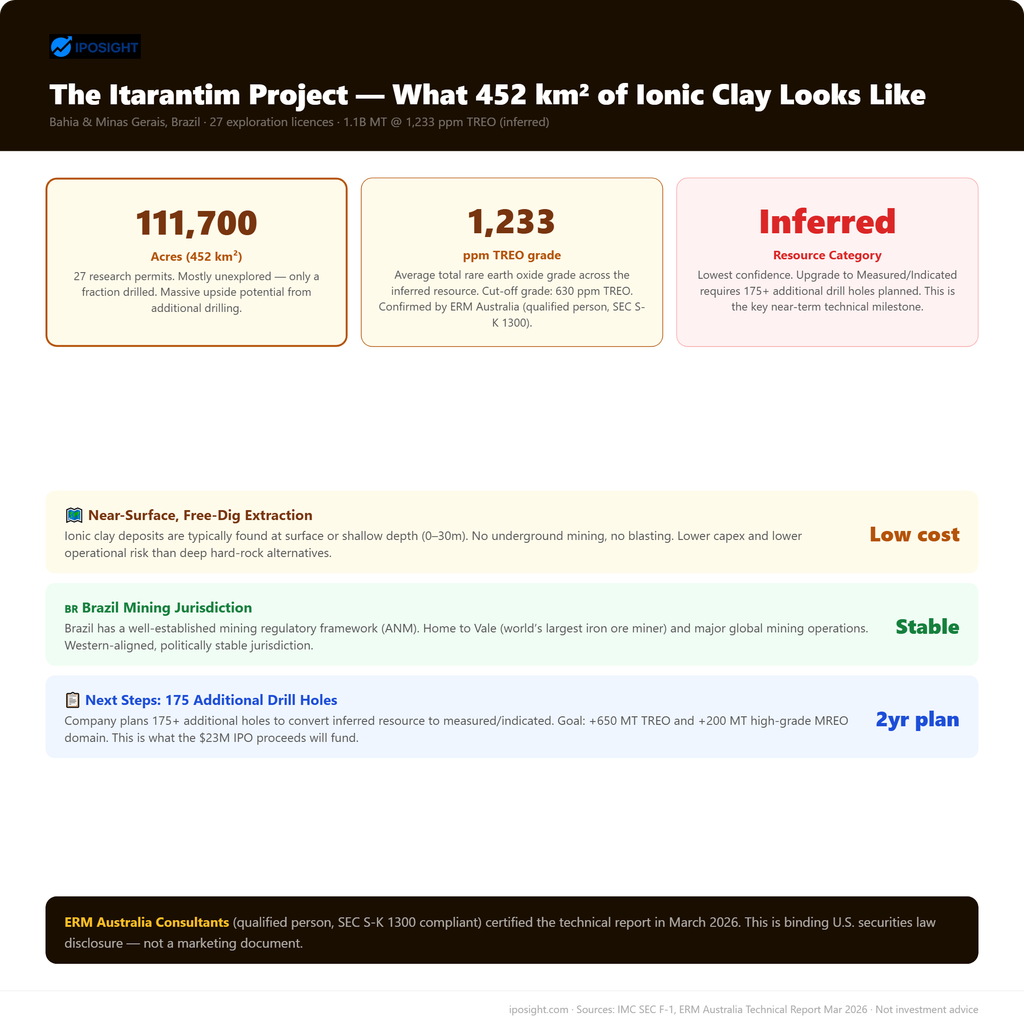
IMC Rare Earths Ltd is a mineral exploration and development company incorporated in the Cayman Islands in September 2025, headquartered in São Paulo, Brazil, with operating subsidiaries (IMC Rare Earths Participações Ltda., Ionic Clays Brazil Ltda.) in Brazil. The company’s flagship project is the Itarantim Project, consisting of 27 mining exploration licences covering approximately 111,700 acres (approximately 452 km²) in the states of Bahia and Minas Gerais, Brazil.
The Itarantim Project is an ionic adsorption clay deposit spanning the states of Bahia and Minas Gerais with an identified mineral resource of approximately 1.1 billion metric tons. Drilling on this ionic adsorption clay (IAC) REE deposit has identified a mineral resource of 1.1 billion MT with an average grade of 1,233 ppm TREO. The four target elements are neodymium (Nd), praseodymium (Pr), dysprosium (Dy), and terbium (Tb) — the four magnet rare earth elements (MREEs) that underpin permanent magnet technology.
The ionic adsorption clay deposit type is the key technological differentiator. Unlike hard-rock rare earth deposits (like Mountain Pass in California or the Brazilian carbonatite deposits), ionic clay deposits hold rare earth ions loosely adsorbed onto clay mineral surfaces. This allows extraction with a simple in-situ or heap-leach process using ammonium sulphate solution — no blasting, no heavy crushing, no high-temperature roasting. The company prioritises environmentally responsible ionic-adsorption clay extraction methods, operating in an ideal mining jurisdiction, and leveraging Brazil’s strategic position between Eastern and Western markets.
Why ionic clay matters: China’s dominance in heavy rare earths comes precisely from its ionic clay deposits in southern China (Jiangxi, Fujian, Guangdong provinces). These deposits produce the world’s dysprosium and terbium. IMC’s Itarantim Project is the same deposit type, the same mineralogy, and produces the same target elements — but in Brazil, outside Chinese jurisdiction. This is not coincidence. It is the strategic thesis.
Why Now: China’s Export Controls and the Western Supply Emergency
The geopolitical context for IMC’s IPO could not be more favourable — or more alarming. On April 4, 2025, the Chinese government introduced export controls on seven heavy rare earth elements, including terbium, dysprosium, samarium, gadolinium, lutetium, scandium, and yttrium, as well as all related compounds, metals, and magnets.
The consequences were immediate and severe. As export volumes fell sharply in April and May, many carmakers in the United States, Europe, and elsewhere struggled to obtain permanent magnets, with some forced to cut utilisation rates or even temporarily shut down factories. Dysprosium oxide rose to roughly $1,450/kg, while terbium oxide reached about $4,500/kg outside China.
The price structure that resulted is extraordinary. In 2025, dysprosium oxide prices on a CIF North America basis were 4.4 times Chinese domestic prices. By 2027, the relative difference is forecast to almost double to 8.3 times. China controlled 85% of total rare earth oxide production in 2025, including 99% of dysprosium oxide and terbium oxide.
This is the structural demand for what IMC is building. Terbium outside China has reached up to $5,000/kg in some transactions. China controls over 90% of magnet rare earth refining, making its domestic prices the gravitational centre of global rare earth economics despite export restrictions.
The Applications: Why the World Cannot Function Without These Elements
The four magnet rare earths that IMC targets are the enabling materials for the global energy and technology transition:
Neodymium (Nd) and Praseodymium (Pr) form the core of NdFeB (neodymium-iron-boron) permanent magnets — the strongest permanent magnets known. These are in every EV motor, every wind turbine generator, every hard drive actuator, every high-efficiency industrial motor. A single offshore wind turbine contains approximately 500–600 kg of NdFeB magnets. A single EV motor uses 1–2 kg. With 45 million EVs per year projected by 2030 and global wind capacity additions of 100+ GW per year, the demand trajectory is structural and growing.
Dysprosium (Dy) and Terbium (Tb) are the critical additives that allow NdFeB magnets to operate at elevated temperatures without demagnetising. Without Dy and Tb, an EV motor magnet fails above approximately 80°C — far below operating temperature in a demanding drive cycle. The F-35 fighter jet requires Dy. Precision-guided missiles require Tb-containing magnets. Heavy rare earth elements such as dysprosium and terbium have essentially no commercially scaled non-Chinese refined supply, and are experiencing price escalation driven not by speculative demand but by genuine scarcity at the processing stage.
Companies that need these materials directly or indirectly: Volkswagen; SK Hynix ; Karman Holdings; Applied Aerospace & Defense ; Quantinuum; The Elmet Group; The Elmet Group; BETA Technologies; Legence
The Itarantim Resource: What the Numbers Mean
The 1.1 billion metric tonne inferred resource at 1,233 ppm TREO is a large-scale figure that requires contextualisation. This is the total in-ground quantity identified to date across the 452 km² licence area — the majority of which has not yet been drilled. The company plans to drill an additional 175 holes to delineate both an increase in TREO and contained MREO into the inferred category, with the goal of delineating a further 650 MT of TREO and an additional 200 MT of high-grade resource within existing and new MREO domains.
The technical report was prepared by ERM Australia Consultants Pty Ltd (an independent qualified person firm) in accordance with SEC S-K 1300 reporting standards — the same disclosure framework used by U.S.-listed mining companies. This provides important regulatory credibility: unlike some junior miners that use lower-standard resource estimates, IMC’s resource is declared under binding SEC disclosure rules with third-party certification.
The critical caveat is that this is an inferred resource — the lowest confidence category in formal resource reporting. The deposit has not yet been drilled to the density required for measured or indicated classification. Converting the inferred resource to higher-confidence categories (requiring more drilling, metallurgical testing, and engineering studies) is the key technical milestone over the next 24–36 months.
The Offtake and Partner Structure
IMC has an offtake agreement in place with Mineradora Havilah (a related party) for 50% of production plus an option for an additional 25%. The related-party nature of this arrangement is a governance flag that investors should note — Havilah is connected to Americas Rare Earths Holdings Ltd, the parent company that holds warrants in IMC. This is common in pre-revenue mining companies but should be monitored. The company has issued Americas Holdings warrants representing in aggregate 20% of the fully diluted equity immediately prior to the IPO, structured in four tranches with exercise prices at the IPO price plus 10%, 20%, 30%, or 40% premiums.
Over the longer term, the company’s strategy extends beyond mining to the creation of a vertically integrated, closed-loop rare earth supply chain in Brazil, encompassing carbonate and oxide production, separation, and ultimately permanent magnet manufacturing, supporting global energy transition and advanced technology markets. This is an extremely ambitious long-term vision that would require 10–15+ years and billions in capital to execute fully. Investors should treat the magnet manufacturing aspiration as directional strategy rather than near-term business plan.
The IPO and Post-IPO Price Performance
IMC raised $20 million by offering 4 million shares at $5, within the $4 to $6 range. The company subsequently closed the underwriters’ full option exercise to purchase an additional 600,000 shares at the IPO price, bringing total gross proceeds to $23 million. The IPO was led by Roberts & Ryan (the first Service-Disabled Veteran-Owned broker-dealer to lead a U.S. IPO) and Revere Securities.
As of August 24, 2026, IMC shares are trading at approximately $10.07 — a gain of approximately 101% from the $5 IPO price in less than 30 days. The market cap as of early August 2026 was approximately $840–$840M at $8/share. At $10/share, the implied market cap approaches $1 billion — an extraordinary valuation for an exploration-stage company that has raised only $23M and has no production or revenue.
Real Competitive Landscape
IMC competes for capital and eventual market share in a sector where the competitive dynamics are unusual: the primary “competitor” is the Chinese state-controlled supply chain, not another Western miner. Within the Western rare earth developer space, the most relevant comparators are:
MP Materials (MP) — the only operating U.S. rare earth mine (Mountain Pass, California), currently processing light rare earths (NdPr) domestically. Does not produce Dy or Tb at commercial scale. Has a DoD offtake with a $110/kg price floor for NdPr. The most established Western alternative but focused on light REEs.
Lynas Rare Earths (LYC.AX) — the world’s largest non-Chinese rare earth producer, mining in Mount Weld, Australia and separating in Malaysia. Produces NdPr at commercial scale; limited heavy REE production. Has processing agreements with DoD and Japan Australia Rare Earths. The benchmark for what a successful Western REE producer looks like.
Energy Fuels (UUUU) — building REE separation capacity in Utah using monazite feedstock from heavy mineral sand operations. Focuses on NdPr with some heavy REE ambitions.
Brazilian Rare Earths (BRE.ASX) — the most direct geographic competitor, also developing ionic clay deposits in Brazil (Rocha da Rocha project). Has similar deposit type and target elements. More advanced in resource definition than IMC.
The key differentiator for IMC is the heavy REE (Dy, Tb) focus in an ionic clay deposit — the same deposit type that makes China the dominant global producer. No Western company currently separates commercial quantities of Dy and Tb. The first non-Chinese ionic clay project to reach commercial production will occupy a uniquely valuable position.
Risk Assessment
IMC is an exploration-stage company. The risks are significant and must be stated clearly:
1. Exploration and development risk. The inferred resource is the lowest confidence category. Conversion to production requires further drilling (175+ holes planned), metallurgical studies, feasibility studies, permitting, and ultimately construction — a process that typically takes 7–12 years for a new mine from initial resource to first production. The $23M IPO proceeds cover perhaps 12–18 months of exploration activity, not a path to production.
2. Financing risk. Building a rare earth mine and processing facility would require hundreds of millions to billions in capital. IMC will need multiple additional equity raises, potentially at dilutive prices, before any production revenue. The warrant structure (20% dilution from the Americas Holdings warrants) adds to the dilution concern.
3. Valuation at current price. At $10/share and approximately $1 billion market cap, IMC is priced for substantial success in an exploration company with no PEA (Preliminary Economic Assessment), no feasibility study, no production timeline, and no processing infrastructure. The market is pricing in the geopolitical premium without the operational de-risking.
4. Related-party offtake. The primary offtake agreement is with a related party (Havilah/Americas Holdings). If this relationship changes or is restructured, the commercial framework for the project changes with it.
5. Geopolitical risk. If U.S.-China trade tensions ease significantly or China lifts export controls, the urgency premium embedded in IMC’s valuation could reverse rapidly.
Bulls and Bears
The bull case for IMC is essentially a macro thesis: China’s export controls on Dy and Tb have created a structural supply crisis that will take 10+ years to resolve through new projects, and IMC holds one of the largest identified ionic clay MREE deposits outside China and Myanmar. Bloomberg Intelligence projects that rare earth shortages are likely to persist through 2030, even accounting for more than $10 billion in non-Chinese project funding committed globally in 2026. If the Itarantim Project advances through its technical milestones, it could attract strategic investment from Western governments (DoD, EU Critical Raw Materials Act funding), major technology companies, or automotive OEMs seeking supply security. The M&A optionality is significant: Lynas was acquired, MP Materials attracted major investors. A critical MREE deposit at commercial scale in a stable Western-aligned jurisdiction would be extremely valuable.
The bear case is that IMC is a pre-revenue exploration company trading near $1 billion market cap on the basis of an inferred resource and a geopolitical narrative. The resource is not yet demonstrated at measured/indicated standard. Production is a decade away at minimum. The $23M raised will need to be followed by many more rounds of capital. And the stock has already doubled from IPO, pricing in much of the near-term optimism. A correction to the $5–7 range (closer to IPO price and more in line with exploration-stage comparators) is entirely plausible if the macro narrative softens or drilling results disappoint.
12-Month Price Scenario Analysis
Bull scenario (~30% probability): $12–$25. Positive additional drilling results expanding the resource or improving grade confidence. U.S. Department of Defense or EU entity announces strategic interest or pre-feasibility funding. China tightens export controls further. The geopolitical premium expands and IMC is re-rated as a strategic asset. Brazilian government announces critical minerals support policy.
Base scenario (~45% probability): $6–$12. The stock consolidates after its rapid post-IPO gain. Drilling continues to demonstrate the resource without dramatic new discoveries. No major partnership announcement. The company is valued as a high-quality exploration asset with a credible path to development but no near-term production catalyst.
Bear scenario (~25% probability): $2–$6. Drilling results show variable grade or unexpected geological complexity. A secondary equity raising at a discount is required. U.S.-China trade tensions ease partially. Comparable junior rare earth miners see valuation compression. The stock retraces toward or below IPO price.
Investment Evaluation
| Factor | Score |
| Geopolitical Urgency & Timing | 10/10 |
| Deposit Type (Ionic Clay) | 9/10 |
| Resource Scale | 9/10 |
| Target Elements (Dy & Tb) | 9/10 |
| Brazil Jurisdiction | 8/10 |
| ERM Independent Resource Report | 7/10 |
| Valuation at $10/share (~$1B cap) | 3/10 |
| Financial Position & Cash Runway | 3/10 |
| Related-Party Offtake | 4/10 |
| Path to Production | 3/10 |
Overall Investment Score: 6.4 / 10 · High-risk speculative play on a structurally correct macro thesis. After +100% post-IPO gain, correction risk is elevated. Best entry: $6–8 on pullback. Long-term hold for believers in the Western rare earth supply chain buildout. Max 1–2% portfolio.
Final Verdict
IMC Rare Earths is entering the market at exactly the right moment in history. China’s decision to weaponise its heavy rare earth monopoly has created a multi-decade demand for exactly what IMC is building: a large-scale ionic clay MREE deposit in a Western-aligned jurisdiction capable of producing the dysprosium and terbium that the global technology economy cannot live without.
The strategic thesis is correct. The deposit is real and large. The deposit type is proven (in China). The target elements are exactly the ones facing the most acute supply crisis. Brazil is a credible mining jurisdiction. The IPO was led by a veteran-owned firm with strategic resonance for U.S. government buyers. Everything about the narrative is right.
What is not yet right is the operational reality: this is an exploration company with 12–18 months of cash, no feasibility study, a decade from production, and a stock that has already doubled. Investors who bought the IPO have done well. Investors entering at $10 are buying a narrative at premium valuation with all the technical risk of an early-stage exploration company still ahead of them.
The correct approach: set a target entry range ($6–8), wait for the inevitable post-run consolidation, and position for a 3–5 year hold through the next major milestones (resource upgrade, PEA, government partnership). This is not a stock for next quarter. It is a stock for the next decade of geopolitical reality.
“China spent 30 years building its rare earth monopoly. The West has spent 5 years realising the mistake. IMC has 452 km² of Brazilian ionic clay and a decade of drilling ahead. The race is on — and the prize is strategic independence.”
Sources & References
[1] IMC Rare Earths — imcrareearths.com · IR — ir.imcrareearths.com
[2] TradingView — NYSE: IMC — tradingview.com
[3] SEC EDGAR — IMC Form F-1, Form 6-K, Form DRS/A — sec.gov
[4] ERM Australia Consultants — Initial Assessment & Technical Report Summary on the Itarantim REE Project, March 2026
[5] Renaissance Capital — IMC IPO Analysis, June–July 2026
[6] Benchmark Mineral Intelligence — Ex-China Rare Earths Premium Report, March 2026
[7] IEA — Critical Minerals Export Controls Commentary, 2026
[8] S&P Global — Rare Earth Supply Bottlenecks 2026, January 2026
[9] Oregon Group — Rare Earth Prices Surge Analysis, June 2026
[10] Oxford Economics — Rare Earth Magnet Price Forecasts, August 2026
[11] Rare Earth Exchanges — China ACREI Index, August 18, 2026
iposight.com — for informational purposes only, not investment advice. Exploration-stage mining investments carry extreme risk including total loss.